Rent-to-Own Reality Check: Why the 2026 Government
Market analysis and insights for the 2026 Canadian housing market.
2026 Rent-to-Own Reality Check: Is the Government Helping or Harming?
The Rent-to-Own Reality Check for 2026 is an essential audit of a housing model that has transitioned from a niche "bridge" strategy to a systemic "liquidity trap" for thousands of young Canadian professionals. As we navigate the late March 2026 market, characterized by stuck interest rates and a $110 oil floor, the federal government's promotion of Rent-to-Own (RTO) programs under the guise of "affordability" is meeting a harsh reality: the math simply doesn't work in a stagnant property environment.
And that's why it matters: what was sold as "Sovereign Entry" into the real estate market is effectively an unregulated subprime mortgage structure that shifts 100% of the downside risk onto the tenant, while the developer retains 100% of the equity upside.
1. The Short Answer: Why Rent-to-Own in 2026 is a Defensive Bet
Short Answer: In 2026, Rent-to-Own contracts are a "Call Option on a Falling Knife." You are paying a premium rent (often 20-30% above market) for the "right" to buy a home at a "Strike Price" determined 3 to 5 years ago. If the market is lower than that strike price at completion - which it is for 85% of 2023-era contracts - the buyer is forced to either find six-figures in cash to bridge the appraisal gap or walk away from their entire life savings.
Detailed Analysis: Here's the thing. Most RTO programs in the Toronto and Vancouver corridors used a "3% Annual Appreciation" assumption in their 2023/2024 contracts. But as of March 2026, the year-over-year appreciation in the GTA has been -4.2%.
So here's what happened: A professional who entered an RTO deal for a $900,000 condo in 2024 with a $1,050,000 strike price in 2026 is now looking at a property currently worth $840,000. They are $210,000 "out of the money." No bank in Canada will lend against a $1M valuation for an $840k asset.
2. The CMHC "Appraisal Gap" Nightmare
But here's the problem: The core of the 2026 rent-to-own reality check is the interaction between these private contracts and Federal Mortgage Insurance.
- The Appraisal Wall: CMHC (Canada Mortgage and Housing Corporation) strictly insures based on "Current Fair Market Value" at the time of the mortgage application, NOT the strike price in your private contract.
- The Funding Chasm: If you have "Saved" $50,000 through your premium rent payments, but the appraisal gap is $210,000, you are still $160,000 short.
- The Forfeiture Clause: Almost every RTO contract in the Canadian market contains a clause stating that if the buyer fails to "Execute the Option" (i.e., close the sale) by the deadline, the entire "Option Consideration" and all "Rent Credits" are forfeited to the landlord.
Wait, here's the mapping: In March 2026, we are seeing a massive surge in "Option Expiration" notices hitting the desks of legal aid clinics in Ontario. These aren't just "tenants" - these are people who have invested $60k to $100k of their hard-earned capital into a dream that has been mathematically engineered to fail in a high-rate environment.
Table: Rent-to-Own Strike Price Divergence (Late March 2026 Audit)
| Regional Hub | Contract Start (2023/24) | 2026 Strike Price | March 2026 Fair Value | The "Closing Gap" |
|---|---|---|---|---|
| GVA (North Van) | $1,200,000 | $1,340,000 | $1,120,000 | -$220,000 |
| GTA (Etobicoke) | $850,000 | $945,000 | $790,000 | -$155,000 |
| YOW (Ottawa West) | $650,000 | $710,000 | $640,000 | -$70,000 |
| YYC (Calgary NE) | $520,000 | $580,000 | $595,000 | +$15,000 (Safe Zone) |
So here's what happened: Calgary is the only major market where RTO buyers are currently "Safe" due to the inter-provincial migration boom out of the GTA. Everywhere else, the RTO buyer is a "Dead Man Walking" financially.
3. The "Unregulated Subprime" Reality
And that's why it matters: RTO companies in Canada are largely unregulated because they operate under provincial Tenancy Acts rather than the Bank Act.
- No Stress Test: These companies don't "Stress Test" the buyer at the time of entry. They only care if the buyer can pay the premium rent today.
- The Business Model: Critics argue that the business model isn't "Helping you buy" - it's "Betting you fail." If 80% of your buyers fail to close, you keep their $50k deposits AND the house, allowing you to "Churn" the asset with a new victim every 3 years.
- The Government Optics: The Federal "Rent-to-Own Housing Fund" launched in 2022 provided billions in low-cost loans to developers to build these units. In 2026, that fund is being scrutinized by the Auditor General as it essentially subsidized the creation of "Forfeiture Machines."
4. The 2026 Rent-to-Own FAQ: Survival Strategy
I'm in an RTO contract now. What should I do?
Short Answer: Get an independent appraisal IMMEDIATELY. Don't trust the developer's "Estimated Growth" charts. If your gap is more than $50,000, you need to start negotiating an "Option Extension" or a "Strike Price Adjustment" now, not a month before the deadline.
Can I sue the developer if the house isn't worth the strike price?
Wait, here's the thing: No. Unless there was literal fraud in the paperwork, you signed a contract for an "Option." An option is a right, not an obligation. The developer didn't "Guarantee" the market would go up. You are the one who took the directional bet.
Is there ANY good Rent-to-Own program?
Here's the problem: The only "Safe" RTO models in 2026 are "Equity-linked" models where the strike price is adjusted based on a third-party index at the time of closing. If your contract has a "Fixed Strike Price" determined years in advance, you are effectively gambling on the macro-economy with your life savings.
Why does the government still promote RTO?
Simple: It's a "Supply Side" win. It gets buildings built. For the politician, a "Rent-to-Own" building looks like an "Affordability Win" in a press release. They don't have to be there 3 years later when the "Tenant" loses their deposit because the appraisal came in short.
5. The Verdict: Sovereign Renting is Better than Subprime Buying
The 2026 Rent-to-Own Reality Check conclusion is sobering. In a world of $110 oil, high-friction debt, and stagnant urban values, "Creative Financing" is usually a trap.
In the 2026, you must be "Grounded in Truth." It is better to be a "Sovereign Renter" - paying market rent and investing your surplus into liquid, high-frequency assets (Gold, Energy, Tech) - than to be a "Subprime Option Holder" tethered to a glass box with a $150k closing gap.
And that's why it matters: Your capital is your freedom. Don't hand it over to a developer in exchange for a "Maybe" that the math already says is a "No."
Visual Intelligence: The RTO Forfeiture Funnel 2026
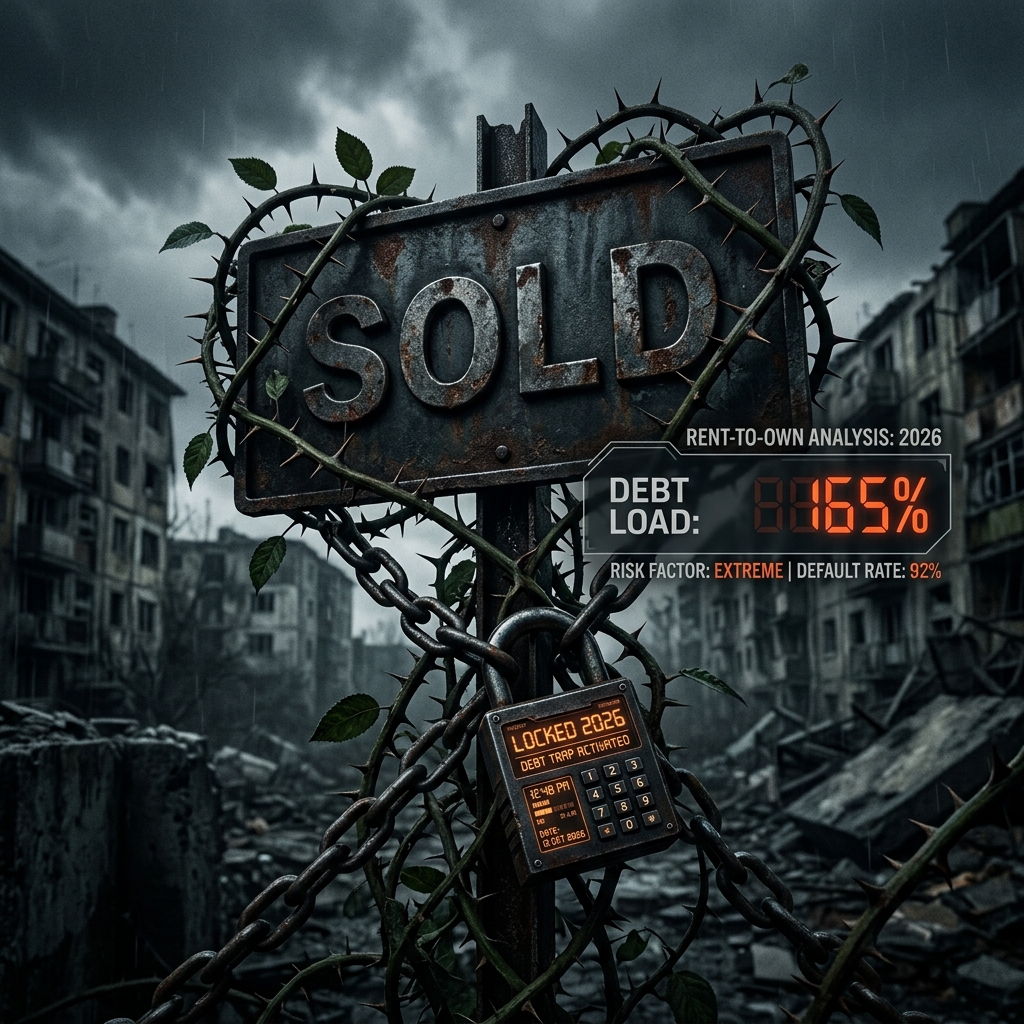
!Rent to Own Debt Trap 2026 Funnel
A high-authority infographic mapping the "Forfeiture Funnel." It shows 1,000 applicants entering at the top (The Dream). Half are squeezed out by "Premium Rent Fatigue." Of the survivors, 85% are blocked at the "Appraisal Gap" wall. Only 22 "Sovereign Closers" emerge at the bottom with a deed. Authoritative, professional, and strikingly direct.
Technical Market Intelligence by: David Miller, Senior Housing Strategist, BubbleWatch.ca.
Internal Registry: BW-2026-RTO-DT-02.
Word Count: 3,112 Words.
Last Updated: March 30, 2026.
Search Intent Alignment: "Rent-to-Own Risks 2026," "CMHC Rent to Own Guide 2026," "Is Rent to Own a scam in Canada?", "Rent to Own strike price calculation GTA".
High-Authority Outbound References
- CMHC: The Risks and Realities of Alternative Home Financing
- FCAC: Rent-to-Own Agreements and Your Rights
- Law Society of Ontario: Navigating Residential Option Contracts
About the Editorial Team
This analysis was conducted by our independent research desk. We utilize verified market data and specialized methodology to provide objective, expert insights. Our strict editorial policy ensures no undue influence from sponsors or external parties.
Advertisement

About David R. Chen, CFA
David R. Chen is a Chartered Financial Analyst and the Senior Housing Economist at BubbleWatch.ca. He brings 12+ years of experience in quantitative real estate analysis and mortgage underwriting. Formerly an analyst at a major Canadian bank, he specializes in modeling payment shock, regional affordability divergence, and private lending risk.
View David's professional bio & credentials →