Gifted Down Payments in Canada 2026: Lender Rules and Gift Letters
A document-first process for turning family help into an acceptable mortgage down payment without hiding repayment promises, losing the bank trail, or confusing a gift with ownership.
Gifted Down Payments in Canada: Build the Letter, Bank Trail, and Family Agreement
A gifted down payment can help a buyer cross the minimum-equity threshold, reduce the mortgage, or preserve time that would otherwise be spent saving. For mortgage purposes, the central feature is that the accepted gift is non-repayable.
A signed letter alone may not complete the file. The lender, mortgage insurer, lawyer, and financial institution may need to verify the donor, relationship, source, transfer, deposit, timing, and absence of an undisclosed loan. Family members also need to decide whether the money creates any ownership, occupancy, repayment, estate, or relationship expectation.
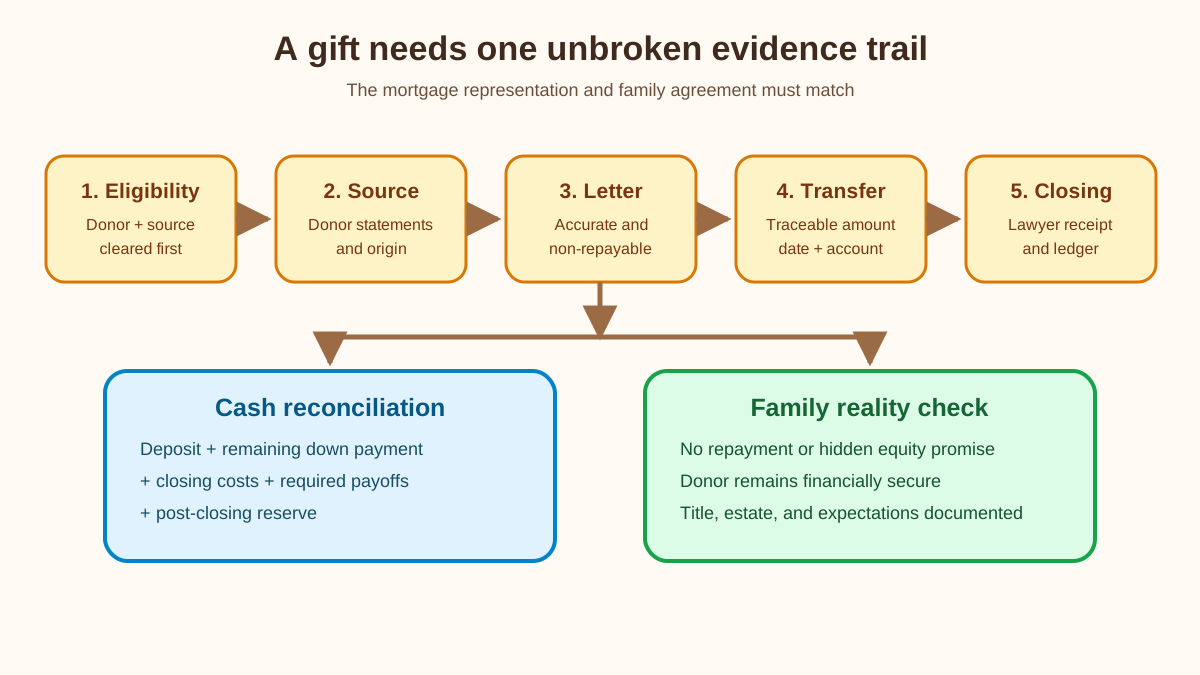
Build one evidence trail from donor account to buyer account to lawyer's trust account. Keep the mortgage representation and the family's actual agreement identical.
Short answer: clear the gift before moving the money
Use this order:
- Tell the mortgage professional the amount, donor relationship, source country, source account, and intended transfer date.
- Confirm the lender and insurer accept that donor and source for the proposed loan.
- Obtain the lender's current gift-letter form and document list.
- Let the donor consult independent legal, tax, and financial advisers where appropriate.
- Sign accurate documents stating whether the funds are non-repayable.
- Transfer directly through traceable accounts and retain every statement and receipt.
- Reconcile deposit, down payment, closing costs, required payoffs, and reserves.
- Give the lawyer and lender updates if any fact changes.
CMHC's current mortgage application tips say borrowers need proof of the down payment and its source. When a family member pays part, CMHC says a signed letter acknowledging the purpose and that the gift is non-repayable is needed.
Gifts are common, but acceptance is transaction-specific
CMHC reported in its 2026 Mortgage Consumer Survey discussion that one in five homebuyers received a down-payment gift and the median gift was $30,000. It also reported that 26% of gift recipients could not have purchased a home meeting their needs without it.
Prevalence does not remove underwriting. CMHC's consumer mortgage-insurance FAQ lists a non-repayable gift from immediate family as a common source. Another lender, insurer, conventional loan, provincial program, or borrower profile can have different definitions and evidence requirements.
Ask these questions in writing:
- Is the donor relationship eligible?
- Can the funds come from a business, trust, estate, sale, investment, borrowed account, or another country?
- Must the money be in the buyer's account before approval or for a minimum period?
- Which donor and buyer statements are required?
- Is the lender's own letter form mandatory?
- Can the donor send funds directly to the lawyer?
- Will the gift affect mortgage insurance, product, rate, or conditions?
- Must the donor receive independent legal advice?
Do not assume a gift accepted at one bank will be accepted identically by another.
A gift, family loan, and co-ownership are different structures
Before documents are signed, name the arrangement accurately.
| Structure | Repayment | Ownership | Mortgage effect | Core document |
|---|---|---|---|---|
| True gift | None | None from gift alone | May be accepted as equity | Gift letter and source trail |
| Family loan | Required or expected | None from loan alone | Debt must be disclosed and qualified | Loan agreement and lender approval |
| Equity contribution | Return tied to value/sale | Intended | May change borrower/title/lender structure | Co-ownership agreement and advice |
| Co-borrowing | Mortgage liability | Depends on title | Income and debts assessed | Mortgage, title, co-ownership terms |
| Inheritance | None after distribution | None from cash alone | Source and estate proof required | Estate/trust records |
Calling a repayable advance a gift creates a false representation. A promise to repay “only when you can,” monthly transfers back to the donor, an expected percentage of sale proceeds, or a side agreement can make the substance inconsistent with the gift letter.
Tell the lender and lawyer the real arrangement. If it is a loan or equity contribution, let them structure and assess it correctly before the offer becomes firm.
What a gift letter should establish
Use the current form supplied by the lender or insurer. It commonly asks for:
- donor's legal name, address, contact information, and relationship to buyer;
- buyer's legal name;
- amount and currency;
- subject-property address, if known;
- statement that the funds are a gift for the home purchase;
- statement that repayment is not required;
- statement that the donor receives no interest in the property, where applicable;
- source financial institution or account details requested;
- transfer date or confirmation;
- signatures and date;
- witness, commissioner, lawyer, or independent-advice fields if required.
Do not download an anonymous template and assume it satisfies the file. A lender may require precise language, wet signatures, identification, or a form completed after the property is known.
The letter should match the bank trail exactly. If the letter says $50,000 and the donor transfers $47,500 plus a later $2,500, disclose both movements and ask whether an amended letter is needed.
Build the donor source file
The lender or lawyer may need to understand how the donor obtained the funds, especially after a recent large deposit. Prepare a source schedule:
| Amount | Original source | Donor evidence | Transfer evidence | Buyer evidence |
|---|---|---|---|---|
| Savings | Account statements | Bank receipt | Deposit statement | |
| Investment sale | Brokerage statement | Transfer record | Deposit statement | |
| Property sale | Sale/closing statement | Wire/draft record | Deposit statement | |
| Inheritance | Estate distribution | Transfer record | Deposit statement | |
| Business distribution | Corporate/tax records | Transfer record | Deposit statement | |
| Foreign funds | Source and exchange records | Wire/SWIFT | Deposit statement |
If $70,000 appears in the donor's account two days before the gift, the reviewer may ask where that deposit came from. Preserve the prior account, sale, estate, or investment record rather than providing only the final balance.
Do not route funds through several relatives or cash accounts to avoid questions. Extra hops make beneficial ownership and source harder to establish.
Build an unbroken transfer trail
Retain legible records showing:
- donor account name and sufficient history;
- withdrawal, wire, electronic transfer, or bank draft issuance;
- reference number, amount, currency, and date;
- buyer account receipt or lawyer trust receipt;
- any foreign-exchange conversion and fees;
- final transfer to the lawyer for closing;
- returned or corrected transactions.
Screenshots that omit names, account numbers, dates, or URLs may be rejected. Download official PDF statements and transaction confirmations when available. Redact only after asking what the reviewer needs to see.
For a bank draft, keep the purchase receipt and a copy of the draft. The debit on the donor statement and credit to the buyer or trust account should reconcile to the same amount.
Reconcile the gift against the mortgage commitment
Mortgage commitments often list several conditions that touch the same funds. Convert each condition into a closure log rather than assuming the gift letter clears all of them.
| Condition | Exact requirement | Document sent | Sent date | Reviewer confirmation |
|---|---|---|---|---|
| Down-payment amount | ||||
| Gift letter | ||||
| Donor eligibility | ||||
| Donor source | ||||
| Buyer receipt | ||||
| Deposit evidence | ||||
| Closing-cost funds | ||||
| Debt payoff | ||||
| Reserve requirement |
A broker forwarding a document is not the same as an underwriter accepting it. Ask whether the condition is satisfied, remains subject to an updated statement, or needs another item. Preserve the response with the final approval file.
If a commitment says the buyer must show 1.5% of purchase price for closing costs, determine whether those funds must be separate from the gift and down payment. If it requires a credit-card payoff, remove that amount from available cash before measuring the remaining equity.
Do not let a larger gift obscure a minimum personal-equity requirement under a specific program. Ask the lender to state how much equity must come from each permitted source.
Coordinate multiple donors without mixing the record
Two parents, grandparents, or other accepted donors may contribute separately. Give each donor a distinct evidence package:
- lender-approved relationship;
- separate letter for the exact amount;
- separate source statements;
- separate transfer confirmation;
- buyer-account entry matching that donor;
- explanation of any shared account.
Avoid combining cash first in one relative's account unless the lender approves the route and the original sources remain visible. If spouses donate from a joint account, ask who must sign and whose identity and relationship must be documented.
Create a control total:
donor A + donor B + buyer savings + eligible withdrawal + deposit credit = verified purchase equity
Then reconcile the control total to the statement of adjustments and lawyer's trust ledger. Investigate every difference, including wire charges, exchange loss, returned transfers, deposit interest, or an amount used for an appraisal or inspection.
Protect personal information while satisfying verification
Gift files contain account numbers, addresses, signatures, identification, and financial history. Send documents only through the secure channel specified by the lender, broker, lawyer, or bank. Confirm the recipient and avoid ordinary group email where a portal is available.
Ask before redacting. A reviewer may need the account holder, partial account number, statement period, balance, transaction history, and institution details, while unrelated account information may be removable. Keep an unredacted original in the donor's secure records and a copy of the exact version submitted.
Beware of last-minute payment-instruction changes. Independently verify lawyer trust instructions using a known telephone number before wiring funds, and have the law office confirm receipt.
Deposit and down payment are related but not identical
The purchase deposit is paid under the purchase agreement, often before the mortgage file is final. At closing, it usually forms part of the buyer's total funds credited toward the price.
Example:
- purchase price: $700,000;
- total planned down payment: $100,000;
- deposit already paid: $25,000;
- remaining down payment at closing: $75,000;
- estimated closing costs and adjustments: $18,000;
- required debt payoff: $7,000;
- target post-closing reserve: $15,000.
Total verified cash needed before considering the reserve is not merely the $75,000 balance. The buyer needs $100,000 for down payment in total, plus $18,000 closing costs and $7,000 payoff. The gift, buyer savings, and deposit source must reconcile across the file.
Use the home-purchase deposit guide to control deadlines and the closing-cost worksheet for cash beyond the down payment.
Calculate the minimum down payment correctly
CMHC's current FAQ says mortgage insurance is generally required when the down payment is below 20%. It also sets out minimum equity tiers for eligible insured purchases and a maximum purchase price below $1.5 million for homeowner loans.
Do not infer the exact minimum from an old article or a rounded percentage. Ask the mortgage professional to calculate it for the purchase price, property type, occupancy, amortization, insurer, and program in effect on the application date.
A gift that moves the buyer from 9.8% to 10% or from 19.8% to 20% may change the insurance premium or underwriting path. Compare total mortgage, premium, rate, closing cash, and reserve in each scenario. More equity is useful only if the family can provide it without compromising its own security.
Timing can determine whether the file closes
Work backward from the financing-condition deadline and closing date:
| Milestone | Owner | Target date | Evidence |
|---|---|---|---|
| Lender confirms gift eligibility | Broker/lender | Before offer if possible | Written note |
| Donor advice completed | Donor | Before commitment | Adviser record |
| Letter signed | Buyer/donor | Before underwriting deadline | Accepted form |
| Source records delivered | Donor/buyer | With letter | Complete statements |
| Transfer initiated | Donor | Before required seasoning/verification | Receipt |
| Buyer receives funds | Buyer | Before lender deadline | Statement |
| Lawyer receives funds | Buyer/donor | Before trust deadline | Trust receipt |
| Final lender condition cleared | Lender | Before waiver/closing | Written confirmation |
Large transfers, foreign wires, account holds, compliance reviews, statutory holidays, and draft clearing can consume days. Do not schedule the gift for the morning of closing.
The lender may update statements near closing. Avoid moving the gift to a different account, spending part of it, or returning money without approval.
Foreign gifts require more lead time
Foreign-source funds can involve identity, source-of-wealth, translation, currency, transfer, sanctions, and anti-money-laundering reviews. Ask the lender, Canadian bank, and lawyer what they require before the donor sends funds.
The file may need:
- donor identification and relationship evidence;
- original-language and translated bank records;
- sale, employment, tax, estate, or business-source records;
- wire/SWIFT confirmation;
- foreign-exchange receipts;
- explanation of intermediaries;
- evidence funds are legally transferable;
- additional time for compliance review.
Use the Canadian-dollar net amount after fees and exchange. If the mortgage depends on a precise gift, add a currency buffer approved by the parties rather than relying on yesterday's rate.
Tax consequences can arise in the donor's country, from asset sales, or under cross-border reporting. Obtain advice for the actual countries and persons involved.
The donor needs a capacity test
A parent should not sacrifice retirement stability to improve a buyer's approval. Prepare a donor balance sheet after the gift:
- cash reserve remaining;
- high-interest debt;
- mortgage and housing needs;
- retirement income and longevity risk;
- health, care, and accessibility costs;
- tax on investments sold;
- support promised to other family members;
- estate plan and powers of attorney;
- ability to tolerate no repayment.
If the donor requires repayment to remain secure, the money is not economically a gift. Explore a disclosed family loan, smaller gift, later purchase, lower price, or other structure with professional advice.
The buyer should never promise informally to “make it right later” while signing a non-repayable letter.
Separate the gift from title and family expectations
A cash gift does not by itself decide who owns the home. Title, mortgage obligations, family-property law, trust claims, cohabitation or marriage, and written agreements can affect rights.
Discuss scenarios before closing:
- Is the gift to one buyer or both?
- Is it intended to remain excluded property if a relationship ends, where local law permits?
- Will the donor live in the home or contribute expenses?
- Does the donor expect veto rights over sale or renovation?
- What happens if the buyer dies before the donor?
- Should a will, cohabitation agreement, marriage contract, trust declaration, or co-ownership agreement be updated?
- Will siblings view the gift as an advance on inheritance?
These are legal and family decisions, not mortgage-form fields. Each affected person should receive independent advice where interests differ.
Do not hide a family loan inside a gift
Warning signs include:
- scheduled monthly payments to the donor;
- a note or text promising repayment;
- donor borrowing with an expectation the buyer services that debt;
- a registered or unregistered charge against the home;
- percentage of appreciation promised;
- repayment triggered by sale or refinancing;
- buyer funding the donor's interest cost;
- money returned shortly after closing.
A disclosed loan may add a payment to TDS, reduce acceptable equity, or require subordination. Calculate its effect using the GDS/TDS worksheet.
Misrepresenting the arrangement can jeopardize approval and create legal or insurance consequences. Correct the file before waiver or advance if the agreement changes.
Appraisal gaps can consume the gift
The lender usually bases its loan-to-value calculation on an accepted property value, which may be lower than the contract price. If the appraisal comes in short, the buyer may need more cash or a lower price.
Example:
- contract price: $800,000;
- lender-accepted value: $770,000;
- maximum loan based on accepted value: lower than expected;
- buyer must fund the price gap plus required equity and closing costs.
Do not promise the entire family gift to the minimum down payment without an appraisal-gap plan. Keep the financing condition long enough for property approval and document review.
Post-closing records matter
Keep the accepted gift letter, statements, transfer receipts, lawyer ledger, mortgage approval, purchase agreement, and relevant family/legal documents together. The records may matter for a later audit, refinance, sale, estate, relationship dispute, or explanation of adjusted cost base.
Do not create after-the-fact paperwork that contradicts the mortgage file. If the donor later makes a separate loan or acquires an interest, obtain lender and legal advice before changing the arrangement.
Common gifted-down-payment failures
The gift arrives before eligibility is confirmed
The donor relationship or source may not fit the product. Clear it first.
The letter says non-repayable but the family expects repayment
Stop and disclose the actual loan or equity terms.
A recent donor deposit has no source evidence
Trace the money to the sale, investment, estate, income, or other origin.
The buyer uses the gift for the deposit and loses the trail
Keep the trust receipt, agreement, and account records connecting it to closing.
Closing costs are omitted
Land-transfer tax, legal work, adjustments, insurance, moving, and reserves require cash beyond the down payment.
The gift leaves the donor exposed
Reduce or stop the gift if the donor cannot tolerate permanent loss of the money.
Family intentions are undocumented
Mortgage acceptance does not settle relationship, estate, occupancy, or title questions.
What to do next
- Prepare a one-page gift summary with amount, donor, relationship, source, country, and timing.
- Obtain written lender/insurer acceptance and the required form.
- Give the donor time for independent advice and a capacity review.
- Collect source statements before funds move.
- Sign truthful documents and make a direct traceable transfer.
- Reconcile the gift with deposit, down payment, closing costs, debt payoffs, and reserve.
- Deliver complete evidence before the financing deadline.
- Preserve the closing file and update legal or estate documents where advised.
Frequently asked questions
Can my parents gift my down payment in Canada?
Often yes. CMHC identifies a non-repayable gift from immediate family as a common insured-mortgage source, but the lender and insurer must confirm the donor relationship, source, amount, and evidence for the specific application.
Does a gifted down payment have to be repaid?
An accepted gift is non-repayable. If repayment is expected, disclose it as a family loan or another structure and let the lender assess it.
What documents prove a gifted down payment?
Common evidence includes the lender's gift letter, donor and buyer statements, source records for recent deposits, transfer confirmation, identification, relationship evidence, and lawyer trust receipt. Requirements vary.
How long must gifted funds stay in my account?
There is no single timing answer for every lender and transaction. Ask when funds must arrive, what history is required, and whether direct transfer to the lawyer is permitted.
Can a friend provide the gift?
Some products restrict eligible donors. Do not assume a friend, corporation, trust, or distant relative is acceptable; obtain written approval before transfer.
Can the donor borrow the gift money?
Borrowed donor funds can raise source, repayment, capacity, and underwriting issues. Disclose the borrowing and obtain lender, legal, and financial advice before proceeding.
Is a Canadian cash gift taxable to the buyer?
Canada generally does not impose a standalone gift tax on receiving a cash gift, but asset sales, attribution, family law, trusts, foreign jurisdictions, and later ownership arrangements can create tax consequences. Get advice for the facts rather than relying on that general statement.
Does a down-payment gift give the donor ownership of the home?
Not by itself. Ownership follows title and applicable law, while trust or family claims can depend on conduct and agreements. Document intentions with a lawyer before closing.
This article is educational and does not provide mortgage, legal, tax, accounting, estate, or financial advice. Requirements change and files are assessed individually. Confirm the structure and current evidence with the lender, insurer, lawyer, tax adviser, and financial planner involved.
Advertisement

About David R. Chen, CFA
David R. Chen is a Chartered Financial Analyst and the Senior Housing Economist at BubbleWatch.ca. He brings 12+ years of experience in quantitative real estate analysis and mortgage underwriting. Formerly an analyst at a major Canadian bank, he specializes in modeling payment shock, regional affordability divergence, and private lending risk.
View David's professional bio & credentials →