GDS and TDS Ratios in Canada 2026: How Lenders Calculate Them
A line-by-line method for reproducing the lender's GDS and TDS worksheet, finding the binding constraint, and converting a mortgage approval into a safer after-tax household budget.
GDS and TDS Ratios in Canada: Rebuild the Mortgage Qualification Math
Gross debt service and total debt service ratios are two lender tests that compare selected monthly obligations with gross income. GDS measures housing costs. TDS adds other debt obligations.
The ratios look simple, but a small input difference can move a borrower from approval to decline. The mortgage payment may be calculated at a stress-test rate rather than the offered rate, only part of a condo fee may enter the worksheet, a revolving balance may receive a minimum assumed payment, and income may be reduced or excluded.
This guide shows how to reproduce the worksheet, identify the disputed input, and build a second budget that answers the more useful household question: can you carry the home after tax and still fund repairs, savings, and ordinary life?
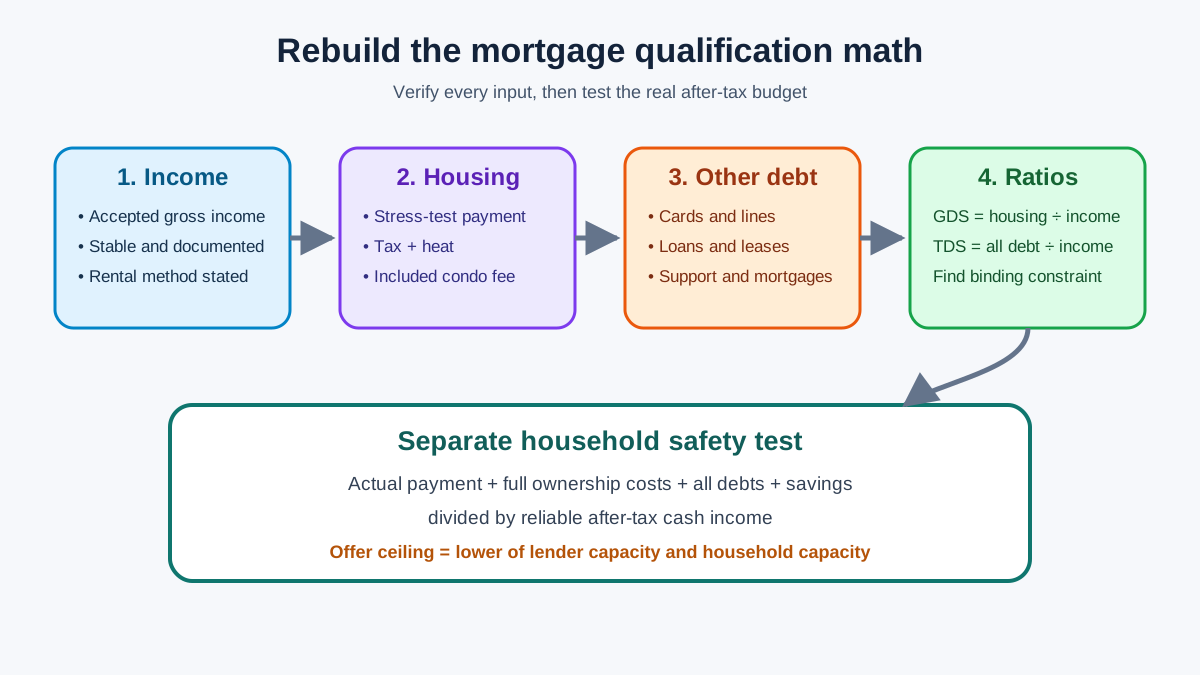
Short answer: calculate three numbers, not one
Prepare three views before setting a price ceiling:
- Lender GDS: qualifying housing costs divided by accepted gross monthly income.
- Lender TDS: qualifying housing costs plus accepted monthly debt obligations, divided by accepted gross monthly income.
- Household carrying ratio: the real payment and all ownership costs divided by reliable after-tax cash income.
CMHC's current GDS and TDS calculation guidance states 39% and 44% limits for its insured underwriting and explains how it treats common inputs. Those ceilings do not promise approval, bind every lender in every transaction, or describe a comfortable personal budget.
CMHC's homebuying workbook also presents 32% GDS and 40% TDS as general affordability rules before stating the higher insured qualification limits. Treat qualification and resilience as separate decisions.
The formulas
At a monthly level:
GDS = qualifying housing costs ÷ accepted gross monthly income × 100
TDS = (qualifying housing costs + qualifying other debt) ÷ accepted gross monthly income × 100
Housing costs commonly include:
- mortgage principal and interest at the qualifying payment;
- property taxes;
- heating cost;
- 50% of condominium fees where CMHC treatment applies;
- 100% of site or ground rent for relevant chattel or leasehold loans.
TDS then adds the lender's recognized payments for credit cards, lines of credit, vehicle loans or leases, student loans, support, and other obligations. The exact treatment can differ by lender, insurer, product, credit profile, and documentation.
Do not copy a web calculator result into an offer decision without obtaining the lender or broker's input assumptions.
Start with accepted income, not household income
The denominator is not automatically every dollar that enters the household. A lender decides whether income is stable, continuous, documented, and acceptable under its policy.
Create an income reconciliation:
| Income source | Current amount | Lender amount | Evidence | Reason for difference |
|---|---|---|---|---|
| Base salary | Job letter, pay stubs | |||
| Bonus/overtime | T4s, notices of assessment | Average or excluded | ||
| Commission | Tax and employer records | Multi-year treatment | ||
| Self-employment | T1, NOA, financials | Add-backs/policy | ||
| Pension/benefit | Statements, tax slips | Continuance | ||
| Rental income | Lease, tax, appraisal | Offset or percentage | ||
| Support received | Agreement, deposits | Documentation | ||
| Accepted annual total |
Divide the accepted annual total by 12. If two applicants earn $90,000 and $60,000 in base salary, their initial gross monthly income is $12,500. If the lender excludes a $15,000 hoped-for bonus, leave it out of the qualification worksheet even if the family expects to receive it.
Variable income is where online estimates often overstate capacity. Ask the mortgage professional which years, averages, declines, probation periods, contracts, and business expenses affect the amount.
Calculate the qualifying mortgage payment
Federally regulated lenders require borrowers to qualify at a rate above the contract payment. The Financial Consumer Agency of Canada's current mortgage preparation guidance says banks use the higher of:
- 5.25%; or
- the negotiated mortgage rate plus two percentage points.
The rule applies to insured and uninsured mortgages at banks. Other lenders may also use a stress test or their own underwriting rules.
If the offered rate is 4.60%, the qualifying rate under that test is 6.60%, not 5.25%. If the offered rate is 3.00%, the qualifying rate is 5.25%, because it is higher than 5.00%.
The qualifying payment also depends on loan amount, amortization, payment frequency, compounding convention, and any mortgage-insurance premium added to the loan. Use the lender's calculated payment for the application rather than substituting the actual contract payment.
For scenario planning, the CalculatorVillage mortgage calculator can show payment sensitivity. Reconcile its assumptions with the lender worksheet before relying on it.
Build PITH line by line
Mortgage professionals often refer to principal, interest, taxes, and heat as PITH. For ratio work, record every component separately:
| Housing input | Monthly amount | Source |
|---|---|---|
| Qualifying principal and interest | Lender worksheet | |
| Property tax | Current bill/municipal estimate | |
| Heat | Actual record or lender estimate | |
| Included condo fee | Fee statement × policy percentage | |
| Site/ground rent | Lease and lender treatment | |
| Qualifying housing total |
Annual property tax should be divided by 12 even if the municipality collects on another schedule. For a new build or reassessed property, the current interim bill may understate the completed-home tax. Estimate the finished value and ask the municipality or lawyer about likely timing.
Heat is not the entire utility bill. CMHC says mortgage professionals should ask for monthly heating cost and use actual records when the borrower provides them. A lender may use a standard estimate when the address has no reliable history.
CMHC includes 50% of condo fees in GDS and TDS. The household must still pay 100%, so place the other half in the after-tax budget. Review what the fee excludes with the condo-fee budget guide.
Worked GDS calculation
Assume accepted gross income of $150,000 a year, or $12,500 a month. The lender worksheet contains:
- qualifying mortgage payment: $3,650;
- property tax: $500;
- heat: $120;
- monthly condo fee: $600, with 50% included.
Qualifying housing cost is:
$3,650 + $500 + $120 + $300 = $4,570
GDS is:
$4,570 ÷ $12,500 × 100 = 36.56%
That example is below 39% but above CMHC's 32% general affordability rule. The distinction matters: it may fit an insured underwriting ceiling while leaving less room for tax, the excluded half of the condo fee, maintenance, insurance, and savings.
Add every recognized debt for TDS
Prepare a debt table from current statements and the credit report:
| Obligation | Balance | Contract payment | Lender payment | End date |
|---|---|---|---|---|
| Credit card | Revolving | |||
| Unsecured line | Revolving | |||
| Secured line | Revolving | |||
| Vehicle loan | ||||
| Vehicle lease | ||||
| Student loan | ||||
| Support | ||||
| Other mortgage |
CMHC's professional guidance says unsecured lines of credit and credit cards receive a monthly amount of at least 3% of the outstanding balance for its calculation. A $12,000 balance can therefore add at least $360 a month under that method, even if a statement minimum is lower.
Term debt generally uses the required payment, subject to lender policy. Do not omit a vehicle payment because it ends soon unless the mortgage professional confirms it can be excluded and records the evidence.
Credit limits can matter even when ratios use outstanding balances. A lender may request repayment or closure, and using the account before closing can change qualification. Keep the financing condition active until the lender has reviewed the property, borrower, and current debt position.
Worked TDS calculation
Continue the earlier example with qualifying housing cost of $4,570 and add:
- vehicle loan: $525;
- student loan: $250;
- credit-card assumed payment: $240.
Total qualifying obligations are $5,585. TDS is:
$5,585 ÷ $12,500 × 100 = 44.68%
GDS passed the illustrated CMHC ceiling while TDS did not. The binding constraint is other debt, not the property alone.
Paying off an obligation may help, but confirm the lender's conditions. A payoff might have to occur before approval, from verified funds outside the down payment and closing reserve, with an account statement or closure letter. Moving debt to another account without reducing the recognized payment does not solve the ratio.
Find the binding constraint mathematically
Instead of asking only “How much mortgage can we get?”, calculate available monthly room.
At a 39% GDS ceiling with $12,500 accepted monthly income:
$12,500 × 39% = $4,875 maximum qualifying housing cost
After $500 tax, $120 heat, and $300 included condo fee, $3,955 remains for the qualifying mortgage payment.
At a 44% TDS ceiling:
$12,500 × 44% = $5,500 maximum total obligations
After $1,015 of other debt, only $4,485 remains for housing. TDS is therefore binding and permits $530 less qualifying housing cost than GDS.
This calculation tells the household what could change the result: lower price, larger down payment, documented income, lower tax/fees, or genuinely retired debt. It also exposes an input error quickly.
Run an input-sensitivity table before changing the application
One ratio result does not show which change produces a meaningful improvement. Ask the mortgage professional to recalculate a small set of controlled scenarios while keeping every other input constant.
| Scenario | Income | Housing cost | Other debt | GDS | TDS | Cash required |
|---|---|---|---|---|---|---|
| Current file | ||||||
| Purchase price lower by $25,000 | ||||||
| Down payment higher by $25,000 | ||||||
| Vehicle debt repaid | ||||||
| Revolving balance repaid | ||||||
| Co-borrower added | ||||||
| Lower-tax property |
A larger down payment reduces the loan, but the result depends on where the transaction sits in the mortgage-insurance premium schedule and whether the funds remain sufficient for closing. A lower purchase price reduces the loan without consuming more savings and may also reduce transfer tax or property tax, although those effects are location-specific.
Debt repayment can be efficient when a modest cash amount removes a large monthly payment. Suppose $8,000 remains on a vehicle loan with a $525 monthly payment. Retiring it may improve TDS more than adding $8,000 to the down payment, but it also uses liquid cash and may trigger a prepayment charge or leave an inadequate reserve. Compare both lender outputs and the post-closing bank balance.
Adding a co-borrower can raise accepted income but also imports that person's debts, ownership issues, and full contractual exposure. It is not a spreadsheet adjustment to make solely because another scenario misses the limit.
Record the date, rate, lender, product, and policy assumptions beside every scenario. A quote from another lender is comparable only after income, debt, amortization, property, fees, and insurance treatment are aligned.
Check cash to close beside the ratios
A borrower can satisfy GDS and TDS while lacking enough verified cash to complete the purchase. Keep a parallel cash reconciliation:
verified available funds − down payment − deposit already paid − closing costs − required debt payoffs − required reserves = post-closing liquidity
Do not count an expected tax refund, sale proceeds without a firm closing path, an undocumented family transfer, or a line of credit the lender has not accepted. Confirm when each amount must arrive and which statements establish its source.
The remaining balance should cover moving, immediate repairs, utility deposits, and an emergency reserve. If every dollar is assigned to approval conditions, reduce the price before waiving financing.
Qualification ceilings are not guaranteed approvals
CMHC says its 39%/44% treatment considers the application and may apply additional conditions. A lender or another insurer can use lower limits, different income treatment, credit requirements, property restrictions, or other risk controls.
Approval also depends on factors outside these ratios:
- credit history and score;
- down-payment source and verification;
- employment and income stability;
- property appraisal and marketability;
- loan-to-value and insurance eligibility;
- mortgage type and amortization;
- unpaid tax, judgments, support, or contingent liabilities;
- lender portfolio and documentation policy.
A pre-approval usually assesses the borrower with assumed property inputs. It does not approve a specific condominium, rural property, appraisal, title issue, or purchase contract. Re-run the ratios for the actual address.
Rental income requires a disclosed method
For a property with rental income, lenders may use an offset method, a percentage of gross rent, or a net-rental calculation. Owner-occupied units, legal suites, subject-property rent, existing rentals, short-term rent, and market rent can receive different treatment.
Ask for a written reconciliation showing:
- gross rent accepted;
- vacancy or expense reduction;
- whether rent is added to income or offsets property costs;
- mortgage, tax, heat, and fee treatment for each property;
- lease, appraisal, tax return, or bank evidence required;
- treatment of a vacant or unauthorized unit.
Do not add all expected rent to gross income while also omitting the rental property's costs. For an investment decision, use the rental-property cash-flow method after reproducing the lender treatment.
Co-borrowers change both sides of the ratios
Adding a co-borrower can add acceptable income, but it also adds that person's debts and legal responsibility. Use the combined accepted income and combined recognized obligations.
Before adding anyone, model:
- their verified income and employment risk;
- mortgages, guarantees, support, leases, and revolving debt;
- ownership and title plan;
- future borrowing capacity;
- exit, refinance, sale, death, disability, or relationship breakdown;
- tax and estate advice.
A person should not sign a mortgage merely to contribute a denominator. A joint borrower is equally responsible for the unpaid balance under federal consumer guidance, regardless of a private family arrangement.
Convert gross qualification into an after-tax budget
GDS and TDS use gross income, but households pay expenses with cash after income tax and payroll deductions. Build a monthly ownership ledger using conservative net deposits:
| Cash use | Monthly amount |
|---|---|
| Actual mortgage payment | |
| Full property tax | |
| Full condo fee | |
| Heat, electricity, water | |
| Home insurance | |
| Maintenance reserve | |
| Special-assessment reserve | |
| Transportation change | |
| All debt payments | |
| Childcare/support | |
| Food and essentials | |
| Retirement and emergency saving | |
| Discretionary margin |
Use the full condo fee, not the 50% underwriting input. Add home insurance even though it is generally outside CMHC's GDS formula. Add a property-specific repair reserve using the home-maintenance budget framework.
Stress the real budget for a renewal rate increase, one income interruption, higher tax and fees, and a repair. If every scenario requires revolving debt, the purchase price is too high for the household even when the lender approves it.
A ratio audit request for your broker or lender
Ask for the worksheet or a written input list containing:
- accepted annual income by person and source;
- qualifying rate and amortization;
- loan amount and insured premium included;
- qualifying principal-and-interest payment;
- monthly property tax and heat;
- condo-fee or ground-rent treatment;
- every debt and assumed monthly payment;
- rental-income method;
- resulting GDS and TDS;
- product limits, insurer, conditions, and document expiry dates.
If the professional cannot provide exact inputs, you cannot reproduce the result or measure the effect of a different home.
Common calculation errors
Using the offered payment in GDS
The stress-test payment can be materially higher. Obtain the qualifying payment.
Dividing annual costs inconsistently
Convert annual tax and annual income to the same monthly basis. Do not compare a biweekly payment directly with monthly income.
Counting the whole condo fee in one view and half in another
Label the lender input and the household cash expense separately.
Ignoring revolving balances
The lender may impute a payment greater than the statement minimum. Update balances before approval and again before closing.
Treating gross rent as free income
Apply the lender's rental method and then run a vacancy, repair, and operating-cost model.
Spending the payoff money twice
Funds used to retire debt are unavailable for the down payment, land-transfer tax, legal costs, moving, and reserves. Reconcile cash with the closing-cost worksheet.
Treating 39% and 44% as a right
They are CMHC insured-underwriting limits described in its current guidance. The lender can decline, apply lower policy limits, or impose other conditions.
A decision table
| Result | Likely issue | Useful next action |
|---|---|---|
| GDS high, TDS similar | Property carrying cost | Lower price/payment, tax, or fee burden |
| GDS passes, TDS high | Other debt | Verify inputs; retire debt with separate funds if sensible |
| Both high | Price/income mismatch | Reset price ceiling or wait |
| Ratios pass, cash flow fails | Gross-income illusion | Use lower household ceiling |
| Online result differs from lender | Input/policy mismatch | Request line-by-line reconciliation |
| Pre-approval passes, property fails | Property or updated file | Keep financing condition; review appraisal/documents |
What to do next
- Download current income, debt, property-tax, fee, and heating evidence.
- Ask the mortgage professional for accepted inputs and the qualifying payment.
- Reproduce GDS and TDS to two decimal places.
- Identify whether GDS, TDS, cash to close, or appraisal is binding.
- Build the after-tax ownership budget with full costs and reserves.
- Test a rate increase, income interruption, and repair.
- Set the offer ceiling from the lower of lender capacity and household capacity.
- Keep a property-specific financing condition unless your lawyer and mortgage professional advise otherwise.
Frequently asked questions
What is a good GDS ratio in Canada?
CMHC's homebuying material uses 32% as a general affordability rule and describes 39% as its insured qualification limit. A suitable household target may be lower after accounting for tax, dependants, savings, variable income, and ownership costs omitted from GDS.
What is a good TDS ratio in Canada?
CMHC presents 40% as a general affordability rule and 44% as its insured qualification limit. Treat the higher number as an underwriting ceiling within the applicable program, not a recommended spending target.
Does GDS use the actual mortgage rate?
The qualifying payment can use a higher stress-test rate. Banks currently use the greater of 5.25% or the negotiated rate plus two percentage points for the federal mortgage stress test.
Are condo fees included in GDS?
CMHC's current professional guidance includes 50% of condominium fees in GDS and TDS. The household budget must include the full fee, and another lender or insurer's applicable policy should be confirmed.
How are credit cards counted in TDS?
CMHC says unsecured lines and credit cards should receive a monthly payment of no less than 3% of the outstanding balance in its calculation. Ask the lender which balance date and policy it used.
Can paying off a car loan improve mortgage qualification?
It can reduce recognized monthly debt if the lender accepts the payoff and evidence. Compare the ratio benefit with the loss of cash needed for the down payment, closing, and emergency reserves.
Does a mortgage pre-approval confirm my GDS and TDS for a home?
It confirms only the assumptions and file reviewed at that time. The actual property's tax, heat, condo fee, appraisal, condition, and lender eligibility can change the result.
Why does my lender calculate a different ratio from an online calculator?
Likely causes include accepted income, qualifying rate, amortization, insured premium, tax, heat, condo-fee percentage, debt payment, or rental-income method. Request each input and reconcile the difference line by line.
This article is educational and does not provide mortgage, legal, tax, accounting, or financial advice. Lending and insurer policies change and applications are assessed individually. Confirm current requirements and calculations with the lender, mortgage professional, insurer, lawyer, and tax adviser involved in your transaction.
Advertisement

About David R. Chen, CFA
David R. Chen is a Chartered Financial Analyst and the Senior Housing Economist at BubbleWatch.ca. He brings 12+ years of experience in quantitative real estate analysis and mortgage underwriting. Formerly an analyst at a major Canadian bank, he specializes in modeling payment shock, regional affordability divergence, and private lending risk.
View David's professional bio & credentials →