Mortgage Prepayment Penalty in Canada 2026 Analysis
A contract-first worksheet for estimating a Canadian mortgage break: three months' interest, IRD, extra fees, portability, and the rate-savings break-even point.
Mortgage Prepayment Penalty in Canada: The Full Break-Cost Test
A mortgage prepayment penalty in Canada is the charge a lender may apply when you break a closed mortgage, transfer it early, repay more than your contract allows, or sell before the term ends. The correct number comes from your lender. A useful estimate must also include discharge, legal, appraisal, reinvestment, and cash-back costs.
!Mortgage break decision map showing the quote, all-in cost, alternative, and break-even tests
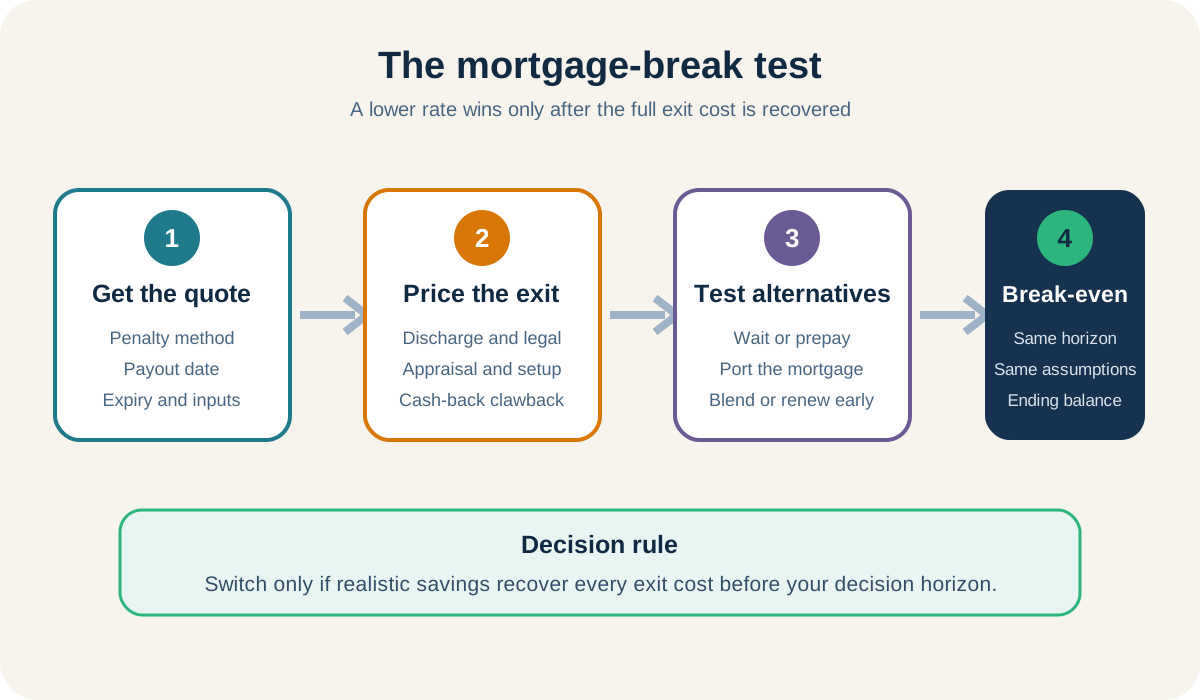
Short answer: don't compare rates until you price the exit
The tempting calculation is old rate minus new rate. That leaves out the contract you have to escape. A lower rate can still produce a loss if the penalty and transaction costs exceed the interest saved before the new term ends.
Use this sequence:
- Ask the current lender for a written payout statement and a dated penalty quote.
- Identify whether the quote uses three months' interest or an interest rate differential, usually called IRD.
- Add every other cost of leaving and joining.
- Compare the all-in exit cost with the interest and fee savings under a realistic new-mortgage schedule.
- Test a same-lender blend, port, early renewal, or wait-to-maturity option before signing anything.
The Financial Consumer Agency of Canada warns that mortgage prepayment penalties can cost thousands of dollars and tells borrowers to check the actual contract because privileges and formulas vary. That contract-first point matters more than any online estimate.
What counts as breaking a mortgage?
Borrowers often associate a penalty only with refinancing. FCAC's definition is wider. A charge may apply when you:
- repay a closed mortgage before its maturity date;
- sell the home and pay out the loan;
- transfer the balance to another lender before the term ends;
- refinance to increase the balance or change the contract;
- pay more than the allowed annual lump sum;
- increase regular payments beyond the stated privilege;
- cannot port the existing mortgage to the next property.
An open mortgage usually permits full repayment without a prepayment penalty, but the interest rate may be higher. A closed mortgage usually has a lower rate and tighter exit rules. “Fixed” and “variable” describe how the interest rate behaves. “Open” and “closed” describe repayment flexibility. Those are different decisions.
The term also differs from the amortization. A five-year term is the contract period before renewal. A 25-year amortization is the planned payoff schedule. Breaking in year two means leaving three years before the term's maturity, even though the mortgage may have decades left to run.
If the exit is connected to a purchase, run BubbleWatch's home-buyer readiness sequence before making the existing mortgage part of an unconditional offer. A portable loan still depends on the new property, dates, and underwriting.
Three months' interest: the simple-looking formula
Many variable-rate closed mortgages use three months' interest as the break charge. Fixed mortgages may also use it when that amount is greater than the lender's IRD result. The contract decides.
A rough simple-interest estimate is:
Three-month estimate = mortgage balance × annual rate × 3 ÷ 12
Suppose the balance is $480,000 and the applicable rate is 5.20%:
| Step | Calculation | Result |
|---|---|---|
| Annual interest | $480,000 × 5.20% | $24,960 |
| Monthly equivalent | $24,960 ÷ 12 | $2,080 |
| Three months | $2,080 × 3 | $6,240 |
That is a planning estimate, not a payout quote. A lender may use a different balance date, rate basis, daily-interest convention, or contract method. Taxes and administrative charges may sit outside the penalty.
The most useful part of this formula is sensitivity. Every $100,000 of balance produces about $250 of three-month interest for each percentage point of annual rate. At 5%, that is about $1,250 per $100,000. At 6%, it is about $1,500.
IRD: why a fixed mortgage can cost far more to leave
The interest rate differential is intended to reflect interest the lender may lose when a fixed-rate borrower leaves early and replacement rates are lower. A simplified estimate looks like this:
IRD estimate = balance × rate difference × months remaining ÷ 12
The hard part is not multiplication. It is finding the lender's comparison rate. Some lenders compare the contractual rate with a current rate for a term similar to the time remaining. Some calculations incorporate the posted rate at origination and the discount the borrower received. Some apply present-value adjustments. Rounding the remaining term can change the comparison product.
FCAC's mortgage prepayment disclosure guidance says federally regulated institutions must explain the process and important components, including a posted rate or original discount when those affect the result. That is why two fixed mortgages with the same balance, contract rate, and maturity date can produce different penalties.
A simplified IRD example
Assume:
- current mortgage balance: $480,000;
- contract rate used in the estimate: 5.20%;
- lender comparison rate: 3.70%;
- months remaining: 28;
- simplified rate difference: 1.50 percentage points.
| Estimate | Calculation | Result |
|---|---|---|
| Three months' interest | $480,000 × 5.20% × 3 ÷ 12 | $6,240 |
| Simplified IRD | $480,000 × 1.50% × 28 ÷ 12 | $16,800 |
| Larger planning estimate | Greater of the two | $16,800 |
The example explains the shape of the risk. It does not reproduce a lender's proprietary calculation. Ask which comparison rate, remaining term, original discount, and balance the lender used. Then ask how long the quote remains valid.
The Bank of Canada's March 2026 working paper, The Value of Mortgage Choice, describes the Canadian pattern: variable-rate full prepayments commonly face three months' interest, while fixed-rate penalties can switch to an IRD when rates fall below the contractual rate. The paper also notes that Big Six bank calculations use posted-rate relationships, while some smaller lenders keep a three-month-interest approach. Product details still control an individual loan.
The posted-rate discount problem
A borrower may remember signing at 4.89%. The original lender paperwork may also show a five-year posted rate of 6.49% and a 1.60-point discount. If the penalty formula reconstructs that discount before comparing the remaining term, the relevant rate may not be the 4.89% the borrower expects.
This creates three common mistakes:
- using today's advertised special instead of the lender's stated comparison rate;
- comparing against a new five-year rate when only 26 months remain;
- ignoring the original posted-rate discount in the contract.
The Bank of Canada posted-rate series is useful context for how major-bank posted rates move. It is not a substitute for the lender's quote. Your mortgage may use a product-specific rate, a different lender schedule, or a present-value method.
The penalty is only line one of the exit bill
FCAC's guide to breaking a mortgage contract lists other possible costs: administration, appraisal, reinvestment, and mortgage discharge fees. Borrowers may also have to repay cash back received at origination.
Build an all-in worksheet:
| Cost | What to request | Why estimates miss it |
|---|---|---|
| Prepayment penalty | Written, dated quote from current lender | Online calculators cannot reproduce every contract |
| Discharge fee | Payout statement or fee schedule | It may apply even when the penalty is zero |
| Legal and registration | Quote from lawyer or notary | Refinancing creates new registration work |
| Appraisal | Written new-lender requirement | A transfer or refinance may need a fresh valuation |
| Cash-back repayment | Original commitment and payout statement | Clawbacks can be full or prorated by contract |
| Reinvestment/admin | Current-lender quote | Labels and amounts vary |
| New-lender setup | Commitment and fee disclosure | “Free switch” offers have conditions |
| Bridge or interim interest | Closing schedule | Sale and purchase dates may not line up |
| Lost privileges | Both mortgage contracts | A low rate can come with weaker flexibility |
If sale proceeds fund the next down payment but the purchase closes first, combine the payout quote with BubbleWatch's two-closing bridge-financing test. The bridge amount must be based on net sale equity after this entire exit bill, not sale price minus principal alone.
FCAC's mortgage discharge guide explains that a discharge removes the lender's rights from the property title and that fees depend partly on provincial or territorial rules. A collateral charge may also affect how easily another lender can take over the loan.
An all-in worked example
A homeowner receives a $16,400 penalty quote. The new lender advertises a lower rate and offers a $2,000 switch incentive.
| Exit or entry item | Cash effect |
|---|---|
| Prepayment penalty | -$16,400 |
| Current-lender discharge/admin | -$450 |
| Legal and registration | -$1,250 |
| Appraisal | -$400 |
| Cash-back repayment | -$2,100 |
| New-lender incentive after conditions | +$2,000 |
| Net switching cost | -$18,600 |
Calling this a $16,400 decision understates the hurdle by $2,200. It also assumes the incentive is received, not clawed back, and has no tax or timing consequence for the borrower.
The break-even test that matters
Do not multiply the rate gap by the balance and call the result “savings.” Mortgage interest falls as principal is repaid. A refinance may restart or extend amortization. Payments, compounding conventions, fees, and prepayment plans may change.
Compare two schedules over the same decision horizon:
- Stay case: current contract until maturity, then a clearly stated renewal assumption.
- Switch case: new mortgage, all exit and entry costs, and the same payment or amortization goal.
Track these outputs:
| Output | Stay | Switch |
|---|---|---|
| Cash paid during comparison period | ||
| Interest paid | ||
| Principal repaid | ||
| Balance at end | ||
| One-time fees | ||
| Remaining prepayment flexibility |
The result should answer two separate questions:
- When does cumulative interest-and-fee saving recover the $18,600 switching cost?
- At the chosen end date, which option leaves the lower balance after accounting for every cash flow?
If the break-even date arrives after the homeowner expects to sell, the switch is not supported by the rate alone. If the new payment is lower only because amortization stretches from 18 years back to 25, the monthly relief is partly delayed principal, not pure saving.
For payment schedules, use a transparent Canadian mortgage tool and copy its assumptions. BubbleWatch links readers to CalculatorVillage because calculators are centralized there; run both scenarios with the Canadian mortgage payment calculator and keep the same payment frequency and amortization basis.
Five alternatives to a full break
1. Wait until maturity
At the term's maturity, a borrower can generally repay or switch without a prepayment penalty, although discharge and setup costs may remain. Waiting is the clean baseline. Count the extra interest paid between today and maturity and compare it with the avoided penalty.
2. Use the prepayment privilege first
Some contracts allow annual lump sums or payment increases. A permitted lump sum can reduce the balance used in a later penalty calculation. But privileges vary, unused room may not carry forward, timing windows matter, and a payment immediately before discharge may be treated according to contract rules.
Ask the lender in writing:
- how much unused room exists today;
- whether it is based on original principal or current balance;
- when the annual allowance resets;
- whether a lump sum made before payout reduces the penalty balance;
- how many business days are required to process it.
Do not move money until the lender confirms the sequence.
3. Port the mortgage
A portable mortgage may move to the next property, sometimes with a “blend and increase” if the new loan is larger. Portability is conditional. The new property, borrower, closing dates, loan amount, and lender underwriting must qualify. Use the mortgage-port decision map to test those gates and document any temporary-penalty refund before relying on it.
The FCAC mortgage-choice guide cautions that a lower-priced replacement home can still create a penalty if the full mortgage amount cannot be ported. A port is not a promise to approve any future purchase.
4. Blend and extend
Some lenders blend the old rate with a new rate and extend the term without charging the normal break penalty. FCAC says lenders must explain how the blended rate is calculated. Compare the blended offer with staying and with paying the penalty to switch. A hidden cost can appear as a higher rate over a longer commitment.
5. Early renewal with the same lender
A lender may waive a penalty inside an early-renewal window. The trade-off is less competition. Get the offered rate, new term, privileges, portability, and future penalty method in writing. Then compare it with quotes available at maturity, acknowledging that future rates are unknown.
Selling a home: put the penalty into the net-proceeds statement
Sellers often estimate equity as sale price minus mortgage balance. The usable number is smaller:
Net proceeds = sale price - mortgage payout - selling costs - adjustments - taxes or legal obligations that apply
The mortgage payout includes accrued interest, the penalty, and applicable fees. A seller who needs proceeds for the next down payment should request the payout well before waiving financing on the replacement home.
Also test whether a lower-than-expected valuation changes the next purchase. BubbleWatch's Canadian appraisal-gap checklist shows how a lender's value can reduce the mortgage advance even after a buyer and seller agree on price.
Use three sale-price cases rather than one:
| Case | Purpose |
|---|---|
| Expected sale | Current evidence-based target |
| 5% lower | Tests negotiation and appraisal pressure |
| Delayed closing | Tests bridge interest and quote expiry |
A penalty quote can move as rates, the balance, and remaining term change. If the sale closes after the quote expires, update the statement. If the mortgage is portable, make the sale and purchase dates part of the financing condition rather than assuming the port will survive a long gap.
Questions to ask the lender
Request answers by secure message, branch document, or other durable format:
- What is the payout amount for a stated date?
- What portion is principal, accrued interest, penalty, and other fees?
- Is the penalty three months' interest, IRD, or another contract formula?
- Which rate and remaining term were used?
- Did the calculation use my original posted-rate discount?
- When does the quote expire?
- How would a permitted lump sum change it?
- Is the mortgage portable to the intended property and dates?
- Is cash back repayable?
- Are there discharge, appraisal, reinvestment, or administrative costs?
- Does a collateral charge create extra legal work?
- Is blend-and-extend or early renewal available, and how is its rate calculated?
If the answer is only a single dollar amount, ask for the components. FCAC disclosure guidance exists because the variables behind IRD can be difficult for borrowers to see.
Red flags in a refinance pitch
Pause if a proposal:
- calls the penalty “only three months” without reading the contract;
- uses an online estimate after the lender supplied a different quote;
- compares payments while extending amortization without showing the ending balance;
- counts a cash incentive but ignores its clawback terms;
- assumes the home will appraise at the desired value;
- adds high-interest debt to the mortgage without showing total lifetime interest;
- promises a port before the next property and dates are underwritten;
- ignores discharge, legal, appraisal, or registration costs;
- uses today's lower rate over five years but compares it with only the remaining months of the old term;
- pressures the borrower to sign before the payout statement arrives.
A refinance can still be sensible. It may reduce expensive unsecured debt, change payment risk, fund a necessary buyout, or resolve a cash-flow problem. The test simply has to include the whole transaction.
Frequently asked questions
Is a Canadian variable mortgage always only three months' interest to break?
No universal rule covers every contract. Three months' interest is common for closed variable mortgages and is described in FCAC material and Bank of Canada research, but the agreement controls the calculation, rate basis, fees, and exceptions. Request a lender quote before making a decision.
Does a mortgage penalty fall every month?
Not smoothly. The balance and time remaining usually decline, but the comparison rate used in an IRD can move. A rate change can cause the quote to jump or fall. Treat a penalty quote as dated, not permanent.
Can I deduct a mortgage break penalty on my taxes?
Tax treatment depends on why the money was borrowed and how the property is used. An owner-occupied home, rental property, and business-purpose refinance may be treated differently. Use current Canada Revenue Agency guidance and advice from a qualified tax professional; do not assume deductibility from a mortgage calculator.
Can a prepayment privilege be used just before breaking the mortgage?
Sometimes, but the amount, reset date, processing time, and effect on the penalty depend on the contract and lender procedure. Ask for written confirmation that the lump sum will be processed before the payout calculation and will reduce the applicable balance.
Is the mortgage discharge fee the same as the penalty?
No. The penalty compensates the lender under the mortgage contract. A discharge removes the lender's charge from title. Discharge, legal, and registration costs can remain even at maturity when no prepayment penalty applies.
Does selling because of job loss, divorce, or illness automatically waive the charge?
Not automatically. A lender may offer relief, a negotiated solution, portability, or another accommodation, but eligibility depends on circumstances and policy. Contact the lender early and document the request. Legal and financial advice may be needed for separation, estate, or insolvency issues.
Sources and method
This guide uses FCAC consumer guidance on prepayment penalties, breaking a mortgage, and mortgage discharge, plus FCAC's industry disclosure guidance. The explanation of Canadian contract structure and IRD behaviour also uses the Bank of Canada's March 2026 staff working paper.
The worked numbers are scenarios, not lender quotes or forecasts. They use simple arithmetic to expose the decision variables. Actual effective rates, compounding, present-value methods, quote dates, provincial fees, and contract terms may produce different results.
What to read next
If the exit calculation is part of a rate decision, read BubbleWatch's fixed-versus-variable mortgage analysis next. It compares payment risk and contract flexibility, which can matter as much as the starting rate.
Advertisement

About David R. Chen, CFA
David R. Chen is a Chartered Financial Analyst and the Senior Housing Economist at BubbleWatch.ca. He brings 12+ years of experience in quantitative real estate analysis and mortgage underwriting. Formerly an analyst at a major Canadian bank, he specializes in modeling payment shock, regional affordability divergence, and private lending risk.
View David's professional bio & credentials →