Porting a Mortgage in Canada 2026 Tool (Guide & Data)
A lender-confirmed portability workflow for moving an existing mortgage to a new property without assuming the old rate, full balance, timing gap, or penalty treatment will survive the move.
Porting a Mortgage in Canada: Test the Borrower, Property, Balance, and Dates
Porting a mortgage means transferring eligible existing mortgage terms - often the balance, rate, and remaining term - from the home being sold to a replacement property with the same lender. It can preserve a favourable rate or avoid some prepayment charges, but portability is not automatic approval.
The lender still needs to accept the borrower, new property, loan amount, ownership, insurance, and closing sequence under the mortgage contract and current underwriting. If the new mortgage is larger, smaller, delayed, differently structured, or secured against an ineligible property, the economic result can differ from the phrase “take your mortgage with you.”
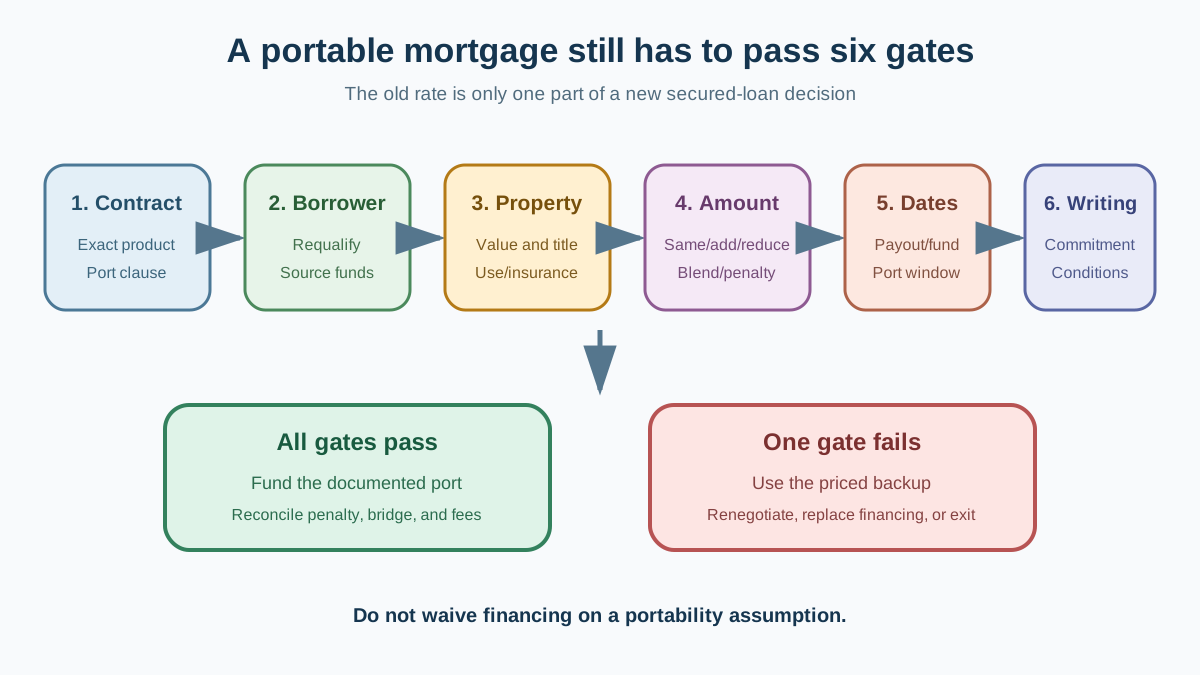
Short answer: a port passes six gates
Do not treat the mortgage as portable until the lender confirms all six:
- Contract: the existing product and charge are eligible.
- Borrower: income, debt, credit, identity, down payment, and ownership pass current review.
- Property: the new home, value, use, title, insurance, and condition are acceptable.
- Amount: the old balance, any added borrowing, and any reduction are approved and priced.
- Dates: sale payout, purchase funding, and the lender's port window fit.
- Documents: written commitment, conditions, penalty treatment, fees, and backup plan are clear.
FCAC's current mortgage-choice guidance describes a portable mortgage as one that allows a borrower to transfer the balance, interest rate, and terms and conditions. It also tells borrowers to ask about restrictions, extra borrowing, and penalties where the replacement costs less.
Portability is a feature, not an unconditional promise
A mortgage commitment was approved for a named borrower and a particular security. Moving the debt to a different property changes the security and may change the loan.
The lender may review:
- current employment, income, and documents;
- other debts, child or spousal support, and credit;
- down-payment source and sale proceeds;
- current mortgage payment history;
- new purchase agreement and sale agreement;
- appraisal or automated valuation;
- property type, location, condition, occupancy, and zoning;
- home insurance and title requirements;
- default-insurance eligibility where applicable;
- legal registration and priority;
- the requested balance, amortization, term, and payment;
- exact closing and payout dates.
A pre-approval or verbal “yes, it is portable” does not waive these checks. Use a financing condition that protects the property-specific decision and allows time to satisfy lender conditions.
Read the existing mortgage before shopping
Collect the contract, commitment, renewal agreement, latest annual statement, payout statement, and registered-charge information. Ask the lender to identify the controlling portability clause.
Record:
| Existing mortgage field | Confirmed detail |
|---|---|
| Product and segment | |
| Fixed, variable, open, or closed | |
| Current principal balance | |
| Contract rate and payment | |
| Maturity date and remaining term | |
| Remaining amortization | |
| Registration type | Standard or collateral charge |
| Port eligibility | Full, restricted, or not eligible |
| Minimum/maximum new amount | |
| Required closing relationship | |
| Port application deadline | |
| Penalty at sale payout | |
| Penalty reversal/refund conditions | |
| Administration, appraisal, and legal costs | |
| Cash-back or incentive clawback |
Do not rely on a portability feature remembered from the original sales conversation. Product versions and contract terms matter.
Four amount cases produce different results
1. Same balance
A simple port may transfer the remaining eligible balance, rate, and maturity date. The lender still approves the borrower and property, and the legal charge still moves through a payout and new registration process.
Ask whether payment frequency, prepayment privileges, amortization, insurance status, and charge structure remain the same. “Same balance” does not mean no fees or paperwork.
2. Larger balance
If the new home requires more borrowing, the lender may offer a blended structure. The added portion is priced at a current rate while the eligible old portion retains its contract economics, then the lender produces a blended rate or multiple segments under product rules.
Two common concepts are:
- blend and keep the remaining term: old and new money share a blended rate for the old remaining maturity;
- blend and extend: old and new money are blended into a longer new term.
BMO's current portable-mortgage overview publicly describes simple portability, a Blended Portable Mortgage that keeps the remaining term, and a Blend & Extend option that extends it. Those are product-specific examples, not universal lender definitions.
Compare the lender's actual annual percentage rate, payment, amortization, term, privileges, fees, and break formula. A low blended coupon can conceal a longer commitment or restrictive future penalty.
3. Smaller balance
Downsizing may require part of the mortgage to be prepaid. FCAC notes that a borrower can face a prepayment penalty when the new home costs less than the mortgage amount.
Ask whether the lender permits a partial port, how much balance must move, which prepayment privileges can reduce the unported portion, and how it calculates the charge. The sale proceeds being large enough to repay debt does not make the repayment penalty-free.
4. No eligible port
An open mortgage may be repayable without a charge under its terms, while a closed mortgage may produce a penalty. A lender may also decline the property, borrower, date sequence, or requested structure.
Obtain a current written payout statement and compare a new mortgage across lenders. The mortgage prepayment penalty guide explains three-month-interest, interest-rate-differential, variable, and lender-specific quote questions.
The blend needs arithmetic, not a label
Assume these illustration inputs:
- existing eligible balance: $400,000;
- old contract rate: 3.00%;
- additional borrowing: $200,000;
- quoted current rate for new money: 5.25%;
- same remaining term for both portions in this simplified example.
A simple balance-weighted illustration is:
($400,000 × 3.00% + $200,000 × 5.25%) ÷ $600,000 = 3.75%
The lender's contractual blended rate may not equal this shortcut because term lengths, discount methods, compounding, payment calculations, fees, dates, or product rules differ. Use its written quote.
Then compare at least:
| Option | Rate/structure | Term end | Payment | Fees/penalty | Future break exposure |
|---|---|---|---|---|---|
| Port plus increase | |||||
| Break and take new term | |||||
| Port with more down payment | |||||
| Wait to maturity |
Use CalculatorVillage's Canadian mortgage calculator to compare payment and amortization scenarios, then replace the illustration rates with lender commitments. A payment-only comparison misses upfront costs and the value of flexibility at the next move or refinance.
Porting and bridge financing solve different problems
Porting addresses the mortgage contract on the replacement property. Bridge financing addresses a short period when purchase funds are required before sale proceeds are available.
A borrower can need both. The old mortgage may be portable, yet the purchase closes on Monday and the sale closes two weeks later. The down payment or equity for the new purchase is still tied up.
Conversely, bridge financing does not guarantee the mortgage can port. TD's current bridge-financing page says its bridge loan requires approval for a TD mortgage or Home Equity FlexLine on the new property. Other lenders have their own requirements.
Build one timeline showing:
- old-home sale condition date;
- old-home closing and mortgage payout;
- new-home financing-condition deadline;
- new-home closing and mortgage funding;
- bridge advance and repayment dates;
- lender port window;
- penalty payment and any possible refund date;
- lawyer document and funding cutoffs.
The bridge financing workflow tests firm sale proceeds, timing, lien priority, interest, fees, and failure cases.
Same-day closings can still fail operationally
Matching sale and purchase dates may avoid bridge interest, but it creates dependency. The purchase may need sale proceeds, the buyer's mortgage may need payout confirmation, and lawyers, banks, registries, and moving arrangements must align.
Ask the lender and lawyer:
- Can the port fund before the old charge is discharged?
- Does the lender require confirmed sale proceeds?
- What if buyer funds on the old home arrive late?
- Is temporary bridge or other approved contingency available?
- Who authorizes the new advance and by what cutoff?
- What documents must arrive before closing day?
- How is the old payment, accrued interest, and payout handled?
Do not schedule a firm purchase on the assumption that money moves instantly. A contractual right to sale proceeds is not the same as cleared funds in the lawyer's trust account.
The temporary-penalty problem
Some port structures require the old mortgage to be paid out and a prepayment charge collected, then refund or reverse some charge only after the replacement mortgage funds and all conditions are met. Others handle a simultaneous port differently.
Ask for written answers:
- Must the penalty be paid from sale proceeds?
- What exact amount is quoted and until what date?
- Which conditions make it refundable?
- What is the application and funding deadline?
- Is the full penalty or only a stated portion eligible?
- When and how is the refund issued?
- What happens if the new purchase is delayed, cancelled, reduced, or declined?
- Are discharge, registration, cash-back, or administrative costs excluded?
Do not remove the penalty from the seller's cash-to-close plan until the lender confirms treatment. The seller net-proceeds guide keeps gross proceeds, mortgage payout, penalty, legal charges, adjustments, and replacement-home cash separate.
Property approval can stop an otherwise eligible port
The lender is exchanging one security for another. It may reject or restrict:
- an appraisal below purchase price;
- major condition or incomplete construction;
- leasehold, co-operative, fractional, hotel, short-term-rental, or unusual title;
- rural acreage, remote access, private road, well, septic, or outbuildings outside policy;
- mixed residential and commercial use;
- non-warrantable condo or weak project documentation;
- insurance difficulty;
- environmental, zoning, permit, or marketability concern;
- a property outside the lender's geographic program;
- intended rental use under an owner-occupied approval.
The old mortgage rate does not compensate the lender for unacceptable collateral. Keep appraisal, inspection, condo-document, insurance, and title conditions alive until the lender confirms the property.
If the appraisal is low, the buyer may need more cash, a price change, another lender, or an exit under the contract. The appraisal-gap risk guide shows how to size that contingency.
Default-insured and conventional ports
A mortgage with default insurance may have insurer requirements in addition to lender policy. The new price, loan-to-value ratio, amortization, occupancy, property, added borrowing, and premium treatment may change eligibility or cost.
Ask the lender to identify:
- whether the existing loan is insured, insurable, or conventional;
- insurer approval required for the replacement;
- treatment of any prior premium credit;
- new premium and sales tax where applicable;
- maximum purchase price and amortization under current rules;
- effect of added borrowing or a different occupancy;
- documentation needed before financing-condition expiry.
Do not assume that paying a premium on the first home creates permanent insurance portability for any later purchase. The lender and insurer must confirm the new transaction.
Porting a variable mortgage
Variable products differ. A port may carry the current discount or rate mechanics, convert to a new product, or be unavailable under a particular contract. Breaking a closed variable mortgage may use a different prepayment formula than a fixed mortgage.
Request both paths in writing:
- port structure, current discount or spread, payment mechanics, term, and added-money pricing;
- break structure, payout charge, new rate, payment, term, and fees.
Also ask whether a fixed conversion before sale changes portability or the penalty. Do not convert merely because it sounds like an easier port; obtain the full before-and-after terms first.
Collateral charges and multiple products
A collateral registration may secure more than one debt or a higher registered amount. A readvanceable product may contain a mortgage segment and line-of-credit balance.
The move can therefore require:
- payout of multiple segments;
- discharge or postponement of a collateral charge;
- new legal registration rather than a simple transfer;
- closure or re-approval of a line of credit;
- different priority arrangements;
- repayment of debts tied to the security;
- extra legal, appraisal, and administration work.
Ask the lender for a complete payout and security list. Ask the lawyer to review title and instructions. The word “portable” on one mortgage segment does not explain every secured obligation.
Port decision worksheet
Use one row for each gate:
| Gate | Evidence required | Deadline | Owner | Status |
|---|---|---|---|---|
| Existing contract eligible | Clause and lender confirmation | Before offer | Borrower/lender | |
| Current payout and penalty | Dated written statement | Offer planning | Lender | |
| Borrower requalified | Commitment conditions | Finance condition | Borrower/lender | |
| New property accepted | Appraisal and property review | Finance condition | Lender | |
| Insurance bound | Binder with lender details | Pre-closing | Buyer/insurer | |
| Port amount approved | Simple/partial/blended quote | Finance condition | Lender | |
| Dates fit | Written port window and closings | Before firm dates | Lender/lawyer | |
| Bridge approved if needed | Commitment and repayment source | Before purchase firm | Lender | |
| Legal instructions complete | Lawyer confirmation | Pre-closing | Lender/lawyer | |
| Backup affordable | Alternative commitment/cash | Before waiver | Buyer |
Every “yes” should point to a document, name, date, and condition. A text from a salesperson saying “should be fine” is not a funding commitment.
Worked move-up example
Assume an owner has a $420,000 fixed mortgage at 3.10% with 22 months left. The old home sells for $800,000, the new home costs $1,050,000, and the buyer wants a $620,000 mortgage. The purchase closes ten days before the sale.
The household needs answers to four separate calculations:
- Port: Is the $420,000 eligible, and what exact term and rate survive?
- Increase: How is the additional $200,000 priced and for how long?
- Bridge: How much equity is available after payout, costs, holdback, and conservative adjustments, and what does ten days cost?
- Alternative: What does breaking the old loan and taking a new $620,000 mortgage cost over the same comparison horizon?
Suppose the lender quotes a $12,000 penalty if the old loan simply pays out. The buyer should not call porting a $12,000 saving until it confirms all conditions and any fees, premium, rate tradeoff, or future-break effect.
The comparison horizon should reach at least the old maturity date and include the balance remaining then. A lower payment created by extending amortization is not the same as lower total cost.
Worked downsizing example
Assume a $500,000 mortgage remains and the replacement purchase requires only $300,000 of financing. The borrower wants to carry the low rate but repay $200,000.
Ask the lender to quote:
- maximum amount that can port to the lower-value home;
- penalty on the $200,000 reduction;
- prepayment privilege available before payout;
- required loan-to-value and property approval;
- payment and remaining amortization on the $300,000;
- option to wait until maturity or adjust closing;
- full break-and-replace alternative.
The correct choice can depend on penalty, term remaining, desired debt, investment of surplus cash, and move timing. Do not borrow more solely to preserve a rate without comparing interest, flexibility, and risk.
Questions to send the lender in one email
- Is my exact mortgage product portable under the attached contract?
- Does portability retain balance, rate, remaining term, amortization, and privileges?
- Must I requalify, and what documents and qualification rate apply?
- Which property types, uses, values, and locations are ineligible?
- What happens if I need a larger or smaller mortgage?
- How is a blended rate calculated, and does the term extend?
- What sale and purchase timing window applies?
- Is a prepayment charge collected first, and when is any refund paid?
- What events cancel refund eligibility?
- What appraisal, legal, discharge, registration, administration, insurer, or cash-back costs apply?
- Can bridge financing work with my proposed dates, and what are its conditions?
- What written approval will I receive before waiving financing?
Attach the proposed purchase only through the lender's secure channel. Do not send identity, income, or account documents over an unverified email address.
Common porting mistakes
- assuming a portable product guarantees borrower approval;
- making a firm offer before the new property is accepted;
- comparing only rates and ignoring penalty, fees, term, and amortization;
- treating bridge financing as part of the port;
- setting closing dates outside the contract window;
- relying on a verbal promise of a penalty refund;
- forgetting that downsizing can trigger partial prepayment charges;
- overlooking insurer approval on an insured mortgage;
- ignoring collateral charge or line-of-credit payout;
- assuming a low appraisal can be solved by the old rate;
- spending sale proceeds before the penalty and holdbacks are reconciled;
- failing to model a declined-port backup.
Frequently asked questions
Can I automatically port my mortgage when I move?
No. The contract must allow it, and the lender generally reviews the borrower, replacement property, amount, dates, insurance, and documents. Obtain written approval.
Does porting avoid every mortgage penalty?
Not always. A full eligible port may avoid or reverse some prepayment charge under the contract, but a smaller balance, missed timing window, failed purchase, or ineligible property can leave a charge. Fees and incentive clawbacks may also remain.
Can I port and borrow more?
Often, subject to approval. A lender may blend the old eligible balance with new borrowing or use separate segments. Compare the exact rate, term, payment, amortization, fees, and future penalty.
Can I port to a cheaper home?
Possibly, but the amount not transferred may be treated as a prepayment and charged under the contract. Ask for a partial-port and full-break quote.
Do I need to requalify?
Expect the lender to reassess the borrower and new property. The extent and rules depend on lender, insurer, product, and transaction.
Is porting the same as switching lenders?
No. Porting usually keeps an existing mortgage with the same lender and moves its security to a new home. Switching transfers or replaces financing with another lender, often near renewal.
Can I port if I buy before I sell?
It may be possible, but the lender must approve the timing, financing, and security. If sale proceeds are needed before they arrive, separately approved bridge financing or other funds may be required.
What happens if the new purchase fails after my old home sells?
The old mortgage may pay out and a penalty may remain if no qualifying replacement funds within the contractual window. Confirm the outcome and build a housing and financing contingency before making firm commitments.
What to read next
- Get the lender's current mortgage-break quote
- Map the sale-purchase gap before requesting a bridge
- Keep property approval inside the financing condition
- Calculate sale proceeds before committing them to the next purchase
Method and sources
This guide was updated July 19, 2026. It uses current FCAC mortgage-choice and prepayment guidance, public RBC and BMO portability explanations, and TD bridge-financing terms as product-specific examples. The controlling answer is the borrower's signed contract and lender commitment; readers should obtain current lender, broker, legal, tax, insurance, and appraisal advice for the transaction.
Advertisement

About David R. Chen, CFA
David R. Chen is a Chartered Financial Analyst and the Senior Housing Economist at BubbleWatch.ca. He brings 12+ years of experience in quantitative real estate analysis and mortgage underwriting. Formerly an analyst at a major Canadian bank, he specializes in modeling payment shock, regional affordability divergence, and private lending risk.
View David's professional bio & credentials →