Bridge Financing in Canada 2026 Tool (Guide & Data)
A two-closing liquidity test for Canadian move-up buyers using sale proceeds for the next down payment, including daily cost, approval conditions, and failure planning.
Bridge Financing in Canada: Survive the Gap Between Two Closings
Bridge financing is a short-term loan that can release part of the expected equity from a firm home sale before that sale closes. A Canadian homeowner may use it when the replacement home closes first and the proceeds from the existing home arrive days or weeks later.
The loan solves a timing gap, not an equity shortage. Approval commonly depends on a firm sale agreement, an accepted purchase agreement, enough net sale proceeds, and approved financing for the new home. If the old sale fails, the bridge does not disappear. The borrower can be left carrying the existing mortgage, the new mortgage, bridge interest, and a new sale process at the same time.
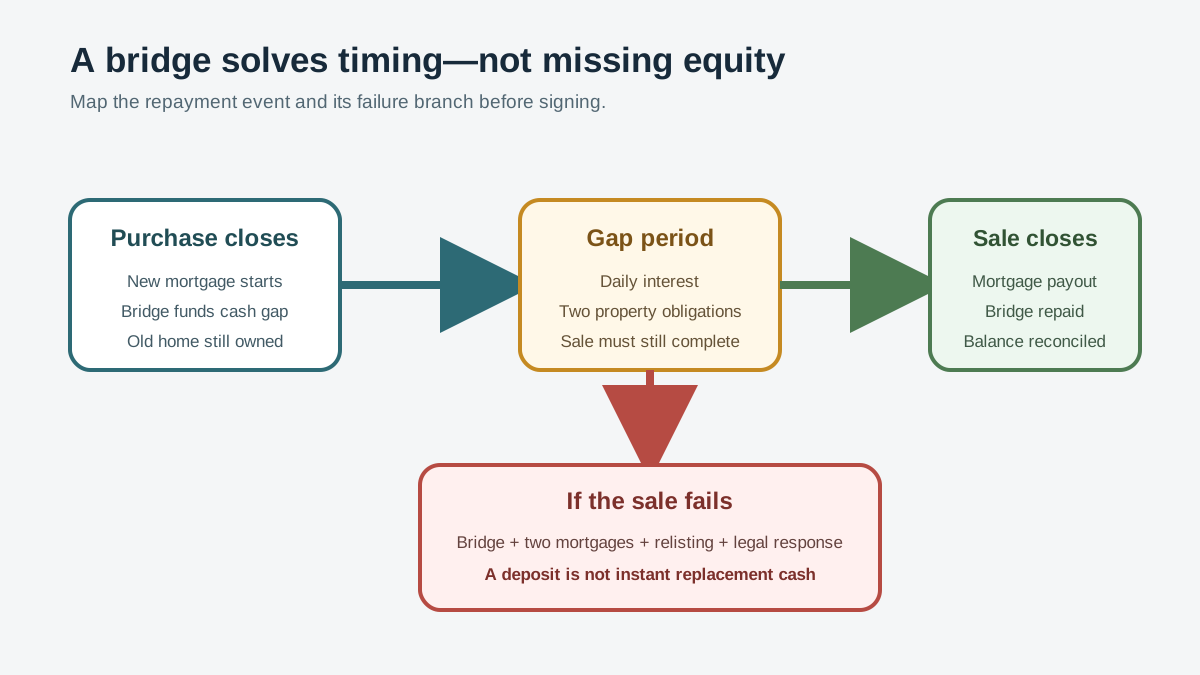
Short answer: map the two closings before comparing rates
Use this sequence:
- Calculate conservative net equity from the old home, after the mortgage payout and sale obligations.
- Calculate every dollar required to close the new purchase.
- Identify the shortfall that exists only because the sale proceeds arrive later.
- Obtain a written bridge offer with amount, rate, fees, security, funding date, maturity, and repayment instructions.
- Stress-test a delayed or failed sale before making the purchase unconditional.
A bridge is suitable only if the answer to two questions is yes: Is the expected sale equity real after every deduction? Can the household survive if that equity arrives late or changes?
The CIBC lending glossary defines a bridge loan around this exact timing problem: sale proceeds from the current home are needed for the new residence, but the old sale occurs after the new closing. Product eligibility and terms remain lender-specific.
What a bridge loan does - and what it does not do
A bridge loan can temporarily fund a portion of the next down payment or related purchase cash that is locked in the current home's expected equity. It usually begins when the new purchase closes and is repaid when the old property sale closes.
It does not automatically:
- finance a purchase when the old home has not sold;
- guarantee that either transaction will close;
- replace the mortgage approval on the new home;
- erase the current mortgage payout or prepayment penalty;
- cover a lower-than-expected sale price without renewed approval;
- extend indefinitely if the buyer's sale is delayed;
- protect the borrower from buyer default on the old home.
TD's current bridge-financing page says its product requires both sale and purchase agreements plus approval for a TD mortgage or Home Equity FlexLine on the new property. TD describes a typical maximum period of 90 days and warns that a failed sale can leave the customer paying two mortgages until another sale closes. Those are TD product details, not universal Canadian rules. Ask each lender for its own requirements.
Start with net sale equity, not the listing price
The bridgeable amount is not “current home value minus mortgage.” The planned sale price must first survive contract, payout, and closing deductions.
Use this worksheet:
Conservative net sale equity = firm sale price − current mortgage payout − sale closing costs − secured debts to discharge − required holdbacks − safety margin
Possible deductions include:
- mortgage principal and daily interest to the actual payout date;
- prepayment penalty or lost cash-back incentive;
- discharge, administration, and registration costs;
- real-estate compensation and applicable tax;
- seller legal fees and disbursements;
- property-tax, fuel, rent, or condo adjustments;
- construction liens, judgments, tax arrears, or other registered debt;
- agreed repairs, credits, or escrow holdbacks;
- moving and temporary accommodation that must be paid from sale cash.
If an existing closed mortgage ends early, use the full mortgage break-cost test rather than guessing three months' interest. A large interest-rate-differential charge can reduce the equity available for the next closing.
Worked net-equity example
Assume the existing home has a firm sale price of $850,000. The seller expects a $460,000 mortgage payout and has collected written estimates for the major sale costs.
| Sale cash flow | Amount |
|---|---|
| Firm sale price | $850,000 |
| Mortgage payout, including quoted penalty and fees | -$468,200 |
| Sale representation cost and tax | -$42,500 |
| Seller legal and discharge estimate | -$2,100 |
| Expected tax and condo adjustments | -$1,400 |
| Contract repair credit | -$3,500 |
| Uncertainty margin | -$7,300 |
| Conservative net sale equity | $325,000 |
The example is a decision model, not a market fee schedule. Every deduction should come from the actual listing agreement, mortgage payout statement, lawyer, sale contract, and property account.
Calling the equity $390,000 because $850,000 minus $460,000 equals $390,000 would overstate usable proceeds by $65,000. A bridge sized from that shortcut may fail the lender's legal review or leave too little sale cash to repay all obligations.
Calculate the purchase-side cash gap
Now build the new home's requirement independently:
Purchase closing cash = remaining down payment + transfer taxes and registration + legal account + net adjustments + required debt clearance + reserve
Subtract cash already available without the old sale. This may include a credited deposit, funds in the lawyer's trust account, and liquid savings the lender has verified.
Do not treat an approved mortgage amount as final cash until the lender has accepted the property, appraisal, income, debt, down-payment trail, and closing instructions. A preapproval is not a promise to finance a specific address.
Use the Canadian cash-to-close worksheet for transfer tax, registration, insurance-tax, legal, adjustment, and reserve lines. Toronto buyers must account for both Ontario and municipal land transfer tax. New-build buyers need a contract-specific adjustment schedule.
Worked purchase-gap example
The same household buys a $1,050,000 replacement home. It plans a $350,000 total down payment and a $700,000 mortgage. A $50,000 deposit has already been delivered.
| Purchase cash flow | Amount |
|---|---|
| Remaining down payment after deposit credit | $300,000 |
| Transfer tax and registration estimate | $19,000 |
| Legal, title, and disbursement estimate | $2,400 |
| Expected closing adjustments | $2,600 |
| Protected post-closing reserve | $20,000 |
| Cash requirement from now through possession | $344,000 |
| Verified liquid cash available without sale proceeds | -$94,000 |
| Timing shortfall | $250,000 |
The conservative old-home equity is $325,000, so a $250,000 timing request appears supported before lender limits and fees. That does not mean the lender will advance $250,000. The lender may deduct more estimated sale expenses, restrict the eligible period, require stronger collateral, or approve a smaller amount.
The $20,000 reserve stays in the requirement by design. If the bridge works only after spending the repair and emergency fund, the household is financing a fragile transaction.
Daily bridge interest: make time visible
Bridge loans are short, so borrowers may dismiss the rate. The relevant cost is amount × annual rate × days outstanding, plus fees and legal or registration work.
Use a planning formula:
Estimated interest = bridge principal × annual interest rate × days ÷ 365
Suppose the written offer is $250,000 at 8.75% and the scheduled gap is 21 days:
| Item | Calculation | Amount |
|---|---|---|
| Daily interest | $250,000 × 8.75% ÷ 365 | $59.93 |
| 21 scheduled days | $59.93 × 21 | $1,258.53 |
| 14 extra days after a delay | $59.93 × 14 | $839.02 |
| 35-day total | $59.93 × 35 | $2,097.55 |
Add the lender setup fee, legal work, registrations, appraisal, discharge, wire charges, and any interest charged on fees. Ask whether the lender uses 365 or another day basis, whether interest is calculated on the approved amount or funded amount, and whether repayment on the sale date includes that date.
Do not copy the example rate into a budget. Use the dated written offer. The key sensitivity is about $60 per additional day in this illustration. A two-week delay adds roughly $839 before other costs.
Build the two-closing calendar
The purchase and sale have separate critical paths. Put both into one table.
| Deadline | Purchase file | Sale file | Financing file | Owner |
|---|---|---|---|---|
| Offer conditions | Financing, inspection, legal review | Preliminary bridge discussion | Buyer/lender/lawyer | |
| Sale becomes firm | Conditions waived or satisfied | Firm sale delivered to lender | Seller/lender | |
| 15 business days before purchase close | Insurance, ID, final funds | Payout statement requested | New mortgage and bridge documents | Lawyer/lender |
| Purchase closing | Title and mortgage register | Old home still owned | Bridge funds purchase gap | Lawyer |
| Gap period | New mortgage active | Old mortgage and obligations continue | Daily bridge interest accrues | Homeowner |
| Sale closing | Buyer funds received; title transfers | Old mortgage and bridge repaid | Lawyer | |
| After sale | Reconcile reserve | Final statement | Confirm discharges and zero bridge balance | Homeowner |
Ask the lawyers on both files whether they need to be the same firm and how they will coordinate payout funds. If the homes are in different provinces, professional roles, registration systems, trust timing, and holidays can differ.
Calendar dates are not enough. Bank, land-registry, lawyer, and wire cutoff times matter. A sale scheduled for Friday afternoon may not give the household usable proceeds for a separate Friday purchase without a coordinated funding plan.
Firm sale versus an unsold home
Many mainstream bridge products are built for a home that already has a firm sale agreement. A listing, conditional offer, or expected sale price is not equivalent.
Firm sale
The lender can inspect the signed agreement, sale price, conditions, closing date, deposit, and buyer details. It still needs to assess the risk that the buyer fails to close, but there is a contractual repayment event.
Conditional sale
If the buyer's financing, inspection, sale-of-property, document review, or other condition remains open, the repayment event is uncertain. The bridge lender may wait until conditions are fulfilled or waived.
Unsold home
Financing before a firm sale is a different credit problem. A home-equity line, second mortgage, private loan, or qualification to carry both homes may be discussed, but each has different rates, security, fees, repayment risk, and approval criteria. Do not call every short-term solution a bridge and assume the mainstream product terms apply.
The decision order matters: obtain the written financing path before making an unconditional purchase. A verbal statement that a lender “does bridges” is not approval of the amount, property, dates, and sale agreement.
The failed-sale scenario
The largest bridge risk is not a few extra days of interest. It is the buyer of the old home failing to complete.
If that happens, the seller may face:
- bridge maturity without sale proceeds;
- two mortgage payments, taxes, insurance, utilities, and maintenance;
- legal action against the defaulting buyer;
- a new listing in changed market conditions;
- a lower resale price or extra representation cost;
- new mortgage-qualification questions;
- insurer restrictions on an unoccupied home;
- moving, storage, or tenant complications;
- pressure to accept a weak replacement offer.
A deposit held under the old sale is not an instant substitute for closing proceeds. Entitlement can be disputed, release may require agreement or court process, and damages depend on facts and law. Ask the sale lawyer what remedies and timelines could apply; do not insert the deposit as immediately available cash in the failure case.
A practical failure reserve
Estimate at least the cost of carrying both properties through a realistic resale period:
| Monthly obligation | Old home | New home | Combined |
|---|---|---|---|
| Mortgage payment | |||
| Property tax | |||
| Insurance | |||
| Condo fee or maintenance | |||
| Utilities and security | |||
| Bridge interest | |||
| Monthly total |
Then add relisting costs, legal advice, and a price-change scenario. If the household cannot finance even one month without immediate distress, the closing order may be too aggressive.
Four closing-order options
1. Sell first, then buy
This removes uncertainty about sale price and equity but may require temporary housing, storage, and two moves. A longer sale closing or seller rent-back may create time to buy, subject to contract, insurance, lender, and local legal advice.
2. Same-day closing
This avoids scheduled bridge interest but creates operational dependency. A delay in the first file can block the second. Lawyers need compatible locations, institutions, registration windows, and funds flow.
3. Buy first with a short bridge
This creates moving flexibility and separates closing days. The household pays interest and fees and accepts failed-sale risk. A firm sale and conservative equity calculation make the structure more defensible.
4. Buy before the old home is sold
This creates price, timing, and qualification risk at once. Approval may require the ability to carry both properties or a different secured credit facility. Test an extended marketing period and lower sale price before committing.
There is no universally best sequence. The safer option is the one whose failure case the household can finance and whose contracts the lawyer has reviewed.
Mortgage portability and the bridge are separate decisions
A borrower may port an existing mortgage to the new property and also need bridge financing. Portability does not automatically fund the equity timing gap. A bridge does not automatically preserve the old mortgage rate. The Canadian mortgage-port workflow keeps the contract, borrower, property, amount, dates, and written approval separate from this bridge decision.
Ask the current lender:
- Is the mortgage portable to this property and borrower structure?
- Must the old sale and new purchase close within a specified window?
- Can the balance be increased, and at what blended or new rate?
- Is the full balance portable if the new home is cheaper?
- What penalty applies if the port fails?
- Can this lender also provide the bridge, and is that required?
FCAC's mortgage-choice guide notes that mortgage contracts differ in portability, collateral-charge, and assumption features. Read the actual contract. A product name does not prove the move fits its conditions.
Questions for the bridge lender
Request written answers to these questions:
- Is a firm sale required, and which conditions must be removed?
- How is eligible net sale equity calculated?
- What is the maximum amount and term for this file?
- Must the new mortgage be placed with the same lender?
- What property will secure the bridge and what registrations are needed?
- What annual rate and daily-interest basis apply?
- Which setup, appraisal, legal, wire, discharge, and extension fees apply?
- When are funds advanced and interest started?
- How will the sale lawyer repay the bridge?
- What happens if the sale is delayed one day, 30 days, or fails?
- Can the lender demand repayment before the expected sale closes?
- Are partial repayments permitted?
- Must both purchase and sale lawyers satisfy special instructions?
- Does a change in sale price, buyer, or closing date require reapproval?
- When does the offer expire?
An answer such as “prime plus a margin” is incomplete. Record the actual reference rate, margin, effective annual rate if disclosed, fees, and date.
Lawyer and insurance checks
The lawyer should see the sale agreement, purchase agreement, existing mortgage, bridge commitment, new mortgage commitment, title information, and payout statement. Ask which file pays each loan and whether sale proceeds will be sufficient after all trust deductions.
Tell both home insurers the possession, vacancy, move, and sale dates. Coverage for an unoccupied former home may change after the household moves. Renovation before possession or a rent-back can also require special treatment.
Fraud controls deserve their own line in the calendar. Independently verify any emailed change to wire or bank-draft instructions using a known number. Limit who receives full agreements, identity documents, and banking information.
A go/no-go bridge decision sheet
| Test | Green | Yellow | Red |
|---|---|---|---|
| Old-home sale | Firm, conditions cleared | One limited condition | Unsold or material conditions |
| Net equity | Written deductions, large margin | Some estimates outstanding | Based on listing price |
| New mortgage | Property and borrower approved | Minor conditions remain | Only preapproved |
| Bridge offer | Written amount, rate, fees, dates | Verbal terms partly confirmed | No lender commitment |
| Timing | Business-day buffer | Same-day dependency | Cutoff or registry conflict |
| Failure capacity | Can carry delay and relist | One-month strain | Immediate default risk |
| Legal coordination | Both files reviewed | Instructions pending | Lawyer has not seen structure |
One red item does not always kill a move, but it identifies a condition that must be solved before the purchase becomes firm. Do not convert uncertainty into optimism because the moving date is emotionally attractive.
Frequently asked questions
How does bridge financing work in Canada?
A lender temporarily advances part of expected equity from a firm home sale so the borrower can close a replacement purchase first. The bridge is usually repaid from sale proceeds when the existing home closes.
Do I need to sell my house before getting a bridge loan?
Many mainstream products require a firm sale agreement. A listed, conditionally sold, or unsold property may not qualify under the same terms. Ask the lender what “firm” means for its approval.
How much can I borrow?
The amount depends on the lender's estimate of net sale equity, the purchase cash gap, security, credit approval, existing and new mortgage obligations, and product limits. Sale price minus mortgage balance is not a sufficient calculation.
How long does a bridge loan last?
The written offer controls. TD describes its bridge period as typically up to 90 days, but other lenders and files may differ. Plan from actual purchase and sale closing dates and ask how extensions work.
What does a bridge loan cost?
Cost can include daily interest, setup fees, legal work, appraisal, registration, wire, discharge, and extension charges. Multiply the funded principal by the written annual rate and actual days, then add every fixed charge.
What happens if my buyer fails to close?
The bridge and both property obligations can remain payable while the home is relisted or legal remedies are pursued. A sale deposit may not be immediately available. Review the failure plan with the lender and lawyer before committing.
Can I use a HELOC instead?
A home-equity line may be an alternative if approved and available, but it has different security, rate, limit, registration, and repayment terms. Compare the all-in cost and failure case, not only the headline rate.
Is a same-day sale and purchase safer?
It removes the planned bridge interval but makes the purchase dependent on sale funds arriving and registering on time. A short bridge may reduce operational pressure at a cost. The lawyers and lenders should confirm the feasible sequence.
Method and source note
This article was updated July 19, 2026. It uses current public bridge descriptions from TD and CIBC to explain the product shape, while treating all limits and approval rules as lender-specific. FCAC's homebuying guidance supports the broader requirement to budget upfront costs and obtain mortgage approval.
The worked figures are illustrations, not offers or fee quotes. Replace every rate, amount, deadline, and sale deduction with documents from the actual lender, lawyer, agreements, and property accounts.
What to read next
- Build the replacement home's cash-to-close number.
- Price any mortgage prepayment penalty and discharge costs.
- Stress-test a low valuation with the appraisal-gap worksheet.
- Put financing, sale, legal, and inspection deadlines into the home-buyer readiness sequence.
Advertisement

About David R. Chen, CFA
David R. Chen is a Chartered Financial Analyst and the Senior Housing Economist at BubbleWatch.ca. He brings 12+ years of experience in quantitative real estate analysis and mortgage underwriting. Formerly an analyst at a major Canadian bank, he specializes in modeling payment shock, regional affordability divergence, and private lending risk.
View David's professional bio & credentials →