Closing Costs in Canada 2026: What You Pay on Closing Day
A province-aware cash calendar for Canadian homebuyers, with official transfer-tax examples, adjustment logic, quote fields, and a final-funds stress test.
Closing Costs in Canada: Build Your Real Cash-to-Close Number
Closing costs in Canada are the cash obligations that sit around a home purchase rather than inside the advertised price. They can include land transfer tax, legal work, title insurance, registration charges, property-tax adjustments, inspection and appraisal costs, mortgage-insurance sales tax in some provinces, and contract-specific new-build charges.
There is no reliable national percentage that fits every buyer. A Toronto purchase can carry both provincial and municipal land transfer tax. A Vancouver purchase uses British Columbia's property transfer tax. An Alberta transfer uses registration levies instead of a percentage-style land transfer tax. Buyer status, property type, price, financing, closing date, and contract wording can all change the result.
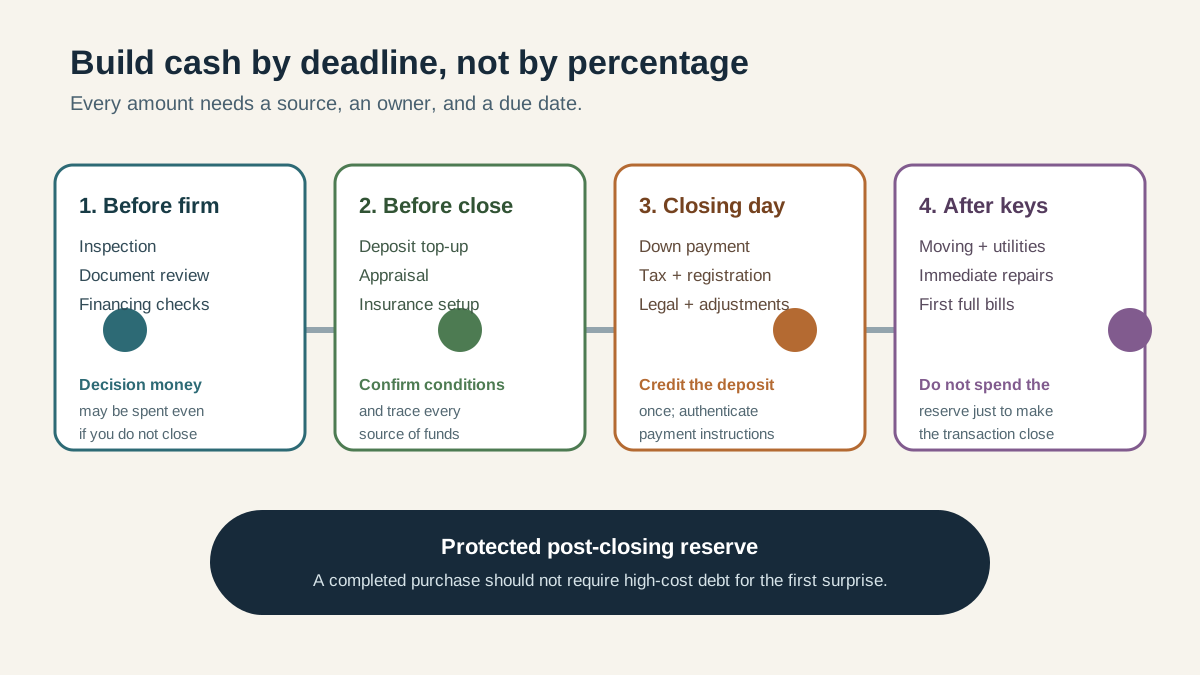
!Closing-cost cash calendar from offer preparation through the first month of ownership
Short answer: use a cash calendar, not a percentage
Build the budget in four time buckets:
- Before the offer becomes firm: inspection, document review, financing work, and any specialist advice.
- After acceptance but before closing: deposit top-ups, appraisal, legal retainer, insurance arrangements, and lender conditions.
- On closing: remaining down payment, transfer tax or registration charges, legal account, adjustments, and any cash-only mortgage-insurance tax.
- After possession: moving, immediate repairs, utility setup, condo fee changes, and the reserve you refused to spend on the transaction.
The final number is not simply “purchase price plus two per cent.” Use this equation:
Cash needed by closing = remaining down payment + closing charges + net adjustments + debt to clear + safety buffer − deposit already credited
That last subtraction prevents a common double count. A deposit normally forms part of the purchase price and down payment. It is not automatically an extra cost. It is still an early liquidity requirement because the money leaves your account soon after an accepted offer.
If the appraisal comes in below the agreed price, the lender may finance against the lower accepted value. That creates a separate cash problem. Run BubbleWatch's appraisal-gap cash test alongside this closing-cost worksheet.
The seven numbers to collect before setting a maximum offer
A serious pre-offer estimate needs seven inputs:
| Input | Where it comes from | What it controls |
|---|---|---|
| Purchase price | Your offer ceiling | Down payment, tax brackets, registration charges |
| Province and municipality | Property address | Transfer tax, rebates, local levies |
| Buyer eligibility | Government program rules | First-time-buyer exemptions or refunds |
| Planned mortgage amount | Lender worksheet | Insurance premium, registration, appraisal conditions |
| Property type and age | Listing, status documents, contract | Condo review, inspection, new-build tax treatment |
| Closing date | Agreement of purchase and sale | Tax, rent, utility, and condo adjustments |
| Written professional quotes | Lawyer/notary, inspector, lender, insurer | Costs that cannot be inferred from price |
Do not use a tax rebate until every buyer on title has been checked against the program's current rules. Marital history, prior ownership, occupancy deadlines, citizenship or residency status, property value, and the ownership shares can matter. Ask the lawyer or notary to confirm eligibility in writing before removing the unreduced tax from the cash plan.
Deposit, down payment, and closing costs are different
These terms are often mixed together.
- Deposit: money delivered under the purchase contract as evidence of the buyer's commitment. It is generally credited toward the purchase price on closing.
- Down payment: the portion of the purchase price not financed by the mortgage, subject to lender and insurance rules.
- Closing costs: taxes, professional charges, adjustments, and other amounts required to complete or support the transfer.
Suppose a buyer agrees to pay $700,000, plans a $140,000 down payment, and has already delivered a $35,000 deposit. Ignoring other adjustments, the remaining down-payment cash is $105,000, not $140,000. The $35,000 has already moved, so the household still had to possess it earlier.
The contract decides when a deposit is due, who holds it, and what happens after a breach or failed condition. Never assume a deposit is safely refundable because financing later fails. The home-buyer readiness sequence explains why financing, appraisal, legal review, and sale-of-property conditions should be settled before an offer becomes firm.
Land transfer tax: calculate the actual jurisdiction
Transfer tax is frequently the largest non-down-payment item. Use the government formula that applies to the property address and registration date.
Ontario example: a $900,000 resale home
Ontario's official land transfer tax calculation applies graduated rates. For a $900,000 home containing one or two single-family residences, the provincial calculation is:
| Ontario bracket | Tax |
|---|---|
| First $55,000 × 0.5% | $275 |
| Next $195,000 × 1.0% | $1,950 |
| Next $150,000 × 1.5% | $2,250 |
| Remaining $500,000 × 2.0% | $10,000 |
| Ontario total before any refund | $14,475 |
Ontario's first-time homebuyer refund can provide up to $4,000 for eligible transfers. Treat that as conditional until the lawyer has checked the purchaser, spouse, property, timing, and occupancy requirements.
Toronto example: two transfer-tax layers
The City of Toronto applies municipal land transfer tax in addition to Ontario tax. For a $900,000 one- or two-family residential property, the city's brackets through $2 million mirror the 0.5%, 1.0%, 1.5%, and 2.0% bands shown above. The municipal tax is therefore another $14,475 before any eligible rebate.
| Layer | Amount before rebates |
|---|---|
| Ontario land transfer tax | $14,475 |
| Toronto municipal land transfer tax | $14,475 |
| Combined transfer tax | $28,950 |
Toronto revised the high-value residential rates above $3 million effective April 1, 2026. It also lists a separate administration fee and a municipal non-resident speculation tax for certain foreign buyers. Confirm the live rate, transaction fee, buyer status, and rebate through the city's MLTT rates and fees page.
The worked total is for a straightforward $900,000 example, not a quote. It excludes rebates, non-resident taxes, unusual consideration, and professional fees.
British Columbia example: a $900,000 Vancouver resale
British Columbia's property transfer tax applies 1% to the first $200,000 and 2% from $200,000 through $2 million. For a $900,000 taxable value:
| British Columbia bracket | Tax |
|---|---|
| First $200,000 × 1.0% | $2,000 |
| Remaining $700,000 × 2.0% | $14,000 |
| BC total before exemptions | $16,000 |
Higher brackets apply above $2 million, with a further residential rate above $3 million. First-time-buyer and newly built home programs have qualification rules and value thresholds that can change. Use the government's current page and have the notary or lawyer confirm the registration treatment.
Alberta example: value and mortgage registrations
Alberta does not use the Ontario or BC percentage-bracket model. The province's land-title registration guidance states a transfer levy and a separate mortgage-registration levy based on value.
Using the published $50 plus $5 for each $5,000 of value structure, a $600,000 transfer produces a $650 levy. A $480,000 registered mortgage produces another $530. The combined planning amount is $1,180 before legal work, searches, title insurance, or other registrations.
| Alberta registration | Calculation | Amount |
|---|---|---|
| Transfer | $50 + 120 × $5 | $650 |
| $480,000 mortgage | $50 + 96 × $5 | $530 |
| Planning total | $1,180 |
Ask the lawyer for a current quote. The official schedule, rounding rule, number of instruments, and transaction facts control the amount at registration.
For a quick second check, use CalculatorVillage's Canadian land transfer tax calculator. The government page and closing professional remain the source of record.
Legal work, title searches, and title insurance
Legal accounts do not scale neatly as a fixed percentage of the home price. A quote may combine professional fees, tax, title search costs, registration disbursements, title insurance, courier or software charges, mortgage work, and trust administration. A refinance, bridge loan, private mortgage, non-resident purchase, corporate buyer, or rushed closing may require more work.
Request an itemized written estimate that answers:
- Is the quote for both the purchase and the mortgage registration?
- Are government registration charges included or shown separately?
- Is title insurance included, and what policy type is assumed?
- Which searches are included?
- Is sales tax included?
- Are condo, well, septic, zoning, tax-certificate, or execution searches extra?
- What changes if the lender is private or the mortgage uses a collateral charge?
- What is charged if closing is delayed or the deal fails?
Title insurance can cover specified title and fraud risks subject to the policy's terms, exclusions, dollar limits, and date. It does not replace a home inspection, guarantee future market value, repair known defects, or erase a problem disclosed before the policy begins. Ask what the policy excludes and whether both owner and lender policies are involved.
Adjustments: the closing statement's moving parts
An adjustment reimburses one party for an amount paid or earned across the closing date. It is not necessarily a fee. Its direction depends on who paid, the covered period, and which party owns or occupies the property during that period.
Common examples include:
- property taxes paid ahead or left owing;
- condo fees or common expenses;
- prepaid fuel in a tank;
The lawyer's property-tax adjustment allocates a billed period between parties; it is not a second annual tax. Reconcile the assessment, full local levies, payment status, supplementary notices, and day count with the Canadian property-tax bill method.
- rents, deposits, or prepaid rent on a tenanted property;
- utilities or local improvement charges where the contract provides for them;
- interest or occupancy charges on certain new-build closings.
Imagine the seller prepaid a $4,800 annual property-tax bill and the buyer is responsible for the final 90 days of that covered year. A simplified debit to the buyer would be about $1,183.56: $4,800 ÷ 365 × 90. If the tax bill was unpaid instead, the statement may move in the other direction. The lawyer uses the actual tax account, contract, dates, and local convention.
Do not add a generic “tax adjustment” and assume it is conservative. Obtain the prior bill, current payment status, and lawyer's draft statement. A large credit can also signal unpaid amounts that need explanation.
Mortgage default insurance: premium versus cash tax
Mortgage loan insurance generally applies when the down payment is below 20%, subject to federal rules and insurer underwriting. The premium is often added to the mortgage principal, so it raises the loan and lifetime interest rather than the immediate down-payment cheque.
Cash planning can still fail at the provincial sales-tax line. CMHC's current premium information says Ontario, Quebec, and Saskatchewan apply provincial sales tax to the insurance premium, and that sales tax cannot be added to the mortgage amount.
Ask the lender for four separate numbers:
- base mortgage before the insurance premium;
- insurance premium and rate;
- final mortgage after any financed premium;
- sales tax or other amount due in cash.
Do not calculate tax from an online premium guess if the lender has not finalized the loan-to-value ratio, amortization, property type, and insurer decision.
Inspection, appraisal, and document review
These costs can occur before the buyer knows the deal will close. They should not be hidden inside the final legal account.
Home inspection
Inspection scope depends on property and region. A general inspection may not include septic, well water, sewer lateral, fireplace, oil tank, mould, asbestos, engineering, electrical certification, or destructive testing. Ask the inspector for the written scope, limitations, insurance, and sample report.
Lender appraisal
The lender may order an automated valuation, desktop review, or physical appraisal. The buyer may pay even if financing is later declined. Ask whether a lender incentive covers it and whether the appraisal can be transferred if the mortgage changes.
Condominium review
Condo buyers need document-specific analysis, not a smaller house inspection. In Ontario, use the status certificate review framework to connect reserve funding, insurance, litigation, common expenses, and unit obligations. Other provinces use different disclosure packages and statutes.
Paying for independent review is a decision cost. It may protect the buyer from turning an uncertain building obligation into an unconditional personal obligation.
New-build closing costs need their own worksheet
A resale-cost estimate is unsafe for a pre-construction or newly built home. The agreement may address GST or HST, rebate assignment, development charges, education levies, utility connections, meter installation, grading, tree planting, Tarion or warranty enrolment, occupancy fees, and vendor legal administration.
The advertised price may be tax-inclusive only if the buyer qualifies for and assigns a rebate. If the buyer intends to rent, changes occupancy plans, sells by assignment, closes through a corporation, or fails a rebate condition, the cash treatment can change.
Create a contract schedule with these columns:
| Contract item | Capped? | Who calculates it? | Due date | Cash estimate |
|---|---|---|---|---|
| GST/HST and rebate treatment | Vendor lawyer | Closing | ||
| Development or education levy | Vendor statement | Closing | ||
| Utility and meter connection | Vendor statement | Closing | ||
| Warranty enrolment | Contract/tariff | Closing | ||
| Interim occupancy charges | Vendor | Monthly before title | ||
| Assignment or change fee | Contract | If triggered |
Have a lawyer who handles new construction review the agreement before the rescission or cooling-off period expires where one applies. Sales-centre summaries are not substitutes for the contract.
A complete cash-to-close worksheet
Use three columns: amount known, amount estimated, and evidence still required.
| Cash item | Amount | Evidence |
|---|---|---|
| Purchase price | Signed agreement | |
| Total down payment | Lender commitment | |
| Less deposit already paid | Trust receipt | |
| Remaining down payment | Calculation | |
| Provincial transfer tax | Government calculation | |
| Municipal transfer tax or levy | Municipal calculation | |
| Registration charges | Lawyer/notary quote | |
| Legal fee, tax, and disbursements | Itemized quote | |
| Title insurance | Policy quote | |
| Mortgage-insurance sales tax | Lender worksheet | |
| Inspection and specialist reports | Accepted quotes/invoices | |
| Appraisal | Lender instruction | |
| Property-tax adjustment | Draft statement | |
| Condo/rent/fuel adjustment | Draft statement | |
| New-build contract adjustments | Contract and vendor statement | |
| Moving and utility setup | Household quotes | |
| Immediate repair reserve | Inspection and owner plan | |
| Total required by possession |
Keep a separate emergency reserve below the table. If every liquid dollar is assigned to closing, a delayed reimbursement, failed appliance, insurance deductible, or first tax bill turns a completed purchase into a high-cost borrowing event.
Verify which fixtures, chattels, and rental contracts change the post-closing budget and whether vacant possession needs temporary storage or accommodation. A negotiated closing holdback is restricted money under legal instructions, not part of the buyer's ordinary repair reserve.
The 10-day final-funds test
Ten business days before closing, ask the lawyer and lender to reconcile the same transaction.
- Has the lender issued final instructions to the lawyer?
- Are all financing conditions satisfied, not merely “approved in principle”?
- Does the lender's mortgage amount match the lawyer's statement?
- Has the deposit been credited once?
- Are transfer-tax refunds shown only where eligibility is confirmed?
- Is mortgage-insurance sales tax funded in cash where applicable?
- Are property-tax, condo, rent, and fuel adjustments based on current documents?
- Is the bank draft or wire amount, payee, deadline, and anti-fraud procedure confirmed directly?
- Is identification current and acceptable?
- Does the buyer still hold an untouched post-closing reserve?
Verify payment instructions using a trusted phone number. Do not rely on last-minute emailed banking changes. Real-estate transactions are attractive fraud targets because the amounts are large and the timing is urgent.
Stress-test the transaction, not only the mortgage payment
Run three cases:
| Case | Transfer tax | Adjustments | Repair reserve | Financing |
|---|---|---|---|---|
| Expected | Confirmed current calculation | Draft statement | Known near-term work | Final commitment |
| Tight | Rebate delayed or disputed | One larger debit | One deductible or appliance | Appraisal slightly low |
| Failure | Rebate ineligible | Material contract adjustment | Urgent building or house issue | Financing condition not met |
The failure case is not a forecast. It identifies which obligations can exceed available cash and which contract conditions prevent that outcome. If an offer depends on a rebate, gift, sale proceeds, bridge loan, or perfect appraisal, record the confirmation deadline and responsible professional.
Buyers comparing ownership with renting should place every one-time acquisition cost in the buy case. BubbleWatch's Toronto rent-versus-buy model shows why transaction costs and the expected holding period can change the break-even result.
Frequent errors and their correction
| Error | Why it fails | Better action |
|---|---|---|
| Using 1.5% or 4% for every purchase | Jurisdictions and contracts differ | Calculate each line from its source |
| Adding the deposit on top of down payment | Counts the same purchase money twice | Credit the paid deposit, but track its earlier date |
| Assuming a first-time rebate | Eligibility can fail for one buyer or spouse | Obtain lawyer confirmation |
| Ignoring municipal tax | Toronto has a separate MLTT | Check both provincial and local layers |
| Treating financed insurance as free | Premium increases principal and interest | Show premium, mortgage, and cash tax separately |
| Budgeting legal work as one opaque number | Disbursements and registrations vary | Request an itemized quote |
| Treating all adjustments as buyer debits | Direction depends on payment and dates | Review the draft statement |
| Using resale assumptions for a new build | Contract charges and tax treatment differ | Build a clause-by-clause schedule |
| Spending the repair reserve at closing | First-month surprises then require debt | Keep the reserve outside final funds |
Questions to send your lender and lawyer
Lender
- What purchase price and appraised value are you using?
- What is the final mortgage amount before and after insurance premium?
- Which costs must be paid from the buyer's own funds?
- Is provincial tax on the insurance premium due in cash?
- Are appraisal and lender legal charges included?
- What proof of down payment, deposit, gift, and closing-cost funds is still required?
- When will final instructions reach the lawyer?
Lawyer or notary
- Which transfer taxes, rebates, and registration charges apply?
- What buyer facts could invalidate a rebate or exemption?
- What is included in the legal estimate?
- Which adjustments are still unknown?
- Does the contract contain new-build, assignment, tenancy, or non-resident issues?
- When will the statement of adjustments and final-funds amount be available?
- How will payment instructions be authenticated?
Frequently asked questions
How much are closing costs in Canada?
There is no single accurate national percentage. Calculate transfer tax or registration for the property's jurisdiction, then add professional quotes, adjustments, financing-related cash items, due-diligence costs, moving, and a separate reserve.
Is the deposit included in closing costs?
The deposit is usually credited toward the purchase price and down payment, so it should not be counted twice. It remains an important early cash requirement under the contract.
Can closing costs be added to the mortgage?
Most closing costs must be available as cash or verified funds. A mortgage-insurance premium is often added to the loan, but CMHC says applicable provincial sales tax on that premium cannot be added. Ask the lender which exact items are financed.
Do first-time buyers pay land transfer tax?
They may qualify for a refund or exemption, depending on the province, municipality, buyer history, spouse, property, value, occupancy, and timing. A first purchase does not by itself prove eligibility.
Why are Toronto closing costs higher?
Toronto applies municipal land transfer tax in addition to Ontario land transfer tax. A $900,000 example produces $14,475 at each layer before rebates, or $28,950 combined.
Are property-tax adjustments an extra tax?
No. An adjustment allocates an existing bill between buyer and seller according to payment status, covered period, contract, and closing date. It may debit or credit the buyer.
What changes for a condo?
Legal and document review must account for common expenses, arrears, special assessments, insurance, status or disclosure documents, parking and locker title, and move rules. The required package depends on the province.
What changes for a newly built home?
GST/HST and rebate treatment, interim occupancy, development levies, connections, warranty enrolment, and vendor adjustments may apply. Use the signed agreement and an experienced lawyer, not a resale percentage.
Method and source note
This worksheet was updated July 19, 2026. The worked examples use the published Ontario, Toronto, British Columbia, and Alberta rules cited in their sections. They intentionally exclude eligibility-dependent rebates and transaction-specific professional charges.
The federal Financial Consumer Agency of Canada homebuying guide identifies common one-time costs such as legal fees, land registration, inspection, appraisal, and adjustments. CMHC's true-cost overview is a useful second checklist. Government formulas and fee schedules can change, so verify them for the actual address and registration date.
What to read next
- Start with the home-buyer readiness hub to sequence financing, deposit, due diligence, and conditions.
- Run the appraisal-gap risk test before setting a firm-offer ceiling.
- For an Ontario condo, use the status certificate cash-risk review.
- If the purchase requires ending an existing loan, estimate the full mortgage break cost.
Advertisement

About David R. Chen, CFA
David R. Chen is a Chartered Financial Analyst and the Senior Housing Economist at BubbleWatch.ca. He brings 12+ years of experience in quantitative real estate analysis and mortgage underwriting. Formerly an analyst at a major Canadian bank, he specializes in modeling payment shock, regional affordability divergence, and private lending risk.
View David's professional bio & credentials →