Condo Fees in Canada 2026: What Your Monthly Fee Pays For
A buyer worksheet that normalizes condo fees by what the corporation owns and pays, how the unit's share is allocated, how much funds operations versus reserves, and which costs remain outside the monthly amount.
Condo Fees in Canada: Compare the Budget, Inclusions, Reserve Contribution, and Unit Share
Condo fees are an owner's allocated share of the corporation's common expenses. They can fund current operations, insurance, utilities, contracted services, management, maintenance, and contributions toward future major repair and replacement. A high monthly number is not automatically wasteful, and a low one is not automatically efficient.
Compare the corporation's annual budget and obligations, then trace the subject unit's allocation. Normalize utilities and services included, examine the reserve plan and fee history, and add owner costs that remain outside the fee.
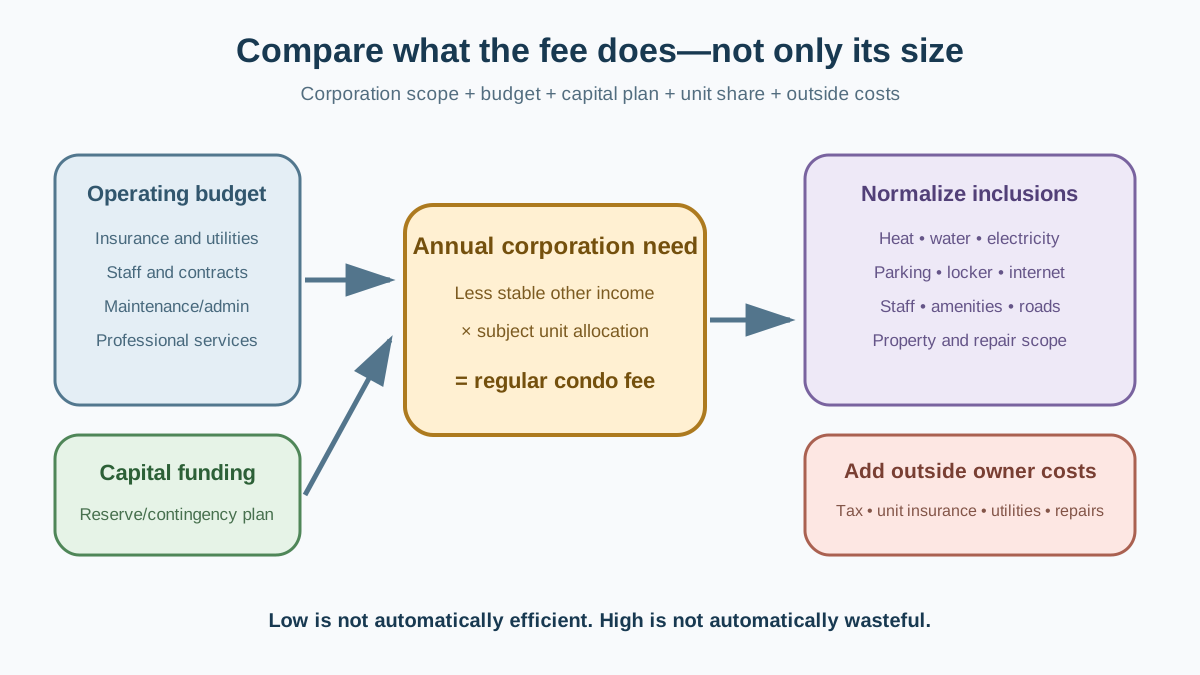
Short answer: compare six layers, not dollars per square foot
- Corporation scope: property, common elements, assets, services, and repair duties.
- Annual operating budget: insurance, utilities, labour, contracts, maintenance, management, professional work, and administration.
- Capital contribution: reserve, contingency, or replacement funding under the local regime.
- Unit allocation: percentage, unit factor, or other lawful formula in the governing documents.
- Inclusions: heat, water, electricity, parking, locker, cable, internet, amenities, or other services.
- Outside costs: unit insurance, utilities, repairs, user fees, chargebacks, special assessments, property tax, and financing.
The Condominium Authority of Ontario's current common-expense guide explains that fees maintain common elements, pay services, and contribute to the reserve fund. It also says the declaration sets the unit's contribution proportion in Ontario.
Why the fee-per-square-foot shortcut fails
A per-square-foot number can help compare similar units in similar buildings only after normalizing scope. It usually misses:
- utilities included in one corporation but metered separately in another;
- parking and locker allocation;
- high-rise elevators, pumps, fire systems, garage, façade, and staffing;
- townhouse roads, roofs, landscaping, snow, water, or private infrastructure;
- reserve contribution versus operating spend;
- concierge, security, pool, gym, guest suite, or shared facility;
- unit size and allocation formula differences;
- corporation-owned land, equipment, and commercial space;
- municipal services that the corporation must buy privately;
- insurance deductibles and coverage changes;
- temporary subsidy, operating deficit, or deferred capital work.
A $700 fee including heat, water, parking, staffed security, and a strong capital contribution may cost the household less than a $500 fee with separate heat, water, no parking, and underfunded reserves. Compare full household cash and corporation condition.
Rebuild the annual corporation budget
Transcribe budget lines into functional groups:
| Budget group | Typical lines | Buyer question |
|---|---|---|
| Insurance | Property, liability, directors, boiler, deductible policy | Coverage and renewal pressure? |
| Utilities | Water, gas, electricity, waste, communications | Master-metered or owner-paid? |
| Labour/services | Superintendent, concierge, security, cleaning, landscape, snow | Contract, staffing, service level? |
| Routine maintenance | Mechanical service, repairs, inspections, supplies | Recurring or deferred? |
| Management/admin | Manager, office, bank, software, records | Scope and contract? |
| Professional | Audit, legal, engineering, reserve/depreciation report | Normal cycle or dispute? |
| Taxes/fees | Corporation tax, licences, authority fees | Recurring and current? |
| Reserve contribution | Transfer to long-term capital fund | Matches current funding plan? |
| Contingency | Operating uncertainty | Amount and use? |
Tie the budget total to expected fee revenue and other income. Ask how commercial leases, parking rentals, laundry, guest suites, telecom agreements, interest, or other income reduce owner contributions - and whether that income is stable.
Separate operating cost from capital saving
Operating funds generally pay expenses that recur at least annually. Reserve or contingency funds generally support less frequent major repair and replacement under local law and governing documents.
British Columbia's current Strata Property Act finance provisions require an operating fund for expenses that usually occur annually or more often and a contingency reserve fund for expenses that usually occur less often. Ontario uses its own statutory reserve-fund regime.
When fees rise because the reserve plan requires higher contributions, owners are funding future common assets rather than consuming a current service. That can still strain cash flow, but it is economically different from a utility overrun or litigation expense.
Ask for a bridge:
Prior monthly fee + operating change + reserve-contribution change + allocation change = new monthly fee
If management cannot explain the change, inspect board minutes, budget notes, contracts, reserve study, insurance renewal, and audited statements.
Trace the subject unit's share
The corporation budget is allocated under provincial law and governing documents. Depending on the regime, the unit may have a percentage, unit factor, entitlement, or separate schedule for certain expenses.
Verify:
- subject unit identifier;
- ordinary common-expense percentage or unit entitlement;
- parking and locker units and their allocations;
- shared-facility or section expense allocation;
- residential/commercial cost split;
- limited-common-element responsibility;
- user fees outside ordinary contribution;
- valid change or reallocation documents;
- current monthly amount calculated from the approved budget.
For a simple Ontario-style illustration, assume a $3,600,000 annual budget and a unit contribution percentage of 0.42%:
$3,600,000 × 0.42% ÷ 12 = $1,260 per month
That is only an illustration. Use the declaration and current budget for the actual unit. Do not divide total budget equally by unit count unless the governing formula does so.
Build an inclusion schedule
CMHC's condo-fee FAQ lists possible services such as snow, garbage, landscape, cleaning, mechanical maintenance, amenities, utilities, cable, internet, corporation insurance, security, staff, management, and reserve contributions. It tells buyers to verify the disclosure, certificate, and budget.
Create a side-by-side comparison:
| Cost | Condo A fee | Condo B fee | Owner separately | Evidence |
|---|---|---|---|---|
| Heat | Budget/bill | |||
| Cooling | ||||
| Water/sewer | ||||
| Unit electricity | ||||
| Parking | ||||
| Locker | ||||
| Internet/cable | ||||
| Corporation insurance | Policy/budget | |||
| Unit insurance | No | No | Yes | Owner quote |
| Reserve contribution | Budget/study | |||
| Property tax | Usually no | Usually no | Yes | Tax bill |
If utilities are master-metered, ask whether cost is allocated by the ordinary formula, submeter, occupancy, or another method. A utility included today may be separately metered after a capital project.
Corporation insurance is not unit-owner insurance
The corporation policy covers interests defined by legislation, declaration, bylaws, standard-unit definition, and policy. The owner usually needs personal coverage for contents, improvements, liability, temporary living expense, deductible exposure, and other gaps.
Read:
- current certificate and policy summary;
- property limits and settlement basis;
- water, sewer, flood, earthquake, and other peril terms;
- deductibles by peril;
- loss history and open claims;
- renewal date and premium trend;
- standard-unit or original specification;
- deductible chargeback rules;
- unit-owner insurance requirements.
The home-insurance-before-closing guide shows how to compare corporation and owner layers. Do not describe the corporation premium inside the fee as “my home insurance is included.”
A low fee can be a timing signal
Low fees can result from a simple property, efficient contracts, few services, strong other income, or an appropriate allocation. They can also result from:
- developer's first-year assumptions;
- temporary subsidy or guarantee;
- omitted or understated contracts;
- low initial reserve contribution;
- deferred maintenance;
- operating deficit carried forward;
- unpaid bills or owner arrears;
- reserve spending on work normally budgeted elsewhere, if permitted;
- one-time credit or surplus;
- services about to renew;
- planned fee increase not yet effective.
Ask what the fee would be without temporary income or subsidy. Compare the first full operating year with the latest actual results.
CMHC's condo-basics guide says fees may need adjustment as goods, services, and reserve needs change. A static fee is not evidence of stability if costs are rising elsewhere.
A high fee can still be rational
High fees may reflect:
- large unit entitlement or parking allocation;
- heat, water, electricity, cable, or internet;
- staffed building and security;
- pool, elevator, garage, central plant, recreation, or grounds;
- older systems requiring routine care;
- strong capital contribution after an updated study;
- private roads, water, sewer, or waste;
- insurance exposure and premium;
- small number of units sharing fixed systems;
- commercial or shared-facility agreements.
The decision is whether the household values and can afford the service and capital plan, not whether the number sounds socially acceptable.
Compare like property systems
Start with the corporation's physical form. Fixed costs and failure consequences differ:
| Form | Common fee drivers | Costs often outside or variable |
|---|---|---|
| High-rise tower | Elevators, central plant, pumps, fire/life safety, façade, garage, staff | Unit electricity, parking, owner improvements |
| Mid-rise | Envelope, elevator, roof, garage, common heating/ventilation | Unit utilities and appliances |
| Low-rise walk-up | Roof, envelope, stairs, landscape, common utilities | Unit heat/electricity depending on metering |
| Condo townhouse | Roof/siding/windows by documents, roads, snow, landscape, private services | Unit mechanical systems, yards, driveways by boundary |
| Bare-land strata/condo | Roads, water, sewer/septic, lighting, gates, shared land | House structure and services by documents |
| Mixed-use | Shared plant, garage, security, loading, commercial interface | Allocation disputes and separate utility/service agreements |
Do not infer responsibility from appearance. A townhouse corporation may maintain roofs but not windows; another may maintain only a private road. A bare-land corporation may own costly wastewater infrastructure even though every owner maintains a detached house.
Normalize amenity quality as well as count. A pool that is closed for major repair still creates capital and insurance obligations. A simple party room may create little operating cost. Inspect current operation, accessibility, hours, booking fees, and planned work.
Small corporations concentrate fixed costs across fewer owners. They may be self-managed and have no elevator, yet one roof, road, well, retaining wall, or legal bill can create a large per-unit share. Large towers spread some costs but own more complex equipment.
Build the comparable group by form, age, responsibility, service, and location before using fee per square foot. Then explain every remaining difference from documents.
Check arrears and collection strength
The approved budget assumes owners pay. Material arrears can create a cash shortage even if the expense plan is reasonable.
Review available statements and certificate information for:
- total common-expense receivables;
- age of arrears;
- number and concentration of delinquent units;
- liens or collection action;
- payment plans and doubtful accounts;
- legal costs and interest recovery;
- developer or commercial-owner balances;
- bank balance and ability to pay current invoices;
- bad-debt allowance and write-offs.
One recent late payment is different from a large disputed commercial allocation. The corporation's legal remedies and timelines differ by province, so ask the lawyer and accountant about collectibility rather than simply dividing arrears by units.
Also check owner dependence. If one commercial unit or developer controls a large share of fees, its non-payment can affect cash disproportionately. If a corporation relies on short-term rental fines or uncertain litigation recovery, remove that income from the conservative case.
An operating line of credit can smooth timing, but it is debt, not revenue. Record limit, balance, interest, security, covenant, purpose, and repayment plan. A recurring year-end line balance may indicate that fees do not match operations.
Fee history needs a cause map
Collect at least several years where available:
| Fiscal year | Monthly fee | Change % | Operating driver | Reserve driver | One-time factor |
|---|---|---|---|---|---|
| Year -3 | |||||
| Year -2 | |||||
| Year -1 | |||||
| Current | |||||
| Proposed |
Read minutes around every material change. An insurance renewal, wage contract, energy price, reserve study, project, court case, utility leak, arrears issue, or management transition may explain it.
Do not project one unusual increase forever. Do not assume zero increases forever either. Build a current case and a stress case tied to known budget or reserve drivers.
Read budget-to-actual results
A budget is a plan. Audited financial statements show what happened.
For each major group, calculate:
Actual expense minus budget = variance
Then ask:
- Is the variance recurring or one-time?
- Did the corporation underbudget utilities, insurance, repairs, legal, or labour?
- Did it delay work rather than save money?
- How was an operating deficit funded?
- Are receivables collectible?
- Are payables current?
- Were expenses moved between operating and reserve accounts appropriately?
- Did a surplus come from uncompleted service?
Repeated negative variance followed by no fee adjustment can precede a larger correction. One storm repair does not prove chronic mismanagement.
Reserve contribution must be read against the project plan
A reserve balance alone is meaningless without the timing and cost of obligations. A corporation can have $4 million saved and a $12 million garage project approaching, or $500,000 saved with only modest near-term work.
Use the condo reserve-fund study guide to compare component inventory, condition date, cost basis, project timing, opening balance, contribution schedule, interest/inflation assumptions, actual projects, and updated plans.
If the current fee excludes the required future contribution increase, add it to the ownership case. Do not label the study's closing balance as “unused surplus”; it may be assigned to later projects.
Special assessments, chargebacks, and user fees are different
- Regular common expense: recurring allocated contribution under budget.
- Special assessment or levy: additional owner contribution for a specified shortfall or project under local law and governing documents.
- Chargeback: corporation cost added to a unit account in circumstances permitted by law or declaration, often linked to an owner act or responsibility.
- User fee: charge for an optional or measured service where permitted.
CAO's Ontario guidance notes that large shortfalls can lead to a special assessment and that certain corporation costs may be charged back to a unit. Provincial rules differ.
The special-assessment buyer workflow checks authorization, allocation, due dates, seller/buyer contract treatment, lender effect, and payment scenarios.
New-construction fees need a stabilized case
Developer disclosure budgets may use estimates before a building has full occupancy and operating history. Review:
- budget assumptions and guarantee rights;
- first-year contracts and related parties;
- utilities during partial occupancy;
- warranty versus operating repair;
- staffing and amenity opening dates;
- reserve/contingency contribution ramp;
- shared-facility completion and allocation;
- property tax and separately metered utilities;
- occupancy fees before registration;
- expected first independent audit and reserve/depreciation study.
Do not compare the sales-centre estimate directly with a mature resale building's current fee. Stress the new figure for full service, current contract pricing, proper capital funding, and no developer subsidy.
Unit-owner affordability worksheet
Add all monthly and irregular costs:
| Owner cash line | Current | Stress |
|---|---|---|
| Mortgage | ||
| Condo fee | ||
| Property tax | ||
| Unit insurance | ||
| Separate utilities | ||
| Parking/locker/user fees | ||
| Unit repairs and appliances | ||
| Deductible/special-assessment reserve | ||
| Other debt |
For the stress case, use documented upcoming budget and reserve changes plus a labeled household assumption for other cost pressure. Do not invent a special assessment as certain; maintain liquid capacity for plausible corporation and unit risks.
Lenders may include a portion of condo fees in qualification under their rules. Qualification does not prove the household can absorb an assessment, deductible, or rapid fee correction.
Convert every comparison to annual household cash
For each candidate, calculate:
Annual condo fee + owner-paid utilities + unit insurance + property tax + recurring user fees + unit maintenance = normalized annual ownership cost before mortgage
Then show the reserve contribution inside the fee as a memo line rather than subtracting it. It is still required cash, but it supports future common assets.
Use current bills for metered utilities, an insurer quote for the subject unit, the municipal tax bill, and the actual parking or locker schedule. If an inclusion cannot be priced separately, state that limitation.
Compare a current case and the approved next-budget case. Add a stress case only from documented drivers or a clearly labeled household assumption. This avoids declaring one building “cheaper” because its heat sits outside the fee or its reserve increase begins two months after closing.
Documents to request before buying
The document name varies by province. Request the legally available resale package plus:
- declaration/strata plan, bylaws, rules, and amendments;
- current and prior budgets;
- audited financial statements;
- reserve fund study or depreciation report and funding plan;
- current reserve/contingency balance;
- minutes and owner notices;
- insurance certificate and deductibles;
- contracts and shared-facility agreements where material;
- arrears, litigation, claims, work orders, and special assessments;
- fee schedule, allocation, parking/locker details;
- utility and amenity inclusions;
- planned projects, financing, and owner votes.
For Ontario, use the status-certificate review process. Buyers elsewhere should have a lawyer familiar with their provincial condominium or strata regime review the correct package.
Common fee-comparison mistakes
- comparing monthly totals without inclusions;
- using price per square foot across different property types;
- treating reserve contribution as wasted spending;
- assuming corporation insurance replaces unit insurance;
- ignoring parking and locker allocations;
- missing private roads or utilities inside townhome fees;
- relying on a seller's current amount without the approved next budget;
- treating a first-year developer budget as stabilized;
- ignoring operating deficits and budget variances;
- reading reserve balance without project schedule;
- assuming low fees prevent assessments;
- forgetting owner-paid utilities and unit maintenance.
Frequently asked questions
What do condo fees cover in Canada?
They cover the owner's allocated share of corporation common expenses and often a reserve or contingency contribution. Exact utilities, services, property, insurance, amenities, and repair duties come from the governing documents and budget.
What is a reasonable condo fee per square foot?
There is no reliable national threshold. Normalize included utilities, services, property type, allocation, reserve contribution, insurance, staffing, amenities, and costs outside the fee before comparing similar buildings.
Do condo fees include property tax?
Usually owners receive a unit property-tax bill, but structures vary. Verify the tax account and budget. Co-operatives and other ownership forms can differ from condominium title.
Do condo fees include home insurance?
They help pay the corporation's policy. The owner generally still needs unit-owner insurance for contents, improvements, liability, living expense, deductibles, and other gaps.
Why do condo fees increase?
Operating costs, insurance, utilities, wages, contracts, maintenance, reserve funding, deficits, services, and allocation can change. Read the budget bridge and reserve plan.
Are lower condo fees better for resale?
Buyers value affordability, but an artificially low fee can signal deferred funding or an approaching correction. Sustainable services, condition, reserves, and transparent governance matter more than the lowest headline.
Can I refuse to pay for an amenity I do not use?
Generally not where it is a common expense allocated to the unit. CMHC cautions that common expenses are not optional. Obtain legal advice rather than withholding payment.
Does a high reserve balance mean fees can fall?
Not necessarily. The balance may be assigned to projects over a long forecast. Compare the balance and contribution plan with timing and cost of obligations.
What to read next
- Read the reserve study as a project-and-cash-flow model
- Calculate special-assessment exposure before buying
- Review an Ontario status certificate as connected evidence
- Compare condo and townhouse responsibility boundaries
Method and sources
This guide was updated July 19, 2026. It uses current Condominium Authority of Ontario common-expense and finance guidance, current British Columbia strata finance law, CMHC's Canadian condo buyer resources, and BubbleWatch's reserve, assessment, insurance, and status-certificate methods. Provincial rules and governing documents control. Obtain current legal, accounting, engineering, insurance, lender, and property-management advice.
Advertisement

About David R. Chen, CFA
David R. Chen is a Chartered Financial Analyst and the Senior Housing Economist at BubbleWatch.ca. He brings 12+ years of experience in quantitative real estate analysis and mortgage underwriting. Formerly an analyst at a major Canadian bank, he specializes in modeling payment shock, regional affordability divergence, and private lending risk.
View David's professional bio & credentials →