Financing Condition on a Home Offer 2026 Tool
A borrower-and-property approval workflow for Canadian buyers deciding when a financing condition is satisfied, needs an extension, or should not be waived.
Financing Condition on a Home Offer: The Approval Test Buyers Miss
A financing condition is contract language that gives a buyer time to obtain acceptable financing for a specific home before the purchase becomes firm, subject to the exact wording and applicable law. It should test both sides of mortgage approval: the borrower's finances and the lender's acceptance of the property.
A preapproval usually tests only part of the borrower file using stated information and assumptions. It does not guarantee the lender will accept the purchase price, appraisal, condo corporation, property condition, location, insurance, down-payment source, or closing schedule. A buyer can be far below a preapproved ceiling and still be declined on the address.
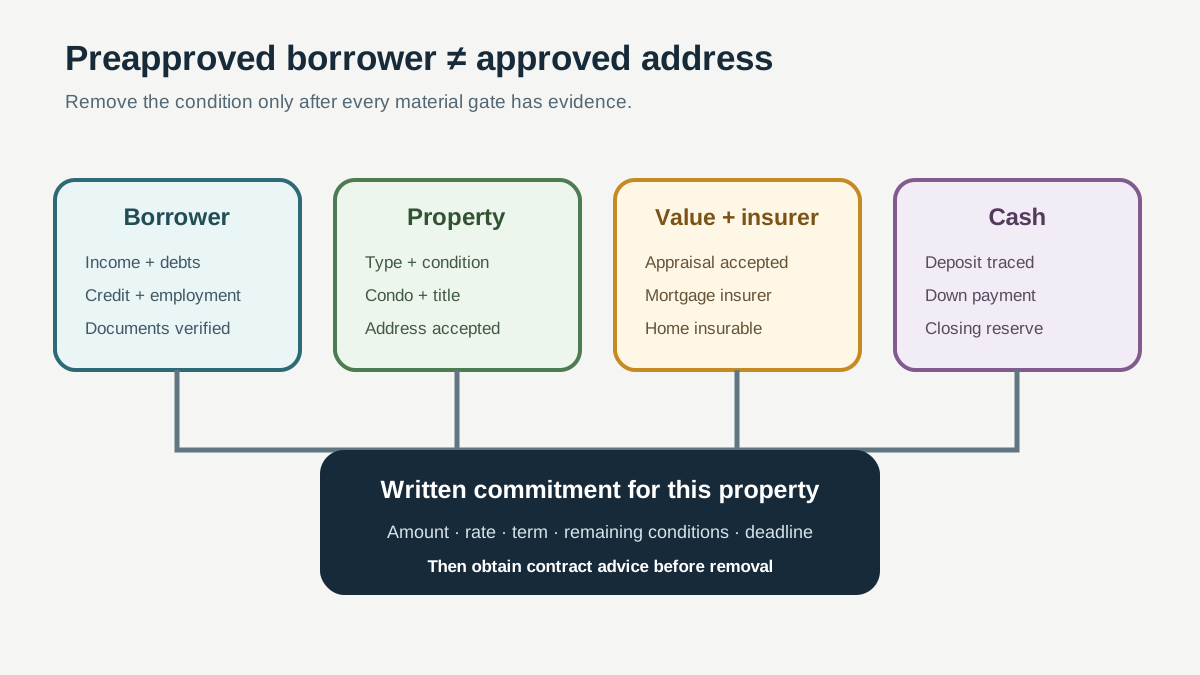
Short answer: waive only after the address is approved
Before waiving or fulfilling the condition, obtain written answers to these questions:
- Has the lender approved the named borrowers using verified income, credit, debts, and down-payment evidence?
- Has the lender accepted the specific property and purchase agreement?
- Is the appraisal complete and acceptable, or has the lender confirmed no further valuation is required?
- Has any mortgage insurer approved the loan and property?
- Are the rate, term, amortization, loan amount, conditions, and closing date acceptable to the buyer?
- Can every remaining lender condition be completed without relying on the financing condition after it is removed?
CMHC's current offer-to-purchase guidance says that even a buyer with a preapproved mortgage certificate must still meet the lender during the conditional period to obtain final mortgage approval. Ontario's regulator, RECO, likewise warns on its competing-offers page that pre-qualification does not safely eliminate the need for a financing condition.
The contract and lawyer decide the buyer's legal rights. The lender decides whether it will advance money. Those are connected but separate documents.
Pre-qualification, preapproval, commitment, and funding
Mortgage language is often used loosely. Ask what work has actually been completed.
| Stage | What may have been checked | What can remain open |
|---|---|---|
| Online estimate | Self-reported income, debts, rate assumption | Credit, documents, property, insurer, appraisal |
| Pre-qualification | Preliminary affordability discussion | Full verification and property approval |
| Preapproval | Credit and some borrower information; rate hold may apply | Address, appraisal, property type, updated borrower facts |
| Conditional commitment | Borrower and property reviewed with listed conditions | Documents, insurer, appraisal, sale, payout, legal items |
| Final instructions | Lender sends the lawyer funding requirements | Lawyer compliance, title, insurance, final funds |
| Advance | Funds delivered under instructions | Closing and registration must still occur |
The label on an email matters less than the conditions attached. A “firm approval” that remains subject to satisfactory appraisal, proof of down payment, employment confirmation, sale of another property, or insurer approval is not complete for those items.
FCAC's mortgage preapproval guide tells buyers that preapproval does not guarantee a final mortgage and that the lender will verify the property and finances before approval. Read the expiry date and rate-hold terms as well.
Why the property can fail after the borrower passes
Lenders finance an acceptable security, not an abstract price. The property must fit lending and insurer rules.
Appraised value below purchase price
If the buyer offers $800,000 but the lender accepts a value of $740,000, financing may be calculated from the lower value. The buyer may need more cash, a smaller loan, a price amendment, or another lender. Use the appraisal-gap worksheet before turning an appraisal issue into an unconditional cash obligation.
Property condition
Major structural damage, active water entry, unsafe wiring, missing kitchen or bathroom, incomplete construction, severe deferred maintenance, or environmental concern can affect insurability and lender acceptance. A purchase price discount does not force a lender to accept unsuitable security.
Condo or strata risk
Lenders and mortgage insurers may review unit, corporation, insurance, reserve, litigation, commercial use, short-term rental exposure, arrears, and marketability. A borrower can qualify for the payment while the building fails the lender's risk rules.
Ontario condo buyers should run the status-certificate cash-risk review during the condition period. Other provinces use their own strata or condo packages.
Unusual property type or location
Leasehold, co-operative, micro-unit, hotel condo, remote, off-grid, seasonal, former grow operation, mixed-use, rural, agricultural, private-road, well-and-septic, or multi-unit properties can require special programs, documents, or larger down payments. For an acreage, assemble the rural title, access, land-use, services, and hazard file before asking the lender to approve the actual type, not a generic detached-home assumption.
Insurance unavailable or restricted
The lender usually requires property insurance before funding. Wildfire, flood, previous claims, vacancy, oil heat, old wiring, business use, renovations, or short-term rental can affect availability and cost. Obtain an insurability indication during the condition period and a binder before closing as instructed.
Why the borrower can fail after preapproval
A preapproval reflects a snapshot. Final underwriting may reveal or receive new facts.
Common changes include:
- reduced hours, probation, job change, leave, layoff, or variable income;
- new car loan, lease, credit balance, line-of-credit draw, or co-signed debt;
- missed payment or lower credit score;
- down-payment money that cannot be documented;
- gift funds without an acceptable letter and transfer trail;
- tax arrears or unfiled returns for a self-employed borrower;
- support obligations or property expenses not previously included;
- another home not sold as assumed;
- closing costs that consume required liquid funds;
- inaccurate income, debt, residency, or occupancy information.
Do not borrow the deposit, buy a vehicle, move large unexplained funds, close an account, change employment, or guarantee another loan without first asking the mortgage professional how it affects approval. Tell the lender about changes; withholding them can turn a late discovery into a failed closing.
For files near the qualification limit, reconcile the underwriter's GDS and TDS inputs. Family money needs the full gift-letter and bank-trail process, while an added co-borrower or guarantor should receive independent advice before the buyer waives conditions.
The financing condition should match the actual risk
Contract clauses vary by province and form. A lawyer should review wording before the offer is signed. At minimum, the clause needs a clear deadline, benefit, process, and standard for satisfaction.
Questions for the drafting professional include:
- Is the condition for the buyer's sole benefit or both parties' benefit?
- Does it require a particular loan amount, term, rate ceiling, amortization, or lender type?
- Does “satisfactory financing” include appraisal, insurer, and property acceptance?
- Must the buyer give notice of fulfillment, waiver, or non-satisfaction?
- What happens automatically at the deadline?
- Does the buyer have a duty to use reasonable efforts or act in good faith?
- Can the seller continue marketing or trigger a shorter decision window?
- Is lender and appraiser access guaranteed?
BCFSA's public clause resource illustrates financing language tied to a satisfactory mortgage commitment by a stated date and notes that more specific loan terms can be inserted. It also warns in its buyer guidance that subjects are not casual escape clauses. Provincial law and the signed language control.
Do not copy a clause from another province, old transaction, or online forum. Small wording differences can change obligations and the standard applied to the buyer's decision.
Set a deadline from the work, not habit
A condition period must allow the critical tasks to finish. Count business days, lender hours, appraisal availability, document delivery, and the buyer's decision time.
Before the offer
- update borrower documents;
- identify the likely lender and backup;
- disclose property type and intended use;
- ask normal underwriting and appraisal turnaround;
- collect deposit and closing-cost evidence;
- line up an insurance quote path;
- have a lawyer available for unusual title or contract issues.
Day 0: accepted offer
Send the complete signed agreement and listing immediately. Include amendments, schedules, property disclosure, taxes, condo documents, leases, and income-property details. A screenshot of the first page is not a mortgage submission.
Days 1–2
Underwriter reviews borrower and property. Appraisal is ordered if required. Buyer supplies missing income, debt, gift, down-payment, and sale documents. Insurer review begins for high-ratio financing.
Days 2–4
Valuation and property questions return. Lender identifies conditions. Buyer compares the actual commitment, not only the rate. Lawyer reviews issues outside the lender's role.
Final decision day
Leave time before the contractual hour to read the approval, resolve inconsistencies, obtain advice, request an extension, or deliver the required notice correctly.
There is no safe universal number of days. A salaried borrower buying a conventional urban resale may move quickly. A rural acreage, self-employed file, condo with litigation, ported mortgage, bridge loan, or private road may need more time.
The six-part approval packet
Before removing the condition, put these documents in one folder:
| Approval part | Evidence | Red flag |
|---|---|---|
| Borrower | Verified income, credit, debts | Material document outstanding |
| Property | Address and type accepted | Generic preapproval only |
| Value | Appraisal accepted or waived by lender | Valuation still ordered/pending |
| Insurance | Mortgage insurer and property insurer status | Approval subject to insurer |
| Cash | Deposit, down payment, closing costs traced | Unverified gift or borrowed money |
| Commitment | Loan amount, rate, term, conditions, expiry | Key condition outside buyer control |
Ask the mortgage professional to distinguish administrative closing items from credit conditions. Providing a void cheque later is different from an approval still subject to satisfactory employment, appraisal, or insurer review.
Keep the cash-to-close worksheet beside the commitment. A lender can approve the mortgage while the buyer still lacks transfer tax, insurance tax, legal funds, or adjustment cash.
A worked firm-offer failure
A buyer is preapproved up to $900,000 and makes an unconditional $850,000 offer on a house. The planned mortgage is $680,000 with a $170,000 down payment.
After acceptance:
- the appraisal supports only $790,000;
- the lender will finance 80% of accepted value, or $632,000, under this illustration;
- the original mortgage request exceeds that by $48,000;
- the buyer has $22,000 of extra liquid cash after closing costs;
- there is a $26,000 unresolved shortfall.
| Item | Original plan | After value review |
|---|---|---|
| Purchase price | $850,000 | $850,000 |
| Accepted property value | $850,000 assumption | $790,000 |
| Mortgage | $680,000 | $632,000 |
| Required price cash | $170,000 | $218,000 |
| Extra liquid cash | $22,000 | |
| Remaining gap | $26,000 |
The preapproval did not promise an $850,000 property value. Without a financing or appraisal condition, the buyer may remain contractually required to close. Failure can put the deposit and further damages at risk, subject to contract and law.
The correct response was to price the appraisal gap before offering, preserve a condition, or hold enough verified cash to accept the risk knowingly.
Competing offers do not change the downside
A seller may prefer fewer conditions because a firm contract offers more certainty. That does not make unconditional financing safe for the buyer.
BCFSA's subject-free offer warning says a buyer may lose the deposit or face a lawsuit if financing fails after a subject-free offer. It specifically notes that a preapproval is not final approval. RECO also tells Ontario buyers to consider the significant risks of removing financing and inspection protection in competition.
Instead of blindly removing the condition, improve the offer's execution:
- complete borrower underwriting before offer day;
- use a short but feasible condition period confirmed by the lender;
- submit documents immediately;
- offer a flexible closing date if it has value to the seller;
- increase price only within the appraisal-gap cash ceiling;
- use a larger deposit only after understanding liquidity and breach exposure;
- arrange a pre-offer inspection where practical;
- ask the lawyer about precise, limited conditions rather than vague language.
Losing a property to a stronger firm offer is disappointing. Winning it without the ability to close can be financially severe.
Extension, waiver, fulfillment, and expiry are not synonyms
The contract specifies how a condition is dealt with. Depending on wording and province:
- Fulfillment may state that the condition has been satisfied.
- Waiver may voluntarily give up the condition's protection.
- Extension changes the deadline only if the required parties agree in writing.
- Non-fulfillment or expiry may end the contract under its terms.
Do not assume silence automatically produces the result you want. Do not deliver a waiver because an agent says the approval “should land tomorrow.” Once protection is removed, a later lender decline may not revive it.
If the lender needs more time, ask why, which item remains open, the earliest realistic decision, and whether the seller will agree to a written extension. The seller may refuse or request another term. Obtain legal advice before the deadline rather than after it.
Backup lenders and alternative financing
A backup plan is useful only if it can fund on time and its all-in terms are acceptable.
Compare:
| Feature | Primary lender | Backup lender |
|---|---|---|
| Approved mortgage amount | ||
| Rate and type | ||
| Term and amortization | ||
| Prepayment terms | ||
| Appraisal and property status | ||
| Mortgage insurance | ||
| Lender/broker/legal fees | ||
| Funding date | ||
| Exit cost if refinanced later |
Private or alternative financing can carry fees, higher rates, shorter terms, interest-only payments, and renewal or exit risk. It should not be treated as a harmless bridge to an approval the buyer hopes will appear later.
If another home must sell first, add the bridge-financing failure test. A firm sale can support a timing bridge; an unsold home creates a different qualification and price risk.
Property-specific financing checks
Resale house
Send taxes, listing, agreement, condition disclosures, leases, rural access, and material inspection findings. Where private services apply, include the well-water testing file and septic inspection, capacity, and replacement review. Ask whether repairs must be completed before funding.
Resale condo or strata
Send the full document package. Ask whether unit size, commercial share, insurance deductibles, litigation, reserve, short-term rental use, or special assessment affects approval.
New construction
Send the full agreement, amendments, incentives, assignments, occupancy dates, taxes, and adjustments. Appraisal at completion can differ from the contract price signed years earlier.
Rental or multi-unit property
Confirm how rent is documented and counted, which expenses are included, whether units are legal, and whether the property fits residential lending rules. Do not use owner-occupied assumptions for an investment file.
Leasehold, co-op, or manufactured home
Confirm tenure, remaining lease, pad agreement, governance, registration, and lender program before offering. Financing options can be narrower.
Questions to ask before removing the condition
Mortgage professional
- Is this approval for the exact property and signed price?
- Has an underwriter reviewed every borrower document?
- Is appraisal complete and accepted?
- Has the mortgage insurer approved, if required?
- Which conditions remain and who controls them?
- What could still cause the lender to reduce, delay, or withdraw funding?
- When will lawyer instructions be sent?
- Does any change in employment, debt, sale, or property require reapproval?
Lawyer
- What does this specific condition require from me?
- What notice must be delivered, by whom, and before what exact time?
- Does the approval satisfy the clause as written?
- What happens to the contract and deposit if financing is not obtained?
- Should we request an extension or amendment?
- What liability can follow if I waive and cannot close?
Insurance broker
- Is the property insurable for the lender-required coverage by closing?
- Which facts, repairs, occupancy, or prior claims affect the quote?
- Can a binder naming the lender be issued on time?
Go, extend, or stop decision table
| Status | Decision signal |
|---|---|
| Go | Borrower, property, value, insurer, cash, and loan terms are accepted in writing; only routine lawyer funding items remain |
| Extend | A defined approval item is pending, the lender gives a credible completion time, and the seller agrees in writing |
| Stop and get advice | Appraisal is low, property is declined, insurer is pending, cash cannot be traced, loan terms changed materially, or lender decision is only verbal |
Do not convert “likely” into “approved.” Record the person, date, document, remaining conditions, and contractual deadline.
Keep the rejection path operational too. Know who will notify the lawyer, how the contract notice must be delivered, where the deposit is held, and which records show the buyer's financing efforts. A condition is useful only when the buyer follows its procedure before the clock expires.
Frequently asked questions
What is a financing condition on a house offer?
It is a negotiated contract term that makes the buyer's obligation subject to obtaining acceptable financing by a stated deadline, according to the clause. A lawyer should explain the wording and notice process.
Do I need one if I am preapproved?
A preapproval does not guarantee financing for a specific property. CMHC, RECO, and BCFSA all warn that final approval can still depend on property, appraisal, insurer, documents, and updated finances.
How long should a financing condition be?
Long enough for underwriting, appraisal, insurer review, insurance, documents, legal questions, and a decision before the contractual hour. Ask the lender about the actual file and count business days. There is no safe universal period.
Can a seller refuse a financing condition?
Yes. Conditions are negotiated offer terms. The buyer then decides whether to improve another term, seek a different property, complete more due diligence before offering, or knowingly accept greater risk after legal advice.
Is mortgage approval enough if the appraisal is pending?
An approval subject to appraisal still carries valuation and property risk. Ask whether the financing condition covers that risk and do not treat the loan amount as final until the lender accepts the value.
What if the lender needs an extension?
The buyer can request a written extension, but the seller may refuse or counter. Do not let the original deadline pass or waive protection based only on expected approval. Obtain legal advice promptly.
Can I cancel for any reason under a financing condition?
Do not assume so. Contract wording and provincial law can require reasonable, good-faith efforts and a decision related to financing. BCFSA explicitly warns that subject clauses are not general escape clauses.
What happens if I cannot close after waiving financing?
The deposit may be at risk, and the seller may claim additional losses such as a lower resale price and carrying costs, subject to contract and law. Seek legal advice immediately.
Does a financing condition include the sale of my current home?
Not automatically. A sale-of-property condition and bridge financing address separate risks. The contract should state the intended dependency clearly.
Method and source note
This guide was updated July 19, 2026. It uses current consumer guidance from CMHC, FCAC, RECO, and BCFSA. Examples explain risk mechanics and do not provide contract wording or legal advice. Provincial law, local forms, court decisions, and the signed agreement govern the condition.
Mortgage policies and turnaround times change. Replace every illustrative amount and step with the actual lender commitment, appraisal, insurer status, lawyer's advice, and contract deadline.
What to read next
- Price the property's appraisal-gap exposure before setting an offer ceiling.
- Confirm the cash required at closing, not only the mortgage amount.
- Put every approval and legal deadline into the home-buyer readiness sequence.
- If sale proceeds arrive later, run the bridge-financing failure case.
Advertisement

About David R. Chen, CFA
David R. Chen is a Chartered Financial Analyst and the Senior Housing Economist at BubbleWatch.ca. He brings 12+ years of experience in quantitative real estate analysis and mortgage underwriting. Formerly an analyst at a major Canadian bank, he specializes in modeling payment shock, regional affordability divergence, and private lending risk.
View David's professional bio & credentials →