Property Tax in Canada 2026: How Your Bill Is Calculated
A bill-reading and purchase-budget method that separates market price from taxable assessment, identifies every levy, tests reassessment risk, and reconciles the lawyer's closing adjustment.
Property Tax in Canada: Calculate the Bill From Assessment, Rate, and Adjustments
Canadian property tax is generally calculated by applying the applicable municipal, provincial or education, and other local levies to a property's taxable assessed value. The purchase price is not automatically the assessed value, and a city's headline rate may omit part of the bill. Assessment dates, rate formats, exemptions, grants, supplementary bills, and local services differ by province and municipality.
For a purchase decision, collect the current tax bill, current assessment notice, property class, official rate table or calculator, and any notice of reassessment or supplementary tax. Recalculate the ordinary bill, then run a higher-tax scenario where the assessment cycle or property change creates uncertainty.
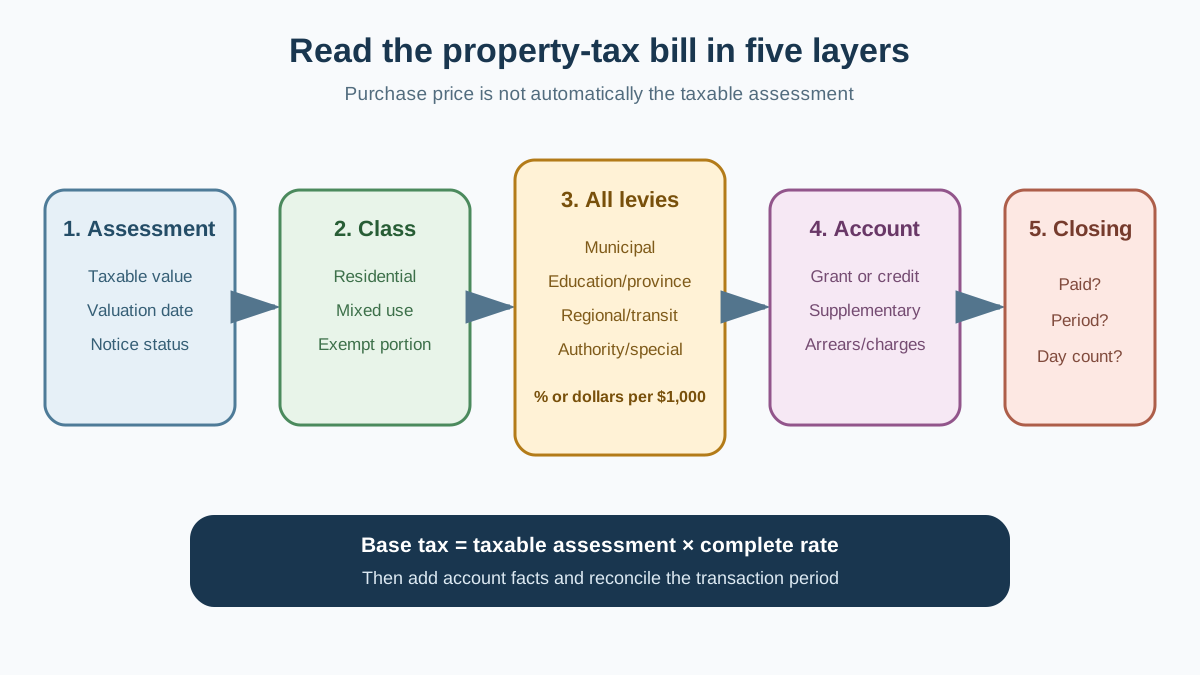
Short answer: use this five-part test
- Confirm the taxable assessed value and the valuation date behind it.
- Confirm the property class and any taxable or exempt portions.
- Add every applicable municipal, education, regional, transit, authority, or special levy in the official format.
- Apply account-specific items such as grants, deferrals, arrears, supplementary taxes, local improvements, rebates, or fees.
- At a sale, reconcile the closing adjustment so buyer and seller bear the amount assigned by the agreement and local practice.
The simplified formula is:
Taxable assessed value × combined percentage rate = base annual tax
If rates are quoted per $1,000:
Taxable assessed value ÷ 1,000 × combined levy per $1,000 = base annual tax
Use the municipality's calculator or bill where available. A precise multiplication using the wrong assessment year or an incomplete rate is still wrong.
Market value, purchase price, assessment, and tax bill are four different numbers
The purchase price is the amount agreed in a transaction. A market estimate is an opinion of current exchange value. An assessment is a value produced under provincial law for taxation, using a specified valuation date and method. The tax bill applies rates, classes, levies, and account items to the assessment.
These numbers may diverge sharply. Ontario's 2026 property-tax assessments continue to use January 1, 2016 current values, according to the Municipal Property Assessment Corporation's assessment-notice guidance. British Columbia assessments generally reflect estimated market value as of July 1 of the previous year, according to BC Assessment.
A Toronto home bought for $1.1 million therefore does not automatically receive a $1.1 million taxable assessment. A Vancouver sale price and the current notice can differ because their effective dates and evidence differ. Never estimate tax solely by multiplying the offer price by a rate without checking the local system.
Who sets what
The roles differ across Canada, but a typical chain looks like this:
| Actor | Typical role | Evidence to collect |
|---|---|---|
| Provincial assessment authority | Determines value, class, exemption status | Assessment notice and property record |
| Municipality | Sets budget and municipal rate; collects bill | Rate bylaw, calculator, tax bill |
| Province | Sets education or provincial requisition/rate | Provincial or municipal breakdown |
| Regional or special authority | Adds transit, regional, finance, improvement, or service levy | Bill line and official rate table |
| Owner | Reviews assessment and pays or arranges lender collection | Account statement and payment record |
| Lawyer/notary at sale | Adjusts prepaid or unpaid tax under the transaction | Statement of adjustments |
In Ontario, MPAC states that it determines assessments, municipalities set municipal rates and collect taxes, and the province establishes assessment law and education rates. The MPAC tax explanation also cautions that an assessment increase does not by itself determine the tax change.
Why an assessment increase does not map one-for-one to a tax increase
Municipalities generally determine how much property-tax revenue a class must raise, then establish rates against the assessment base. Your result can depend on how your assessment changes relative to comparable properties in the class, plus budget changes and other levies.
Suppose every similar property in a class doubles in assessed value while the revenue requirement is unchanged. The rate could fall enough that bills do not double. If one property rises much faster than the class average, its share may rise.
For underwriting, ask two separate questions:
- How will the municipality's required revenue and levies change?
- How will this property's taxable assessment change relative to the class?
A market headline such as “values rose 15%” cannot answer either question alone.
Toronto 2026 worked example
The City of Toronto's official 2026 property-tax rate table lists these residential components:
| 2026 residential component | Rate |
|---|---|
| City tax | 0.605295% |
| Education tax | 0.153000% |
| City Building Fund | 0.009016% |
| Total | 0.767311% |
Assume a taxable residential assessment of $800,000. The base calculation is:
$800,000 × 0.767311% = $6,138.49
That is an example calculation using the official total rate, not a quote for a specific account. Special charges, class differences, rebates, arrears, supplementary items, or other account facts may change the bill.
The crucial 2026 Toronto fact is that the $800,000 input would be an MPAC assessment under the applicable Ontario cycle, not an assumed current sale price. Obtain the notice and bill rather than reverse-engineering assessment from a listing.
Toronto buyer checklist
- current final tax bill and payment status;
- MPAC assessed value and property class;
- any Property Assessment Change Notice;
- supplementary or omitted assessment exposure after construction or conversion;
- local improvement or special charge;
- rebate, vacancy, charity, or subclass status if relevant;
- seller's prepaid or unpaid amount for closing adjustment.
If a home has been newly built, substantially renovated, severed, combined, converted, or changed in use, ask the lawyer and municipality about future notices. The current bill may not capture the completed property.
Calgary 2026 worked example
Calgary assesses property annually and publishes both a calculator and rate breakdown. Its official 2026 rate page lists a residential City rate of 0.0038906 and provincial/education rate of 0.0027593, for a total of 0.0066499.
The same page gives this official illustration for the 2026 median single-detached residential assessment:
| Item | Official 2026 illustration |
|---|---|
| Median assessment | $706,000 |
| City portion | $2,746.76 |
| Provincial portion | $1,948.06 |
| Total | $4,694.82 |
The arithmetic check is approximately:
$706,000 × 0.0066499 = $4,694.83
The one-cent difference reflects displayed-rate rounding. Use Calgary's property-tax calculator and the actual account inputs for an estimate.
Calgary's example also shows why comparing only municipal portions is misleading: the province component forms part of the total bill. Compare full bills and services, not a single line detached from its assessment base.
Vancouver 2026 worked example
Vancouver quotes residential levies as dollars per $1,000 of taxable value. Its official residential rate table lists the 2026 total as $3.36394 per $1,000, composed of general purpose, provincial school, TransLink, BC Assessment Authority, Metro Vancouver, and Municipal Finance Authority levies.
For an example taxable assessment of $1,200,000:
$1,200,000 ÷ 1,000 × $3.36394 = $4,036.73
That is the rate-table result before account-specific grants, exemptions, supplementary items, penalties, or other charges. Confirm the actual bill.
BC Assessment explains that its notice contains assessed value, classification, and exemption status, and that taxing authorities set rates for classes. The value generally reflects July 1 of the prior year, even though the notice arrives the following January.
Vancouver bill-reading checklist
- current BC Assessment notice and property class;
- taxable value after any exemption;
- every levy per $1,000;
- Home Owner Grant status, if applicable, without assuming a seller's grant transfers;
- Empty Homes Tax declarations or account issues where relevant;
- utility charges billed separately or on the property account;
- supplementary assessment or new-construction exposure;
- closing adjustment and payment dates.
Do not use Vancouver's relatively low percentage equivalent to claim ownership is cheap. Purchase price, strata fees, insurance, utilities, maintenance, financing, transfer tax, and other costs are separate.
Why city-to-city rate rankings fail
A rate ranking becomes unreliable when it compares:
- current-market assessments in one city with older base-year assessments in another;
- municipal rate only in one place with total levies in another;
- dollars per $1,000 with percentages without converting;
- different property classes;
- a median bill in one city with a hypothetical bill elsewhere;
- gross tax before grants with net tax after grants;
- property taxes without separately billed local services.
The meaningful household comparison is the expected bill for realistic properties, then the full ownership budget. The home-maintenance reserve method adds physical upkeep and emergency liquidity that tax comparisons omit.
Read the actual bill line by line
Create a transcription table instead of saving only the total:
| Bill field | Current year | Prior year | Explanation/evidence |
|---|---|---|---|
| Taxable assessment | Assessment notice | ||
| Property class | Notice/bill | ||
| Municipal levy | Official rate | ||
| Education/provincial levy | Official rate | ||
| Regional/special levies | Bill lines | ||
| Local improvement | Account/bylaw | ||
| Supplementary tax | Notice | ||
| Grants/rebates/credits | Eligibility approval | ||
| Penalty/interest/arrears | Account statement | ||
| Separate utilities | Utility bill | ||
| Net amount and due dates | Final bill |
Recalculate each rate-based line. If the arithmetic does not match, ask the municipality whether rounding, capping, phase-in, minimum tax, classification, area rate, grant, or account adjustment explains the difference.
Supplementary and omitted assessments can create a delayed bill
New construction, additions, renovations, severances, conversions, or newly taxable property may not appear immediately in the ordinary assessment. The authority may later issue a supplementary or omitted assessment, and the municipality may bill tax for the applicable prior period within legal limits.
MPAC's homeowner resources explain that supplementary taxes are calculated by multiplying the supplementary assessment by the tax rate. A buyer of a recently completed home should not assume the first partial bill represents the steady state.
Ask:
- Is the completed improvement reflected in the assessment?
- What effective date will the change use?
- Which years or months can be billed later?
- Does the purchase agreement allocate pre-closing and post-closing amounts?
- Is the lender's tax collection based on the old bill?
- How much cash should be held for catch-up?
Obtain legal and tax advice for the contract and jurisdiction. A builder's estimate is not a municipal bill.
Property-tax adjustments at closing
Property tax is commonly adjusted between buyer and seller on the statement of adjustments. If the seller prepaid tax covering days after closing, the buyer may reimburse the seller for the buyer's period. If tax attributable to the seller's period remains unpaid, the transaction may credit or otherwise account for it.
The exact method follows the agreement, closing date, local practice, bill availability, and lawyer or notary's calculation. It does not create a second annual tax; it allocates an already paid or payable amount between parties.
Review:
- annual or instalment amount used;
- period covered by that bill;
- day-count convention and who owns the closing day;
- payments actually made;
- arrears, penalties, supplementary bills, or credits;
- seller grant or rebate that may not benefit the buyer;
- separate utility or local-improvement balances.
The cash-to-close guide places this adjustment on the buyer's funding calendar. Sellers can include it in the net-proceeds worksheet.
If the lender collects property tax
Some mortgage arrangements add an amount to each payment or separate monthly collection, then remit tax for the borrower. This does not change the underlying tax liability.
Confirm:
- whether the lender or owner pays the municipality;
- amount collected and calculation basis;
- current account surplus or shortage;
- how a tax increase changes collection;
- what happens at renewal, refinance, payout, or lender switch;
- how the first and final bills are reconciled;
- whether the owner must still send notices to the lender.
Do not count a lender tax balance as household cash. At a sale or mortgage change, request a current statement and confirm the lawyer's treatment.
Due dates, instalments, penalties, deferrals, and grants
The annual calculation and the payment schedule are separate. A municipality may issue interim and final bills, divide the balance into instalments, offer an approved pre-authorized plan, or permit a lender to remit. Missing an instalment can trigger penalty or interest even though later instalments are not yet due.
Build a payment record with these fields:
| Payment field | What to confirm |
|---|---|
| Bill type | Interim, final, supplementary, or revised |
| Period | Tax year or effective dates covered |
| Instalment | Amount and due date |
| Payment channel | Owner, lender, bank, municipal plan, lawyer |
| Receipt | Transaction reference and posting date |
| Account status | Current balance, credit, arrears, penalty |
| Next notice | Expected issue date and delivery method |
An owner who pays through online banking should verify the roll or account number after a move. An owner whose lender collects tax should still open municipal notices and confirm remittance. Paperless billing, lender collection, and pre-authorized debit are administrative methods; none makes an incorrect bill self-correcting.
Grants, rebates, cancellations, or deferrals can reduce or postpone cash due, but each program has eligibility, application, occupancy, income, age, disability, ownership, property, deadline, and repayment rules of its own. A deferral is commonly a delayed obligation that may accrue interest or become payable on transfer; it should not be described as erased tax without reading the program. Senior homeowners weighing that trade can work through the provincial programs in property tax deferral for seniors, including the interest and estate consequences.
For purchase underwriting, show the gross bill first. Subtract a grant only after confirming that the buyer - not the seller - qualifies and can complete the application. Show a deferral as financing or delayed payment, including interest and discharge consequences, rather than as lower annual property cost.
If a payment appears missing, contact the municipality through its official channel before sending it again. Confirm whether the money was posted to another account, held by the lender, returned, or still processing. Keep proof and avoid sharing account or identity information with an unsolicited caller or payment link.
At closing, ask the lawyer whether arrears, credits, deferred amounts, and penalties appear on the tax certificate or account inquiry. A clean-looking seller receipt may predate a later adjustment.
Appeal the assessment, not the tax bill's policy choices
Assessment authorities and municipalities usually handle different questions. An assessment review challenges value, classification, exemption, or property facts under a deadline and procedure. Disagreeing with the municipal budget does not by itself prove the assessment is wrong.
Before filing:
- Verify property description, size, age, class, and improvements.
- Review the valuation date and comparable evidence allowed by the authority.
- Compare the property with genuinely similar assessed properties.
- Understand whether a review can confirm, reduce, or increase the assessment.
- Meet the filing deadline and evidence requirements.
- Keep paying amounts required while the process proceeds unless official instructions say otherwise.
MPAC offers a Request for Reconsideration and AboutMyProperty comparison tool in Ontario. BC Assessment provides a review and appeal process with its own deadlines. Use the authority for the property; do not follow a generic national appeal template.
Budget for change, not only the last bill
Underwrite at least three cases:
| Case | Assessment assumption | Rate/levy assumption | Account items |
|---|---|---|---|
| Current | Latest confirmed taxable value | Current official rates | Known grants and charges |
| Expected | Documented pending change | Approved or reasonable current basis | Known supplementary amount |
| Stress | Higher supported assessment or class risk | Higher levy scenario | Grant loss, catch-up, no uncertain rebate |
Do not fabricate a future municipal increase. Label the stress rate as a household assumption and show the resulting monthly cash difference.
If a purchase works only when the stale bill never changes, the affordability decision is fragile. Property tax belongs beside mortgage, heating, insurance, condo fees, maintenance, and debt in the cash-flow test.
Investor and rental-property considerations
Property tax is an operating cost for rental analysis, but accounting and income-tax treatment require current professional advice. Use the actual property class and municipal bill rather than a residential owner-occupier estimate where the use differs.
Check for:
- multi-residential or non-residential classification;
- mixed-use allocation;
- vacancy or declaration regimes;
- licensing and separately billed fees;
- reassessment after construction or conversion;
- recoverability from commercial tenants under leases;
- rent-control or lease constraints on passing costs through;
- income-tax deductibility and capital-versus-current treatment.
The investment-property math guide uses operating income before financing and should be fed the full recurring tax, not only the municipal portion.
Common calculation errors
- multiplying current purchase price by a rate meant for assessed value;
- treating $3.36 per $1,000 as 3.36 per cent;
- omitting education, regional, transit, or authority levies;
- using another property class;
- subtracting a grant without confirming buyer eligibility;
- annualizing a partial or interim bill as though it were final;
- overlooking a supplementary notice after construction;
- assuming assessment and tax rise by the same percentage;
- counting a closing adjustment as a recurring second bill;
- ignoring separate water, waste, frontage, or local-service charges;
- comparing cities by rate without comparable assessed properties.
Frequently asked questions
Is Canadian property tax based on purchase price?
Usually it is based on taxable assessed value under provincial law, not automatically the sale price. A sale may be evidence used in future assessment, but valuation dates, methods, and cycles vary.
How do I convert a levy per $1,000 into tax?
Divide taxable assessed value by 1,000, then multiply by the levy. For $1.2 million and $3.36394 per $1,000, the result is $4,036.73 before account adjustments.
Why is Toronto's assessed value below the listing price?
Ontario's 2026 assessments continue to use January 1, 2016 current values. The listing reflects a current asking price, while assessment follows the legislated base date and system.
Does a 10% assessment increase mean a 10% tax increase?
Not necessarily. The bill also reflects municipal revenue needs, tax rates, other levies, property class, and the property's assessment change relative to the class.
Who pays property tax on the closing date?
The purchase agreement and local closing calculation determine allocation. Lawyers or notaries commonly adjust prepaid or unpaid tax between buyer and seller using the relevant period and day count.
Can a new owner receive a bill for an earlier construction period?
Supplementary or omitted assessments can produce delayed bills. Contract allocation and legal responsibility depend on the facts and jurisdiction. Ask the assessment authority, municipality, and closing lawyer before relying on the current bill.
Are utilities included in property tax?
It depends on the municipality and service. Water, sewer, waste, drainage, or local improvements may be separate bills or account lines. Read all current statements.
Should I use the seller's grant or rebate in my budget?
Only if the buyer independently qualifies and completes any required application. Seller-specific grants, deferrals, credits, or status may end at transfer.
What to read next
- Build the full Canadian cash-to-close calendar
- Estimate a seller's net proceeds after tax adjustments and mortgage payout
- Create a condition-based home maintenance reserve
- Underwrite an investment property with actual operating costs
Method and sources
This guide was updated July 19, 2026. The examples use official 2026 City of Toronto, City of Calgary, and City of Vancouver rates and examples, plus current MPAC and BC Assessment explanations. Rates and account facts can change; confirm the assessment, class, calculator, bill, grants, supplementary notices, and legal adjustment for the specific property before acting.
Advertisement

About David R. Chen, CFA
David R. Chen is a Chartered Financial Analyst and the Senior Housing Economist at BubbleWatch.ca. He brings 12+ years of experience in quantitative real estate analysis and mortgage underwriting. Formerly an analyst at a major Canadian bank, he specializes in modeling payment shock, regional affordability divergence, and private lending risk.
View David's professional bio & credentials →