Seller Closing Costs in Canada 2026 Tool (Analysis)
A seller net-proceeds worksheet that replaces a sale-price-minus-mortgage shortcut with dated payouts, negotiated fees, adjustments, repairs, moving, bridge, and tax reserves.
Seller Closing Costs in Canada: Calculate Net Proceeds Before Listing
Seller closing costs in Canada are the debts, professional charges, contract adjustments, transaction expenses, and tax reserves deducted from a home's sale price. The useful number is net sale proceeds: cash left after the lawyer receives buyer funds, pays registered and contractual obligations, and completes the statement.
Sale price minus mortgage balance is not net equity. A closed mortgage may have a prepayment penalty. A HELOC or collateral charge may also need repayment. Representation, legal, discharge, tax, condo, repair, moving, bridge, and holdback amounts can materially reduce usable cash.
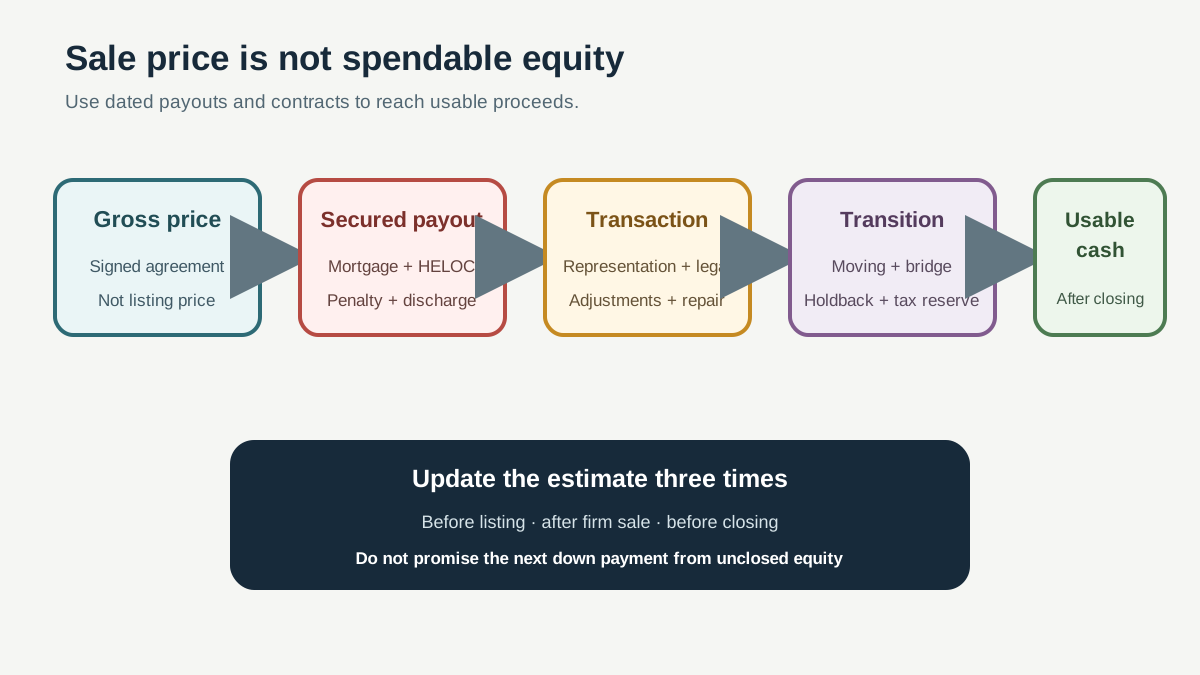
Short answer: build three net-proceeds versions
Use this equation:
Net sale proceeds = gross sale price − mortgage and secured payouts − transaction costs − property adjustments − agreed credits/holdbacks − moving costs − tax reserve
Calculate it at three dates:
- Before listing: conservative price range and written cost estimates.
- After a firm sale: signed price, conditions, closing date, and lender payout quote.
- Before closing: lawyer's statement, final payout, adjustments, repairs, and holdbacks.
FCAC's current selling-a-home guide lists legal fees, mortgage discharge, representation, repairs, inspection, appraisal, moving, staging, cleaning, and mortgage prepayment penalties as possible selling costs. It tells sellers to account for costs when setting the price.
The purpose is not to make every expense smaller. It is to stop the seller from promising the next home's down payment before the old home's cash has been reconciled.
The net-proceeds waterfall
Create one line for every claim on sale cash.
| Layer | Evidence | Estimate |
|---|---|---|
| Gross sale price | Signed agreement | |
| Mortgage payout | Dated lender statement | |
| HELOC/secured debts | Lender and title | |
| Prepayment penalty | Dated quote | |
| Discharge/admin | Lender and lawyer | |
| Representation and tax | Listing agreement/offer | |
| Seller legal and disbursements | Itemized quote | |
| Property-tax adjustment | Lawyer statement | |
| Condo/rent/fuel adjustment | Lawyer statement | |
| Repairs, credits, holdbacks | Amendments/invoices | |
| Staging, moving, storage, cleaning | Accepted quotes | |
| Bridge and overlap | Financing offer/calendar | |
| Tax reserve | Accountant advice | |
| Estimated net proceeds |
Do not put a percentage in every row. Use contracts and dated quotes. A blank line marked “pending” beats a precise invented number.
Mortgage payout is more than the online balance
The app balance may omit daily interest, penalty, discharge fee, cashback repayment, tax, or another secured product. Request a written payout statement for the expected closing date.
Ask the lender:
- principal balance on the closing date;
- daily interest and quote validity;
- three-month-interest or IRD penalty;
- discharge, administration, reinvestment, or assignment fee;
- cashback or incentive clawback;
- HELOC, line, overdraft, or loan secured by the charge;
- portability conditions if buying another home;
- how an earlier or later closing changes the amount;
- whether a permitted prepayment before payout reduces the penalty.
Use BubbleWatch's mortgage prepayment penalty worksheet to combine penalty, discharge, legal, appraisal, lost incentive, and alternative options. The lender's dated quote remains the source of record.
FCAC's mortgage discharge guide says a sale requires the lender's registered rights to be removed and that discharge process and fees vary by province. It also warns that a related HELOC may need to be paid and closed.
Representation fees are negotiated contract terms
There is no universal Canadian commission. The listing agreement determines services, fee structure, tax, cooperating-brokerage arrangement, expenses, holdover period, termination, and payment trigger.
Before signing, ask for a dollar worksheet at three sale prices:
| Sale price | Listing-side amount | Buyer-side/co-operating amount | Tax | Total |
|---|---|---|---|---|
| Lower case | ||||
| Expected case | ||||
| Higher case |
Ask:
- Is the fee fixed, percentage-based, tiered, or mixed?
- Which amount is offered to a buyer's brokerage?
- Does the seller owe a shortfall under any offer term?
- Is staging, photography, floor plan, cleaning, advertising, or cancellation included?
- When is tax added?
- When is the fee earned and payable?
- Does it apply to a private buyer introduced during a holdover period?
- What happens if the listing expires, is cancelled, or the buyer fails to close?
Compare services and obligations, not a headline percentage. A lower fee with separate marketing and staging charges may not be lower in total. A seller representing themselves still needs legal, disclosure, marketing, showing, fraud-control, and negotiation processes.
Seller legal work and discharge
The seller's lawyer reviews the agreement, title, payout instructions, tax and utility accounts, adjustments, closing documents, trust funds, and discharge obligations. Complexity increases with multiple mortgages, private lenders, liens, non-resident status, estate authority, separation, corporate ownership, tenants, or title problems.
Request an itemized quote that distinguishes:
- professional fee;
- sales tax;
- title and execution searches;
- mortgage payout and discharge work;
- government registration;
- courier, software, wire, and bank charges;
- extra mortgage or lien;
- document commissioning;
- failed or delayed closing work;
- holdback or post-closing undertaking.
Do not assume title insurance pays the seller's ordinary discharge work. The buyer and lender may receive policies, but the seller must still deliver title under the agreement and clear required registrations.
Property-tax, condo, rent, and fuel adjustments
An adjustment allocates an existing amount across the closing date. It can credit or debit the seller.
Property tax
If the seller paid taxes beyond the seller's responsibility date, the buyer may reimburse the applicable period. If taxes are unpaid, sale funds may cover the seller's share or arrears. The lawyer uses actual bills and local convention.
Condo or strata
Common expenses, arrears, special assessments, move deposits, chargebacks, and status-document fees may affect the statement or contract. Responsibility for a special assessment can depend on declaration, statute, approval date, due date, and agreement wording.
Tenanted property
Rent, prepaid rent, last-month deposits, damage or security deposits where lawful, interest, arrears, and utilities need a tenancy and legal reconciliation. The buyer also needs lease, notices, and tenant records.
Fuel and services
Propane, oil, leased equipment, solar arrangements, water heaters, security, and service contracts may be adjusted, assumed, paid out, or cancelled under the agreement.
Use the lawyer's draft statement rather than adding a generic adjustment reserve. Direction and amount can change with the closing date and payment status.
Repairs, preparation, and staging need a recovery test
Not every dollar spent before listing returns a dollar in price. Separate work into four groups:
| Group | Purpose | Evidence needed |
|---|---|---|
| Safety/legal | Resolve dangerous or contract-blocking issue | Specialist, permit, lawyer |
| Sale friction | Remove a clear buyer, lender, or insurer obstacle | Market feedback and quote |
| Presentation | Improve cleanliness, light, repair, and photography | Listing plan and budget |
| Speculative renovation | Hope for price premium | Comparable renovated sales and downside |
Fix active leaks, unsafe conditions, broken essentials, and obvious damage where feasible. Clean, declutter, and document. Be cautious with a major kitchen, bath, or basement project launched solely to chase a predicted sale premium.
Ask for a before/after net test:
Required extra sale price = renovation cash + carrying cost + financing cost + selling-cost increase + risk margin
If a $40,000 project extends ownership by two months, requires storage, and adds no verified comparable value, it may reduce net proceeds even if the sale price rises.
Keep permits, invoices, warranties, and contractor details. Misstating unpermitted work can create contract and disclosure risk.
A worked seller net-proceeds example
A homeowner accepts a $900,000 sale. The mortgage payout quote is $487,800 including penalty and fees. The listing agreement and transaction produce $45,000 of representation cost plus $5,850 tax in this illustration.
| Sale cash flow | Amount |
|---|---|
| Gross sale price | $900,000 |
| Mortgage payout, penalty, and lender fees | -$487,800 |
| Representation | -$45,000 |
| Tax on representation | -$5,850 |
| Seller legal and disbursement estimate | -$2,100 |
| Tax/condo adjustment estimate | -$1,650 |
| Repair credit under amendment | -$4,000 |
| Moving, storage, and cleaning | -$6,600 |
| Tax/accounting reserve | -$5,000 |
| Estimated usable proceeds | $342,000 |
The shortcut $900,000 minus a remembered $480,000 mortgage would produce $420,000. It overstates usable proceeds by $78,000 in this example.
Replace every cost with the actual contract, payout, lawyer statement, and tax advice. The commission illustration is not a standard rate.
Price reductions have a net, not gross, effect
If an offer falls from $900,000 to $880,000, the seller does not always lose the full $20,000 in final cash because a percentage-based representation fee and tax may also decline. Fixed costs do not.
Use:
Net effect of price change = price change − variable selling-cost change − tax effect of those costs
The exact math comes from the listing agreement and tax treatment. This helps compare a lower firm offer with a higher conditional offer that carries delay or failed-sale risk.
Also compare possession, deposit, financing, inspection, sale-of-property condition, repair request, and closing date. A price is not a complete offer.
Failed sale and relisting reserve
A buyer default can leave the seller with an unsold home, another purchase, legal dispute, and carrying costs. The deposit may remain in trust while entitlement is decided.
Build a failure reserve:
| Exposure | Monthly or one-time amount |
|---|---|
| Mortgage and bridge interest | |
| Property tax and condo fee | |
| Insurance and utilities | |
| Relisting and presentation | |
| Moving/storage changes | |
| Legal advice | |
| Price-change scenario |
Do not count the buyer's deposit as immediately available sale cash. The home-deposit risk guide explains why the stakeholder may require a mutual release or court order and why claimed loss can exceed the deposit.
Selling and buying: do not spend unclosed equity
If the replacement home closes before the sale, the seller may use bridge financing. Size the bridge from conservative net proceeds, not sale price minus current balance.
The two-closing bridge worksheet subtracts:
- mortgage payout and penalty;
- representation and legal costs;
- adjustments and repair credits;
- secured debts and holdbacks;
- a safety margin.
Align three documents: old-home sale statement, new-home cash-to-close statement, and bridge commitment. A $20,000 surprise in the sale file can become a shortage in the purchase file.
If the mortgage is portable, confirm whether the lender approves the borrower, new property, amount, dates, and any blend. The six-gate mortgage-port test also records temporary penalty and refund conditions. Portability does not guarantee a bridge or remove all penalty risk.
Principal-residence tax reporting is still required
CRA says the sale of a principal residence must be reported on the tax return for the year of sale, even where the principal residence exemption eliminates the gain. Its current real-estate sale guidance says all real property sold in 2016 or later must be reported, including a principal residence.
Tax can be more complex where:
- the property was not the principal residence for every owned year;
- another property is designated for overlapping years;
- the owner was non-resident for some period;
- all or part was rented or used for business;
- capital cost allowance was claimed;
- the property was bought or renovated mainly for resale;
- ownership is corporate, trust, estate, partnership, or multiple parties;
- sale occurs within the residential property flipping-rule period;
- the transaction is an assignment or new construction;
- costs and capital improvements need adjusted-cost-base records.
CRA's principal residence reporting page says the owner reports on Schedule 3 and may need Form T2091(IND). Late reporting can create penalties. Obtain current tax advice before spending all proceeds.
Non-resident and estate sellers need early advice
Canadian tax clearance and withholding rules can affect a non-resident seller and the buyer's lawyer. Estate and power-of-attorney sales need proof of authority. Separation or co-ownership can create signing and proceeds disputes.
Tell the lawyer before listing if:
- any owner is or may be non-resident;
- an owner is deceased, incapable, separated, bankrupt, or a corporation;
- title names differ from expected sellers;
- a matrimonial or family claim may affect sale;
- proceeds must pay judgments, tax liens, support, or private debt;
- a court order or consent may be required.
These facts can change timing, documents, withholding, and whether all owners can deliver title. A high offer cannot cure missing authority on closing day.
Seller insurance through closing
Keep home insurance active until the insurer and lawyer confirm the seller's ownership, possession, and risk have ended. A firm agreement is not a completed sale.
Tell the insurer about:
- vacancy after move-out;
- renovations or staging changes;
- tenant departure;
- overlapping ownership;
- a seller rent-back;
- material damage before closing.
If damage occurs, notify the lawyer, insurer, and transaction professionals promptly. The home-insurance closing workflow explains the buyer's binder and the seller-to-buyer coverage handoff.
The final walkthrough can change the closing statement
At the buyer's last visit, a missing included appliance, incomplete repair, new water damage, or abandoned property may trigger a contract response. It does not automatically give the buyer a unilateral deduction.
Use the final-walkthrough evidence checklist to prepare the property and evidence. Complete promised repairs early, keep invoices and permits, protect the home during move-out, and take dated photos after belongings leave.
A negotiated holdback reduces immediate seller proceeds until release conditions are met. Record:
- holdback amount;
- lawyer holding it;
- work and evidence required;
- access and completion date;
- inspection or approval standard;
- partial release and dispute process;
- treatment if work is never completed.
Prepare the seller's evidence with the fixtures and chattels inventory and a unit-by-unit vacant-possession plan. If funds must remain after closing, use the detailed holdback amount, evidence, release, and dispute framework rather than subtracting a token number from expected proceeds.
Compare offers by expected net and failure risk
The highest price may not produce the strongest expected outcome. Build an offer grid before acceptance:
| Offer field | Offer A | Offer B |
|---|---|---|
| Price | ||
| Deposit and holder | ||
| Financing/appraisal condition | ||
| Inspection/document condition | ||
| Sale-of-property condition | ||
| Repair or seller credit | ||
| Included/excluded items | ||
| Closing and possession dates | ||
| Bridge/carrying cost | ||
| Expected net proceeds | ||
| Failed-sale exposure |
A $910,000 offer with a long sale-of-property condition may delay certainty and the seller's next purchase. An $895,000 offer with verified financing, a feasible short condition, larger documented deposit, and preferred closing can have a different risk-adjusted value. This is not a rule to prefer condition-free offers; it is a prompt to value each term.
Ask the representative to explain the dollar effect of every requested credit, inclusion, closing-date change, or representation. Ask the lawyer about legal uncertainty. Do not accept a clause you cannot translate into cash, timing, action, and failure consequences.
If two offers use different representation arrangements, ensure the seller receives the required remuneration disclosure and understands any effect under the listing agreement. Compare the seller's actual statement, not assumptions about who “pays commission.”
Ten-business-day seller closing check
- lawyer has the full agreement and amendments;
- lender payout statement covers the closing date;
- every secured debt and discharge is identified;
- representation invoice and tax are confirmed;
- property tax, condo, rent, and fuel records are current;
- repair invoices, permits, and warranties are ready;
- non-resident, estate, tax, or authority issues are resolved;
- moving and vacancy insurance dates align;
- keys, remotes, codes, and included items are organized;
- buyer visit access is scheduled;
- net proceeds destination is authenticated;
- no one relies on emailed banking changes without voice verification.
Wire fraud can redirect sale proceeds. Confirm lawyer instructions and receiving-account details through trusted channels. Ask how a last-minute change will be authenticated.
Seller net-proceeds scenarios
| Scenario | Sale price | Payout | Transaction costs | Other costs/tax reserve | Net |
|---|---|---|---|---|---|
| Conservative | |||||
| Expected | |||||
| Strong | |||||
| Failed-sale delay |
For the conservative case, use a lower supported price, current penalty quote, full service and moving costs, and no uncertain tax exemption. For the strong case, do not erase known costs merely because price improves.
Update the table when the listing agreement, offer, condition removal, repair amendment, payout, and lawyer statement arrive. Net proceeds are a moving estimate until closing.
Keep a fourth column for confidence. Mark each line confirmed, quoted, calculated, or unknown. A $3,000 confirmed legal and discharge amount is less dangerous than a blank tax question that could be much larger. Resolve the high-impact unknowns first, and do not use the optimistic total for the replacement purchase.
Frequently asked questions
What closing costs does a home seller pay in Canada?
Possible costs include mortgage payout and penalty, discharge, representation, legal work, adjustments, repairs, staging, cleaning, moving, bridge interest, holdbacks, and tax. The actual contracts and property determine which apply.
How do I calculate net proceeds from a home sale?
Start with gross sale price, then subtract every secured payout, transaction cost, property adjustment, agreed credit, moving cost, and tax reserve. Update the estimate with the firm agreement and lawyer's statement.
Is real-estate commission fixed in Canada?
No universal rate applies. The listing agreement sets the negotiated fee, services, tax, cooperating arrangement, expenses, holdover, and payment trigger. Ask for dollar examples at several sale prices.
Does the mortgage balance shown online equal the payout?
Not necessarily. The final payout can include daily interest, prepayment penalty, discharge and administration fees, cashback repayment, and related secured credit. Request a dated statement.
Do sellers pay land transfer tax?
Land transfer or property transfer tax is generally a buyer-side transfer cost, but sellers pay their own closing obligations and adjustments. Unusual taxes, non-resident rules, or local charges require lawyer advice.
Is profit on a principal residence always tax-free?
Not automatically. Eligibility and reporting facts matter. CRA requires the sale to be reported even where the principal residence exemption shelters the gain. Rental, business, non-resident, flipping, and multiple-property facts can change treatment.
Can I use the buyer's deposit for my next purchase?
Do not treat it as available. It is normally held under the agreement and credited on closing. If the transaction fails, entitlement can be disputed. Bridge financing should use conservative net sale proceeds and lender approval.
When can the seller cancel home insurance?
Only after the lawyer and insurer confirm the seller's risk and possession have ended. Keep coverage through the advised date and disclose vacancy, rent-back, or damage.
What if a repair is unfinished at closing?
The parties may negotiate completion, amendment, holdback, or another legal response. The seller should not assume a verbal promise is sufficient, and the buyer should not deduct money unilaterally.
How soon will I receive sale proceeds?
Timing depends on buyer funds, registration, lender payout, trust clearance, lawyer process, holdbacks, and banking cutoffs. Ask the lawyer when cleared net funds can be sent and verify the destination securely.
Method and source note
This guide was updated July 19, 2026. It uses FCAC selling, mortgage-break, and discharge guidance plus current CRA principal-residence and real-estate reporting resources. It deliberately avoids quoting a standard commission or legal fee because those are negotiated and transaction-specific.
The worked example is illustrative. Sellers should obtain a dated lender payout, listing-agreement calculation, lawyer statement, and current tax advice for their ownership and use history.
What to read next
- Calculate the full mortgage break and discharge cost.
- Size any bridge loan from conservative net equity.
- Prepare the buyer visit with the final-walkthrough evidence checklist.
- If buying again, build the replacement home's cash-to-close number.
Advertisement

About David R. Chen, CFA
David R. Chen is a Chartered Financial Analyst and the Senior Housing Economist at BubbleWatch.ca. He brings 12+ years of experience in quantitative real estate analysis and mortgage underwriting. Formerly an analyst at a major Canadian bank, he specializes in modeling payment shock, regional affordability divergence, and private lending risk.
View David's professional bio & credentials →