Bank of Canada October 28, 2026 Rate Decision: What a Hike or a Hold Does to Your Mortgage Payment
On Wednesday, October 28, 2026, at 9:45 a.m. ET, the Bank of Canada announces its next policy rate decision and publishes its quarterly Monetary Policy Report. The rate goes in at 2.25%, where it has sat through seven straight holds since the cut of October 29, 2025, and bank prime goes in at 4.45%. This time a quarter-point hike is a live outcome, not a remote one: September inflation printed 3.1% on gasoline, a Reuters poll of 34 economists taken October 21 to 23 found 19 expecting a hike to 2.50%, and the C.D. Howe Institute Monetary Policy Council voted the other way, six of seven for a hold. This preview prices both outcomes for variable borrowers, HELOC holders, fixed-rate shoppers, and renewers, using Canadian semi-annual compounding, and closes with the exact figures to check on decision morning.
Bank of Canada October 28, 2026 Rate Decision: What a Hike or a Hold Does to Your Mortgage Payment
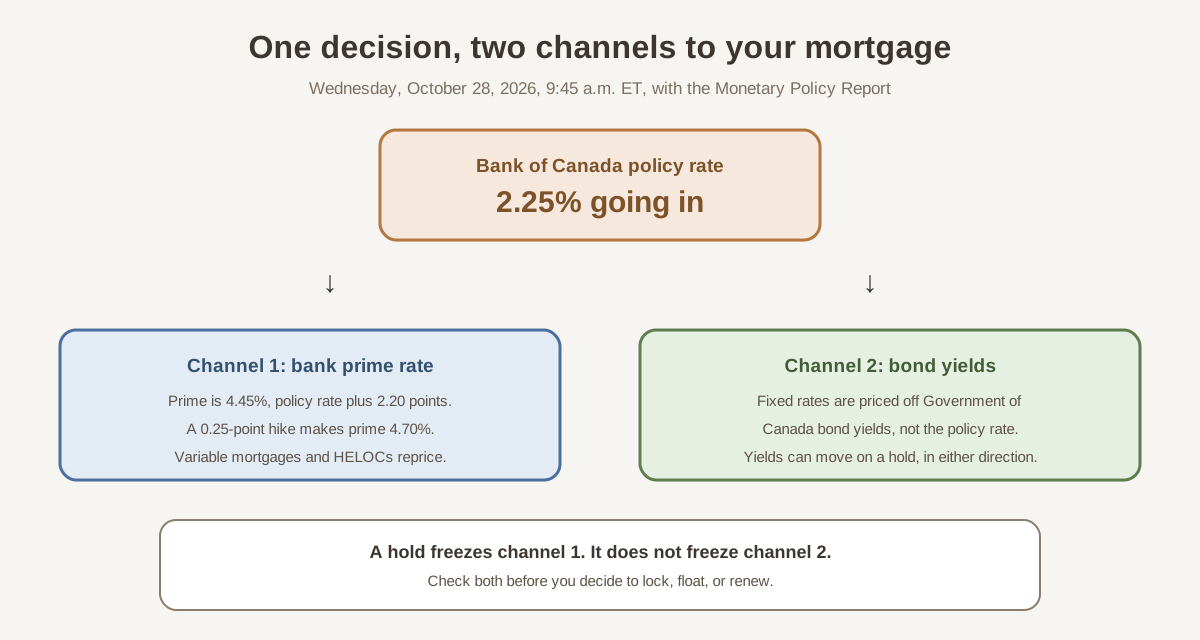
Short answer: The Bank of Canada announces its next decision on Wednesday, October 28, 2026, at 9:45 a.m. ET, together with its quarterly Monetary Policy Report. The policy rate goes into the meeting at 2.25% and the big-bank prime rate at 4.45%. If the Bank holds, variable mortgage and HELOC payments do not change. If it raises the rate by a quarter point, to 2.50%, prime is expected to follow to 4.70%, and an adjustable-payment variable mortgage priced at prime minus 0.50% costs about $54 a month more on a $400,000 balance and about $82 a month more on $600,000, both on a 25-year amortization. Fixed mortgage rates are a separate channel: they are priced off Government of Canada bond yields, so a hold does not freeze them. What the statement and the new forecasts say about December can move fixed offers even when the rate itself does not move.
This article is general education about how the decision reaches a mortgage. It is not financial advice, and it does not predict the decision. The forecasters cited below disagree with each other, which is the point: price both outcomes before Wednesday, and you do not have to react to either one on Wednesday.
What to do with this decision, step by step
- Find your exposure before Wednesday. Check whether your mortgage payment moves with prime (adjustable-payment variable), stays fixed while the interest share changes (static-payment variable), or does not move at all in this term (fixed).
- Price the hike on your own balance using the table below: about $13.61 a month per $100,000 of variable balance for a quarter-point move, on a 25-year amortization at the example discount to prime.
- If you carry a HELOC balance, price that separately. A HELOC at prime is interest-only for most borrowers, so a quarter point is about $20.83 a month per $100,000 drawn.
- If your renewal falls in the next few months, get a written offer and ask two questions in writing: how long the offered rate is held, and whether a better rate can be substituted before closing if offers fall.
- If you are buying, ask your lender or broker to re-run your stress test numbers at a contract rate a quarter point higher, so a hike cannot quietly shrink your approval between offer and closing.
- On Wednesday at 9:45 a.m. ET, read the rate first, then the statement language on inflation risk, then the Monetary Policy Report forecast. The forecast is what bond yields, and therefore fixed rates, react to most.
- Wait for your own lender's prime notice before assuming your payment changed. Banks normally announce prime the same day or within a day or two, effective the following day.
- After the decision, do the December math once. The next, and last, decision of 2026 is December 9, and the October statement is the best guide to what the Bank is watching between now and then.
Where rates stand going into Wednesday
The starting point is a rate that has not moved in a year, and a prime rate that has not moved with it.
| Item | Level going into October 28 | Since when |
|---|---|---|
| Bank of Canada policy rate (target for the overnight rate) | 2.25% | Cut to this level on October 29, 2025, from 2.50% |
| Bank Rate | 2.50% | Unchanged through the hold sequence |
| Deposit rate | 2.20% | Unchanged through the hold sequence |
| Big-bank prime rate | 4.45% | In place since November 5, 2025 |
| Consecutive holds before this decision | 7 | Most recent: September 2, 2026 |
| Next decision after this one | December 9, 2026 | Last decision of 2026 |
Prime sits 2.20 percentage points above the policy rate, a spread the big banks have held through this cycle. That spread is a banking convention, not a law, but it is the arithmetic every variable borrower should use for planning: a quarter-point move in the policy rate has, in practice, meant a quarter-point move in prime in the same week. Our guide to how mortgage rates are set in Canada works through the prime and bond channels in full.
The September decision, covered in our September 2026 hold analysis, kept the rate at 2.25% as expected. Two things in that statement matter for Wednesday. The Bank flagged that upside risks to inflation had increased, pointing at energy prices and renewed tariff pressure on Canadian exports. And September was not a Monetary Policy Report meeting, so the Bank published no new forecasts. Wednesday is one: the October report carries the Bank's updated inflation and growth projections, and Governor Tiff Macklem's press conference follows at 10:30 a.m. ET. Forecast revisions have moved bond yields more than the rate decision itself at several past meetings, because fixed mortgage pricing is forward-looking.
Why a hike is on the table: the inflation print
The case starts with one number. Statistics Canada reported on October 19 that the Consumer Price Index rose 3.1% in the year to September 2026, up from 3.0% in August. That is above the top of the Bank's 1% to 3% control range around its 2% target. The composition, though, is where the argument lives.
| September 2026 CPI component | Year-over-year change | Reading |
|---|---|---|
| All-items CPI | 3.1% | Above the 1% to 3% control range |
| Gasoline | +27.8% | The main driver of the headline increase |
| CPI excluding gasoline | 2.2% | Down from 2.4% in August |
| Energy overall | +19.0% | Up from +15.4% in August |
| CPI-trim (core measure) | 1.8% | Below the 2% target |
| CPI-median (core measure) | 1.9% | Below the 2% target |
| Shelter | +1.8% | Up from +1.5% in August |
| Rent | +2.8% | Same pace as August |
| Mortgage interest cost | -0.2% | Falling, a year into the lower policy rate |
| Food purchased from stores | +1.7% | Smallest yearly gain since May 2024 |
Source: Statistics Canada, Consumer Price Index for September 2026, released October 19, 2026, as reported from the release.
Read the table two ways and you get the two camps. The headline says inflation is outside the range, driven by an energy shock tied to the conflict in the Middle East, and the Bank's own Business Outlook Survey, published in the same week, showed business inflation expectations rising, with renewed Canada-U.S. trade tension adding to cost pressure. Reuters reported that Governor Macklem told reporters the Bank expects to revise its inflation forecasts higher in the October report, remarks markets read as a signal that a hike is being considered. A central bank that lets expectations drift while the headline sits above its range can end up needing larger moves later. That is the hike case.
The other reading is that the Bank sets policy for the inflation it can influence. Strip out gasoline and inflation is 2.2% and falling. Both of the Bank's preferred core measures sit below target, at 1.8% and 1.9%. Mortgage interest costs are falling. Grocery inflation is at its slowest in over two years. On that reading, the 3.1% headline is an imported energy price level shock, and raising domestic borrowing costs does not produce more gasoline. That is the hold case, and the jobs data below is its second half.
Why a hold is also defensible: the jobs print
Statistics Canada's Labour Force Survey for September, released October 9, was weak by any measure, and it is the last jobs report before this decision.
- Employment fell by 68,000 jobs in September (-0.3%), the second monthly decline in a row, after a loss of about 42,000 in August.
- The unemployment rate rose to 6.5%, from 6.4% in August.
- The participation rate fell to 64.8%, the lowest outside the pandemic period since December 1997, which Statistics Canada attributes largely to an aging population.
- Losses split almost evenly between full-time work (-35,000) and part-time work (-33,000).
- Public sector employment fell by 70,000, its fourth straight monthly decline; private sector employment was little changed.
- Average hourly wages rose 2.3% year over year, to $37.64.
A quarter-point hike lands on that labour market within weeks, through prime-linked borrowing: variable mortgages, HELOCs, and the floating-rate business and consumer credit that small employers and households carry. The two-month loss of about 110,000 jobs is the strongest single argument for waiting until December, when the Bank will have the October jobs report (due November 6) and the October CPI print (due November 16) in hand. Nothing in the calendar forces a move on Wednesday. The Bank has held seven times in a row on exactly that logic: the rate is already in place, and each meeting buys another month of data.
Who expects what, stated plainly
Forecasts are not facts, and this section reports them as forecasts, with their sources and dates attached, because the split itself is the useful information.
| Source | Call for October 28 | Detail |
|---|---|---|
| Reuters poll of economists, October 21 to 23 | Hike, by a narrow majority | 19 of 34 economists (56%) expected a 25-basis-point hike to 2.50%, with a further hike by the end of March |
| Interest rate futures, as reported by Reuters on October 23 | Hike likely | Pricing had moved to roughly a three-in-four likelihood of an October hike, up from about 30% earlier |
| C.D. Howe Institute Monetary Policy Council, October 22 | Hold | Six of seven members in attendance voted to keep the rate at 2.25% on October 28; the median call was 2.50% by April 2027 and 2.75% by October 2027 |
| Market pricing tracker at WOWA.ca, crawled in the days before the decision | Hike likely | 2.50% priced at 77%, 2.25% at 23% for the October 28 meeting |
Two things stand out. First, the professional forecasters and the shadow council disagree, which almost never happens this close to a decision; the Reuters majority flipped from hold to hike during the poll week itself, after the CPI release and the Governor's weekend remarks. Second, even the hold camp's median path has rates higher next year, not lower. Nobody in the table above is forecasting a cut on Wednesday, and a cut is not part of the current debate. Plan around two outcomes, hold and hike, and treat any talk of an imminent cut as unsupported by these sources.
This site does not add a third forecast to that table. The worked examples below price the hike in full so that, if it comes, the payment change is a number you have already seen, and if the Bank holds, the same table tells you what did not change.
The payment math: a quarter point, priced
The examples below are labelled hypotheticals built for arithmetic, not quotes. They assume an adjustable-payment variable mortgage priced at prime minus 0.50%, which is 3.95% at today's prime of 4.45% and would be 4.20% if prime rises to 4.70%. Payments use the Canadian mortgage convention: a nominal rate with semi-annual compounding, converted to the equivalent monthly rate, over a 25-year amortization. Your own rate, discount to prime, balance, and remaining amortization will move your number; the per-$100,000 row is the portable figure.
| Variable balance | Payment at 3.95% (today) | Payment at 4.20% (after a hike) | Monthly change |
|---|---|---|---|
| Per $100,000 | $523.31 | $536.92 | +$13.61 |
| $400,000 | $2,093.25 | $2,147.67 | +$54.42 |
| $600,000 | $3,139.88 | $3,221.51 | +$81.63 |
| $800,000 | $4,186.50 | $4,295.34 | +$108.84 |
The monthly change is the small number. The term number is the one to budget against if a hike is the first of two, as the Reuters poll's median path suggests. Over a five-year term, the $600,000 example at 4.20% pays about $117,419 in interest and ends the term owing about $524,128. At 3.95% the same loan pays about $110,260 in interest and ends at about $521,868. The quarter point is worth about $7,159 of extra interest over the term, plus a balance about $2,260 higher at renewal. On $400,000, the five-year interest gap is about $4,772. None of this is a reason to panic over one decision. It is a reason to count a hiking path, not a single hike, when you compare a variable rate against a fixed offer this fall.
HELOCs price faster and simpler. A home equity line of credit at prime charges interest on the drawn balance, usually with a minimum payment of interest only. On a $100,000 drawn balance, interest at prime of 4.45% is $370.83 a month. At 4.70% it is $391.67, an increase of $20.84 a month, or about $250 over a year if the balance and rate both stay put. There is no amortization cushion in that math: the full quarter point reaches the payment in the first cycle after prime changes. Our home equity borrowing guide covers how HELOC, loan, and reverse mortgage pricing differ.
Static-payment variable mortgages do not show the change in the payment. If your variable mortgage has a fixed payment, a hike raises the interest portion inside that payment and stretches the amortization instead. The payment notice will look calm while the balance falls more slowly, and if rates rise far enough the payment can hit the trigger rate in your contract, at which point the lender can raise the payment or ask for a lump sum. After a hike, check two numbers in your lender portal: the interest portion of the last payment, and the current amortization estimate. Our variable-rate cliff analysis explains the trigger mechanics. A small voluntary payment increase, made while it is still voluntary, is the cheapest response most static-payment borrowers have.
The channel a hold does not freeze: fixed rates
A hold leaves prime, variable payments, and HELOC interest exactly where they are. It does not promise anything about fixed mortgage rates, because lenders price fixed terms off Government of Canada bond yields for the matching term, plus a spread, and bond yields react to the whole package on Wednesday: the decision, the statement's risk language, and the new Monetary Policy Report forecasts.
That cuts in both directions, and borrowers get this wrong in both directions.
- If the Bank hikes and signals that it is done, long-term yields can fall on the news, because markets read a decisive Bank as lower future inflation. Fixed offers can ease after a hike.
- If the Bank holds and the report revises inflation forecasts sharply higher, yields can rise on the news, because markets read a hesitant Bank as more hikes later. Fixed offers can rise after a hold.
- If the Bank holds and the report reads as calm about the energy shock fading, yields can fall, and fixed offers can ease without any rate cut at all.
The practical point is narrow. A rate hold you are quoted this week is a contract detail, not a market detail: ask how many days the hold lasts, whether it survives a change in the lender's posted offers, and whether you can take a lower offer from the same lender before closing if one appears. A hold that expires on October 30 is not protection against November pricing. The fixed versus variable comparison on this site sets out the break-even arithmetic for choosing between the two at renewal, and it is worth re-running with Wednesday's offers rather than September's.
Renewers: what Wednesday changes for you
If your term ends in the next six months, you are the borrower with the most at stake in this decision, and the least ability to wait it out. Three rules keep the decision manageable.
First, a straight switch may not be re-stress-tested, but a refinance is. Since November 21, 2024, borrowers who switch lenders at renewal for the same balance and amortization do not face the stress test again. If Wednesday's outcome pushes you to change lenders for a better offer, that exemption is what makes the switch practical. It does not extend to refinances that raise the balance or extend the amortization; those are tested at the greater of the contract rate plus two percentage points or 5.25%. Our switching lenders at renewal guide has the eligibility checklist.
Second, price your current lender's first offer against the hike scenario, not against today. Renewal offers are priced off the same bond market discussed above. If you are holding an offer that expires shortly after Wednesday, the expiry date matters more than the headline rate decision: an expiring fixed offer can be withdrawn and repriced on Thursday's yields whatever the Bank did on Wednesday.
Third, run the blend numbers before you break anything. If a hike path makes your remaining term expensive, a blend-and-extend can average your current rate into a new term without a prepayment charge in many contracts, while breaking and refinancing can trigger a penalty that eats the saving. The renewal wave guide walks through the order to check these options: renewal offer, blend, switch, refinance, in that sequence.
Buyers: the stress test moves even when your payment does not
For a buyer with a pre-approval, the decision reaches you through the qualifying rate. Under the mortgage stress test, you qualify at the greater of your contract rate plus two percentage points or the 5.25% benchmark. On a variable contract at the example rate of 3.95%, the qualifying rate is 5.95%, and the qualifying payment on $600,000 over 25 years is $3,821.03. If the contract rate rises to 4.20% after a hike, the qualifying rate becomes 6.20% and the qualifying payment rises to $3,910.46. At the same qualifying payment, the loan that fits falls from $600,000 to about $586,278: roughly $13,722 of borrowing room gone, with no change in the home, the income, or the down payment.
Fixed-rate buyers feel the same squeeze through the contract rate itself if bond yields rise after the decision, because a higher fixed contract rate raises the contract-plus-two figure one for one once it passes the 5.25% floor. The full rules, including the insured and uninsured split, are in our mortgage stress test guide. The action item is one phone call: after Wednesday, have your lender or broker confirm in writing that your pre-approval still carries the purchase price you are shopping at, at the new rates. A pre-approval that quietly lost $13,000 of room is a failed closing in slow motion.
What to watch on Wednesday, in order
- 9:45 a.m. ET, the rate. 2.25% is a hold; 2.50% is the hike. Everything else is commentary until this number prints.
- The statement's inflation language. Compare it with September's framing that upside risks to inflation had increased. Stronger language points to December; language that stresses the energy shock as temporary points to a longer hold.
- The Monetary Policy Report forecast. The size of the inflation forecast revision is the number bond yields will trade on. Reuters reported the Governor saying the revision would be significant; the published figure settles it.
- 10:30 a.m. ET, the press conference. Watch for any sentence that separates the energy shock from underlying inflation. That separation is the hold argument, in the Bank's own words, if it comes.
- Your lender's prime notice. Variable and HELOC pricing changes when your bank moves prime, usually announced the same day and effective the next business day, not at 9:45 a.m.
- Fixed offers on Thursday and Friday. Lenders reprice fixed terms off bond yields after the report has been digested. The first offer you see on Wednesday afternoon is not necessarily the week's final pricing.
Sources
Primary and official sources read for this article, plus the two attributed forecast sources:
- Bank of Canada, interest rate announcement of September 2, 2026: the policy rate held at 2.25%, with the Bank Rate at 2.50% and the deposit rate at 2.20%, and the statement's flag that upside risks to inflation had increased. The Bank's published schedule sets the remaining 2026 announcement dates as Wednesday, October 28 (with the Monetary Policy Report) and Wednesday, December 9.
- Statistics Canada, The Daily, Consumer Price Index, September 2026 (released October 19, 2026): all-items inflation of 3.1%, gasoline up 27.8%, CPI excluding gasoline up 2.2%, energy up 19.0%, CPI-trim at 1.8%, CPI-median at 1.9%, shelter up 1.8%, rent up 2.8%, mortgage interest cost down 0.2%, and food purchased from stores up 1.7%.
- Statistics Canada, The Daily, Labour Force Survey, September 2026 (released October 9, 2026): employment down 68,000, unemployment rate 6.5%, participation rate 64.8%, and average hourly wages of $37.64, up 2.3% year over year.
- Reuters, poll of economists conducted October 21 to 23, 2026, reported October 23: 19 of 34 economists expecting a hike to 2.50% on October 28 and one more hike by the end of March, futures pricing at roughly a three-in-four likelihood of an October hike, and the Governor's remarks that the Bank expects to revise its inflation forecasts higher.
- C.D. Howe Institute, Monetary Policy Council recommendation of October 22, 2026: six of seven members voting to hold at 2.25% on October 28, with a median path of 2.50% by April 2027 and 2.75% by October 2027.
Payment examples are hypothetical, computed from the stated balances, rates, and a 25-year amortization under the Canadian semi-annual compounding convention. They are not rate quotes, and no lender's current offer is stated or implied anywhere in this article. This article is general education about monetary policy and mortgages in Canada. It is not financial, mortgage, or investment advice. For a decision on your own mortgage, use a licensed mortgage professional and your lender's current documents.
Advertisement

About David R. Chen, CFA
David R. Chen is a Chartered Financial Analyst and the Senior Housing Economist at BubbleWatch.ca. He brings 12+ years of experience in quantitative real estate analysis and mortgage underwriting. Formerly an analyst at a major Canadian bank, he specializes in modeling payment shock, regional affordability divergence, and private lending risk.
View David's professional bio & credentials →