Ontario Condo Status Certificate Review
A five-document method for reviewing an Ontario resale condo's fees, reserve plan, special-assessment exposure, insurance, litigation, rules, and unit obligations.
Ontario Condo Status Certificate Review: A Buyer Risk Worksheet
An Ontario condo status certificate is a dated disclosure package about a unit and its condominium corporation. It can show fees, arrears, planned increases, special assessments, reserve-fund information, insurance, litigation, and governing documents. A buyer should make the offer conditional on a satisfactory legal review unless their lawyer advises a different structure.
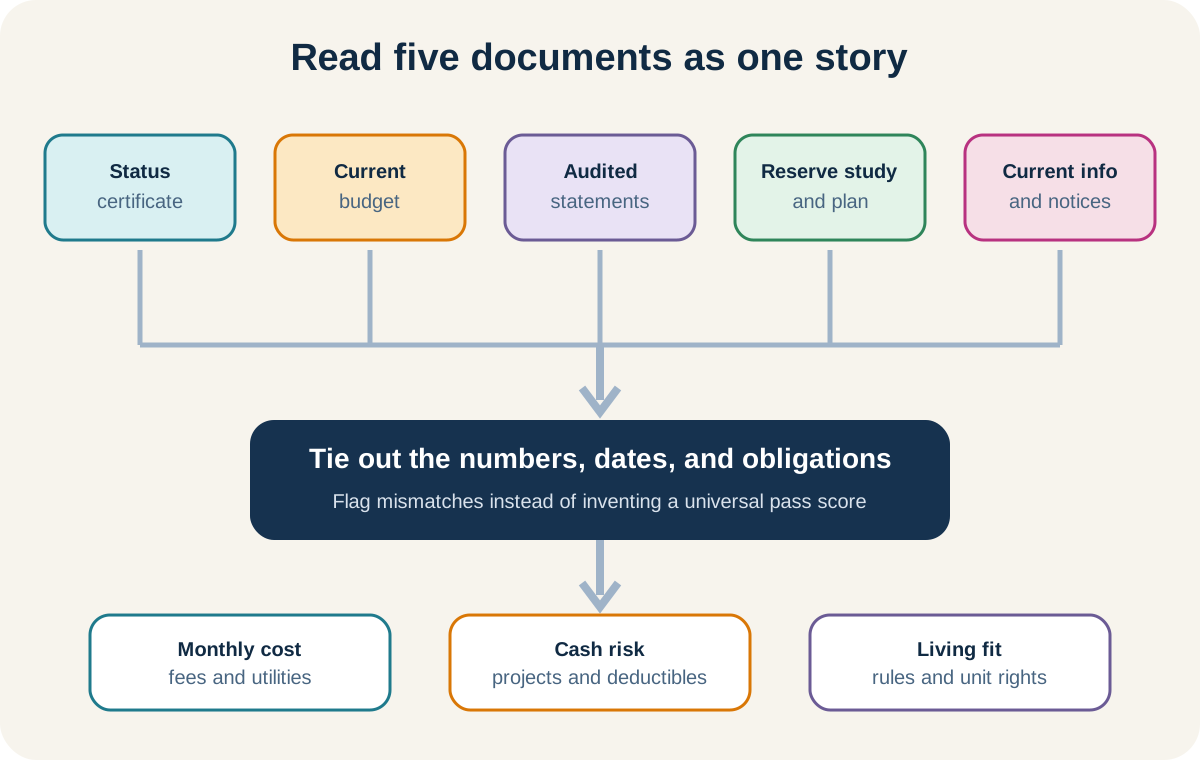
Short answer: read five documents as one financial story
The certificate form is important, but the real decision comes from reconciling it with its attachments. Do not judge a building from the reserve balance alone or from a rule of thumb such as “70% funded.” Ontario does not give every condo one universal safe percentage.
Use the BubbleWatch five-document tie-out:
- Status certificate: the corporation's dated statements about this unit and current risks.
- Current budget: the operating plan and contributions for this fiscal year.
- Audited financial statements: what actually happened in the last completed year.
- Reserve fund study and funding plan: expected major-component work and planned contributions over time.
- Current information certificates and notices: events that may have occurred after the older statements or study.
The Condominium Authority of Ontario's status-certificate page says the package can include the budget, audited statements, reserve-study information, unit arrears, fee increases, special assessments, insurance, litigation, and governing documents. CAO tells buyers to review it with legal counsel.
This guide is for Ontario resale condos
Condo law and document names differ across Canada. British Columbia uses strata documents and Form B information certificates. Alberta, Quebec, and the Atlantic provinces have their own statutes and practices. This worksheet is built around Ontario's Condominium Act framework and CAO material current on July 19, 2026.
A new-construction purchase is also different. Ontario's home-buying guidance describes a statutory 10-day cooling-off period for many new-condo agreements after the buyer receives the required documents. It also says there is no equivalent general statutory cooling-off period for a resale condo. A resale buyer usually creates protection through the agreement of purchase and sale, including a status-review condition drafted for the transaction.
This is educational information, not a legal opinion on a certificate or offer. A real-estate lawyer should review the actual package and explain the condition, deadlines, title, and closing obligations.
What the certificate can tell you
According to CAO, the package may disclose:
- the unit's common expenses and whether the unit is in arrears;
- increases in common expenses and the stated reason;
- special assessments charged since the current budget;
- the current budget and latest audited financial statements;
- information about the most recent reserve fund study and fund state;
- outstanding judgments and ongoing litigation involving the corporation;
- current insurance certificates;
- the declaration, by-laws, and rules;
- directors and officers;
- other prescribed statements and attachments.
Anyone can request a certificate. CAO states that a corporation can charge up to $100 including applicable taxes and must provide it within 10 days after receiving the request and payment. Confirm the current process and package date with the corporation or property manager.
The certificate binds the corporation in important ways, but buyers should not treat it as a warranty that no future cost can occur. Conditions can change after issuance. A repair may be discovered, an insurance renewal may change, a lawsuit may begin, or a board may adopt a new budget. The offer and lawyer's review should address freshness and material changes.
Step 1: confirm the unit before studying the building
Start with the exact legal unit, parking unit, locker, and exclusive-use areas. Marketing descriptions can blur ownership. A parking space may be a separate unit, an exclusive-use common element, an assigned space, or rented from another owner.
Ask the lawyer to match each interest to title and the purchase agreement, then check the owner and lender policies with the Canadian title-insurance policy map. Insurance does not convert an assigned or rented space into owned title.
Ask the lawyer to reconcile:
| Item | Certificate or document | What must match |
|---|---|---|
| Residential unit | Status certificate and title work | Legal description and municipal address |
| Parking | Declaration, schedules, certificate | Owned unit, exclusive use, assignment, or lease |
| Locker | Declaration, plans, certificate | Same ownership and transfer treatment |
| Common expenses | Certificate and budget | Correct amount and unit allocation |
| Arrears or lien | Certificate and closing statement | Who pays and how it is cleared |
| Alterations | Agreements, rules, corporation records | Approval for walls, plumbing, HVAC, balcony, charger, or flooring |
A clean corporation does not cure a unit-specific problem. Unapproved renovations, chargebacks, arrears, or a disputed parking right can follow the transaction if the agreement and closing work do not resolve them.
Step 2: tie current fees to the operating budget
The advertised condo fee is only today's monthly line. Find the current amount in the certificate, then trace it into the budget.
Separate:
- operating expenses such as management, cleaning, utilities, snow removal, security, repairs, and insurance;
- reserve contributions for major repair and replacement of common elements;
- utilities included in the common expense;
- parking or locker charges;
- shared-facility or reciprocal-agreement costs;
- loan payments or unusual projects;
- any announced increase not yet reflected in the listing.
Build a fee bridge:
| Fee bridge | Monthly amount |
|---|---|
| Listing-stated fee | |
| Confirmed current common expense | |
| Announced increase | |
| Parking/locker or shared-facility cost | |
| Unit-paid utilities omitted from listing | |
| Underwritten monthly housing cost |
Do not mark a fee “high” or “low” without checking what it covers, the building type, service level, age, and reserve contribution. A low fee can mean efficient operations. It can also mean weak funding or a recent building whose major costs have not arrived. A high fee can include heat, water, staff, extensive amenities, or catch-up reserve funding.
Compare the full monthly ownership cost in BubbleWatch's condo-versus-townhouse guide. Purchase price alone cannot tell you which property is affordable.
Step 3: read the audit before trusting the budget
The budget is management's plan. The audited statements show the last completed year's results and the auditor's report. The two should tell a coherent story.
Look for:
- operating surplus or deficit;
- unpaid common expenses and collection issues;
- transfers between operating and reserve accounts;
- loans, lines of credit, or major payables;
- unusual related-party transactions;
- material commitments after year-end;
- legal contingencies;
- auditor qualifications or emphasis paragraphs;
- large variances between budget and actual expenses;
- insurance costs that rose sharply;
- reserve spending that differs from the study schedule.
One deficit is not automatically fatal. A timing difference or one-off item may explain it. Repeated deficits funded through owner charges, reserve borrowing, or delayed maintenance deserve a clear explanation.
The three-year question set
One year can hide a trend. If available through the seller, corporation, or public owner records, ask how these items changed over three fiscal years:
| Trend | Stable pattern | Question to investigate |
|---|---|---|
| Common expenses | Changes explained by services and inflation | Repeated jumps without a catch-up plan |
| Operating result | Small, explained variances | Persistent deficits |
| Arrears | Controlled and collected | Rising unpaid fees or liens |
| Insurance | Renewed with manageable deductibles | Reduced coverage or large deductible changes |
| Reserve contribution | Follows the adopted funding plan | Contributions below plan or repeatedly deferred |
| Major repairs | Track study timing | Projects delayed while failures accumulate |
This trend approach is more useful than dividing the reserve balance by the number of units. A new tower and a 40-year-old townhouse complex face different components, timing, and costs.
Step 4: turn the reserve study into a project calendar
Ontario condo corporations use reserve funds for major repair and replacement of common elements and assets. CAO's reserve-fund overview says the study assesses physical components and financial health and includes a recommended funding plan projected for at least 30 consecutive years.
The CAO reserve-funds guide explains the study cycle: a comprehensive Class 1 study is followed by updates, with Class 2 including a site inspection and Class 3 completed without one, according to the prescribed cycle.
Extract the next ten years into a simple calendar:
| Component | Planned year | Study cost | Inflation basis | Current signal | Buyer question |
|---|---|---|---|---|---|
| Garage membrane | Leaks, patching, report | Is scope still current? | |||
| Elevators | Service issues, modernization | Contract or quote obtained? | |||
| Windows/wall system | Seal failures, water entry | Unit or corporation responsibility? | |||
| Roof | Repairs and age | Full replacement or phased work? | |||
| Plumbing | Leaks, riser history | Is replacement included? | |||
| Mechanical equipment | End-of-life or efficiency work | Is access disruptive? |
Then compare planned annual contributions and withdrawals with the corporation's adopted funding plan and actual statements. The Canada-wide reserve-study audit provides a component variance table, current-balance reconciliation, and five-year cash runway. The useful question is not “How big is the fund?” It is “Can the contribution path and available assets meet the dated work under reasonable cost assumptions?”
Four reserve mismatches to flag
- Timing mismatch: a major project appears sooner in engineering or board material than in the study.
- Cost mismatch: recent bids or inflation are far above the study estimate.
- Contribution mismatch: the budget contributes less than the adopted plan without a documented reason.
- Scope mismatch: a known system - such as risers, cladding, waterproofing, or accessibility work - is missing or narrowly defined.
None proves that an assessment will occur. Each changes the question the lawyer and buyer should ask.
CAO's reserve-fund survey report found that 16% of respondent condo corporations reported issuing a special assessment between 2018 and 2023. The report also warns about sample and data limitations. Use it as evidence that assessments are real, not as a probability forecast for the building in front of you.
Step 5: calculate unit-level special-assessment exposure
A special assessment is an extra charge to owners when regular common expenses and available funds do not cover a cost. The allocation is not necessarily total project cost divided equally by unit count. The declaration usually sets each unit's proportion of common expenses.
A planning formula is:
Unit assessment estimate = unfunded corporation cost × unit common-expense percentage
Suppose a repair is expected to cost $6 million. Insurance or other recovery is assumed at $500,000, reserve money approved for the work is $3.5 million, and the remaining gap is $2 million. A unit with a 0.22% common-expense share would face a simple planning estimate of $4,400.
| Scenario | Corporation gap | Unit share | Unit estimate |
|---|---|---|---|
| Base scope | $2,000,000 | 0.22% | $4,400 |
| Cost 25% higher | $3,500,000 | 0.22% | $7,700 |
| Recovery delayed or denied | $4,000,000 | 0.22% | $8,800 |
The example is not a forecast. It shows how scope, recoveries, reserve allocation, borrowing, and unit percentage drive the result. The special-assessment transaction workflow adds approval status, sources and uses, instalments, seller/buyer allocation, lender review, and later-phase risk. The board may choose a different combination of assessment, loan, fee increase, phasing, or reserve use within its authority and advice.
Ask who is responsible for an assessment already declared: seller, buyer, or an agreed adjustment. The answer depends on the declaration, assessment terms, agreement of purchase and sale, payment dates, and legal advice. “Seller already paid it” also does not prove the underlying repair is complete or that no further cost exists.
Step 6: treat insurance as a balance-sheet risk
The corporation's insurance does not replace an owner's condo-unit policy. Review the certificate of insurance and ask the lawyer about coverage, deductibles, exclusions, and unit obligations. Use the home-insurance before-closing workflow to compare unit improvements, loss assessment, deductible chargeback, water coverage, and the lender binder.
Questions include:
- What are the water, sewer-backup, flood, earthquake, and other major deductibles?
- Can the corporation charge a deductible back to an owner under the declaration, by-laws, statute, or circumstances?
- Does the unit policy need deductible-assessment coverage?
- Are improvements and betterments covered by the corporation or owner?
- Have claims or renewal terms changed materially?
- Does the lender require specific coverage before funding?
A large deductible is not the same as a special assessment, but it creates a potential owner cash exposure. Confirm the unit insurer can provide suitable coverage before the financing condition is removed. Do not assume a policy can be arranged after closing without exclusions or a higher premium.
Step 7: read litigation by size, subject, and insurance response
The word “litigation” ranges from routine collection to a dispute that threatens a large uninsured cost. Ask the lawyer to explain:
- parties and subject matter;
- amount claimed and possible counterclaim;
- current procedural stage;
- insurance defence and coverage position;
- deductible and uninsured exposure;
- legal costs already incurred;
- whether the reserve study or budget includes related physical work;
- whether financing or resale could be affected.
Avoid predicting the case outcome. Build a range of possible owner exposure and decide what uncertainty the buyer can carry. If the corporation cannot provide enough information during the condition period, uncertainty itself is part of the price decision.
An appraisal may also react to building-level risk, thin comparable sales, or a lender's condo eligibility rules. The appraisal-gap buyer checklist explains why borrower pre-approval does not guarantee approval of this unit.
Step 8: governing documents decide how you can live there
Financial review gets most attention, but declaration, by-laws, and rules can make a suitable unit unusable for a buyer's plans.
Check:
- pets by type, number, weight, or existing-animal status;
- leasing, short-term accommodation, and tenant procedures;
- smoking and cannabis rules;
- flooring and sound-transmission requirements;
- balcony and terrace use;
- barbecues, planters, storage, and seasonal items;
- electric-vehicle charging and electrical capacity;
- renovations, contractor hours, deposits, and approvals;
- window coverings, door hardware, and visible finishes;
- move bookings, elevator fees, and deposits;
- bicycle, mobility device, stroller, and locker rules;
- business use, signs, deliveries, and client visits.
Do not rely on an agent's summary or what neighbours currently do. A rule may be enforced later even if violations appear common today. Ask the lawyer which document controls if the declaration, by-law, rule, listing, and actual practice conflict.
Step 9: check freshness before the condition expires
A certificate is a dated snapshot. Record:
| Date | Why it matters |
|---|---|
| Certificate date | The corporation's statements speak as of this point |
| Budget year | It may expire shortly after closing |
| Audit year-end | Actual results may be months old |
| Reserve study inspection and report dates | Physical and cost assumptions age |
| Latest information certificate | May disclose newer changes |
| Offer condition deadline | Lawyer needs the full package before this time |
| Closing date | New events can arise before ownership transfers |
Ask what happens if a material notice, assessment, lawsuit, insurance change, or budget arrives between waiver and closing. The purchase agreement should be interpreted by the lawyer, not by a generic checklist.
At the last permitted visit, use the final-walkthrough evidence checklist to confirm the unit, included improvements, parking, locker, fobs, repairs, and new damage. It does not update the corporation's finances, so request material new notices separately under the agreement and lawyer's advice.
The BubbleWatch condo cash-risk worksheet
Convert findings into money and timing:
| Risk | Best current estimate | Stress case | Timing | Evidence | Decision response |
|---|---|---|---|---|---|
| Announced fee increase | Budget/certificate | Recalculate monthly affordability | |||
| Existing assessment | Certificate/notice | Allocate in agreement | |||
| Reserve project gap | Study/audit | Price range; ask follow-up | |||
| Insurance deductible exposure | Policy/declaration | Confirm unit coverage | |||
| Litigation exposure | Certificate/lawyer | Insured, uninsured, or unknown | |||
| Unit alteration issue | Agreements/records | Require approval or remedy | |||
| Move/renovation charges | Rules/fee schedule | Add to closing budget |
Then add the stress-case amount to closing cash, not to an imaginary long-term average. A buyer who can afford the mortgage but has no liquidity for a $10,000 assessment has a different risk profile from one with the same income and a large emergency reserve.
Run the full purchase through the BubbleWatch home-buyer readiness hub, including land transfer tax, legal work, inspection, moving, repairs, and emergency cash.
A practical offer and review sequence
- Confirm with the lawyer how the status condition should be written for this offer.
- Identify who will order and pay for a current certificate.
- Do not start the review clock without a complete package.
- Send every attachment to the lawyer, not only the form summary.
- Give the lawyer your actual plans: pet, rental, renovation, EV, parking, work-from-home, and move date.
- Complete the five-document tie-out and write follow-up questions.
- Obtain financing and insurance confirmation for the exact unit and corporation.
- Recalculate monthly cost and liquid-cash stress.
- Let the lawyer explain the choices available under the agreement before the deadline.
- Keep the reviewed package and written answers with closing records.
Waiving a status condition because a certificate is available in advance is not the same as completing the review. A seller-provided package may help timing, but the buyer's lawyer still needs to assess its date, completeness, and implications.
Frequently asked questions
How much does an Ontario status certificate cost?
CAO states that a condominium corporation may charge up to $100 including applicable taxes and must provide the certificate within 10 days after request and payment. Legal review and any expedited third-party delivery service are separate costs. Confirm the current ordering channel and fee.
Is a large reserve fund always healthy?
No. The balance must be compared with the component schedule, adopted funding plan, recent spending, current bids, and timing of major work. A large tower can hold millions and still face a gap; a small corporation may need less cash but have concentrated unit exposure.
What reserve-funded percentage should a buyer require?
Ontario official guidance does not set one universal buyer pass score for every corporation. Be cautious with websites that apply a single percentage without showing the study method, component timing, contribution plan, and building type. Ask the lawyer and relevant technical professionals to review the actual documents.
Can a special assessment happen after a clean certificate?
Yes. A certificate is a dated disclosure, not a guarantee that no later failure, cost increase, insurance event, legal dispute, or board decision will occur. Its accuracy and legal effect matter, but future conditions can change. Keep liquidity for ownership surprises.
Should a buyer walk away from any litigation?
Not automatically. Routine collections, insured claims, construction disputes, and major uninsured cases carry different risks. The lawyer should explain what is disclosed, available insurance information, possible unit exposure, and uncertainty. The buyer can then price or reject that risk under the agreement.
Does a paid special assessment remove the risk?
No. Confirm what work the assessment funds, whether the amount is final, whether contracts are signed, whether more phases are expected, and whether payment changes hands under the purchase agreement. A paid levy can coexist with an unfinished or expanding project.
Is the status certificate enough for financing approval?
No. The lender may review the unit, appraisal, insurance, corporation, occupancy, and other property factors. Borrower pre-approval is not final property approval. Keep a financing condition unless professional advice supports a different decision.
Sources and method
This worksheet relies primarily on the Condominium Authority of Ontario's pages for status certificates, resale condo buying, reserve funds, and the reserve-funds guide. It also uses the Government of Ontario's home-buying overview to distinguish new and resale condo timing.
The five-document tie-out, project calendar, mismatch test, and unit cash-risk worksheet are BubbleWatch editorial frameworks. They organize official documents but do not replace legal, engineering, accounting, insurance, mortgage, or tax advice.
What to read next
If the documents are acceptable but the monthly ownership choice is still unclear, read the condo-versus-townhouse cost and risk comparison. It tests fees, maintenance control, special assessments, land, insurance, and resale flexibility together.
Advertisement

About David R. Chen, CFA
David R. Chen is a Chartered Financial Analyst and the Senior Housing Economist at BubbleWatch.ca. He brings 12+ years of experience in quantitative real estate analysis and mortgage underwriting. Formerly an analyst at a major Canadian bank, he specializes in modeling payment shock, regional affordability divergence, and private lending risk.
View David's professional bio & credentials →