Condo Special Assessments in Canada 2026 Tool
A transaction and owner-liquidity method that distinguishes an approved assessment from a rumoured project, verifies legal purpose and allocation, reconciles the sale agreement, and stress-tests overruns and later phases.
Condo Special Assessments in Canada: Calculate the Unit Share, Due Dates, and Buyer Risk
A condo special assessment or strata special levy is an additional owner contribution outside the ordinary fee schedule, raised under provincial law and the corporation's governing documents for a shortfall, project, judgment, insurance cost, or other authorized purpose. It may be payable once or in instalments.
For a buyer or seller, the headline amount is only the beginning. Confirm whether it is proposed or approved, the exact purpose and authority, total amount, subject unit allocation, due dates, unpaid balance, project scope, overrun exposure, sale-agreement treatment, lender response, and available cash.
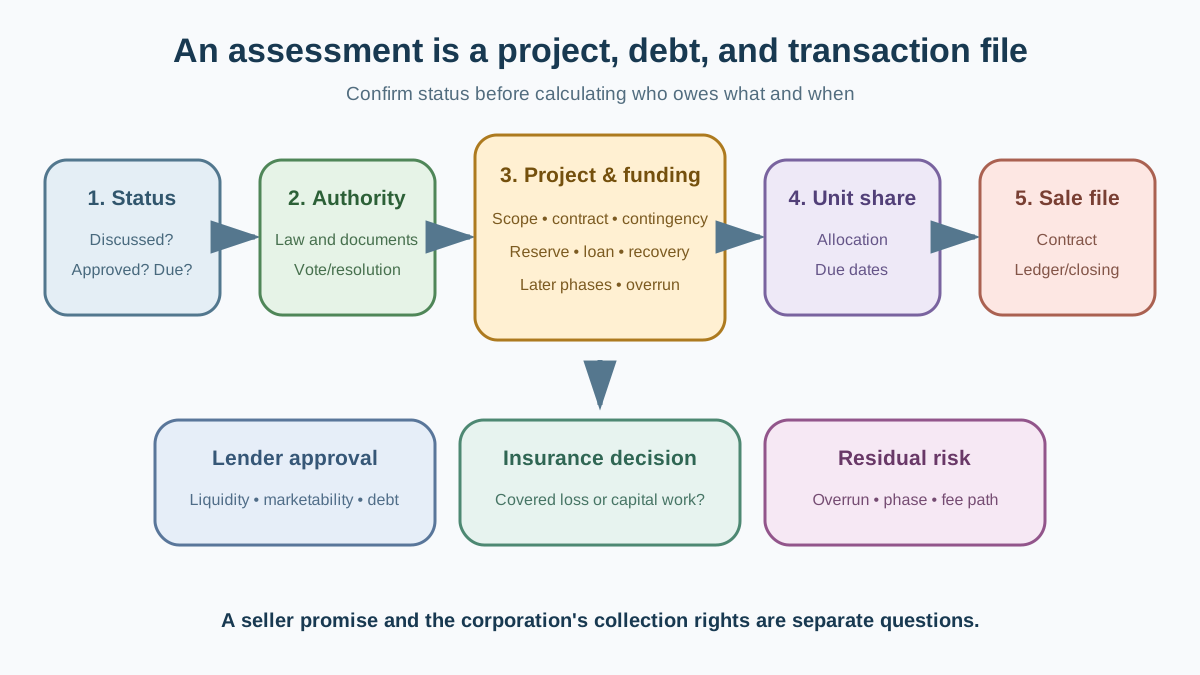
Short answer: do not ask only “who pays?”
Answer these questions in order:
- Status: rumour, study scenario, board discussion, owner notice, approved assessment, or registered unit balance?
- Authority: which statute, declaration/bylaw, budget, board decision, or owner resolution authorizes it?
- Purpose: defined project or general operating shortfall?
- Total: gross amount, financing, tax, professional fees, contingency, and recoveries?
- Unit share: which percentage, unit factor, section, or expense schedule applies?
- Payment: exact due dates, interest, lien/default consequence, and corporation borrowing?
- Transaction: what do certificate, agreement, adjustments, representations, and lawyer say?
- Residual risk: later phase, change order, litigation, deductible, or recurring operating gap?
Ontario's Condominium Authority defines a special assessment as an extra one-time charge added to owners' common expenses to cover a budget shortfall. It says Ontario boards can charge one through common expenses without obtaining owner permission, subject to that province's law and documents. Other provinces use different approval rules.
Proposed, approved, billed, due, and unpaid are different states
Use a status ladder:
| State | Evidence | Buyer treatment |
|---|---|---|
| Risk identified | Study, engineering, minutes | Scenario; not yet a debt amount |
| Funding options discussed | Board material, owner meeting | Track approval path |
| Assessment approved | Resolution/board notice under local rules | Confirm unit amount and dates |
| Billed | Unit ledger/invoice | Reconcile paid and unpaid |
| Due | Payment schedule | Allocate under agreement/legal advice |
| Arrears | Certificate/ledger/lien | Closing and lender problem |
A reserve report showing a future funding gap is not automatically an assessment. A manager email mentioning “likely owner contribution” is not an approved invoice. Conversely, a board may have approved an amount after the last minutes in the package.
Obtain a current certificate, unit ledger, notices, minutes through the latest date, and lawyer confirmation.
Provincial approval rules are not interchangeable
Ontario commonly treats a special assessment as common expenses allocated under the declaration. CAO says the board can levy without a separate owner permission vote in the circumstances described by Ontario law.
British Columbia's current Strata Property Act contains detailed special-levy provisions, including resolution content, voting, allocation, payment, use, and surplus treatment. The applicable vote and exceptions depend on the purpose and statutory section.
Alberta uses its Condominium Property Act, regulation, bylaws, and corporation decisions. Other provinces and territories have their own systems.
Do not tell a seller “the owners must vote” or a buyer “the board can do anything” without jurisdiction-specific legal review. Ask the lawyer to verify authority, procedure, notice, allocation, and unit enforceability.
Identify the funding problem beneath the assessment
Common causes include:
- capital project larger or earlier than the reserve plan;
- operating budget shortfall;
- insurance premium, deductible, uninsured loss, or coverage gap;
- litigation judgment or legal cost;
- emergency repair;
- construction defect or warranty recovery not available in time;
- owner arrears or failed commercial/shared-party contribution;
- loan repayment or financing cost;
- code, fire, accessibility, environmental, or authority order;
- utility leak or unexpected service cost;
- new condominium first-year budget deficit;
- project change order or later phase.
The cause predicts recurrence. A one-time roof scope with a fixed contract differs from chronic annual operating deficits financed by repeated assessments.
Ask what policy, budget, reserve contribution, contract, or physical repair prevents the same shortage next year.
Read the project package
For a repair assessment, collect:
- condition assessment and investigation;
- consultant's recommended scope;
- tender documents and bids;
- signed contract and change-order process;
- engineering, permit, tax, contingency, access, and restoration;
- schedule and resident impact;
- warranty and holdback;
- insurance, warranty, litigation, grant, or other recovery;
- reserve contribution and corporation borrowing;
- later phases and excluded components;
- risk if work is delayed.
The reserve-fund study audit shows how to replace an old conceptual allowance with current engineering or tender evidence.
If only a preliminary estimate exists, the approved assessment may be an initial funding tranche. Ask whether the corporation can levy more after design or opening concealed assemblies.
Calculate the subject unit amount
The allocation may follow ordinary common-expense percentage, unit entitlement, a section formula, benefit-based schedule, or another lawful governing rule.
Simple illustration:
- total assessment: $2,400,000;
- subject unit percentage: 0.375%;
- payment schedule: 40% now, 30% in six months, 30% in twelve months.
The unit total is:
$2,400,000 × 0.375% = $9,000
Instalments are:
- $3,600;
- $2,700;
- $2,700.
Confirm the unit percentage and whether parking, locker, commercial, section, or shared-facility interests change it. Confirm whether the invoice rounds or includes unit-specific arrears, interest, or chargebacks.
Do not divide the corporation total by number of units unless the governing allocation is equal.
Build a sources-and-uses statement
An assessment can fund only part of a project. Show the whole plan:
| Uses | Amount | Evidence |
|---|---|---|
| Construction contract | Signed/tender | |
| Design/engineering | Agreement | |
| Permit/tax | Estimate | |
| Contingency | Approved budget | |
| Temporary/access/restoration | Scope | |
| Financing cost | Loan terms | |
| Total uses |
| Sources | Amount | Certainty |
|---|---|---|
| Reserve/contingency fund | Available after commitments | |
| Special assessment/levy | Approved and collectible | |
| Corporation loan | Signed/conditional | |
| Insurance/warranty recovery | Paid, accepted, disputed | |
| Grant/other | Approved or application | |
| Total sources |
Do not count disputed insurance or warranty recovery as available cash. Do not use the gross reserve bank balance without deducting other projects and commitments.
“Seller pays” is not a universal closing rule
Responsibility between buyer and seller depends on provincial law, governing documents, the purchase agreement, representations, disclosure, assessment approval and due dates, certificate, and closing adjustments. The corporation may pursue the registered owner or unit under its legal rights regardless of a private promise between buyer and seller, leaving the parties to enforce their agreement separately.
Have the lawyer answer:
- Who owes the corporation at each due date?
- Does the agreement allocate assessments approved, levied, due, or contemplated before closing?
- Does the seller covenant to pay the full balance or only instalments due before closing?
- Will the lawyer pay from sale proceeds, obtain a discharge, hold funds, or adjust the price?
- Does the certificate disclose the amount and unit standing?
- What happens if the project total increases after closing?
- Are representations repeated at closing?
- Does lender approval require payment or holdback?
Use exact dates and documents. A handshake that the seller will e-transfer later is not closing protection.
Status and disclosure documents can become stale
An Ontario status certificate, BC Form B and records, Alberta estoppel, or another provincial package reflects information as of a date and under its statutory content. Boards continue to meet and conditions continue to change.
For Ontario, the status-certificate guide connects special assessments, reserve plans, budgets, litigation, insurance, and unit default. Buyers elsewhere need the correct current provincial documents.
Before waiver and again near closing, request available updates on:
- new board/owner meetings;
- project investigation and tender;
- insurance renewal or claim;
- new assessment or fee notice;
- unit arrears;
- litigation or order;
- signed contract and change order.
Ask the lawyer which update rights can be placed in the agreement. A pre-closing update is not a substitute for a satisfactory due-diligence condition.
The lender needs the assessment file
A material assessment can affect property marketability, borrower liquidity, debt, down payment, and the lender's condo review. A lender may require the amount paid, retained from proceeds, included in qualification, or supported by reserves.
Send:
- approved notice and unit amount;
- payment schedule and current ledger;
- sale-agreement allocation;
- project and building condition evidence;
- source of buyer payment;
- corporation loan and regular-fee effect;
- updated appraisal or condo documents requested.
Do not borrow assessment money on a credit card or line without telling the lender if disclosure is required. New debt can change mortgage approval.
The financing-condition guide keeps condo documents and borrower liquidity inside property approval.
Corporation borrowing changes the owner cash path
Instead of collecting the full amount immediately, a corporation may borrow under applicable law and bylaws. Owners then fund principal, interest, fees, and covenants through common expenses or a specified charge.
Compare:
| Funding choice | Immediate cash | Total financing cost | Sale treatment | Default/covenant risk |
|---|---|---|---|---|
| Lump-sum assessment | High | Low/no corporation interest | Paid/unpaid allocation | Owner liquidity |
| Instalment assessment | Medium | Possible admin/interest | Future instalments | Owner default |
| Corporation loan | Lower initially | Interest/fees over term | Embedded in future fees | Corporation covenant |
| Owner financing | Depends | Personal credit cost | Personal debt remains | Mortgage qualification |
A smaller monthly charge can cost more over time. Ask whether owners may prepay their share, whether the loan follows the unit, and how sale certificates disclose it.
Loss assessment insurance is not a general project fund
Some unit-owner policies include loss-assessment coverage for specified assessments arising from covered insured losses. Coverage depends on peril, corporation policy, deductible, cause, timing, policy wording, limit, deductible, ownership date, and notice.
It usually should not be assumed to cover:
- ordinary wear or end-of-life replacement;
- deferred maintenance;
- operating deficit;
- uninsured or excluded water/flood/earthquake event;
- pre-existing assessment before policy inception;
- betterment or code work outside coverage;
- amount above the unit policy limit;
- every corporation deductible chargeback.
Send the assessment notice, cause, corporation policy, claim information, and unit policy to the insurer. Obtain a written coverage decision. The insurance-before-closing guide explains corporation and unit layers.
Do not buy a policy after an assessment and assume it retroactively pays a known loss.
Separate an assessment, deductible chargeback, and owner damage claim
Three owner bills can arise from one event but follow different rules:
| Owner exposure | Typical basis | Documents to review |
|---|---|---|
| Corporation-wide assessment/levy | Common funding need allocated under law/documents | Resolution, project budget, allocation |
| Deductible chargeback to a unit | Corporation policy deductible attributed under statute/declaration/bylaws | Claim cause, corporation policy, chargeback authority |
| Direct unit repair or liability | Owner boundary, improvement, contents, negligence, or policy | Standard unit, owner policy, contracts, facts |
Suppose a pipe event damages several units and common property. The corporation may pay a deductible, repair its insured interest, charge an amount to a unit where legally permitted, and separately assess owners for uninsured work or a budget shortfall. The unit owner may also claim contents and living expense under the personal policy.
Do not combine these into “the condo assessment.” Ask the condo lawyer and insurers to map each dollar to authority, cause, policy, deductible, allocation, and appeal or payment process.
A corporation deductible shown on the policy is not an automatic bill to the originating unit. A unit owner's act is not an automatic finding of legal liability. Preserve evidence and avoid admitting fault before advice.
Compare buyer negotiation structures
Where an approved assessment exists, price and payment can be structured in different ways, subject to lawyer and lender approval:
Seller pays corporation from closing proceeds
The lawyer directs enough proceeds to satisfy the documented unit balance. This can give the buyer cleaner cash flow, but it does not remove project overrun or later-phase risk.
Purchase price reduced
The buyer retains responsibility and receives a lower price. A price reduction does not always create equal cash for a near-term invoice because down payment and mortgage advance also change.
Credit or adjustment at closing
The statement of adjustments allocates a defined amount. The lender must accept the structure, and the agreement should state what happens if the final balance differs.
Holdback
The lawyer holds a defined sum under written release conditions. Holdbacks can create disputes if the trigger, amount, duration, interest, and shortfall treatment are vague. The corporation may still require payment on its due date.
Seller remains responsible by covenant
This leaves collection and credit risk after closing unless secured and carefully drafted. It may not stop corporation collection against the unit or current owner.
CMHC's resale condo buying guide recommends conditional review of financial statements, budget, reserve information, judgments, insurance, and the applicable certificate package. The lawyer should connect that review to the chosen negotiation structure.
Compare structures by actual buyer cash on each due date, lender treatment, legal enforceability, tax advice, and residual project risk - not by headline concession.
Model overrun and later-phase risk
An approved $9,000 unit assessment can be the first cash call. Stress:
- contract contingency fully used;
- concealed damage discovered;
- tax or professional costs omitted;
- another component needs coordinated work;
- insurance/warranty recovery delayed or denied;
- commercial/shared party disputes its share;
- interest rises on corporation borrowing;
- project delay creates temporary repair and access cost;
- reserve contribution rises after the project;
- later phase follows within the buyer's ownership horizon.
Build three cases:
| Case | Unit current assessment | Additional scenario | Regular-fee impact | Liquidity needed |
|---|---|---|---|---|
| Approved | 0 | |||
| Supported overrun | ||||
| Later phase |
Use engineering or board evidence for scenarios. Label them as buyer stress tests, not forecasts.
Personal payment options need full-cost comparison
Possible sources include cash, lower down payment where lender-approved, negotiated price/credit, seller payment through closing, secured credit, personal loan, or other financing. Each affects liquidity, interest, qualification, tax, and risk.
Compare:
- cash due by date;
- interest and fees;
- effect on emergency reserve;
- effect on mortgage approval and ratios;
- prepayment terms;
- security against the unit;
- tax treatment for rental property with professional advice;
- consequence if a second assessment follows.
Do not empty all emergency cash merely to preserve a purchase price. The household still faces unit repairs, deductible, moving, and ordinary living risks.
Worked buyer scenario
Assume a 180-unit corporation approves $4.8 million for garage waterproofing. The subject unit's declaration percentage is 0.31%, producing $14,880. Half is due before closing and half four months after.
The seller offers to pay the first $7,440 instalment. The buyer should not assume exposure is therefore $7,440.
The lawyer should clarify who pays the second instalment under the agreement and to the corporation, whether the seller will pay the entire balance from proceeds, and whether a holdback is acceptable. The buyer should also review whether $4.8 million is a signed all-in budget, whether contingency and tax are included, and whether later garage phases exist.
If a supported 15% project overrun were allocated the same way, the unit scenario would add:
$4,800,000 × 15% × 0.31% = $2,232
That is stress math, not a claim the board will assess it. The buyer can decide whether total liquidity, price, and building economics remain acceptable.
For sellers: prepare the file before listing
Collect current:
- assessment notice and approving resolution;
- project scope and funding statement;
- unit ledger and payment receipts;
- remaining instalments and due dates;
- corporation loan terms;
- fee changes and later phases;
- certificate/status documents;
- sale-agreement strategy from the lawyer;
- net-proceeds impact.
Do not market the assessment as “fully paid” if later instalments, loan payments, change orders, or separate phases remain. Accurate early evidence reduces failed financing and closing disputes.
The seller net-proceeds worksheet should include the full promised seller payment, legal treatment, and any holdback.
Update the assessment file before closing
Between waiver and closing, confirm new minutes, change orders, instalments, owner defaults, corporation borrowing, insurance recovery, and later-phase decisions. Ask the lawyer whether the seller's representations repeat and whether a new certificate or ledger is needed.
At the final walkthrough, focus on the unit and agreed work; do not attempt to inspect a major common project without authorization. Report new leaks, access restrictions, shutdowns, or damage immediately because they may affect insurance, lender, and closing advice.
Common special-assessment mistakes
- treating a study scenario as an approved bill;
- accepting rumour that no assessment is coming despite documented funding gap;
- applying another province's voting rule;
- dividing total equally by units;
- ignoring parking, section, or commercial allocation;
- reading the assessment without the project scope;
- subtracting disputed insurance or warranty proceeds;
- assuming seller always pays every future instalment;
- failing to update the lender;
- assuming unit insurance covers ordinary capital work;
- modelling approved amount but no overrun or later phase;
- withholding regular fees or assessment without legal advice.
Frequently asked questions
What is a condo special assessment in Canada?
It is an additional owner contribution outside ordinary fees, raised under the applicable provincial law and governing documents for an authorized expense or shortfall. BC commonly uses “special levy.”
Can a condo board impose an assessment without an owner vote?
It depends on the province, purpose, law, and documents. CAO says Ontario boards can charge special assessments through common expenses without owner permission. BC and other regimes have different resolution and voting provisions.
How is my unit's amount calculated?
Use the lawful allocation in the declaration, strata plan, section, or governing documents. It may be a percentage or unit entitlement and may differ for certain expenses.
Who pays an assessment when a condo is sold?
The corporation's rights and the buyer-seller allocation are separate legal questions. The agreement, due dates, certificate, provincial law, and closing adjustments matter. Have the lawyer document payment from proceeds or other protection.
Does a paid assessment remove all project risk?
No. Scope changes, overruns, later phases, reserve replenishment, loan costs, and other components may remain. Read the full project and funding plan.
Will home insurance cover a special assessment?
Only if the unit policy's loss-assessment coverage applies to the cause and timing. Ordinary deterioration and capital replacement are not automatically insured. Obtain a written insurer decision.
Can I finance a special assessment?
Possibly through corporation or personal financing, subject to law, lender approval, credit, and terms. Compare total interest, fees, qualification impact, security, and future cash risk.
What happens if an owner does not pay?
Corporations may have lien, interest, legal-cost, voting, collection, or sale remedies under provincial law and documents. Do not withhold payment without condo legal advice.
What to read next
- Reconcile the reserve plan before estimating another cash call
- Compare regular condo fees and funding contributions
- Review the Ontario status certificate and current updates
- Confirm insurance layers and deductible exposure
Method and sources
This guide was updated July 19, 2026. It uses current Ontario CAO special-assessment and common-expense guidance, current BC Strata Property Act finance provisions, CMHC condo buyer materials, and BubbleWatch's reserve, certificate, lender, insurance, and transaction workflows. Provincial law and governing documents control. Obtain current condominium legal, engineering, accounting, insurance, lender, and tax advice.
Advertisement

About David R. Chen, CFA
David R. Chen is a Chartered Financial Analyst and the Senior Housing Economist at BubbleWatch.ca. He brings 12+ years of experience in quantitative real estate analysis and mortgage underwriting. Formerly an analyst at a major Canadian bank, he specializes in modeling payment shock, regional affordability divergence, and private lending risk.
View David's professional bio & credentials →