Condo Reserve Fund Studies in Canada 2026 Analysis
A province-aware reserve-study audit that reconciles physical components, responsibility, project timing, estimate basis, actual work, current fund balance, contribution path, inflation, interest, and special-assessment exposure.
Condo Reserve Fund Studies in Canada: Read the Component Plan, Cash Flow, and Funding Gap
A condo reserve fund study, depreciation report, or replacement-reserve plan is a dated model of common components and future capital cash flow. It should identify what the corporation must repair or replace, estimate condition and timing, project costs, and recommend a contribution plan under the governing regime.
It is not a building warranty or a promise that projects will occur on exact dates and budgets. Buyers should reconcile the report with current physical evidence, completed and deferred work, contracts, minutes, insurance, audited statements, current fund balance, and the board's actual funding plan.
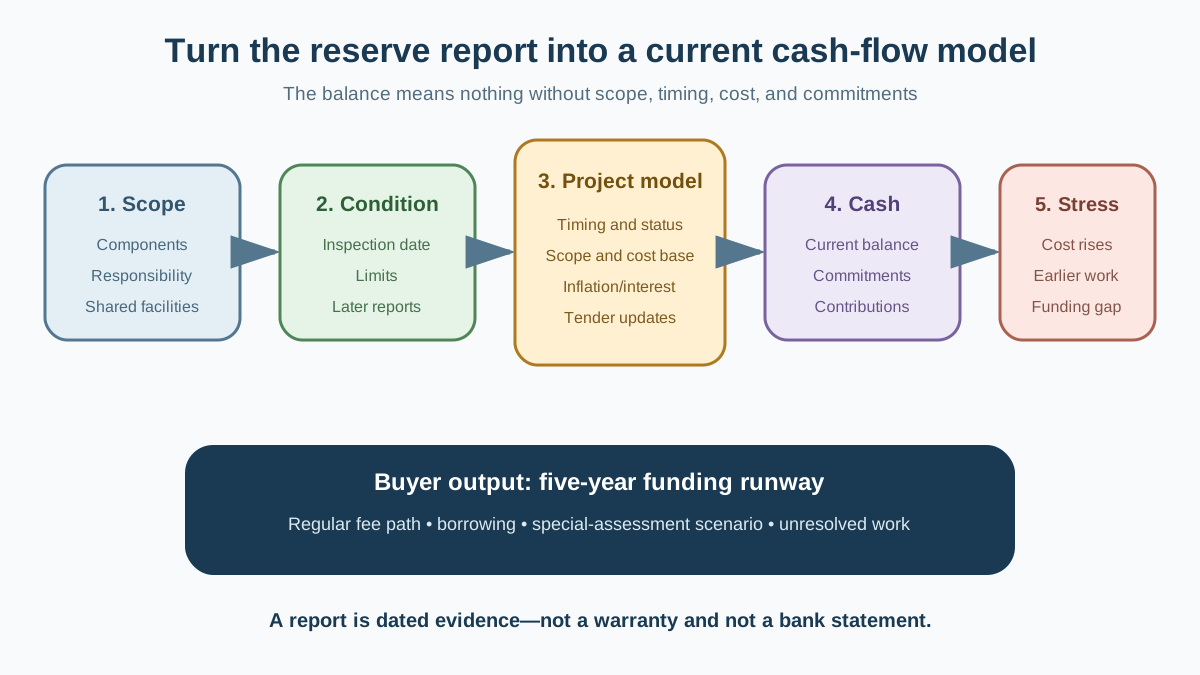
Short answer: answer seven questions
- Scope: Are all corporation-responsible components and shared obligations included?
- Condition date: When was the site inspected and what was inaccessible?
- Timing: Which projects are due, underway, deferred, advanced, or combined?
- Cost basis: What estimate date, scope, inflation, tax, professional fees, contingency, and restoration are assumed?
- Current cash: What is the reconciled reserve balance after commitments and recent spending?
- Contributions: Does the approved budget follow the recommended funding path?
- Failure case: What fee increase, borrowing, scope change, or special assessment follows if costs rise or timing advances?
The Condominium Authority of Ontario's reserve-fund guide says the mandatory reserve pays for major repairs and replacements of common elements and assets and that periodic professional studies establish and update estimates. Other provinces use different names, cycles, and rules.
Use the correct provincial framework
Condominium legislation is provincial or territorial. Do not transfer a rule from Toronto to Vancouver or Calgary.
Ontario
Ontario's CAO describes three reserve-study classes and a cycle of professional updates. Its current guide says the initial comprehensive study is followed by alternating updates, including studies with and without site inspection, within the prescribed three-year periods.
The study supports a funding plan, but the buyer should also review notices, audited statements, periodic information certificates, status certificate, budgets, and minutes. The Ontario status-certificate workflow connects those documents.
British Columbia
BC calls the document a depreciation report. The province's current requirements page says strata corporations with five or more lots must obtain reports on a five-year cycle and may no longer use an annual three-quarter vote to defer.
For strata corporations without a qualifying recent report, the current transition deadlines are July 1, 2026 in Metro Vancouver, the Fraser Valley, and most of the Capital Regional District, and July 1, 2027 in other areas, subject to the page's island details. Buyers in 2026 should verify whether the specific corporation met or is approaching its deadline.
BC reports project common-property and asset maintenance, repair, and replacement over 30 years. Bare-land strata responsibilities can include roads, water, electricity, and sewage, not only buildings.
Alberta
Alberta requires qualified reserve-fund study providers under its Condominium Property Regulation. The province's condominium information page and provider fact sheet should be checked with the current Act and regulations.
Alberta consumer resources describe a five-year study cycle. Confirm the report date, plan, annual report, and current corporation compliance with an Alberta condominium lawyer or qualified reviewer.
The comparison point is not which province has the “best” interval. It is whether the subject corporation has the required current document and has turned it into a realistic, followed plan.
Inventory every corporation responsibility
The component inventory is the foundation. Compare it with declaration, strata plan, bylaws, standard-unit definition, shared-facility agreement, reciprocal agreements, and maintenance obligations.
Possible components include:
- structure, foundations, parking garage, balconies, and waterproofing;
- roof, façade, windows, doors, sealants, cladding, and skylights;
- elevators, fire protection, security, electrical, generator, and emergency systems;
- plumbing, drainage, pumps, domestic water, sewer, gas, heating, cooling, ventilation, and controls;
- roads, sidewalks, curbs, retaining walls, fencing, lighting, landscape, irrigation, and snow equipment;
- pool, gym, party room, guest suite, marina, dock, shoreline, recreational and amenity systems;
- common interiors, furnishings, equipment, and building envelope;
- bare-land strata water, septic, electrical, roads, bridges, or private infrastructure;
- components inside units or limited common property that the corporation must repair;
- shared facilities allocated with another corporation, hotel, commercial owner, or adjoining property.
If a report omits windows because owners were assumed responsible, verify that assumption against the governing documents. A technical consultant does not rewrite the declaration.
Read the site-inspection date and limitations
A report issued in 2026 may rely on a 2025 or earlier site inspection. Record:
- inspection date and weather;
- report date and cost base date;
- areas and sample sizes inspected;
- concealed or inaccessible components;
- reliance on management or prior reports;
- destructive testing excluded;
- engineering, code, environmental, and insurance limits;
- assumptions about maintenance history;
- recommendations for specialist investigation.
A reserve planner often estimates long-run capital needs from visual evidence and records. It may not perform a structural assessment, garage investigation, elevator audit, pipe sampling, façade testing, energy study, or environmental test.
When the report recommends a condition assessment, treat it as a separate unresolved task. Read later engineering reports and minutes for the result.
Build a component variance table
For every material component, compare study and current evidence:
| Component | Study action/year | Current evidence | Timing change | Cost change | Status |
|---|---|---|---|---|---|
| Garage membrane | Engineering/minutes | ||||
| Roof | Contract/inspection | ||||
| Elevators | Maintenance/modernization proposal | ||||
| Plumbing | Leak history/pipe study | ||||
| Windows | Responsibility/condition | ||||
| HVAC | Service/energy plan |
Classify status as complete, underway, tendered, planned, deferred, under investigation, or unknown. Do not mark a project complete because a board discussed it.
If work was deferred, ask whether condition changed, interim repair was completed, or cash was redirected. Deferral can be prudent after better evidence or risky if driven only by cash shortage.
Study cost is not a contractor quote
Reserve estimates may use unit rates, benchmarks, allowances, indexed prior costs, or conceptual scope. Ask what is included:
- demolition and disposal;
- access, swing stage, crane, shoring, traffic, and protection;
- hazardous-material handling;
- design, engineering, tender, permit, and inspection;
- tax;
- contingency;
- inflation to project year;
- code, accessibility, energy, or bylaw work;
- temporary services and resident relocation;
- interior restoration and landscaping;
- shared-facility allocation;
- escalation during multi-year construction.
Once a project enters investigation or tender, replace the old study allowance with the newer scope and estimate in the buyer scenario. Keep both values so the variance is visible.
Understand inflation and interest assumptions
A 30-year model compounds cost and investment assumptions. Small differences can materially change distant balances.
Record:
| Assumption | Study value | Current plan | Stress case |
|---|---|---|---|
| Construction inflation | |||
| Interest/investment return | |||
| Tax treatment | |||
| Contribution growth | |||
| Opening balance | |||
| Minimum/target balance |
Do not replace the professional model with an arbitrary national inflation forecast. Ask whether actual projects and investments are tracking the assumptions, then stress near-term material work at supported current costs.
Interest should match eligible investments and liquidity needs under local law. A high assumed return is not free money if funds must remain available for projects.
Reconcile the opening balance to current cash
The report's opening balance becomes stale as contributions, interest, projects, and fees move.
Use this bridge:
Study opening balance + actual contributions + actual interest − actual eligible spending = expected current balance
Then compare with the latest bank/investment balances and audited or interim financial statements. Adjust for outstanding cheques, receivables, payables, committed contracts, and restricted amounts.
Ask:
- Are all reserve accounts and investments included?
- Are contributions deposited on schedule?
- Which contracts are committed but not yet paid?
- Has operating cash borrowed from or owed money to the reserve?
- Are special-assessment proceeds separately traceable?
- Did investment maturity match project timing?
- Are there audit adjustments or internal-control concerns?
A quoted bank balance can overstate free cash if a major contract is signed. It can understate total assets if investments are shown separately.
Compare recommended and approved contributions
Extract the report's annual contribution path, then compare it with budgets actually approved.
| Fiscal year | Study recommendation | Approved budget | Actual contribution | Variance |
|---|---|---|---|---|
| Prior | ||||
| Current | ||||
| Next |
Investigate every material shortfall. The board may have adopted a different lawful plan, updated project timing, used surplus, received insurance proceeds, or failed to fund adequately.
Ontario's CAO reserve-fund explainer cautions that a large or small balance alone does not determine health. The question is whether enough money will be available when projects are due.
Funding percentage can create false precision
Some reports or advisers describe a reserve as a percentage funded. Definitions vary. A ratio can compare current assets with a theoretical fully funded balance, projected needs, or another benchmark.
Always ask:
- funded relative to which liabilities and date?
- does the denominator include all components and current costs?
- are committed contracts deducted?
- is the contribution plan on track?
- what happens in the next five years, not only at year 30?
A building can show an acceptable long-run ratio while facing a near-term liquidity gap. Another can show a low ratio under one method yet have an approved contribution path and manageable project sequence.
Focus on the five-year project runway
Long-range modelling matters, but the first five years usually affect a buyer's cash and resale horizon most directly.
Build this table:
| Year | Opening cash | Contributions/interest | Projects | Closing cash | Decision or tender status |
|---|---|---|---|---|---|
| 1 | |||||
| 2 | |||||
| 3 | |||||
| 4 | |||||
| 5 |
Replace report values with known current contract or engineering figures. Add a timing-advance case for a material component whose condition could require earlier work.
If projected closing cash turns negative or below an operational minimum, identify the assumed response: higher regular contributions, special assessment, borrowing, project deferral, scope reduction, or other lawful funding.
Match projects to minutes and physical evidence
Search several years of minutes and notices for each major component. Look for:
- recurring leaks, shutdowns, failures, or resident complaints;
- engineering proposals and investigations;
- tender approval and change orders;
- insurance claims and deductible;
- warranty disputes;
- code or authority orders;
- litigation involving construction;
- repeated temporary repairs;
- votes to defer, borrow, assess, or change scope;
- access planning and resident disruption.
Minutes can show a problem before it appears in the next reserve update. They can also show that a scary old recommendation was investigated and narrowed.
The condo fee guide ties reserve contributions to operating budgets and actual owner cash.
Shared facilities need allocation evidence
Two towers, a residential and commercial condominium, or a hotel-residence complex may share garage, mechanical, recreation, roads, utilities, or staff. The reserve report may show only the subject corporation's assumed share.
Review:
- shared-facilities or reciprocal agreement;
- component ownership and repair authority;
- cost-allocation formula;
- voting and dispute process;
- reserve responsibility;
- arrears or dispute with the other party;
- insurance and deductible allocation;
- project schedule across entities.
A 50% line in a report is not proof the other entity will willingly pay on time. Ask the lawyer to assess enforceability and current disputes.
New, converted, and recently repaired buildings need different questions
A new corporation has little operating and repair history. Its first study may rely on design documents, expected components, and new-construction assumptions rather than observed ageing. Check whether every common component and shared obligation was transferred, commissioned, warranted, and included.
Ask for:
- developer disclosure budget and first-year guarantee or reconciliation rights;
- performance audit, deficiency, warranty, and turnover records;
- commissioning and equipment inventory;
- shared-facility agreements and cost allocation;
- first reserve/depreciation report deadline;
- owner-developer contribution required by local law;
- uncompleted amenities or common elements;
- litigation or warranty claims and legal cost;
- actual first independent budgets and insurance renewals.
A conversion from rental, commercial, institutional, or older freehold use may begin with components already partly consumed. Review the conversion technical report, building condition, code work, warranty limits, and opening reserve separately.
A recently repaired building also needs reconciliation. A new roof can reduce one forecast need while a large garage project remains. Ask whether the completed work has warranty, holdback, deficiencies, liens, final engineering certification, and updated remaining-life assumptions.
Do not assume “new” means no capital risk or “old” means immediate failure. The question is whether the study accurately describes the transferred assets and current obligations.
Know when a reserve study needs a deeper condition report
A planner may recommend a specialist investigation because visual evidence cannot define scope. Triggers can include recurring garage leakage, façade movement, balcony deterioration, pipe failures, elevator obsolescence, roof moisture, structural distress, fire-system deficiencies, or unexplained equipment shutdowns.
Create an investigation ledger:
| Trigger | Recommended specialist | Approval date | Report due | Budget allowance | Buyer status |
|---|---|---|---|---|---|
If the investigation is not complete, do not invent a repair figure from the reserve study. Show the old allowance, current warning evidence, expected report date, and a labeled liquidity stress case.
If the report is complete, compare its tested scope, options, urgency, and estimate with the reserve model. The later technical report usually provides better project evidence for that component, while the reserve study remains useful for the full funding sequence.
Insurance, warranty, and reserve are separate funding sources
A reserve funds deterioration and replacement within its lawful purpose. Insurance responds to covered events under limits, deductibles, exclusions, and settlement terms. Warranty responds to eligible defects under its contract or statute.
For a project with possible recovery, show:
| Gross project cost | Expected insurance/warranty recovery | Timing/conditions | Net reserve need | Unfunded risk |
|---|---|---|---|---|
Do not subtract disputed recovery as cash. Litigation and claims can take time and cost money.
Build three buyer scenarios
Plan case
Use the current reconciled balance, approved contribution path, current project schedule, and supported cost estimates.
Cost case
Increase one or more near-term project amounts using current engineering or tender evidence. Keep the assumption explicit.
Timing case
Move a material project earlier because of documented condition or uncertainty. Do not invent failure; show the liquidity effect if timing advances.
For each, calculate the unit's share using the governing allocation and possible funding response. The output is not a prediction of a special assessment. It is a cash-capacity test.
The special-assessment workflow carries a proposed or scenario amount into authorization, due dates, sale contract, lender, and owner liquidity.
Worked reserve audit
Assume a corporation's 2024 study showed:
- $2.4 million opening reserve;
- $600,000 annual contributions;
- a $1.8 million garage project in 2027;
- a $1.2 million roof project in 2029.
In 2026, minutes show garage investigation now estimates $3.0 million and recommends 2027 work. The current reserve statement is $3.1 million, and the approved 2026 contribution is $650,000.
The buyer should rebuild the 2026–2029 cash flow with the $3.0 million garage scope, confirm tax/professional/contingency inclusion, deduct any signed commitments, and check whether the roof timing or cost changed. The $3.1 million balance is not “more than enough” merely because it exceeds one year's original project number.
If the model shows a $1.0 million shortfall under the updated sequence and the subject unit's allocation is 0.5%, a simple exposure illustration is $5,000 before financing costs or a different allocation. The board may choose higher contributions, borrowing, scope, timing, or another lawful response. Label the $5,000 as scenario math, not an announced assessment.
Seller reserve-file checklist
A seller can reduce buyer uncertainty by gathering the current report and every material update before listing. Include the latest funding plan, budgets, audited statements, current reserve balance, project contracts, engineering reports, assessment notices, insurance claims, and minutes through the listing date.
Identify work completed after the report, open deficiencies, signed commitments, and contributions already approved for the next fiscal year. Do not advertise the reserve as “fully funded” without defining the measure and project date.
Ask the lawyer which records can be supplied, which representations should be avoided, and how new board decisions will be disclosed before closing. A clear chronology is more useful than a screenshot of the bank balance.
Common reserve-study mistakes
- reading only the current balance;
- assuming report date equals site-inspection date;
- overlooking omitted or owner-responsible components;
- treating conceptual estimates as contractor bids;
- ignoring tax, design, access, restoration, and contingency;
- failing to update completed, deferred, or accelerated projects;
- comparing study opening cash with a current bank balance without reconciliation;
- ignoring contribution shortfalls;
- relying on a percentage-funded label without definition;
- overlooking shared facilities;
- subtracting uncertain insurance or warranty recoveries;
- looking at year 30 but missing next year's liquidity.
Frequently asked questions
What is a condo reserve fund study?
It is a professional physical and financial plan for major repair and replacement of corporation-responsible components under the applicable provincial regime. BC commonly calls it a depreciation report.
How often are reserve studies required?
It depends on the province. Ontario uses a prescribed alternating update cycle; BC generally requires a five-year depreciation-report cycle for strata corporations with five or more lots; Alberta uses its own five-year framework. Confirm current local law.
How much money should a condo reserve have?
There is no useful Canada-wide amount per unit. Compare reconciled assets and future contributions with the timing and current cost of all obligations.
Does a recent study mean the building is in good condition?
No. It is a dated planning document with scope and inspection limits. Read condition assessments, inspection reports, minutes, claims, orders, and current projects.
Can reserve money pay any corporation expense?
No. Permitted uses follow provincial law and governing documents. Operating, improvement, repair, replacement, and insurance items may be treated differently. Obtain legal/accounting advice.
Does a reserve shortfall guarantee a special assessment?
No. The corporation may adjust regular contributions, borrow, change lawful scope or timing, use recoveries, or levy an assessment. Model plausible responses and read actual board decisions.
Is a large reserve balance always good for buyers?
It is useful only relative to obligations and commitments. A large balance may be assigned to larger imminent projects.
Should buyers hire an engineer to review the study?
For material technical uncertainty, a qualified engineer, reserve planner, accountant, or other specialist can help. A condo lawyer should review legal responsibility and documents. Scope depends on risk and jurisdiction.
What to read next
- Normalize condo fees and reserve contributions
- Stress-test a proposed or possible special assessment
- Connect an Ontario status certificate to the underlying evidence
- Build a personal reserve for unit and corporation exposure
Method and sources
This guide was updated July 19, 2026. It uses current Ontario CAO reserve guidance, current British Columbia depreciation-report requirements and strata law, current Alberta condominium information, CMHC condo buyer resources, and an evidence-reconciliation method. Provincial law and governing documents control. Obtain current condominium legal, engineering, reserve-planning, accounting, insurance, lender, and management advice.
Advertisement

About David R. Chen, CFA
David R. Chen is a Chartered Financial Analyst and the Senior Housing Economist at BubbleWatch.ca. He brings 12+ years of experience in quantitative real estate analysis and mortgage underwriting. Formerly an analyst at a major Canadian bank, he specializes in modeling payment shock, regional affordability divergence, and private lending risk.
View David's professional bio & credentials →