First Home Savings Account (FHSA) in Canada: The 2026 Rules, Worked Through
The First Home Savings Account pairs an RRSP-style deduction with TFSA-style tax-free withdrawals for first-time buyers: $8,000 a year to a $40,000 lifetime limit. This guide works the 2026 rules end to end: the carry-forward trap, the December 31 deadline, what counts as a qualifying withdrawal, the 15-year clock, and the no-buy escape hatch, with every dollar figure worked out.
First Home Savings Account (FHSA) in Canada: The 2026 Rules, Worked Through
Short answer: The FHSA is a registered account for first-time home buyers that takes a tax deduction on the way in and pays out tax-free on the way out. In 2026 you can contribute up to $8,000 a year, to a $40,000 lifetime limit, and the growth inside the account is sheltered too. Contributions must be in by December 31, 2026 to count for 2026. There is no RRSP-style 60-day window. And room only starts accumulating in the year you open the account, so opening it early, even with nothing in it yet, is the single highest-value move most future buyers can make this year.
This guide is education only. It is not tax, legal, or financial advice. FHSA rules have edge cases, and the CRA pages are the final word. Confirm anything unusual with a tax professional before you act.
What the account actually does
Three tax treatments stack in one account:
- Deduction going in. Every dollar you contribute reduces your taxable income for the year, the same way an RRSP contribution does. Contribute $8,000 and the CRA taxes you as if you earned $8,000 less. You can claim the deduction in the year you contribute or defer it to a later year.
- Sheltered growth. Interest, dividends, and capital gains inside the FHSA are not taxed while they sit in the account. You can hold GICs, stocks, ETFs, bonds, and mutual funds, the same menu as an RRSP or TFSA.
- Tax-free coming out. A qualifying withdrawal, used to buy or build your first home, is not taxed and is never repaid. The growth comes out tax-free too. There is no cap on a qualifying withdrawal: $40,000 of contributions plus $12,000 of growth leaves as $52,000, tax-free.
That combination, deduction plus tax-free withdrawal, is what makes the FHSA the strongest savings vehicle the federal government has built for first-time buyers. Our FHSA vs RRSP (HBP) comparison works the sequencing strategy in full. This guide covers the account's own rules: who qualifies, how room works, the deadlines that trip people up, and what the money does if you never buy.
The account has been available from Canadian financial institutions since April 2023.
Who can open one: the four gates
All four must be true:
- You are a resident of Canada.
- You are 18 or older, and 71 or younger on December 31 of the year. In provinces and territories where the age of majority is 19, you must be 19.
- You are a first-time home buyer. The CRA test: you did not live in a home that you owned, or that your spouse or common-law partner owned, at any time in the current calendar year or the previous four calendar years. The spouse part is the gate people miss. If your partner owned the condo you lived in two years ago, you are not a first-time buyer for FHSA purposes, even if you personally never held title.
- You have a valid SIN and file a tax return. Practically, the account runs through your tax filings.
If all four hold, any Canadian bank, credit union, or brokerage that offers FHSAs can open one for you.
The room rules: $8,000 a year, $40,000 for life, and the trap inside them
The contribution limits are simple numbers with one sharp edge.
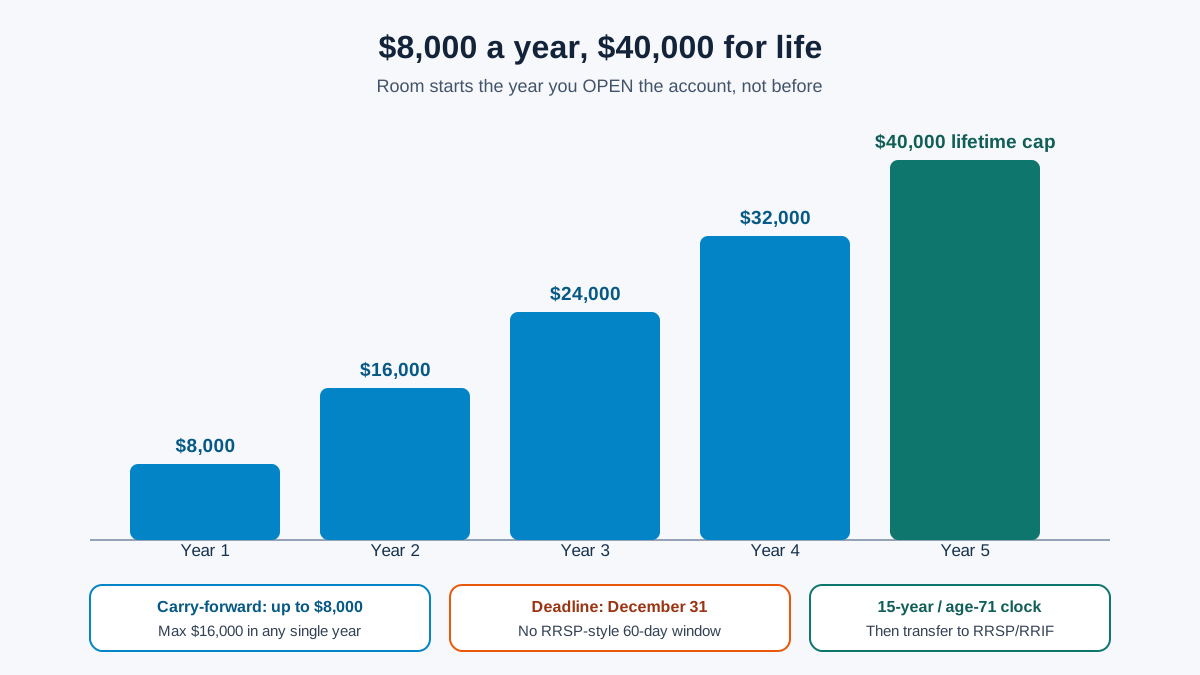
- Annual limit: $8,000. Your FHSA contribution room for a year is $8,000.
- Lifetime limit: $40,000. Contributions plus any RRSP amounts you transfer directly into the FHSA, combined, cannot exceed $40,000.
- Carry-forward: up to $8,000. Unused room carries forward, but only $8,000 of it. So the most you can contribute in a single year is $16,000: this year's $8,000 plus $8,000 carried forward.
Now the sharp edge: contribution room only starts accumulating in the year you open your first FHSA. A TFSA accrues room from the year you turn 18 whether you open one or not. The FHSA does not. Open your first FHSA in 2026 and 2026 is your first room year. Wait until 2028 and 2026 and 2027 never existed for you.
Run two savers through it. The figures below are labelled illustrations.
- Amara opens in 2026, contributes $0. In 2027 her room is $16,000: $8,000 of 2027 room plus $8,000 carried from 2026.
- Jonah waits and opens in 2028. His 2028 room is $8,000. The 2026 and 2027 room is gone permanently.
And the carry-forward is not cumulative beyond one year's room: skip contributing for three straight years and you carry forward $8,000, not $24,000. The account rewards opening early and contributing steadily, not hoarding room.
The December 31 trap
RRSP contributions made in the first 60 days of a year can be claimed for the previous tax year. The FHSA has no such window.
An FHSA contribution counts for the calendar year in which it is made, full stop. Contribute $8,000 on January 15, 2027 and it is a 2027 contribution. To use 2026 room, the money must be in the account by December 31, 2026. Brokerage settlement times and holiday processing mean the last week of December is a bad time to start; the practical deadline is a few business days earlier.
This is the most common FHSA mistake in the account's early years, because every Canadian saver has the RRSP's 60-day habit. Different account, different clock.
What five full years actually produce
The worked example: $8,000 contributed each year for five years, at a labelled hypothetical 5% annual return, contributions assumed at year end.
| Year | Contributed that year | Total contributed | Balance at 5% |
|---|---|---|---|
| 1 | $8,000 | $8,000 | $8,000 |
| 2 | $8,000 | $16,000 | $16,400 |
| 3 | $8,000 | $24,000 | $25,220 |
| 4 | $8,000 | $32,000 | $34,481 |
| 5 | $8,000 | $40,000 | $44,205 |
$40,000 of contributions, about $4,205 of sheltered growth, all of it available tax-free for a first home. A couple where both partners are eligible runs the same table twice: $80,000 of contributions growing to about $88,410, each partner's account separate.
Now the deduction side, at labelled hypothetical marginal rates. An $8,000 contribution:
- At a 25% marginal rate, it cuts your tax bill by $2,000.
- At a 30% marginal rate, $2,400.
- At a 40% marginal rate, $3,200.
Five full years at 30% is $12,000 of tax saved on top of the $44,205. A couple at 30% each keeps $24,000 of tax plus the $88,410. That is the double benefit in dollars: the government funds part of your down payment through the deduction, then lets the whole thing out tax-free.
Deferring the deduction: when waiting pays
You do not have to claim the deduction in the year you contribute. You can carry the deduction forward and claim it in a later year, which is worth doing when your income, and therefore your marginal rate, will be higher.
$8,000 contributed in a 25% year and claimed then saves $2,000. Contribute in the 25% year, defer the claim to a 40% year, and the same $8,000 saves $3,200. The $1,200 difference costs nothing but patience.
Two cautions. First, deferral only helps if your rate actually rises. A saver whose income is flat should claim now: a certain $2,400 today beats a possible $3,200 later, because the later claim is worth less in present value and the deferral has an opportunity cost if the refund would have been reinvested. Second, the 15-year clock in the section below keeps running either way. Deferring the deduction does not extend anything.
The qualifying withdrawal: five conditions
A withdrawal is tax-free only if it is a qualifying withdrawal. The conditions, from the CRA framework:
- You are a first-time home buyer and a Canadian resident when you withdraw. Same four-year test as account opening.
- You have a written agreement to buy or build a qualifying home in Canada, signed before October 1 of the year after the withdrawal. Withdraw in 2028 and the agreement must exist by October 1, 2029.
- You intend to occupy the home as your principal residence within one year of buying or building it.
- The home qualifies. Single, semi-detached, mobile, or townhome; a condo or apartment unit, including in a duplex, triplex, fourplex, or apartment building; or a co-operative housing unit that gives you an equity interest.
- You had not acquired the home 30 or more days before the withdrawal. Buy on June 1 and withdraw on June 20 and it still qualifies. Buy on June 1 and withdraw on July 15 and it does not.
Note what is absent: there is no minimum holding period for contributions the way the Home Buyers' Plan requires 90 days of RRSP seasoning. Money contributed in November can fund a qualifying withdrawal in December, provided the other conditions hold.
A qualifying withdrawal has no dollar cap. Contributions, transfers, and all the growth come out together, tax-free, and nothing is repaid. Ever. That is the FHSA's structural advantage over the Home Buyers' Plan, which must be repaid to your RRSP over 15 years.
The account's clock: 15 years, age 71, or the year after you buy
An FHSA cannot stay open forever. It ceases to be an FHSA after December 31 of the year in which the earliest of these happens:
- The 15th anniversary of the year you first opened an FHSA. Open in 2026 and the account must close by the end of 2041.
- The year you turn 71.
- The year following your first qualifying withdrawal. Buy with the FHSA in 2028 and the account winds up by the end of 2029. You cannot keep contributing after you have used it to buy.
Fifteen years is generous for a savings account, but it makes the opening date real in the other direction too: open at 25, buy nothing, and the decision in the next section arrives at 40.
If you never buy: the RRSP escape hatch
Life changes plans. The FHSA has a built-in exit that makes opening one nearly risk-free.
Transfer the balance to your RRSP or RRIF, tax-free. The transfer does not use any of your RRSP contribution room, and the growth transfers with it. The money stays sheltered and is taxed only when you eventually withdraw it from the RRSP or RRIF, like any retirement savings.
Or withdraw it and pay tax. A non-qualifying withdrawal is added to your income for the year, like an RRSP withdrawal, with withholding tax at source.
The transfer is why financial planners describe the FHSA as a no-lose account for eligible savers: if you buy, the money was tax-free both ways; if you don't, it becomes retirement savings that never touched your RRSP room. The only real cost of opening one and never using it for a home is the paperwork.
Over-contributions: the 1% monthly tax
Contribute more than your available room and the CRA charges 1% per month on the excess for each month it remains in the account. The usual way this happens: contributing the full $8,000 in January, then contributing again after a job change or a second account at another institution, or misreading the carry-forward as cumulative.
Two-account holders take note: the $8,000 annual and $40,000 lifetime limits apply to you across all your FHSAs combined, not per account. The CRA totals them.
If you over-contribute, withdrawing the excess stops the monthly tax, but the withdrawal is taxable income. Fix it fast: the tax compounds monthly while the excess sits.
The FHSA and the Home Buyers' Plan, together
The two programs are separate and stackable. One person can contribute $40,000 to an FHSA and separately withdraw up to $60,000 from an RRSP under the Home Buyers' Plan, for $100,000 of tax-advantaged down payment money. A couple where both partners are eligible can reach $200,000 combined.
Two mechanics worth knowing:
- RRSP to FHSA transfers are allowed. Moving RRSP funds directly into your FHSA uses FHSA room but generates no new deduction (you already claimed it when the money went into the RRSP). The transferred amount can later leave as a tax-free qualifying withdrawal, which is the one path where RRSP-sourced money escapes tax entirely.
- FHSA first, HBP second, is the usual sequencing, because FHSA money never has to be repaid while HBP withdrawals are repaid to your RRSP over 15 years. The full sequencing argument, with the repayment-burden math, is in our FHSA vs RRSP (HBP) strategy guide.
Where the down payment goes from here: our down payment rules guide covers how much you need at every price, down payment sources covers what lenders accept and the 90-day seasoning rule, gifted down payments covers the family-help paperwork lenders want to see, and the first-time buyer roadmap sequences the whole purchase. Once you have the down payment number, the GDS and TDS guide works the income ratios your lender will apply.
Seven mistakes that cost real money
- Waiting to open. Every year before your first FHSA is a year of room that never existed. Open it the year you become eligible, even if the first contribution is months away.
- January contributions for the wrong year. The FHSA has no 60-day window. December 31 is the line.
- Claiming the deduction in a low-income year. If a higher-earning year is coming, deferring the claim can be worth $1,200 per $8,000 in the 25%-to-40% case.
- Double-counting room across two institutions. Limits are per person, not per account. Two FHSAs at two banks share one $8,000 annual limit.
- Forgetting the spouse in the first-time buyer test. Living in a partner-owned home within the last four years disqualifies you, even with no title in your name.
- Treating every withdrawal as qualifying. No written agreement by October 1 of the following year, or buying more than 30 days before the withdrawal, turns it into taxable income.
- Contributing after the purchase. The account winds up by December 31 of the year after your first qualifying withdrawal. Contributions after that are excess, taxed at 1% a month.
Can both partners open an FHSA for the same home purchase?
Yes. If both partners meet the eligibility tests, each opens their own FHSA and contributes up to their own $40,000 lifetime limit. A couple can put up to $80,000, plus growth, toward the same first home, and each claims their own deductions. The accounts stay individual: one partner's room cannot be transferred to the other.
Do I need to open an FHSA now if I cannot contribute yet?
Yes, and this is the highest-value sentence in the guide. Room only accrues from the year you open your first FHSA. Opening with $0 this year banks $8,000 of carry-forward room for next year. Waiting costs you room you can never recover.
What is the deadline for 2026 FHSA contributions?
December 31, 2026. Contributions are attributed to the calendar year they are made in, unlike RRSP contributions, which have a 60-day window into the new year. In practice, contribute a few business days before year end to clear settlement and holiday processing.
Can I claim the deduction in a later year?
Yes. You can deduct the contribution in the year you make it or carry the deduction forward to a future year. Deferring makes sense when your marginal tax rate will be higher later: an $8,000 deduction is worth $2,000 at a 25% rate and $3,200 at a 40% rate.
What if my spouse owned a home recently?
Then you are likely not a first-time home buyer for FHSA purposes. The test looks at whether you lived in a home owned by you or your spouse or common-law partner at any time in the current year or the previous four calendar years. Your partner's ownership history counts against you even if your name was never on title.
Can I use the FHSA and the Home Buyers' Plan together?
Yes. They are separate programs. One person can use up to $40,000 from an FHSA and up to $60,000 through the HBP, for $100,000 of tax-advantaged down payment money. The HBP amount must be repaid to your RRSP over 15 years; the FHSA amount never is.
What happens to FHSA money if I never buy a home?
Transfer it to your RRSP or RRIF tax-free. The transfer does not consume RRSP contribution room, and the growth transfers too. Alternatively, withdraw it and pay tax on the amount as income. The account must close by the end of the 15th anniversary year of opening, or the year you turn 71, whichever comes first.
What is the penalty for over-contributing to an FHSA?
1% per month on the excess for each month it stays in the account. The limits apply per person across all FHSAs combined, not per account. Withdrawing the excess stops the monthly tax, but the withdrawal is taxable.
Can I hold investments in an FHSA, or just cash?
The same qualified investments as an RRSP or TFSA: GICs, stocks, ETFs, bonds, and mutual funds. Growth inside the account is tax-sheltered, and on a qualifying withdrawal the growth comes out tax-free along with the contributions.
Sources and method: Contribution limits ($8,000 annual, $40,000 lifetime), carry-forward cap ($8,000), eligibility tests, the December 31 contribution deadline, qualifying-withdrawal conditions, the 15-year and age-71 participation limits, the RRSP/RRIF transfer exit, and the 1% monthly excess tax are CRA-published FHSA rules, cross-checked against guides retrieved October 2026 (housingportal.ca FHSA rules guide updated September 2026; Wealthsimple FHSA FAQs; Desjardins Financial Security Investments RRSP/TFSA/FHSA comparison; thecanadianwire 2026 tax-deadline guide). All worked figures are labelled hypothetical illustrations computed at the stated rates and are not CRA figures, quotes, or tax advice. Confirm edge cases against the CRA's First Home Savings Account pages or a tax professional.

About David R. Chen, CFA
David R. Chen is a Chartered Financial Analyst and the Senior Housing Economist at BubbleWatch.ca. He brings 12+ years of experience in quantitative real estate analysis and mortgage underwriting. Formerly an analyst at a major Canadian bank, he specializes in modeling payment shock, regional affordability divergence, and private lending risk.
View David's professional bio & credentials →