Insured vs Insurable vs Uninsurable Mortgages in Canada (2026): Which Bucket Your Loan Falls Into, and What It Costs You
Every Canadian mortgage sits in one of three buckets. Insured means you put down less than 20% and you pay the default-insurance premium. Insurable means you put down 20% or more and the loan still meets every insurer rule, so the lender can insure it behind the scenes if it chooses. Uninsurable means at least one rule fails - price, amortization, purpose, or borrower ratios - so no insurer will stand behind the loan at all. The bucket decides who pays for insurance, which lenders will compete for your file, and why two neighbours with the same income can be quoted differently. This guide classifies your loan in three questions, prices the buckets on three worked purchases, and flags the $1M to $1.5M band where the December 2024 reforms quietly split insured from insurable.
Insured vs Insurable vs Uninsurable Mortgages in Canada (2026): Which Bucket Your Loan Falls Into, and What It Costs You
Short answer: If your down payment is under 20%, your mortgage is insured and you pay the premium. If your down payment is 20% or more and the loan still meets every mortgage-insurance rule, your mortgage is insurable: no premium is charged to you, but the lender may buy insurance on the loan for its own account. If any one rule fails (the price is at or above the applicable cap, the amortization runs past the insured maximum, the purpose is a refinance or a single-unit rental, or the borrower file falls outside insurer limits), the mortgage is uninsurable: no default insurance is available and the lender carries the full risk itself. Same house, same borrower, three different buckets - and the bucket changes your rate conversation before you have said a word about your credit.
Most buyers only meet the first bucket. They hear "CMHC insurance" at the pre-approval, see the premium added to the balance, and file the whole subject under closing costs. What they miss is that the second and third buckets are quietly pricing their renewal, their port, and their next purchase. A lender that can insure a loan can fund it more cheaply and quote it more aggressively than a lender that cannot. That is why classifying the loan - before you shop the rate - is the highest-value five minutes in a Canadian mortgage application.
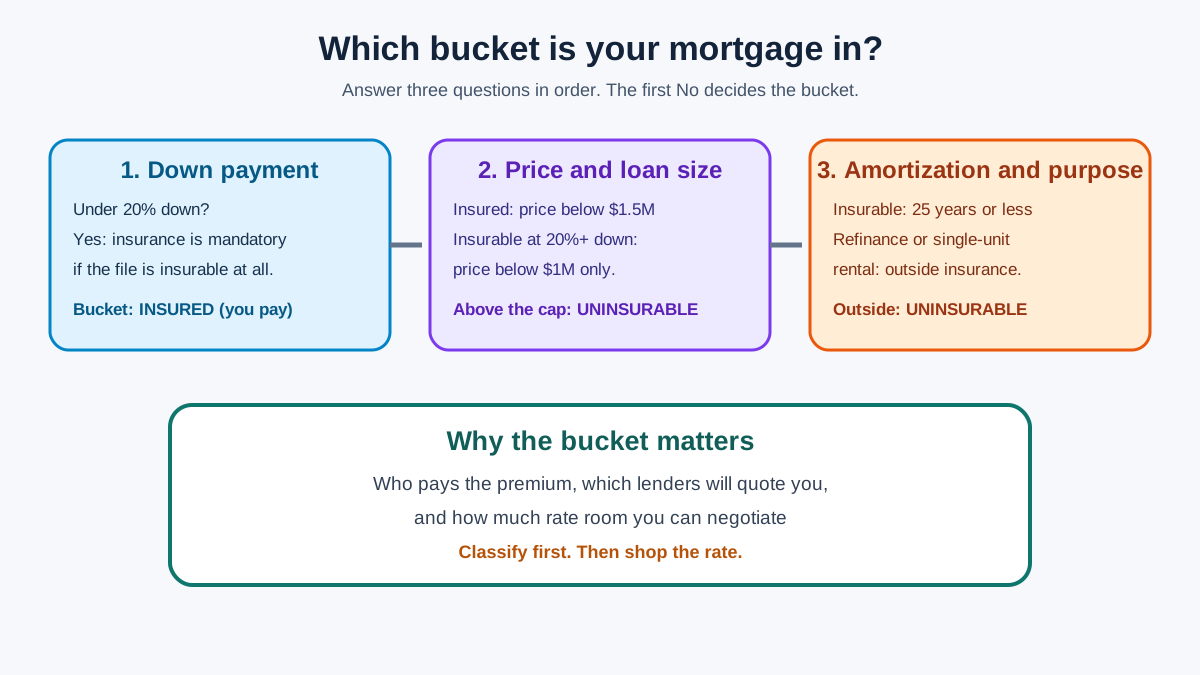
The classifier: three questions, in order
Ask these in sequence. Stop at the first answer that decides the bucket.
Question 1: Is the down payment under 20%? If yes, the loan needs default insurance to exist at all with a federally regulated lender. If the file also passes the insurer rules in Questions 2 and 3, it is insured and the premium is yours. If it fails those rules, the loan cannot be insured - and with less than 20% down, it generally cannot proceed as a standard purchase either. Our down payment rules hub prices the minimum down payment at every price point.
Question 2: Is the price below the cap that matches your loan-to-value? This is where the December 2024 reforms split the buckets. For a high-ratio loan (more than 80% loan-to-value), the insured purchase-price ceiling is below $1,500,000. For a low-ratio loan (80% or less loan-to-value), the insurance ceiling is below $1,000,000. Read that again, because it is the most misquoted line in Canadian mortgage advice: putting 20% down does not extend the insurance ceiling. It shrinks it. The insured mortgage cap explainer walks the $1.5M ceiling edge case by edge case.
Question 3: Do amortization and purpose stay inside insurer rules? An insurable low-ratio loan is capped at a 25-year amortization. The 30-year option that arrived on December 15, 2024 belongs to the insured bucket only, and only for first-time buyers or buyers of newly built homes - the 30-year amortization guide sets out who qualifies. Purpose matters just as much: a refinance that takes new money out, and a single-unit non-owner-occupied rental, sit outside homeowner insurance altogether. Two-to-four-unit rentals can be insured under separate small-rental rules with at least 20% down, which is a different product conversation with your lender.
If all three answers pass, a 20%-plus buyer is insurable. If Question 1 says under-20% and Questions 2 and 3 pass, the buyer is insured. Any failure in Questions 2 or 3 with 20% or more down lands in uninsurable. The matrix below is the whole article on one screen.
| Test | Insured | Insurable | Uninsurable |
|---|---|---|---|
| Down payment | Under 20% | 20% or more | 20% or more |
| Price ceiling | Below $1.5M | Below $1M | At or above the matching cap, or no cap applies |
| Amortization | 25 years; 30 only for first-time buyers or new builds | 25 years or less | Longer than the insured maximum, or any length if another test fails |
| Purpose | Owner-occupied purchase or permitted transfer | Owner-occupied purchase or permitted transfer | Refinance with new money, single-unit rental, other ineligible purpose |
| Borrower tests | Insurer limits apply, including credit and debt-service rules | Same insurer limits apply | At least one insurer limit fails, or the lender underwrites outside insurance |
| Who pays the premium | You, usually financed into the loan | The lender, only if it chooses to insure | Nobody: there is no policy |
| Rate tendency | Insured files often price at the sharp end | Insurable files usually price between insured and uninsurable | Uninsurable files carry the lender's full risk and price accordingly |
That last row needs care. Bucket order is a tendency, not a quote. Lenders fund insured, insurable, and uninsurable loans differently, and insured loans frequently carry the most competitive posted pricing because the default risk sits with the insurer. But your actual rate still depends on term, lender, credit, and timing. Treat the bucket as the starting position in the negotiation, never as a promised number. The worked examples below therefore use one labelled hypothetical rate for every bucket, so the premium and amortization math is visible without inventing a market spread.
Bucket 1: insured - you pay for access, and the premium is exact
An insured mortgage is not a penalty box. It is the legal gateway that lets a federally regulated lender lend above 80% loan-to-value. The insurer - CMHC, Sagen, or Canada Guaranty - guarantees the lender against default loss, and you pay for that guarantee.
The mechanics are standardized. For a one-to-two-unit owner-occupied home, the minimum down payment is 5% of the first $500,000 of value plus 10% of the remainder, up to the insured ceiling below $1.5 million. For three-to-four-unit properties the minimum is 10%. At least one borrower or guarantor needs a minimum credit score of 600 under CMHC's framework, and the file is tested inside the standard debt-service limits at the federal qualifying rate. Our stress test guide works that qualifying-rate math, and the GDS and TDS guide rebuilds the ratio worksheet line by line.
The premium itself is a published schedule, not a negotiation. For amortizations of 25 years or less, CMHC's standard homeowner bands run 4.00% of the loan amount at 90.01% to 95% loan-to-value, 3.10% at 85.01% to 90%, and 2.80% at 80.01% to 85%. A 30-year amortization, where available, adds 0.20 percentage points to the band. The premium is usually added to the mortgage balance, so you pay interest on it for the full amortization - the CMHC premium guide prices that financing cost and the four provinces that charge sales tax on the premium in cash at closing. Budget the tax where it applies. It cannot be financed.
Two insured-bucket facts change behaviour once buyers know them. First, the premium steps down in cliffs: crossing from just under 10% down to exactly 10% down moves the whole loan from the 4.00% band to the 3.10% band. On a $500,000 loan that single boundary is worth about $4,500 before interest. If you are close to a band edge, finding the difference is usually the highest-return money in the transaction. Second, an insured borrower who switches lenders at renewal on a straight transfer has long been exempt from re-passing the prescribed stress test, because the original insured underwriting stands behind the file. Keep that in mind for Section 5: since late 2024 the uninsured side has a matching straight-switch exemption, which makes renewal shopping fairer across all three buckets.
Bucket 2: insurable - no premium on your statement, real value in the funding
Put down 20% or more and most buyers assume insurance disappears from the story. The borrower premium does disappear. The insurance question does not.
A low-ratio loan is insurable when it still satisfies the insurer rulebook: price below $1 million, amortization of 25 years or less, an eligible owner-occupied purpose, and a borrower file inside insurer credit and debt-service limits. A lender may then buy portfolio (bulk) insurance on a pool of such loans for its own balance-sheet and funding purposes. You do not pay that premium, you do not choose the insurer, and many lenders never insure a given loan at all. Insurable describes eligibility, not a guarantee that a policy exists on your file.
Why should a borrower care about a cost they never see? Three reasons. First, funding: a lender that can insure a loan can often fund and price it more efficiently than an identical loan it must hold uninsured, which is why insurable files commonly quote between insured and uninsurable files for the same term. Second, portability and transfer treatment: an insurable purchase loan keeps options open that a refinance-originated loan does not, because purchase money and refinance money are not interchangeable under the insurance rules. Third, underwriting discipline: because the insurer limits still frame the file, an insurable borrower who keeps ratios, amortization, and documentation inside those limits preserves the largest possible lender audience at renewal. The pre-approval guide explains how to get that audience tested before you shop, rather than after you have a deposit at risk.
The insurable bucket has one hard edge buyers in Toronto and Vancouver hit constantly. The price ceiling is below $1 million - not the $1.5 million insured ceiling. A $1.2 million purchase with 25% down is not "more insurable" for the extra equity. It is uninsurable, because the property value itself is outside the low-ratio insurance limit. Extra down payment cannot cure a price-cap failure. Only the insured high-ratio route (with its own below-$1.5M ceiling) reaches into the $1M to $1.5M band, and it requires less than 20% down by definition. That inversion - more cash down can move you out of the insured system entirely - is the single most useful insight in this guide for buyers in high-price markets.
Bucket 3: uninsurable - no policy, no premium, and the lender prices its own risk
Uninsurable does not mean unmortgageable. It means no default insurer will stand behind the loan, so the lender underwrites and prices the full risk itself, or declines the file. Most uninsurable loans are perfectly ordinary mortgages. They are uninsurable for a structural reason, not because the borrower is weak.
The common triggers:
- Price at or above the matching cap. At or above $1.5 million no homeowner purchase can be insured at any down payment. Between $1M and $1.5M, a 20%-plus purchase cannot be portfolio-insured either, for the reason above.
- Amortization beyond the insured maximum. A low-ratio loan stretched past 25 years leaves the insurable bucket. (The insured 30-year door is narrow: first-time buyers and new-build buyers only.)
- Refinance with new money. Taking equity out, consolidating debt into the mortgage, or increasing the balance at renewal moves the loan outside purchase insurance. Our home-equity borrowing guide prices the HELOC, refinance, and reverse-mortgage alternatives side by side.
- Single-unit non-owner-occupied rental. Investor purchases of single units are uninsurable. Multi-unit rentals follow separate small-rental insurance rules with at least 20% down.
- Borrower file outside insurer limits. Credit below the insurer floor or debt-service ratios above insurer thresholds push an otherwise conventional loan into uninsured underwriting, often with alternative or private lenders at higher cost.
What changes in practice? The lender audience shrinks, rate pricing carries the lender's own loss exposure, and product features (prepayment privileges, portability windows, transfer rules) vary more by lender because no insurer template standardizes them. None of that makes an uninsurable mortgage a bad mortgage. A paid-down refinance, a $1.6 million family home, and a long-amortization equity take-out are all legitimate financial decisions. The mistake is shopping them as if they were insured files: asking why the quote does not match an insured advertisement, or assuming a premium you will never pay must be hidden in the rate. Classify first, then compare quotes within the correct bucket.
The same rate, three buckets: worked purchases at $800K, $1.2M, and $1.6M
Every payment below is computed at one labelled hypothetical contract rate of 4.50% with Canadian semi-annual compounding. It is an illustration rate, not a quote from any lender. Premium percentages are the published schedule above. Use the structure, then re-run the arithmetic at your own quoted rate.
$800,000 purchase: insured at 10% down vs insurable at 20% down
At 10% down ($80,000), the loan is $720,000 at exactly 90% loan-to-value, inside the 3.10% premium band. The premium is $22,320, typically financed, for a starting balance of about $742,320. At the hypothetical 4.50% over 25 years, the payment is about $4,109 a month and total interest over the amortization is about $490,242.
At 20% down ($160,000), the loan is $640,000, no borrower premium applies, and the file is insurable (price below $1M, 25-year amortization, owner-occupied). At the same hypothetical rate the payment is about $3,542 a month and total interest is about $422,668.
The honest comparison is not "insurance costs $67,574" - most of that $566-a-month payment gap is simply $80,000 less borrowed. The insurance-specific cost is the $22,320 premium plus the interest paid on it, weighed against keeping $80,000 of cash out of the house for a year or more of market exposure, closing costs, and reserves. Neither answer is automatically right. What is always right is pricing the premium as its own line, not burying it in the payment.
$1,200,000 purchase: the band where the buckets split
Minimum down payment under the tiered formula is $95,000 (5% of the first $500,000 plus 10% of the remaining $700,000), or about 7.9%. The loan is $1,105,000 at about 92% loan-to-value, inside the 4.00% band. The premium is $44,200, for a starting balance of about $1,149,200. At the hypothetical 4.50% over 25 years, the payment is about $6,361 a month.
A first-time buyer (or a buyer of a newly built home) eligible for 30 years pays the 0.20-point surcharge instead: a $46,410 premium, a balance of about $1,151,410, and a payment of about $5,806 a month at the same hypothetical rate - lower monthly, materially more interest over the longer amortization. The 30-year guide puts that trade in full.
Now put 20% down ($240,000) on the same home. The loan falls to $960,000 and the payment at the hypothetical rate falls to about $5,313 a month - but the bucket is uninsurable, not insurable, because the $1.2 million price is above the $1M low-ratio insurance ceiling. Buyers who assume "20% down means best rate" miss this completely. In the $1M to $1.5M band, the insured file (small down payment, premium paid) and the uninsurable file (large down payment, no premium available) are the two real options. There is no insurable middle. Your broker should say that sentence out loud before quoting either.
$1,600,000 purchase: uninsurable by definition
Above $1.5 million, homeowner insurance is unavailable at any down payment. The minimum down payment is therefore 20% ($320,000), the loan is $1,280,000, and at the hypothetical 4.50% over 25 years the payment is about $7,084 a month. There is no premium to cut, no tier boundary to chase, and no insured rate advertisement that applies to the file. The negotiation here is purely lender, term, and feature selection - which is exactly why classifying the bucket first saves time.
One rate-sensitivity note for all three examples: at 25 years, each 0.25 percentage point on the contract rate moves the payment by roughly $14 a month per $100,000 borrowed. That arithmetic, not a guessed "insured discount," is how to weigh any two real quotes a lender puts in front of you.
Renewal, switching, and porting: the bucket follows the loan
Buyers meet the buckets at purchase, but homeowners live with them at renewal. Three rules matter.
First, the straight-switch exemption now covers both sides. Insured borrowers switching lenders at renewal without increasing the balance or extending the amortization have long been exempt from re-passing the prescribed stress test. Effective November 21, 2024, OSFI extended the same straight-switch treatment to uninsured borrowers moving between federally regulated lenders with the balance and remaining amortization unchanged (a small allowance of up to $3,000 to cover transaction costs is permitted). Take new money, extend the amortization, or refinance, and the exemption ends - the file is underwritten fresh. The practical consequence: shop your renewal. The exemption exists so that your current lender has to compete.
Second, a refinance is a bucket change. The moment a renewal becomes a refinance (more money, longer amortization, debt consolidation), the new loan is uninsurable purchase-money no longer. Price it as an uninsurable file from the start, and compare it honestly against the HELOC and home-equity options rather than against your original insured rate from five years ago.
Third, porting preserves a bucket, it does not upgrade one. Moving an insured mortgage to a new insured purchase can carry the insurance with it under insurer porting rules and avoid a second full premium. Porting an uninsurable balance does not make the new loan insurable, and blending new money into a port can create a mixed file whose insured and uninsured portions price differently. Confirm the bucket of the new balance, not just the old one, before you rely on a port to avoid a penalty. Our mortgage porting guide works through the six-gate port test in full.
A five-step classification checklist to run before you get quotes
- Write the price and down payment as a loan-to-value. Under 80.01% loan-to-value needs the premium bands. At 80% or below, ask the price question next.
- Test the price against the matching ceiling. Below $1.5M for a high-ratio insured file. Below $1M for a low-ratio insurable file. At or above either, stop calling the file insurable.
- Test amortization and purpose. Twenty-five years or less for insurable. Thirty only inside the insured first-time-buyer or new-build door. Any refinance-with-new-money or single-unit rental purpose is uninsurable.
- Test the borrower file against insurer limits. Credit score floor and debt-service ratios at the qualifying rate. Use the GDS and TDS worksheet before a lender does it for you.
- Get the bucket in writing, then shop within it. Ask each lender: is this file insured, insurable, or uninsurable, and who pays for insurance if a policy is placed? Compare rates only against quotes in the same bucket and term.
The traps we would flag to a friend
Quoting an insured rate against an uninsurable file. Advertised best rates frequently assume an insured or insurable purchase. If your file is a $1.3 million purchase with 25% down or a refinance, that advertisement was never priced for you. The gap is structural, not a broker failing.
Assuming 20% down buys the $1.5M ceiling. It buys the opposite. The $1.5M ceiling belongs to high-ratio insured loans. Low-ratio insurance stops below $1M. Buyers who save to 20% specifically to "unlock" insured pricing on a $1.2 million home unlock themselves out of insurance instead.
Financing the premium without pricing it. A financed premium is borrowed money at your mortgage rate for 25 or 30 years. On the $1.2 million example, the $44,200 premium is not a one-time fee. It is $44,200 of extra balance inside every payment and inside the stress-test calculation itself.
Letting a renewal drift into a refinance unnoticed. Adding "just a little" new money or extending amortization to cut the payment ends the straight-switch exemption and re-underwrites the file. Sometimes that trade is worth it. Make it on purpose, with the new bucket priced, not by accident on a renewal form.
Treating "insurable" as "insured." If your lender portfolio-insures an insurable loan, that policy protects the lender at the lender's cost. It does not give you insured-borrower transfer treatment by itself, and it does not mean a premium is buried in your payment. Ask who pays, and for what.
Frequently asked questions
What is the difference between an insured and an insurable mortgage in Canada?
An insured mortgage has a down payment under 20%, requires default insurance, and charges the premium to you. An insurable mortgage has 20% or more down and still meets every insurer rule (price below $1M, amortization of 25 years or less, eligible owner-occupied purpose, borrower file inside insurer limits), so the lender may insure it for its own account at its own cost. You pay no borrower premium on an insurable loan.
Can a mortgage be both insurable and uninsurable at the same price?
Yes, because price is only one test. A $900,000 owner-occupied purchase with 20% down and a 25-year amortization is insurable. The same $900,000 property bought as a single-unit rental, or financed with a refinance that takes new money out, is uninsurable. Purpose and amortization decide the bucket alongside price.
Why is the insurable price cap $1M when the insured cap is $1.5M?
The December 2024 federal reforms raised the ceiling for high-ratio insured homeowner loans to below $1.5 million, so buyers with less than 20% down could reach homes in the $1M to $1.5M band. The low-ratio (portfolio) insurance ceiling stayed below $1 million. In that band, the only insured route is a high-ratio loan with less than 20% down; a 20%-plus purchase there is uninsurable.
Do insurable mortgages get better rates than uninsurable mortgages?
Usually, as a tendency, because a lender that can insure a loan funds and prices risk differently from a lender holding the full default exposure. It is not a guaranteed spread and no honest source can quote you a universal bucket discount. Compare real quotes for the same term, in the same bucket, at the same time - each 0.25 point is worth roughly $14 a month per $100,000 borrowed over 25 years.
Is a refinance ever insured or insurable?
A straight transfer at renewal with no new money and no amortization increase keeps its existing treatment and, since November 21, 2024, can switch lenders without re-passing the prescribed stress test on both the insured and uninsured sides. A refinance that increases the balance or extends the amortization is new money underwriting and sits outside purchase insurance. Price it as an uninsurable file.
Does the 30-year amortization make a mortgage uninsurable?
For a low-ratio loan, yes: insurable amortizations cap at 25 years. The 30-year option exists only for insured (high-ratio) loans to first-time buyers or buyers of newly built homes, with a 0.20 percentage point premium surcharge. A repeat buyer of a resale home cannot combine 30 years with insurance.
Who pays the insurance premium on an insurable mortgage?
If the lender chooses to portfolio-insure the loan, the lender pays. No premium is charged to you and none is added to your balance. Many insurable loans are never insured at all; insurable means eligible, not insured. Ask your lender which treatment applies to your file.
How do I find out which bucket my existing mortgage is in?
Start with the original purchase: down payment under 20% means it began insured. Then ask whether anything since (a refinance, an amortization extension, a rental conversion) moved it outside purchase insurance, and confirm with your lender in writing before you port, transfer, or refinance. The bucket of the new balance is the one that prices your next move.
Sources and method: insured eligibility, down payment tiers (5% of the first $500,000 plus 10% of the remainder for one-to-two-unit owner-occupied homes; 10% minimum for three-to-four units), loan-to-value limits, the purchase-price framework (below $1,500,000 for high-ratio homeowner loans and below $1,000,000 for low-ratio loans), the 25-year amortization maximum (30 years where loan-to-value is above 80% and the borrower is a first-time buyer or buying a newly built home), the 600 minimum credit score, and the 39% and 44% debt-service thresholds are from CMHC's published Purchase program requirements, read October 2026. The December 15, 2024 effective date for the $1.5M insured ceiling and the expansion of 30-year amortizations to all first-time buyers and all new-build buyers is from the Department of Finance Canada announcements of the 2024 federal mortgage reforms. Premium bands (4.00%, 3.10%, and 2.80% for 25 years or less, plus 0.20 points for 30 years) are the standard published homeowner schedule summarized in our CMHC premium guide; confirm the current schedule with your lender, as insurers can revise pricing. The November 21, 2024 straight-switch stress-test exemption and its same-balance, same-amortization conditions (with up to $3,000 permitted for transaction costs) are from OSFI's Guideline B-20 renewal guidance as published by OSFI and summarized by Ratehub. All purchase prices and the 4.50% contract rate in the worked examples are labelled hypothetical illustrations; payments were calculated from those stated assumptions using Canadian semi-annual compounding, not quoted from any lender. Insurer and lender rules change and vary by file. This article is educational and informational only. It is not mortgage or financial advice. Confirm your bucket, premium, and qualifying rate on your own application with a licensed mortgage professional before you sign.

About David R. Chen, CFA
David R. Chen is a Chartered Financial Analyst and the Senior Housing Economist at BubbleWatch.ca. He brings 12+ years of experience in quantitative real estate analysis and mortgage underwriting. Formerly an analyst at a major Canadian bank, he specializes in modeling payment shock, regional affordability divergence, and private lending risk.
View David's professional bio & credentials →