Short-Term Rentals in Canada: The Registration Rules That Decide If You Can Host, and the Tax Deduction You Lose If You Skip Them
Whether a Canadian home can legally be rented by the night is decided at four levels at once: federal tax law, a provincial registry or licensing system, a city bylaw, and the condo, strata, or lease that governs the unit itself. This guide maps the four levels, works through the systems in BC, Toronto, Vancouver, and Quebec with their fees, caps, and certificate rules, and prices the federal penalty that catches the most hosts off guard: for tax years after 2023, the Canada Revenue Agency denies a pro-rated share of your expense deductions, including capital cost allowance, for every day a short-term rental was non-compliant. A worked example on the CRA formula, a labelled hypothetical host budget, and a five-gate checklist close the guide.
Short-Term Rentals in Canada: The Registration Rules That Decide If You Can Host, and the Tax Deduction You Lose If You Skip Them
Short answer: A short-term rental in Canada is legal only when every layer of rules that applies to the address is satisfied at the same time. British Columbia limits most hosts in larger communities to their principal residence plus one secondary suite or accessory unit on the same property, and requires a provincial registration number for each unit, at $100 a year for the home the host lives in and $450 a year for a secondary unit. Toronto allows short-term rentals only in a principal residence, requires city registration, and caps renting out the entire home at 180 nights a year. Quebec requires a registration certificate from the Corporation de l'industrie touristique du Québec (CITQ) for tourist rentals of 31 days or less, renewed every 12 months. On top of the permission rules sits a federal tax rule with real teeth: for tax years after 2023, a rental that is non-compliant with provincial or municipal registration, licensing, or permit requirements loses a pro-rated share of its expense deductions, calculated day by day. Getting the licence late does not just risk a fine. It raises your taxable profit.
This guide is general education about how the rules are structured. It is not legal or tax advice. Short-term rental rules change at the city level more often than almost any other housing rule, and the bylaw for your street is the document that decides your case. Check the current rules with your province and municipality before you list, and use a tax professional for a property with a mixed personal and rental history.
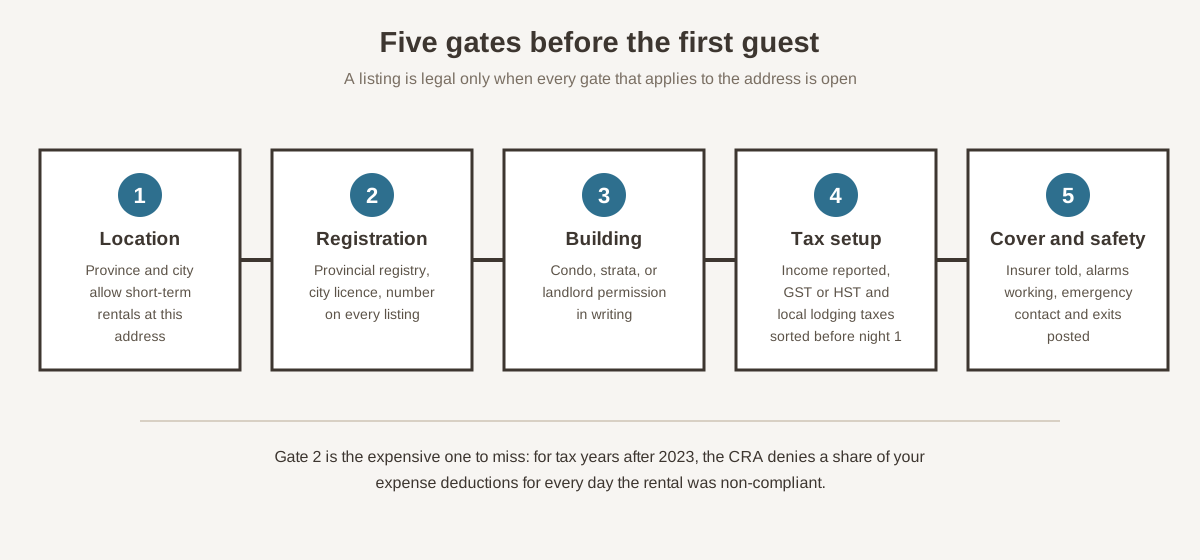
How compliance works, step by step
- Confirm the province and city allow short-term rentals at the address, and whether a principal residence limit applies there.
- Register with every registry that applies: the provincial registry in BC, the CITQ in Quebec, the city in Toronto, and both levels where a city licence sits on top of a provincial number, as in Vancouver.
- Put the registration or licence number on every listing, exactly as issued, and renew before it expires.
- Get the building-level permission in writing: condo or strata approval where the bylaws require it, and your landlord's written permission if you rent the home yourself.
- Tell your insurer the home will take paying guests, and confirm the policy responds to that use before the first booking.
- Set up the tax side before night one: how income will be reported, whether GST or HST registration is required, and which local lodging taxes apply.
- Keep the records that prove compliance for the whole period you operated: registrations, licences, booking and expense records.
- Recheck the rules every year. Night caps, fees, and registration systems in this area have all changed within the last three years, and a renewal is not automatic permission if the underlying bylaw moved.
Four layers of rules, and a listing has to pass all of them
Hosts usually ask one question, can I rent this home on a nightly platform, and expect one answer. The rules give four answers, and the most restrictive one wins.
| Layer | Who sets it | What it decides | What happens if you fail it |
|---|---|---|---|
| Federal tax law | Canada Revenue Agency, under the Income Tax Act | Whether your expenses stay deductible, and how the income and GST or HST are treated | A pro-rated share of expenses, including capital cost allowance, is denied for non-compliant days after 2023 |
| Provincial rules | The province (BC registry, Quebec CITQ system, and provincial law elsewhere) | Whether the rental may operate at all, principal residence limits, registration and certificate duties | Listings can be removed by platforms, bookings cancelled, registration refused or revoked |
| Municipal bylaws | Your city or district | Local licence, night caps, zoning, lodging taxes, enforcement | Fines, licence loss, orders to stop operating |
| The building and the tenancy | Condo or strata bylaws, your lease, your mortgage and insurance terms | Whether this unit, held this way, may be used for paid guests at all | Bylaw enforcement, lease breach, or an insurance claim problem, even where the city allows the rental |
The fourth layer is the one that surprises people. City registration does not override a condo corporation's ban, and a provincial registration number does not cure a lease that prohibits subletting or commercial use. Vancouver's rules state the point directly for renters: tenants can apply to host, but they need written permission from their landlord, and strata residents must have approval from their strata council. Treat each layer as a separate gate, and clear them in writing.
The same words mean different lengths of stay
There is no single Canadian definition of a short-term rental. Each authority drew its own line, and the line decides which system you are in.
| Authority | A short-term rental is | Consequence of the line |
|---|---|---|
| Canada Revenue Agency (income tax) | A residential property rented or offered for rent for less than 90 consecutive days | The non-compliant expense denial applies to rentals on this side of the line |
| British Columbia (provincial law) | Accommodation for less than 90 consecutive days, hotels and motels excluded | Provincial registration is required, and the principal residence requirement applies in the communities listed by the province |
| City of Vancouver | A stay of less than 90 consecutive days | A city short-term rental business licence is required on top of the provincial registration number |
| City of Toronto | All or part of a dwelling rented for less than 28 consecutive days, bed and breakfasts included, hotels and motels excluded | City registration, the principal residence rule, and the 180-night entire-home cap apply on this side of the line |
| Quebec (Tourist Accommodation Act) | Lodging offered to tourists for periods not exceeding 31 days | A CITQ registration certificate and number are required |
Read the Toronto and BC rows together and the practical trap appears. A 40-night stay is a long-term arrangement in Toronto's bylaw and sits outside its registration system, while the same stay in BC is a short-term rental that needs provincial registration. A host who moves a listing strategy across provinces, or who copies a rule from a forum post written about another city, can be compliant in one system and offside in another on identical facts. Work from the definition that applies to your address, not from the platform's labels.
British Columbia: a provincial registry, a principal residence limit, and per-unit fees
BC built the most complete provincial system in the country, in force through the Short-Term Rental Accommodations Act. The province defines short-term rentals as accommodation provided to the public for money for less than 90 consecutive days, hotels and motels excluded, and it runs a provincial registry that every host must join.
The principal residence requirement. In municipalities with a population of 10,000 and over, and in smaller neighbouring communities the province lists, short-term rentals are limited to the host's principal residence plus one secondary suite or accessory dwelling unit on the same property. The province publishes the community list and an address lookup map, and the list can change: smaller communities, regional districts, and resort municipalities start outside the requirement but may opt in each year, and a community with a rental vacancy rate of 3 percent or more for two consecutive years may ask to opt out. Local bylaws can be stricter than the provincial floor, and hosts must follow both.
Registration is per unit, and it is not free. Each short-term rental unit needs its own registration number. The province charges $100 a year for the unit that is the host's principal residence, which covers renting a room or renting the whole home while the host is away, and $450 a year for a secondary unit on the property, such as a suite, cottage, carriage home, or laneway house. Hosts must show the provincial registration number, and a local business licence number where the city requires one, on all listings. Where a local business licence is required, a copy of the valid licence forms part of the provincial application.
Platforms enforce it. Under the timeline the province set in 2025, platforms were required from June 2, 2025 to stop advertising listings without a valid registration number and prevent new bookings from those hosts, and from June 23, 2025 to cancel future bookings from hosts without a valid number, or face investigation and a possible monetary penalty. Hosts were still expected to register by May 1, 2025. A registration problem in BC is therefore not a quiet paperwork issue. It can delete the listing and the bookings attached to it.
Exemptions are narrow and specific. Hotels and motels sit outside the legislation. Some categories, including time shares, home exchanges, and strata guest suites, are exempt from registration and the principal residence requirement but still under the Act. Strata hotels that meet the province's tests, fractional ownership properties that cannot be used as a principal residence, and farm land in the BC Assessment farm class must register but are exempt from the principal residence requirement. If your property does not clearly sit in one of the listed categories, plan on the standard rules applying and confirm with the registry before you rely on an exemption.
Vancouver adds its own layer on top of the provincial one, covered in its own section below. Other BC cities add business licence requirements of their own. The provincial number is the floor, not the whole job.
Toronto: principal residence only, registered, and 180 nights for the whole home
Toronto's system, in Municipal Code Chapter 547, starts from a shorter stay: a short-term rental is all or part of a dwelling rented for less than 28 consecutive days in exchange for payment. Bed and breakfasts are included. Hotels, motels, and student residences run by publicly funded or non-profit educational institutions are excluded, as is accommodation with no payment.
The city's stated purpose is narrow: residents may rent out the home they live in, and other units stay available as long-term housing. Four rules do the work.
- Principal residence only. A short-term rental is allowed only in the operator's principal residence, the home the person stays in and uses for bills, identification, taxes, and insurance. A second property bought or kept as a rental does not qualify, no matter how it is furnished.
- Registration before operating. Operators must register with the City of Toronto, and listings must carry the city-issued registration number, in the format STR-0000-XXXXXX. Guests are told by the city to check for that number and not to rent listings that do not show it.
- The 180-night cap. Renting out the entire home is capped at 180 nights per calendar year, a limit city council confirmed in its 2024 bylaw amendments, which also tightened the rules for partial-unit operators from January 1, 2025. Renting rooms while you remain in the home is treated as a partial-unit rental under its own conditions.
- Duties during the stay. The host must give guests the contact information of a person available 24 hours a day, and a diagram of all exits from the building must be physically posted in the rental.
The lodging tax. Toronto charges a Municipal Accommodation Tax on short-term rentals. The rate is 6 percent: the temporary increase to 8.5 percent ended on July 31, 2026, and the city confirms the rate returned to 6 percent effective August 1, 2026. Operators file a MAT report every quarter, within 30 days of the quarter's end, and the report is due even if the unit was not rented in the quarter or a platform collected and remitted the tax under a voluntary collection agreement. Keep a record of all accommodation transactions, including revenue and any exemptions claimed.
One boundary does a lot of quiet work in Toronto. A stay of 28 consecutive days or more falls outside the short-term rental bylaw entirely: no registration, no night cap, no principal residence rule under that chapter. That is a real legal category, not a loophole to dress up. A booking structured as 28 days that is really a series of short stays invites exactly the enforcement the bylaw was written for. If you plan to work the longer-stay market, document genuine longer stays and get advice on the tenancy rules that then apply, because a guest who stays long enough can gain rights under Ontario's Residential Tenancies Act that a nightly guest does not have.
Vancouver: two numbers on the listing, and permission for renters and strata owners
Vancouver hosts carry two credentials. The province requires a BC short-term rental registration number, and the city requires its own short-term rental business licence before advertising or hosting. Both numbers go in all listings. The city's definition now matches the province's: a short-term rental is a stay of less than 90 consecutive days, after council aligned the city definition with the provincial Act in the fall of 2024. Renting for 90 days or more at a time takes a long-term rental business licence instead.
- Principal residence only. The rental must be your primary home, the place where you live, receive mail, and pay bills. A commercial or investment property is not a principal residence under the city's glossary. A basement suite or laneway home can be rented only if you live in that specific unit.
- Owners and renters can both apply. A tenant needs written permission from the landlord. A strata resident needs approval from the strata council. Those permissions are part of eligibility, not a courtesy.
- Safety and neighbours are licence conditions. The home must meet fire and building safety standards, and hosts are expected to limit noise, manage waste properly, and respect neighbours. The city's licence glossary sets out equipment duties in detail, including working carbon monoxide detectors on each floor where the unit has a gas appliance, and sprinkler or fire-separation requirements for units attached to another dwelling.
The Vancouver file is the cleanest illustration of the four-layer point. A host can hold both numbers, satisfy the province and the city, and still be stopped by a strata bylaw or a lease. Clear the building layer before paying for either credential.
Quebec: a CITQ certificate for any tourist rental of 31 days or less
Quebec regulates short-term rentals as tourist accommodation. Anyone who offers lodging to tourists for periods not exceeding 31 days must hold a registration certificate issued through the CITQ under the Tourist Accommodation Act. The certificate carries the minister's signature, the registration number, the address and category of the establishment, the number of units offered, and its issue and expiry dates. It is valid for 12 months and is renewed each year. The 2026 registration fees are $54 for a principal residence establishment and $156 for a general tourist accommodation establishment.
The display duties are specific, and platforms sit inside them:
- The certificate must be displayed in view of guests at the main entrance of the establishment.
- The six-digit registration number must appear in all advertising, including social media and any website used for the operation, in the form "Registration #: XXXXXX".
- The certificate must be sent to transactional platform operators, who must verify its validity before posting the establishment's offer.
Revenu Québec adds a filing duty that hosts miss. All income from renting an accommodation unit must be reported, and a host who completes form TP-128-V for rental property income, or form TP-80-V for business income, must enter the CITQ registration number on line 59 of the form, or provide it on request. The registration number is therefore part of the tax file, not just the listing. Quebec hosts should also confirm their municipality's own zoning and permit rules, because a provincial certificate does not settle whether tourist rentals are allowed on a given street.
The federal tax layer: report everything, and keep the records that prove compliance
Income tax treats short-term rental income the same way it treats other rental income at the first step: all of it is reported, and reasonable expenses incurred to earn it are deducted, with shared expenses split by the rented space and the rented period. Revenu Québec states the same structure for Quebec filings. Two federal rules then separate short-term rentals from ordinary long-term rentals.
GST or HST. Long-term residential rent is exempt: the CRA's supply tables list rentals of residential accommodation for one month or more as exempt supplies, and hotel-style accommodation as taxable. Short-term accommodation is a taxable supply. A host whose taxable revenues pass $30,000 over the last four calendar quarters, or in a single quarter, must register for the GST or HST, charge and remit the tax, and may then claim input tax credits on related costs. Below the threshold a host may register voluntarily or stay unregistered and not charge the tax. Platforms add a second system: accommodation platform operators have their own GST or HST registration and collection duties for platform-based short-term accommodation under the digital economy rules, so read your platform statements to see which tax the platform already collected before you file.
The change-of-use and exemption side effects. Renting out space you also live in does not, by itself, end a home's status as a principal residence, but the details matter: claiming capital cost allowance on the home and making structural changes for the rental are the two moves the CRA treats most seriously, and they connect directly to the exemption you will want when you sell. Our capital gains and principal residence guide works through those rules with the designation formula. Price that interaction before you optimize the rental, not after.
The rule with teeth: expenses denied day by day for non-compliant rentals
The 2023 Fall Economic Statement announced it, and the rule now sits in the CRA's guidance for tax years after 2023: income tax deductions related to non-compliant short-term rentals are denied. A rental is non-compliant when it sits in a province or municipality that does not permit short-term rentals at that location, or when it does not comply with all applicable provincial or municipal registration, licensing, and permit requirements.
The denial is pro-rated, not all or nothing. The CRA formula is:
Non-compliant amount = A x B / C
- A** is the total of the expenses that would otherwise be deductible for the property for the period it was used as a short-term rental in the year.
- B is the number of days in the year the property was a non-compliant short-term rental.
- C is the number of days in the year the property was a short-term rental.
The denied amount comes off your deductions on the rental statement (Form T776, line 9366), and the same treatment applies to capital cost allowance, which has its own chart and line (9367). The 2024 transition relief, which deemed a rental compliant for all of 2024 if it was compliant by December 31, 2024, applied to the 2024 tax year only. It does not protect a late registration in 2025, 2026, or later.
The CRA's own example, with its numbers
The CRA illustrates the rule with a condo owner in a city that licenses rentals of less than 30 days. The owner rented the unit for 300 nights at $250 a night in 2025, for $75,000 of revenue, and incurred $60,000 of expenses, but only obtained the city licence on July 1, 2025, after offering the unit for the first 181 days of the year.
- A = $60,000 of expenses
- B = 181 non-compliant days
- C = 365 days the property was a short-term rental in the year
- Denied: $60,000 x 181 / 365 = $29,753
- Deductible: $60,000 - $29,753 = $30,247
- Taxable profit: $75,000 - $30,247 = $44,753
Had the licence been in place all year, the same file deducts the full $60,000 and reports a profit of $15,000. The late licence alone moved $29,753 of profit into taxable income. At any marginal rate, that is a four-figure tax cost for a paperwork delay, on top of any municipal fine for operating unlicensed. The CRA also states that hosts must keep books and records documenting that the property was somewhere short-term rentals are permitted and that it complied with all registration, licensing, and permit requirements, and that it may audit or review returns to check the deductions were permitted. Your registration dates are tax documents now. Keep them with the return they support.
A smaller host, priced the same way
The following figures are a labelled hypothetical, built to show the formula at a common host scale. They are not market averages, and the 40 percent marginal rate is an assumption chosen for arithmetic, not your rate.
A Toronto host rents their principal residence as an entire home for 120 nights at $175 a night, which is $21,000 of revenue, within the city's 180-night cap. Deductible expenses for the rental period total $9,000. The host registered with the city on time and is compliant all year in the first case. In the second case, the same host operated the first 60 short-term rental days of the year before registering, out of 200 days in the year the home was offered as a short-term rental.
| Item | Compliant all year | Unregistered for 60 days |
|---|---|---|
| Revenue | $21,000 | $21,000 |
| Expenses incurred | $9,000 | $9,000 |
| Denied under A x B / C | $0 | $9,000 x 60 / 200 = $2,700 |
| Expenses deductible | $9,000 | $6,300 |
| Taxable profit | $12,000 | $14,700 |
| Extra tax at an assumed 40% marginal rate | n/a | about $1,080 |
Two lessons sit in that table. First, the denial scales with days, so registering in week one instead of month three is worth real money even when no inspector ever calls. Second, the denial applies to expenses, not revenue: the host is taxed on money they never kept, in proportion to the days they were offside. Compliance timing is a tax decision, not an administrative detail.
If the address cannot host, the alternatives that stay legal
A principal residence limit or a licensing refusal closes the nightly-rental door at that address. It does not close the property file. The options that remain, each with its own rulebook:
- Long-term rental. Rent the unit to a tenant under the provincial tenancy law. The rent rules, notice periods, and eviction grounds of that system apply, and our rent increase limits guide covers the annual increase side. For the return math on a tenanted property, see the investment property math guide.
- Longer stays, genuinely. Stays at or past the local line, 28 days in Toronto and 90 days in BC and Vancouver, sit in a different legal category. In BC, note the split: a stay of 31 to 89 days can escape a local business licence rule written for shorter stays and still require provincial registration, because the provincial line is 90 days. Structure nothing around a line without advice, and expect tenancy law to matter more as stays lengthen.
- A secondary suite, rented the way the rules allow. In BC, the one secondary unit beside a principal residence is the sanctioned second door, at the $450 registration tier. Financing and building that suite legally is its own project; our secondary suite financing guide covers the money side.
- Sell or hold without renting. A vacant second property in many Canadian cities now carries its own tax filings even when it earns nothing. The vacant home tax guide and the underused housing tax guide map those duties before you decide that doing nothing is the cheap option.
The five-gate checklist, before you take a booking
Run the address, not the idea, through these five questions. Any no stops the listing until it is fixed.
- Location. Does provincial and municipal law permit short-term rentals at this address, and is a principal residence limit in force there? In BC, check the province's community list and map for your address rather than assuming from the city name.
- Registration. Do you hold every number that applies, provincial, CITQ, and municipal, is each one current, and does each listing show the number exactly as issued? Note the renewal dates in the same calendar as the tax deadlines.
- Building. Do the condo or strata bylaws allow it, does your strata council or landlord need to approve it, and do you have that permission in writing?
- Tax. Is the income reporting set up, the GST or HST position decided, the local lodging tax handled, and the file of registration records started, so a CRA review can be answered from documents?
- Cover and safety.** Has your insurer confirmed in writing that the policy covers paid short stays, and are the safety duties for your city met: detectors tested, exits posted where required, a 24-hour contact named where required?
Print the answers with dates and keep them with the property file. If a platform, a bylaw officer, or the CRA asks how the rental was compliant in a given month, that page is the answer.
Sources
Primary and official sources read for this guide:
- Canada Revenue Agency, Changes to rules for eligible deductions from short-term rental income (January 22, 2025): the less-than-90-day definition, the non-compliant definition, the A x B / C formula, the worked 2025 example, the 2024 transition rule, and the books and records requirement.
- Canada Revenue Agency, Rental expenses you cannot deduct and Form T776 guidance: the non-compliant amount at line 9366 and the non-compliant capital cost allowance chart at line 9367.
- Canada Revenue Agency, GST and HST pages on types of supply and on platform-based short-term accommodation: short-term accommodation as a taxable supply, long-term residential rentals of one month or more as exempt, and the $30,000 registration threshold.
- Government of British Columbia, short-term rental pages, including B.C.'s short-term rental principal residence requirement (updated September 21, 2026): the principal residence plus one secondary unit limit, the communities where it applies, the $100 and $450 per-unit registration fees, exemptions, and opt-in and opt-out mechanics; and the province's 2025 platform enforcement timeline for removing unregistered listings and cancelling their bookings.
- City of Toronto, short-term rental pages and Municipal Accommodation Tax pages: the less-than-28-day definition, principal residence and registration rules, the registration number format, guest safety duties, the MAT filing calendar, and the 6 percent rate effective August 1, 2026 after the temporary 8.5 percent rate ended.
- City of Vancouver, short-term rental pages and licence glossary: the city licence on top of the provincial number, the less-than-90-day definition, principal residence eligibility for owners and renters, landlord and strata approval, and safety equipment duties.
- Corporation de l'industrie touristique du Québec (CITQ), registration certificate and legal provisions pages: the certificate for tourist rentals not exceeding 31 days, 12-month validity, display at the main entrance, the six-digit number in all advertising, and platform verification.
- Revenu Québec, Filing your income tax return: short-term accommodations: reporting all rental income and entering the CITQ registration number on line 59 of form TP-128-V or TP-80-V.
This article is general education about how short-term rental rules are structured in Canada. It is not legal or tax advice, and it does not settle whether a specific property may be rented. Municipal bylaws, strata and condo bylaws, and registration systems change, and the version in force for your address on the dates you operate is the one that governs. Confirm your position with your municipality, your registry, and a tax professional before you list.
Advertisement

About David R. Chen, CFA
David R. Chen is a Chartered Financial Analyst and the Senior Housing Economist at BubbleWatch.ca. He brings 12+ years of experience in quantitative real estate analysis and mortgage underwriting. Formerly an analyst at a major Canadian bank, he specializes in modeling payment shock, regional affordability divergence, and private lending risk.
View David's professional bio & credentials →