The Smith Manoeuvre in Canada (2026): Converting Mortgage Debt Into Deductible Debt, Honestly
The Smith Manoeuvre uses a readvanceable mortgage to slowly convert non-deductible home-mortgage debt into a tax-deductible investment loan, without increasing total debt. It is legal, well documented, and widely oversold. This guide explains the five-step cycle, the CRA tests the interest deduction has to survive (Income Tax Act s.20(1)(c), the Supreme Court's Ludco reasonable-expectation-of-income test, and the direct-use link from Singleton), and runs a labelled hypothetical $400,000 model for 10 years. The model's verdict is the part marketing leaves out: over the first decade the out-of-pocket carry is slightly negative, the total debt is unchanged, and everything depends on investment growth nobody can promise.
The Smith Manoeuvre in Canada (2026): Converting Mortgage Debt Into Deductible Debt, Honestly
Short answer: The Smith Manoeuvre is a debt-conversion strategy, not a debt-reduction strategy. Using a readvanceable mortgage (a mortgage bundled with a home equity line of credit under one charge), each regular mortgage payment frees up HELOC room. You borrow that room back out and invest it in a taxable account holding investments that can pay interest or dividends. The distributions, plus the annual tax refund created because the investment-loan interest is tax-deductible, are used to prepay the mortgage, which frees up more HELOC room, which is borrowed and invested again. Year by year, the balance migrates from a non-deductible mortgage to a deductible investment loan. Total debt does not fall. Whether you end up ahead depends on investment returns nobody can guarantee, which is why this strategy deserves a clear-eyed read before it deserves your signature.
Two disclaimers before any mechanics. First, this is education, not tax or financial advice; interest deductibility is fact-specific and a qualified Canadian tax professional should review any real implementation. Second, nothing in this guide is a prediction. Every dollar figure below comes from a labelled hypothetical model whose assumptions are printed next to it. Real rates, real distributions, and real tax brackets will differ.
The problem the manoeuvre solves
Canada does not let you deduct mortgage interest on your own home. A $400,000 mortgage at a hypothetical 4.50% costs about $8,900 of interest in the first year, and every dollar of it is paid with after-tax money. Interest on money borrowed to earn income from a business or property is different: paragraph 20(1)(c) of the Income Tax Act can make it deductible. Same bank, same borrower, same house as collateral - two opposite tax treatments depending on what the borrowed money was used to buy.
That asymmetry is the entire opportunity. If some of your home debt could be honestly re-characterized - not by relabelling it, but by actually borrowing against the home to buy income-producing investments - the interest on that slice becomes deductible. The Smith Manoeuvre, popularized in Canadian personal-finance literature since the 1980s, is a systematic way to shift the balance slice by slice, using the mortgage's own amortization as the engine. Our broader guide to borrowing against home equity covers the HELOC, home equity loan, refinance, and reverse mortgage options on their own terms; this article is about one specific, more demanding use of that equity.
The legal footing: three tests and a paper trail
Interest deductibility for borrowed-to-invest money in Canada rests on the statute, two Supreme Court decisions, and the Canada Revenue Agency's published folio. None of them mention the Smith Manoeuvre by name, and none of them offer a rubber stamp. They set tests. A real implementation has to keep passing them every year.
The statute. Subparagraph 20(1)(c)(i) allows a deduction for interest paid or payable in the year on borrowed money used for the purpose of earning income from a business or property, where there is a legal obligation to pay the interest and the amount is reasonable. Four elements, all required: borrowed money, an income-earning purpose, a legal obligation, and reasonableness.
The income test. In Ludco Enterprises Ltd. v. Canada (2001 SCC 62), the Supreme Court held that the purpose test asks whether, considering all the circumstances, the taxpayer had a reasonable expectation of income at the time the investment was made. Two consequences matter here. First, an expectation of capital gains alone is not enough - the CRA's current folio wording is explicit that a reasonable expectation of capital gains does not meet the income test. The investments must be capable of paying interest or dividends. A portfolio of non-dividend-paying growth stocks bought with borrowed money is the classic deductibility failure. Second, the income does not have to exceed the interest, and a modest expected income can suffice absent a sham - but there has to be a genuine, documentable expectation when each investment is bought, which is one reason dividend and interest history matters more than marketing yields.
The direct-use link. In Singleton v. Canada (2001 SCC), the Court allowed a taxpayer who had restructured his affairs so that borrowed money was directly used for an income-earning purpose to deduct the interest, holding that financing arrangements are not frozen in their original form. The CRA's own later commentary confirmed that Singleton was not overruled by the subsequent Lipson decision, which turned on the attribution rules and the general anti-avoidance rule in a spousal arrangement, not on the refinancing itself. The practical lesson is the one courts keep repeating: the borrowed money must be traceable, dollar by dollar, to the eligible use. A clean, separate investment loan with an unbroken paper trail - HELOC advance out, same amount into the investment account, investment statements matching - is what makes the deduction defensible. Commingling the borrowed money with spending money is how the trail dies.
The paperwork and the boundaries. The CRA's Income Tax Folio S3-F6-C1 (Interest Deductibility) is the working reference for all of this, including how the agency treats common shares (a stated dividend policy and dividend history matter), what happens when investments are sold (deductibility follows the current use of the borrowed money, and returning capital can shrink the deductible balance), and why compound interest is only deductible when actually paid. Quebec adds its own restriction, limiting the deduction of investment-loan interest in a year to investment income reported, with unused amounts carried forward. None of this is exotic, but it is unforgiving of sloppiness: the deduction is claimed year by year, and each year's claim is only as good as that year's trail.
The machine: how a readvanceable mortgage converts debt
The engine is a readvanceable mortgage, an all-in-one product that combines a term mortgage and a HELOC under a single collateral charge. Under federal lending rules, a HELOC on its own is limited to 65% of the home's value, and a combined mortgage-plus-HELOC arrangement is limited to 80% of the value. Inside that combined limit, the product readvances: every dollar of mortgage principal you repay becomes a dollar of available HELOC credit, automatically, without a new application.
The standard cycle has five steps, shown in the diagram:
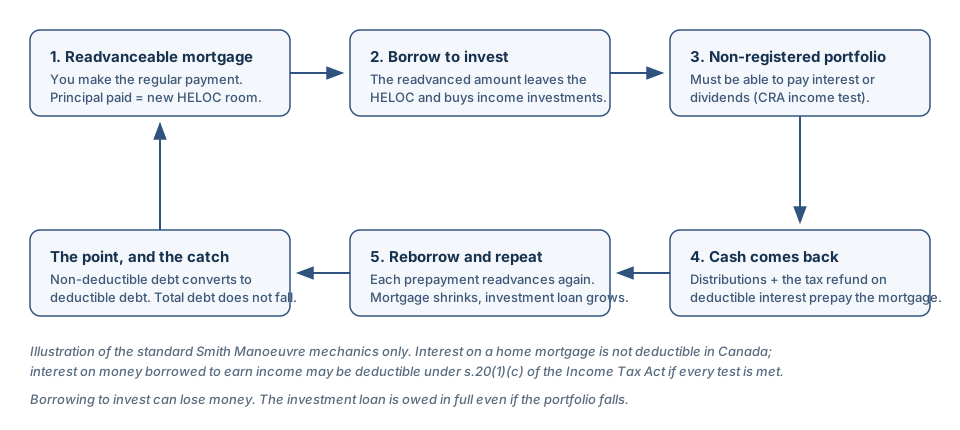
- Make the regular mortgage payment. The principal portion readvances as HELOC room.
- Borrow that amount from the HELOC and move it to a non-registered (taxable) investment account. It has to be non-registered: interest on money borrowed to invest inside an RRSP or TFSA is not deductible, because the borrowing is not for the purpose of earning taxable income.
- Buy investments that can pay interest or dividends, so the Ludco income test is met on each purchase.
- When distributions arrive, use them to make a mortgage prepayment (inside your lender's prepayment privileges, to avoid penalties). The prepayment readvances as new HELOC room; borrow it and invest again.
- Claim the HELOC interest as a deduction. When the tax refund arrives, prepay the mortgage with it too, and reborrow that amount into the portfolio.
Each loop is small. The strategy is the repetition: hundreds of small conversions, over years, moving the balance from the non-deductible column to the deductible column while the house-secured total stays roughly constant.
One honest model: $400,000 over 10 years
Here is the strategy run on printed assumptions, computed month by month. These are illustrations, not quotes, forecasts, or promises:
- Mortgage: $400,000, 25-year amortization, hypothetical contract rate 4.50% (payment $2,223 a month).
- HELOC: hypothetical 6.00% a year, interest paid monthly out of pocket (not capitalized).
- Portfolio: distributions of a hypothetical 3.00% a year on the invested balance, paid in cash, all used as mortgage prepayments and immediately reborrowed. No market growth or decline is modelled at all - the portfolio is assumed to be worth exactly what was invested. That is deliberately ungenerous to the strategy on the growth side and deliberately honest on the cash side.
- Tax: deductible interest refunded at an assumed combined marginal rate of 33% purely for illustration, applied once a year as a prepayment and reborrowed. Your rate depends on your province and income and could be higher or lower.
| After | Mortgage without the manoeuvre | Mortgage with the manoeuvre | Investment loan | Total debt |
|---|---|---|---|---|
| 1 year | $391,139 | $390,897 | $9,103 | $400,000 |
| 5 years | $351,432 | $344,611 | $55,389 | $400,000 |
| 10 years | $290,634 | $256,084 | $143,916 | $400,000 |
Read the last column first: a decade in, this household owes exactly what it owed at the start. The strategy converted about $144,000 of mortgage debt into investment debt and paid the mortgage down about $34,550 faster than doing nothing - and every dollar of that faster paydown was reborrowed. Anyone who describes the Smith Manoeuvre as a way to become debt-free faster is misdescribing the arithmetic. It changes the character of the debt, not the amount.
Now the carry, which is the table almost nobody publishes. Over the 10 modelled years, the household pays about $36,420 of HELOC interest out of pocket. It receives about $18,210 of distributions and, at the assumed 33% marginal rate, about $12,018 of tax refunds. Net modelled carry: about $6,190 out of pocket over the decade, before any investment growth, any fees, and any tax owing on the distributions themselves (which are taxable, and which this simple model does not tax again - a real return would look modestly worse). The first year, by the way, is nearly a rounding error: about $289 of deductible interest and a refund of roughly $95. The tax benefit only becomes meaningful as the investment loan compounds into six figures.
That negative carry is not an argument that the strategy never works. It is the price of the conversion, and it tells you where the payoff has to come from: investment returns above the distributions - capital growth, over long horizons, on a portfolio bought with borrowed money. If the portfolio grows, the household holds growing assets against a flat total debt and the conversion looks clever. If it stagnates or falls, the household has paid real interest for a tax deduction worth a third of it, still owes every borrowed dollar, and would have been better off simply prepaying the mortgage. Our explainer on how mortgage rates are set is worth a read alongside this: the HELOC side of this structure is almost always variable, priced off prime, so the cost column of the model moves with the Bank of Canada whether you are paying attention or not.
The risks, in the order they bite
Leverage risk is the whole risk. You owe the investment loan in full even if the portfolio drops 30%. A margin call does not exist on a HELOC the way it does on a brokerage margin account, but the debt does not shrink when the market does, and a lender can reduce or call HELOC room under the credit agreement. Borrowing to invest magnifies outcomes in both directions; that is not a caveat, it is the mechanism.
Negative or thin carry at real-world rates. The model above uses a 6.00% borrowing cost against 3.00% distributions. Whenever the HELOC rate sits well above the portfolio's cash yield - as it has for stretches of the past few years - the household funds the gap monthly, betting on growth to make it whole. Growth is the least reliable leg of the plan.
The income test can fail quietly. Switch the portfolio into non-dividend payers, let a fund change its distribution policy, or hold investments with no reasonable expectation of interest or dividends, and the deduction is exposed - potentially retroactively, with arrears interest. Roc (return of capital) distributions create a further trap: under the CRA's current-use rules, returned capital that is spent rather than reinvested can reduce the amount of the loan that remains deductible.
Tax law and audit risk are real, if modest. The strategy has survived at the Supreme Court level on its core mechanics, but deductibility is claimed annually, file by file. Sloppy records, borrowed money routed through personal spending accounts, or spousal arrangements that trip the attribution rules (the actual problem in Lipson) can all unwind years of assumed refunds. The spouse point deserves emphasis: having a lower-income spouse borrow and invest, or shuffling funds between spouses to manufacture a deduction, is where courts have pushed back.
Friction costs eat the edges. Prepayment privileges cap how much mortgage you can prepay each year without penalty (often 15-20% of the original balance, contract-specific); exceeding them triggers prepayment charges. Readvanceable products may price slightly above the cheapest plain-vanilla mortgage. Brokerage commissions, fund fees, and an annual tax-preparation bill for a more complicated return all come out of the same thin carry. And the strategy demands monthly administration for years - a dozen small, correct, documented transfers a year, every year. Lapsed discipline is a tax risk, not just an inconvenience.
Opportunity cost against the simple alternatives. Most households carrying unused TFSA and RRSP room will do better, with far less risk, by investing inside those shelters and prepaying the mortgage with what is left. The Smith Manoeuvre only starts once registered room is genuinely exhausted, because borrowing to fill a TFSA or RRSP earns no deduction at all.
Who this may suit, and who it plainly does not
This strategy was built for a narrow household profile. Being outside it is not a character flaw; it is most people.
It may be worth a professional conversation if you: have maximized RRSP and TFSA room; hold a stable, well-documented income comfortably clear of the 39/44 debt-service limits tested at the stress-test rate (our stress test guide shows that math); have a long horizon and a high, stable marginal tax rate; already hold and understand a diversified income-producing portfolio; keep meticulous records; and can watch a leveraged portfolio fall by a third without selling or losing sleep. Note that qualifying for the readvanceable product itself is a fresh underwriting: as our insured vs insurable guide explains, refinance-style structures sit in the uninsurable bucket, with 20%-plus equity and lender-level pricing.
It plainly does not suit you if you: still have registered room; carry any high-interest consumer debt; have variable or commission income that a bad year could halve; would need the invested money within a decade; are relying on the tax refund to make the monthly carry affordable (a refund that depends on an annual claim surviving review is not a budgeting tool); or have not yet done the unglamorous groundwork - emergency fund, insurance, will - that makes leverage a choice rather than a bet.
If it proceeds: the setup checklist
- Get independent tax advice first, before the product. The question is not whether the strategy works in a book; it is whether your investments, your records, and your province support a deduction on your facts, every year.
- Confirm the readvanceable product's terms: readvance mechanics, the 80% combined and 65% HELOC limits, prepayment privileges, and what happens to HELOC room if you port, renew, or switch lenders. (Porting a collateral-charge product is often not possible; switching usually means discharging and re-registering, with legal fees.)
- Open a dedicated, separate HELOC sub-account and a dedicated non-registered investment account used for nothing else. One clean trail: HELOC advance, transfer, purchase confirmation, statement.
- Choose investments for the income test first and performance second: a stated distribution policy and a record of paying. Document the expectation of income at purchase.
- Set the monthly ritual: payment, readvance, borrow, invest, file the statements. Keep every confirmation; the CRA can ask years later.
- Direct distributions to mortgage prepayment, claim the interest (line 22100 on the federal return), and route the refund into the next prepayment. Never spend return-of-capital without checking its effect on the deductible loan balance with your tax advisor.
- Re-run the honest carry table once a year with your actual HELOC rate, actual distributions, and actual marginal rate. If the math has stopped working, the strategy can be wound down by selling investments and repaying the loan - at whatever the market happens to be offering that day, which is exactly why step zero was the risk conversation.
Frequently asked questions
Is the Smith Manoeuvre legal in Canada?
The underlying mechanics rest on mainstream law: paragraph 20(1)(c) of the Income Tax Act, the Supreme Court's reasonable-expectation-of-income test in Ludco (2001 SCC 62), and the direct-use principle confirmed in Singleton (2001 SCC), which CRA commentary has since confirmed was not overturned by Lipson. That is not the same as the CRA pre-approving any household's implementation. Deductibility is assessed on your facts, your investments, and your paper trail, year by year.
Why can't I run the strategy inside my TFSA or RRSP?
Because the deduction requires the borrowing to be for the purpose of earning income from a business or property in a taxable sense. Investments inside a TFSA are tax-free and RRSP income is sheltered and deferred; borrowing to contribute to either does not earn you an interest deduction, and CRA rules against using registered accounts this way with leverage are strict. The manoeuvre is run in a non-registered account by necessity, which also means the distributions and any eventual capital gains are taxable.
How much tax do I actually save?
Only your marginal rate multiplied by the deductible interest actually paid, and only if the deduction survives. In the worked model (which assumes a 33% marginal rate for illustration), year one saved about $95; by year ten, the annual refund on about $7,941 of HELOC interest was about $2,620. Against that, the household had paid the full $7,941. A deduction is a discount on interest you really paid, never a profit centre - and if your marginal rate is lower, or the investments fail the income test, the saving shrinks or vanishes.
What happens if my investments fall?
You still owe the full investment loan, plus interest, due monthly. The mortgage does not care what the portfolio did. A falling market also pressures the strategy's logic: distributions can be cut, and selling to repay the loan in a downturn locks in the loss. This is the central risk of any leveraged investing, and no tax deduction compensates a household that is forced to sell at the bottom.
Can I just claim interest on any investment loan?
No. The borrowed money must be traceably used to buy investments with a reasonable expectation of paying interest or dividends at the time of purchase. Borrowed money used for investments expected only to produce capital gains does not meet the test on the CRA's current published position, and borrowed money that drifted into personal spending breaks the direct-use link. Records are not optional.
Does the manoeuvre pay off my mortgage faster?
It pays down the mortgage balance faster in the narrow sense that distributions and refunds become extra prepayments - in the model, about $34,550 ahead of schedule after 10 years - but every extra dollar prepaid was reborrowed as investment debt. Total debt was $400,000 at the start and $400,000 a decade later. The endgame only arrives when the household eventually chooses to sell investments and retire the investment loan, or pays it down from other income.
Should I do this instead of filling my TFSA and RRSP?
Almost never. Registered shelters provide tax-free or tax-deferred growth with no leverage, no interest cost, no income test, and no audit trail to defend. The Smith Manoeuvre is a strategy for households that have genuinely exhausted those shelters and still want to invest in a taxable account with borrowed money - a small group, and one that should be taking individualized tax advice before it starts.
The bottom line
The Smith Manoeuvre is a legitimate, court-tested debt-conversion technique wrapped in some of the most misleading marketing in Canadian personal finance. Stripped to arithmetic, it converts non-deductible mortgage debt into deductible investment debt at a roughly constant total balance, costs you the spread between your HELOC rate and your portfolio's cash distributions every month, refunds a minority share of the interest at tax time, and makes you whole only if leveraged investments grow over a long horizon. For a disciplined, high-income, fully-sheltered, record-keeping household that understands it is running a leveraged investment program - not a mortgage trick - that trade can be rational. For everyone else, the boring sequence of filling registered accounts, prepaying the mortgage within penalty-free limits, and sleeping well is not a failure of sophistication. It is the strategy the math usually picks.
Sources and method: Income Tax Act s.20(1)(c)(i); Ludco Enterprises Ltd. v. Canada, 2001 SCC 62 (reasonable expectation of income; capital gains alone insufficient); Singleton v. Canada, 2001 SCC (direct use of borrowed money; confirmed in later CRA commentary as not overruled by Lipson, which turned on attribution and GAAR); CRA Income Tax Folio S3-F6-C1, Interest Deductibility (current-use rule, common-share income expectation, return-of-capital treatment, Quebec deduction limit noted); federal HELOC limits (65% standalone, 80% combined) per the Financial Consumer Agency of Canada. All purchase prices, rates (4.50% mortgage, 6.00% HELOC), the 3.00% distribution assumption, and the 33% marginal tax rate in the worked model are labelled hypothetical illustrations computed month by month from those stated assumptions; portfolio growth and decline were deliberately excluded, and taxes on distributions were not layered in, both of which a real implementation must model. Product terms, prepayment privileges, and deductibility vary by lender, province, and file. This article is educational and informational only and is not tax, legal, mortgage, or financial advice. Consult a qualified Canadian tax professional before implementing any leveraged investment strategy.

About David R. Chen, CFA
David R. Chen is a Chartered Financial Analyst and the Senior Housing Economist at BubbleWatch.ca. He brings 12+ years of experience in quantitative real estate analysis and mortgage underwriting. Formerly an analyst at a major Canadian bank, he specializes in modeling payment shock, regional affordability divergence, and private lending risk.
View David's professional bio & credentials →