CMHC Eco Plus and Eco Improvement (2026): The 25% Mortgage Insurance Refund Most Buyers Never Claim
If your mortgage is insured by CMHC, an energy-efficient home can put 25% of the insurance premium back in your bank account: Eco Plus for newly built homes with a certificate or an EnerGuide rating at least 20% better than a typical new house, and Eco Improvement for existing homes after at least $20,000 of qualifying envelope, mechanical or renewable upgrades. On the premium tiers most insured buyers pay, the refund runs from about $2,100 to $7,500. It is not automatic, the application window closes 2 years after your mortgage closing date, and the first check is which of the three insurers actually insured your loan, because Sagen and Canada Guaranty run separate programs with separate forms.
On this page(11 sections)ShowHide
- CMHC Eco Plus and Eco Improvement (2026): The 25% Mortgage Insurance Refund Most Buyers Never Claim
- What to do now, step by step
- The two programs side by side
- Eco Plus: the new-build refund
- The refund math
- Eco Improvement: the renovation refund
- The financed-premium catch
- If your insurer is not CMHC
- Six ways these claims die
- Pre-application checklist
- Sources
CMHC Eco Plus and Eco Improvement (2026): The 25% Mortgage Insurance Refund Most Buyers Never Claim
Short answer: Buy with less than 20% down and you pay a mortgage insurance premium, usually added to your loan. If CMHC insured that loan, CMHC will refund 25% of the premium in two situations. Eco Plus pays when you buy a newly built, energy-efficient home and can prove it with an eligible certificate or an EnerGuide rating showing at least 20% lower energy use than a typical new home. Eco Improvement pays when you buy an existing home and complete at least $20,000 of qualifying energy upgrades after the purchase. The application goes to CMHC within 2 years of your mortgage closing date, signed by every borrower, with the certificate or paid invoices and a void cheque. On a $540,000 loan at the 3.10% premium tier, the refund is $4,185. Nothing about it is automatic: if nobody files the form, the money stays with CMHC.
This is education only, not mortgage or tax advice. Program rules are stated from the CMHC, Sagen and Canada Guaranty program pages listed at the end, read on October 30, 2026. Dollar examples are labelled hypotheticals computed for this guide from the premium schedule in our CMHC premium guide.
What to do now, step by step
- Find out which insurer insured your mortgage. Your lender picked the insurer, and many borrowers never learn the name. Ask the lender in writing: CMHC, Sagen, or Canada Guaranty. The refund program, the form and the mailing address all follow that answer.
- If the answer is CMHC and you bought a new build, ask the builder for the energy paperwork before you take possession: the final certificate from an eligible program, or the home's EnerGuide label or rating report. Getting this after closing, from a builder who has moved on to the next project, is the slowest version of this task.
- Run the 20% test if there is no certificate. CMHC accepts an EnerGuide rating showing energy use at least 20% lower than a typical new home. If the home was never rated, CMHC points you to a Natural Resources Canada energy advisor for an assessment.
- If you bought an existing home and plan upgrades, add up only the work in CMHC's three categories (envelope, mechanical systems, renewables) and check the total against the $20,000 floor before you start. Work below the floor earns no refund at any efficiency level.
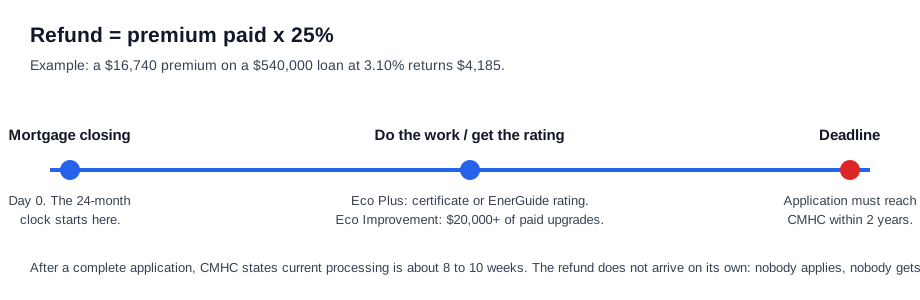
- Do the refund math on your own premium before you spend anything for the sake of the refund. Refund = premium paid x 25%. The premium is on your mortgage commitment and your closing documents.
- Keep every paid invoice. For Eco Improvement, CMHC's application asks for paid invoices confirming the completed renovations and the amount spent. A quote is not an invoice, and an invoice you cannot produce is spending you cannot prove.
- Put the deadline in a calendar the day you close. Applications must reach CMHC within 2 years of the mortgage closing date. A home that closed on October 30, 2026 has a deadline of October 30, 2028, and CMHC states current processing of about 8 to 10 weeks after that.
- File as soon as the proof exists rather than at the deadline. Certificates and invoices are easiest to replace in the first months, and a rejected or incomplete file still has time to be fixed inside the window.
The two programs side by side
| Eco Plus | Eco Improvement | |
|---|---|---|
| Who it is for | Buyers of newly built homes | Buyers of existing homes who renovate |
| Refund | 25% of the CMHC premium | 25% of the CMHC premium |
| Core test | Eligible energy certificate, or EnerGuide energy use at least 20% below a typical new home | At least $20,000 of qualifying upgrades completed after purchase |
| Property types CMHC names | Newly built homes, high-rise condo units, prefabricated homes | Eligible condominium units and prefabricated homes included |
| Proof | Final certificate, or EnerGuide label or rating | Paid invoices for the work; EnerGuide Renovation Upgrade Report or label if an evaluation was done |
| Deadline | Within 2 years of mortgage closing | Within 2 years of mortgage closing |
| Processing | About 8 to 10 weeks, per CMHC | About 8 to 10 weeks, per CMHC |
One definition does heavy work in the left column. CMHC footnotes "newly built" as a home that has never been occupied. A condominium unit counts if it was never occupied for residential purposes, apart from the buyer occupying it on an interim basis before the condominium declaration was registered or before taking possession. A resale home that happens to be very efficient is not an Eco Plus home, no matter what its EnerGuide score says. It can only reach a refund through the renovation route, and only if the $20,000 of qualifying work happens after that buyer purchases it.
Advertisement
Eco Plus: the new-build refund
The buyer's side of Eco Plus is simple. The proof side is where claims stall, so work it in this order.
Route 1: an eligible certificate. CMHC publishes a table of accepted certifications. The names a Canadian buyer is most likely to meet on a builder's feature sheet include ENERGY STAR for New Homes, R-2000, LEED Canada for Homes or LEED Building Design and Construction at Gold or Platinum, Certified Passive House, CHBA Net Zero Energy and Net Zero Energy Ready, Quebec's Novoclimat, Built Green at Gold or Platinum, the Zero Carbon Building Standard, and BC Energy Step Code steps (Step 3, 4 or 5 for detached Part 9 homes; Step 2, 3 or 4 for Part 3 buildings). The full table, with versions and levels, is on CMHC's Eco Plus page. A certificate at the wrong level of the right program does not qualify, so match the level, not just the logo.
Route 2: the EnerGuide rating. If the home carries no eligible certificate, the rating can still carry the claim: energy consumption at least 20% lower, in the EnerGuide Rating System's terms, than a typical new house. New homes in Canada are routinely EnerGuide-rated as part of code and builder programs, and the label is a builder document. Ask for it by name. If the home was never rated, CMHC's instruction is to have it assessed by a qualified energy advisor registered with Natural Resources Canada.
Two practical points follow. First, the certificate or rating describes the home as built. A buyer who upgrades a new build after moving in does not improve an Eco Plus claim; the claim stands or falls on the home the builder delivered. Second, stack this refund against the other new-build money rather than treating it as the whole story. The same purchase may also sit inside the first-time home buyer GST rebate or the older GST/HST New Housing Rebate, and it carries a new home warranty with its own deadlines. Each program has a separate form, a separate clock and a separate proof file. Buyers lose money by assuming one application covers the rest.
The refund math
CMHC's premium schedule for a standard purchase, set out in full in our premium guide, charges 2.80% of the loan at 80.01% to 85% loan-to-value, 3.10% at 85.01% to 90%, and 4.00% at 90.01% to 95%. The refund is a flat 25% of whatever premium was charged, so the dollar value is set by two numbers you already have: the loan amount and the tier.
| Loan amount | Refund at 2.80% premium | Refund at 3.10% premium | Refund at 4.00% premium |
|---|---|---|---|
| $300,000 | $2,100.00 | $2,325.00 | $3,000.00 |
| $450,000 | $3,150.00 | $3,487.50 | $4,500.00 |
| $540,000 | $3,780.00 | $4,185.00 | $5,400.00 |
| $750,000 | $5,250.00 | $5,812.50 | $7,500.00 |
Every figure in this table is premium x 0.25, computed for this guide. The $450,000 loan at the 4.00% tier, for example, carries an $18,000 premium, and a quarter of that is $4,500.
Worked example 1, Eco Plus. Labelled hypothetical. A buyer purchases a newly built townhouse for $600,000 with 10% down, a $60,000 down payment and a $540,000 mortgage. At 90% loan-to-value the premium tier is 3.10%, so the premium is $540,000 x 3.10% = $16,740, added to the loan in the usual way. The builder delivers an ENERGY STAR certificate, which is on CMHC's eligible list. The buyer confirms with the lender that CMHC insured the loan, sends the signed form, the certificate and a void cheque inside the 2-year window, and receives 25% of $16,740, which is $4,185. The steps that produced the money were a document request and a form. The steps that lose it are a certificate never collected and a deadline never calendared.
The 30-year wrinkle. First-time buyers and new-build buyers who take a 30-year insured amortization pay a premium 0.20 percentage points higher at each tier under CMHC Home Start pricing, so their refunds are larger in dollars. A $475,000 loan at the 4.20% Home Start tier carries a $19,950 premium and a $4,987.50 refund, against $4,750 at the standard 4.00% tier. The higher premium is a cost first and a bigger refund second; nobody should extend an amortization to enlarge a refund cheque. Our 30-year amortization guide works through what the longer term does to total interest.
Eco Improvement: the renovation refund
Eco Improvement is the same 25% applied to a different fact pattern: an existing home, a CMHC-insured mortgage, and energy work done after the purchase. CMHC sets the floor at $20,000 of qualifying upgrades, in one or more of three categories:
| Category | Work CMHC lists |
|---|---|
| Building envelope | Insulation, windows, doors, roofing, attic upgrades, air sealing, foundation work |
| Mechanical systems | Heating, ventilation, air conditioning, heat pumps |
| Renewable energy | Solar, wind, geothermal installations |
Note what the test is and what it is not. It is a spending test inside named categories, proved with paid invoices. It is not a measured-efficiency test: CMHC says that if you completed an EnerGuide evaluation after the renovations, you should submit the Renovation Upgrade Report or label, but the eligibility wording turns on the insured mortgage, the $20,000 of completed work and the categories. A $19,000 heat pump, however efficient, is below the floor on its own. A $12,000 heat pump plus $9,000 of attic insulation and air sealing crosses it, because the categories can be combined.
Worked example 2, Eco Improvement. Labelled hypothetical. A buyer purchases an existing house for $500,000 with 5% down. The mortgage is $475,000, the loan-to-value is 95%, the premium tier is 4.00%, and the premium is $19,000. In the first year the buyer replaces the furnace with a heat pump system for $14,600 and adds attic insulation and air sealing for $6,800, both invoiced and paid, for a total of $21,400 inside two eligible categories. The refund is 25% of the $19,000 premium: $4,750.
Now the misconception this example exists to correct. The refund is not 25% of the renovation bill. On these figures it equals about 22.2% of the $21,400 spent, and the share falls as spending rises: the same buyer spending $40,000 still receives $4,750, because the premium did not change. Run the comparison the other way before planning work around the refund. A buyer whose premium was $12,600 (a $450,000 loan at 2.80%) receives $3,150, which is 15.75% of a $20,000 renovation budget. Eco Improvement lowers the net cost of work that already makes sense for the house. It does not turn a $20,000 project into a $15,000 project, and a project that only pencils with the refund at 25% of spend was mispriced from the start.
Sequencing matters for resale buyers. The qualifying work has to be completed after the purchase and the application has to land within 2 years of the mortgage closing date, so the renovation calendar and the refund calendar are the same calendar. A buyer planning a staged retrofit should put the envelope and mechanical items that count toward the $20,000 inside the first 2 years, keep cosmetic work outside the claim file, and hold the paid invoices together from the first contractor visit. Work the seller did before closing does not count toward your total, however recent it is. If the seller's upgrades matter to you, their value is in the price negotiation, not in your refund.
The financed-premium catch
Most insured buyers add the premium to the mortgage rather than paying it in cash at closing. The refund does not reverse that choice. CMHC's application asks for a void cheque in the name of one of the borrowers, which tells you how the money travels: it is paid to the borrower, and the mortgage balance, including the financed premium, stays where it was. A borrower who wants the refund to reduce the loan has to make that happen, for example by applying it as a prepayment under the mortgage's prepayment privileges, subject to that lender's rules.
There is a second cash item the refund does not touch. In provinces that tax the premium, the provincial sales tax on the premium is due in cash at closing, as our premium guide sets out. CMHC's Eco pages describe the refund as 25% of the mortgage insurance premium. Sagen and Canada Guaranty, by contrast, state in their program material that their 25% refund is calculated including applicable provincial sales tax. Treat the tax line as insurer-specific, and confirm the treatment on your own file rather than assuming the three programs match.
If your insurer is not CMHC
The lender, not the borrower, selects the insurer, and two other insurers operate in this market. Both run energy-efficiency refund programs of their own, with their own forms and addresses. Sending a CMHC form for a Sagen-insured loan is a delay measured in months, which is why step 1 of this guide is the insurer check.
| Insurer | Program | What its own material states |
|---|---|---|
| CMHC | Eco Plus / Eco Improvement | 25% of premium; new builds by certificate or 20% EnerGuide test, or $20,000+ of qualifying renovations; apply within 2 years of closing; processing about 8 to 10 weeks |
| Sagen | Energy-Efficient Housing Program | 25% refund of the Sagen premium including applicable provincial sales tax; purchase of a new construction property; certified, or at least 20% lower energy use than a typical new house on the EnerGuide system. Sagen's own example: a $300,000 mortgage at 95% loan-to-value pays a $12,000 premium and a $3,000 refund |
| Canada Guaranty | Energy-Efficient Advantage Program | 25% premium refund for a newly constructed, energy-efficient home, calculated on the standard premium including applicable provincial sales tax; applications within 24 months of the mortgage closing date; supporting documents no more than 5 years old; refunds issued within 8 to 12 weeks of receiving the application |
The three programs agree on the headline number and differ in the details that decide a file: what counts as proof, how the tax is treated, and where the form goes. Read the page for the insurer on your commitment, not the page for the insurer you expected.
Six ways these claims die
- The deadline passes. Two years from the mortgage closing date, for both CMHC programs. There is no step in either application that asks why you filed late.
- The insurer was wrong. The borrower assumed CMHC because CMHC is the name they know. The loan was insured by Sagen or Canada Guaranty, the CMHC file goes nowhere, and the correct program's clock kept running.
- The certificate never left the builder's office. An eligible new build with no certificate and no EnerGuide label in the buyer's hands is a claim that cannot be proved until someone produces the document. Ask at purchase, not at month 23.
- The renovation total lands under $20,000. One category short, or a project split so that part of the work falls outside the eligible categories or outside the window. Add the invoices before the work starts, not after it ends.
- The work predates the purchase. Eco Improvement counts upgrades completed after you buy. The seller's new heat pump is a selling feature, not your qualifying spend.
- The proof is a quote. CMHC asks for paid invoices for Eco Improvement and the certificate or rating for Eco Plus. Estimates, feature sheets and a realtor's assurance that the home is efficient are not the documents named in the application.
A related boundary sits on the financing side. None of these refunds changes how you qualified: the stress test ran on the full mortgage including the premium, and the refund arrives after closing, so it cannot rescue a file that did not qualify. It also cannot be assigned to the down payment. The down payment rules decide what you bring to closing; the Eco refund is money that comes back later, to a borrower who filed.
Advertisement
Pre-application checklist
- Insurer confirmed in writing by the lender: CMHC, Sagen, or Canada Guaranty.
- Premium amount copied from the mortgage commitment or closing documents, and the refund computed as premium x 25%.
- For Eco Plus: final eligible certificate in hand, or EnerGuide label or rating showing at least 20% lower energy use than a typical new home; if neither exists, an energy advisor assessment booked.
- For Eco Improvement: paid invoices totalling at least $20,000, all inside the envelope, mechanical or renewable categories, all for work completed after the purchase and inside the 2-year window.
- Mortgage closing date written down, and the 2-year deadline calendared with months to spare.
- Application form signed and dated by every borrower on the mortgage.
- Void cheque in the name of one of the borrowers, as CMHC's steps require.
- A copy of everything submitted kept in the home's file, with the submission date. Processing runs about 8 to 10 weeks at CMHC; a file you cannot reconstruct is a file you cannot follow up.
Sources
Program rules in this guide were taken from the sources below, read on October 30, 2026. The insurer named on your mortgage commitment governs your file, and program terms can change.
- CMHC, Eco Plus: 25% partial premium refund for a CMHC-insured purchase of a newly built energy-efficient home; newly built defined as never occupied, with the condominium interim-occupancy exception; eligibility by eligible certificate or an EnerGuide rating at least 20% better than a typical new home; eligible property types including high-rise condo units and prefabricated homes; the eligible certifications table (ENERGY STAR, R-2000, LEED, Passive House, CHBA Net Zero, Novoclimat, Built Green, Zero Carbon Building Standard, BC Energy Step Code and others); application within 2 years of the mortgage closing date; processing about 8 to 10 weeks; signed form, certificate or rating, and void cheque: https://www.cmhc-schl.gc.ca/consumers/home-buying/mortgage-loan-insurance-for-consumers/cmhc-eco-products/cmhc-eco-plus
- CMHC, Eco Improvement: 25% refund for CMHC-insured homeowners completing at least $20,000 of qualifying renovations after purchase; the three categories (building envelope, mechanical systems, renewable energy) and their listed examples; condominium units and prefabricated homes included; paid invoices, signed form and void cheque; EnerGuide Renovation Upgrade Report or label where an evaluation was completed; supporting documents usable for up to 5 years, including for subsequent purchasers; application within 2 years of the mortgage closing date; processing about 8 to 10 weeks: https://www.cmhc-schl.gc.ca/consumers/home-buying/mortgage-loan-insurance-for-consumers/cmhc-eco-products/cmhc-eco-improvement
- CMHC, Eco Products overview: the two programs presented as the routes to a 25% mortgage insurance refund for energy-efficient homes and renovations: https://www.cmhc-schl.gc.ca/consumers/home-buying/mortgage-loan-insurance-for-consumers/cmhc-eco-products
- Sagen, Energy Efficient Housing Program: 25% refund of the Sagen premium including applicable provincial sales tax on a new construction purchase; certified or at least 20% lower EnerGuide energy use than a typical new house; worked example of a $300,000 mortgage at 95% loan-to-value, $12,000 premium, $3,000 refund: https://www.sagen.ca/products-and-services/energy-efficient-housing/
- Canada Guaranty, Energy-Efficient Advantage Program: 25% premium refund for a newly constructed, energy-efficient home, on the standard premium including applicable provincial sales tax; certified or at least 20% lower energy consumption than a typical new house; applications within 24 months of the mortgage closing date; supporting documentation no more than 5 years old; refunds issued within 8 to 12 weeks: https://www.canadaguaranty.ca/wp-content/uploads/CG-Energy-Efficient-Advantage-Program-July_2025-Eng.pdf
- Premium tiers used in the worked examples (2.80%, 3.10%, 4.00%, and the 30-year Home Start tiers 0.20 points higher) are CMHC's homeowner premium schedule as set out in our CMHC premium guide, checked October 24 to 26, 2026.
Worked examples were computed for this guide from the stated loan amounts and premium rates. They are illustrations of the arithmetic, not quotes, listings, or a recommendation for any household.
Frequently asked questions
How much is the CMHC Eco refund?
25% of the mortgage insurance premium you paid. On CMHC's standard premium tiers (2.80%, 3.10% and 4.00% of the loan), a $450,000 mortgage carries a premium of $12,600, $13,950 or $18,000, so the refund is $3,150, $3,487.50 or $4,500. A $750,000 loan at 4.00% produces a $30,000 premium and a $7,500 refund. The refund follows the premium, not the purchase price and not the renovation bill.
What is the difference between CMHC Eco Plus and Eco Improvement?
Eco Plus is for newly built homes: CMHC-insured, never occupied, and energy-efficient, proved by an eligible certificate or an EnerGuide rating at least 20% better than a typical new home. Eco Improvement is for existing homes: CMHC-insured, with at least $20,000 of qualifying energy renovations completed after the purchase, in the building envelope, mechanical systems or renewable energy categories. Both refund 25% of the premium and both require an application within 2 years of the mortgage closing date.
Is the CMHC Eco refund automatic?
No. CMHC's steps require you to confirm the mortgage is CMHC-insured, complete the application form signed and dated by all borrowers, attach the certificate or rating (Eco Plus) or the paid renovation invoices (Eco Improvement), and include a void cheque in a borrower's name. CMHC states current processing of about 8 to 10 weeks. A borrower who never applies receives nothing, however efficient the home is.
My mortgage is insured by Sagen or Canada Guaranty. Can I still get an energy refund?
Yes, through that insurer's own program rather than CMHC's. Sagen's Energy-Efficient Housing Program refunds 25% of the Sagen premium including applicable provincial sales tax on a new construction purchase that is certified or uses at least 20% less energy than a typical new house. Canada Guaranty's Energy-Efficient Advantage Program refunds 25% of its premium including applicable provincial sales tax for a newly constructed, energy-efficient home, with applications inside 24 months of closing and refunds issued within 8 to 12 weeks. Your lender can tell you which insurer is on your mortgage.
Does a very efficient resale home qualify for Eco Plus?
No. CMHC defines the Eco Plus property as newly built, meaning never occupied, with a narrow interim-occupancy exception for condominium units. An efficient resale home can only reach a refund through Eco Improvement, and only when the current buyer completes at least $20,000 of qualifying upgrades after purchasing it. Efficiency the seller paid for does not count toward the buyer's total.
What renovations count toward the Eco Improvement $20,000?
Work in CMHC's three categories: building envelope improvements such as insulation, windows, doors, roofing, attic upgrades, air sealing and foundation work; mechanical system upgrades including heating, ventilation, air conditioning and heat pumps; and renewable energy systems such as solar, wind or geothermal. Categories can be combined to reach $20,000, the work must be completed after the purchase, and CMHC asks for paid invoices proving the amounts.
Does the refund lower my mortgage balance?
Not by itself. The premium is usually added to the mortgage, and the refund is paid to the borrower (CMHC's application requires a void cheque in a borrower's name). The balance, including the financed premium, stays in place unless the borrower uses the refund to make a prepayment under the mortgage's prepayment privileges. The refund also does not change the provincial sales tax that was due in cash on the premium at closing.
How long do I have to apply for a CMHC Eco refund?
Two years from your mortgage closing date, for both Eco Plus and Eco Improvement. CMHC also notes that eligible supporting documents may be used for up to 5 years, including for subsequent purchasers, but that document shelf life does not extend your own application deadline. A mortgage that closed on October 30, 2026 must have its application in by October 30, 2028.
About the BubbleWatch editorial team
BubbleWatch is written and checked by its editorial team under the site brand. Figures come from public sources such as CREA, Statistics Canada, CMHC and the Bank of Canada, and each article links the sources it uses. BubbleWatch is independent of realtor boards and lenders.
Read our full editorial methodology →