Multigenerational Home Renovation Tax Credit in Canada (2026): Why the $7,500 Credit Is Now $7,250, and $7,000 Next
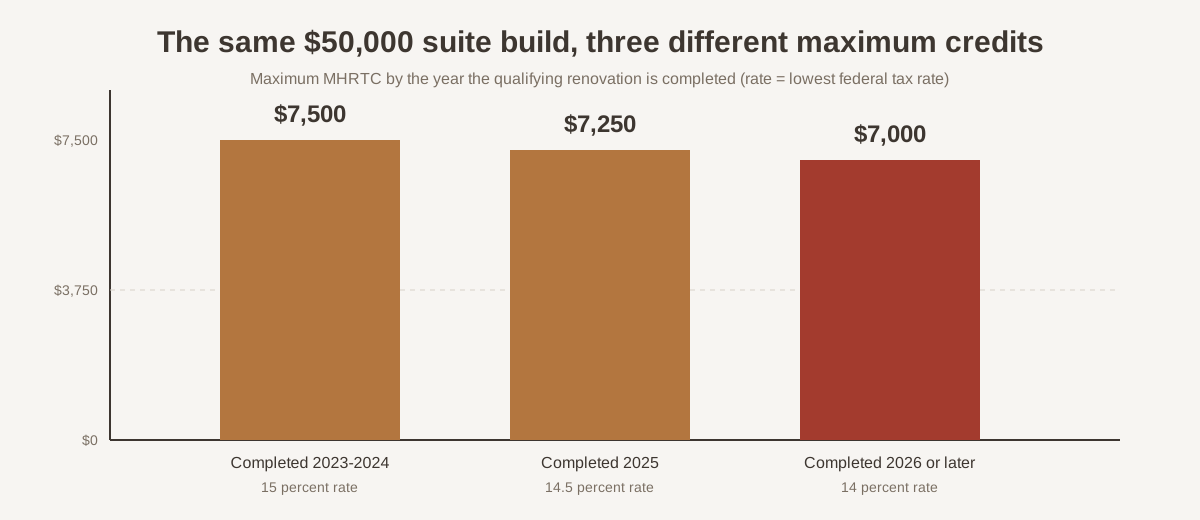
The multigenerational home renovation tax credit (MHRTC) refunds part of what a family spends building a self-contained secondary unit so a senior or an adult eligible for the disability tax credit can live with a relative. The claim is capped at $50,000 of qualifying expenses per renovation, and the credit rate is the lowest federal tax rate for the year the renovation is completed. That rate was 15 percent for 2023 and 2024 completions, 14.5 percent for 2025, and 14 percent for 2026 and later, so the maximum credit has stepped down from $7,500 to $7,250 to $7,000 without the program itself changing. This guide works through the CRA definitions that decide eligibility, the expenses that count and the ones that do not, three worked claims including the CRA's own cost-splitting example, and the filing traps that cost families the credit.
Multigenerational Home Renovation Tax Credit in Canada (2026): Why the $7,500 Credit Is Now $7,250, and $7,000 Next
Short answer: The multigenerational home renovation tax credit (MHRTC) is a refundable federal credit for building a self-contained secondary unit inside a home so that a senior aged 65 or older, or an adult eligible for the disability tax credit, can live with a close relative. You claim the lowest federal tax rate on up to $50,000 of qualifying expenses for each qualifying renovation. Because the rate is tied to the lowest federal rate, and that rate was cut in 2025, the maximum credit depends on the year your renovation is completed: $7,500 for a renovation completed in 2023 or 2024, $7,250 for one completed in 2025, and $7,000 for one completed in 2026 or later. The program rules did not shrink. The rate underneath it did, and a family that lets a nearly finished suite slip from December into January loses $250 at the maximum claim and $192.50 on the $38,500 worked example in this guide.
This guide is education, not tax advice. Eligibility turns on relationships, ownership, and dates in your own file. CRA's MHRTC pages and Schedule 12 are the deciding documents, and a tax professional can apply them to your situation before you spend or file.
The rate fell because the lowest federal tax rate fell
Most coverage of this credit still quotes 15 percent and a $7,500 maximum. That was correct for renovations completed in 2023 and 2024. It is out of date now, and the reason sits outside the housing file entirely.
The MHRTC is calculated at the lowest federal personal income tax rate for the year. The federal government's middle-class tax cut reduced that rate from 15 percent to 14 percent effective July 1, 2025. Finance Canada's backgrounder on the cut explains the arithmetic: because the cut landed halfway through 2025, the full-year rate for 2025 is 14.5 percent, and the full-year rate for 2026 and future years is 14 percent. Bill C-4, which contains the cut, received royal assent on March 12, 2026.
CRA's forms already reflect the change. Schedule 12 for the 2025 tax year states the rate directly: the MHRTC is 14.5 percent of whichever is less, $50,000 or your total qualifying expenditures, and the maximum credit is $7,250. CRA's own worked example on its expenses page uses the same figures: $70,000 of qualifying costs is capped at $50,000, and $50,000 at 14.5 percent gives a $7,250 refundable credit. For a renovation completed in 2026, the Schedule 12 for that year applies the 14 percent rate, which puts the maximum at $7,000. Check the schedule for your completion year when you file rather than relying on any guide, this one included, because the rate line is the one number in this program that has moved twice in two years.
| Renovation completed in | Credit rate | Maximum credit on $50,000 of expenses | Credit on $38,500 of expenses |
|---|---|---|---|
| 2023 or 2024 | 15 percent | $7,500 | $5,775 |
| 2025 | 14.5 percent | $7,250 | $5,582.50 |
| 2026 or later | 14 percent | $7,000 | $5,390 |
Two properties of the credit matter as much as the rate. It is refundable, so it is paid even if it exceeds the tax you owe: in CRA's example, a claimant with a $2,000 balance owing before the credit receives a $5,250 refund after the maximum $7,250 credit is applied. And it is claimed in the year the renovation is completed, not the years the money was spent, which is where the timing rules below come in.
Four definitions decide whether you qualify
The credit runs on defined terms, and most failed claims fail on a definition rather than on the dollar amounts. CRA's Schedule 12 sets them out.
Qualifying individual. The person the unit is built for. Before the end of the renovation period tax year, that person must be either 65 years of age or older, or 18 years of age or older and eligible for the disability tax credit. A parent who turns 65 in the completion year qualifies on age. An adult child who is not DTC-eligible does not, no matter how real the family's need is.
Qualifying relation. The relative the qualifying individual will live with. The list is fixed: a parent, grandparent, child, grandchild, brother, sister, aunt, uncle, niece, or nephew of the qualifying individual or of their cohabiting spouse or common-law partner, and the relation must be 18 or older before the end of the renovation period tax year. A cousin is not on the list. Neither is a family friend, a tenant, or a caregiver who is not a listed relative.
Eligible dwelling. A housing unit in Canada that both the qualifying individual and a qualifying relation ordinarily live in, or intend to ordinarily live in within 12 months of the end of the renovation period. It must be owned, jointly or otherwise, by the qualifying individual or a qualifying relation (or by a trust of which one of them is a beneficiary) at some point in the renovation period tax year. The land that counts as part of the dwelling is generally limited to half a hectare, about 1.24 acres. A rental property the family owns but does not live in is not an eligible dwelling.
Secondary unit. A self-contained housing unit with a private entrance, a kitchen, bathroom facilities, and a sleeping area, meeting any local requirements for a secondary dwelling unit. It can be newly constructed or created from an existing living space. A basement bedroom with a shared kitchen upstairs is not a secondary unit. A basement apartment with its own entrance, kitchen, and bathroom is.
The renovation itself must be of an enduring nature and integral to the dwelling, and it must establish the secondary unit for occupancy by the qualifying individual or the qualifying relation. Either person can be the one living in the new unit: the parent can take the suite while the adult child keeps the main house, or the reverse.
Who can claim, and the once-in-a-lifetime limit
An eligible individual who incurred qualifying expenditures can claim. In practice that is the qualifying individual, their cohabiting spouse or common-law partner, or a qualifying relation who owns the dwelling or will live in it. The claimant must be a resident of Canada throughout the tax year. Where a trust owns the dwelling, expenses incurred by the trust can count for a beneficiary who is an eligible individual, if the trust notifies them of the amount.
Three limits frame every claim:
- One qualifying renovation per qualifying individual, per lifetime. If a family claimed the credit to build a unit for a parent, that parent cannot ground a second claim later, even at a different house with a different relative. A claim for a different qualifying individual is a separate matter, and CRA notes you may claim more than one qualifying renovation in the same year.
- One $50,000 cap per renovation, shared by everyone. If two eligible individuals paid for parts of the same renovation, their combined claimed expenses cannot exceed $50,000, and each person can only claim the expenditures they actually incurred. If the claimants cannot agree on the split, the Minister of National Revenue may decide the portions.
- The cap applies even if two qualifying individuals will live in the unit. Building one suite for two parents does not double the $50,000.
Our secondary suite financing guide covers the separate insured-refinance program that can fund a suite build up to 90 percent of as-improved value. That program and this credit are different instruments from different departments: the refinance is about borrowing, the MHRTC is a tax claim after the fact, and neither one's approval implies the other's.
Which expenses count, and which do not
A qualifying expenditure has to be a reasonable expense directly attributable to the qualifying renovation, made or incurred after December 31, 2022, and before the end of the renovation period, by an eligible individual (or a qualifying trust). CRA's lists are specific enough to plan a budget around.
| Generally qualifying | Do not qualify |
|---|---|
| Labour and professional services: contractors, electricians, plumbers, carpenters, architects | Annual, recurring, or routine repairs and maintenance |
| Building materials and fixtures | Household appliances |
| Building permits and building plans | Electronic home-entertainment devices |
| Equipment rentals used in the renovation | Housekeeping, security monitoring, gardening, outdoor maintenance and similar services |
| If you do the work yourself: materials, fixtures, equipment rentals, plans, and permits | Financing costs for the renovation |
| The value of your own labour or tools | |
| Goods or services from someone not at arm's length (a relative, for example) unless that person is registered for GST/HST | |
| Expenses that can reasonably be considered reimbursed, including government assistance and related rebates such as GST/HST rebates | |
| Expenses not supported by receipts | |
| Expenses already claimed under the medical expense tax credit or the home accessibility tax credit |
Four of the exclusions catch real projects. The suite's fridge and stove are appliances, so they come out of the claim even though the kitchen itself qualifies. The interest on the loan or HELOC that funded the build is a financing cost and never enters the claim, however large it gets. A brother-in-law who is a carpenter can be paid, but his invoices only qualify if he is GST/HST registered, because he does not deal with the family at arm's length. And if a provincial program, a municipal grant, or a GST/HST rebate covers part of the cost, the claim is reduced by that amount first: Schedule 12 subtracts reimbursements and assistance before the $50,000 cap is applied.
Receipts are not a formality. CRA's supporting-document standard asks for documents that identify the vendor or contractor, their business address and GST/HST number if any, a description of the goods or work and the address it was done at, the dates goods were delivered or work was performed, the invoice amount, and proof of payment in full or payment evidence such as a card slip or cancelled cheque. A project paid in cash with a single lump-sum invoice from an unregistered relative fails on several of these at once.
The math: three claims priced
Example 1: one claimant, a basement suite, completed in 2025. Labelled hypothetical: a homeowner converts a basement into a self-contained unit for her father, who is 71. Qualifying expenditures total $38,500 after removing the suite's appliances and a small grant. Completed and final-inspected in November 2025, the claim goes on her 2025 return: $38,500 at 14.5 percent is a $5,582.50 refundable credit.
Example 2: the identical project, completed in 2026. Same house, same father, same $38,500, but the final inspection lands in February 2026. The claim goes on the 2026 return at 14 percent: $5,390. The delay costs $192.50. At the $50,000 cap the same slip costs $250, and against a 2024 completion it costs $500. None of this justifies rushing an inspection that should fail, but it does mean a project sitting at 95 percent complete in December has a real, priced reason to finish the paperwork before year-end, and a project planned for early 2026 should be budgeted at $7,000, not at the $7,500 figure most websites still print.
Example 3: CRA's own splitting example. Two eligible individuals, Rey and Jax in CRA's example, shared the cost of a qualifying renovation in 2025. Total qualifying expenses were $62,000, of which Rey incurred $29,000 and Jax $33,000. The claimed total is capped at $50,000, and CRA shows two ways to divide it. Split in proportion to what each paid, Rey claims $23,500 of expenses (47 percent) and Jax claims $26,500 (53 percent). Tilted to maximize one side, Rey can claim up to the $29,000 he actually incurred, leaving Jax $21,000, or Jax can claim up to $33,000, leaving Rey $17,000. At the 2025 rate of 14.5 percent, the proportional split produces credits of $3,407.50 and $3,842.50, which add to the $7,250 maximum for the renovation. The split changes who receives the money. It never changes the combined total, which is fixed by the expenses and the cap.
Timing: the year the renovation ends is the year you claim
CRA's rule is short: claim the renovation in the tax year when the renovation period ended, even if the work took more than one year. The renovation period begins when the first qualifying expenditure is made or incurred, for example when you apply for a building permit, and ends when the renovation is completed, for example when it passes final inspection or proof of completion is received. CRA's example makes the consequence concrete: a renovation that started with an expense in April 2025 and passed final inspection in July 2026 is claimed on the 2026 return, at the 2026 rate, regardless of when most of the money went out.
Practical consequences follow. Expenses are only qualifying if they fall after December 31, 2022 and before the end of the renovation period, so pre-2023 costs from an earlier phase of work are out. A claim filed a year early, in the year you paid the contractor rather than the year the suite passed inspection, is a claim in the wrong year. And the 12-month occupancy intention is tested against the end of the renovation period: the qualifying individual and the relation must ordinarily live in the dwelling, or intend to, within 12 months of that date.
For 2024 and later tax years the claim is made on line 45355 of the return, worked out on Schedule 12. Keep the supporting documents rather than sending them in; CRA can ask for them after the fact.
The MHRTC is not the home accessibility tax credit
Families renovating for a senior relative meet two credits with similar casts and different jobs. Confusing them is expensive, because an expense claimed under one cannot be claimed under the other.
| MHRTC | Home accessibility tax credit (HATC) | |
|---|---|---|
| Purpose | Create a self-contained secondary unit so a qualifying individual can live with a qualifying relation | Renovate or alter a home so a qualifying individual can gain access to it, be more mobile or functional in it, or face less risk of harm in it |
| Refundable? | Yes | No, it only reduces tax otherwise owing |
| Claim size | Up to $50,000 of expenses per qualifying renovation, once per qualifying individual in their lifetime | Up to $20,000 of expenses per year per eligible dwelling |
| Rate and maximum | Lowest federal rate: 15 percent and $7,500 for 2023-2024 completions, 14.5 percent and $7,250 for 2025, 14 percent and $7,000 for 2026 and later | Set at the same lowest rate, on the smaller annual cap: at 15 percent the maximum was $3,000; at 14 percent the same $20,000 claim is worth $2,800 |
| Typical work | A new basement, garden, or converted suite with its own entrance, kitchen, bathroom, and sleeping area | Wheelchair ramps, walk-in bathtubs, wheel-in showers, grab bars |
| Where claimed | Line 45355, using Schedule 12 | Line 31285, using the federal worksheet |
The interaction rules run in both directions. CRA states that expenses claimed for the medical expense tax credit or the HATC cannot be claimed for the MHRTC. Budget 2025 separately proposed that, for 2026 and later years, an expense claimed under the medical expense tax credit cannot also be claimed under the HATC, closing a double claim that earlier years allowed. If part of a project is suite construction and part is accessibility work inside the main home (a ramp and grab bars in the parents' bathroom, say), the invoices need to be separated by purpose from the start, with each dollar assigned to one claim only. Retrofitting that separation from a single lump-sum contract a year later is where claims get reduced.
Paying for the build is a separate problem
The credit arrives after the work is done and the return is filed. The build has to be financed in the meantime, and the options price very differently. A construction mortgage pays out in draws as work passes inspection, which matches a suite build's cash flow; our construction mortgage guide works through the draw and completion mechanics. A HELOC or home equity loan is simpler and charges interest only on the drawn balance in the HELOC case; our home equity borrowing guide compares the routes. A refinance can fold the project into the mortgage at renewal or mid-term, at the cost of a new stress test and possibly a penalty; our refinance guide prices that break-even. In every case, the financing cost itself stays out of the MHRTC claim, and the eventual credit (at most $7,000 on a 2026 completion) should be treated as a partial rebate on a much larger budget, never as the reason the project pencils out.
Two adjacent decisions belong in the same family conversation. If the parent is selling their own home to move in, the principal residence exemption on that sale has its own designation and reporting rules, covered in our capital gains guide. And if the real question is whether to renovate at all or move the whole household, our renovate or relocate comparison prices the two paths against each other. For a parent who wants to stay in their own home instead, a reverse mortgage is the alternative structure families usually weigh against moving in together.
Before you build: a short checklist
- Confirm the qualifying individual: 65 or older before the end of the completion year, or 18 or older and DTC-eligible. If the DTC is the basis, the eligibility has to be real and current, not assumed.
- Confirm the qualifying relation is on CRA's list, and that both parties will ordinarily live in the dwelling within 12 months of the renovation period ending.
- Confirm ownership: the qualifying individual or a qualifying relation owns the dwelling at some point in the completion year (or is a beneficiary of a trust that does).
- Design the unit to the definition: private entrance, kitchen, bathroom, sleeping area, plus whatever your municipality requires for a legal secondary unit. Get the building permit; the permit application can also start your renovation period.
- Budget at the right rate: 14.5 percent for a 2025 completion, 14 percent for 2026 and later, on at most $50,000 of qualifying expenses, minus any grants or rebates.
- Hire with the paper trail in mind: itemized invoices, GST/HST numbers where applicable, and proof of payment. If a relative does the work, confirm their GST/HST registration before they start.
- Keep appliances, financing costs, and routine maintenance out of the claim budget from day one. They are real project costs; they are just not qualifying expenditures.
- Separate the invoices if any part of the work belongs to the HATC or the medical expense credit instead. One dollar, one credit.
- Calendar the completion: the claim belongs to the completion year, at that year's rate, on line 45355 with Schedule 12.
Sources
- CRA, Multigenerational home renovation tax credit (MHRTC): who can claim, expenses you can claim, how to claim, and line 45355. canada.ca
- CRA, Schedule 12 (T1-2025), Multigenerational Home Renovation Tax Credit: definitions, the 14.5 percent rate, and the $7,250 maximum for 2025. canada.ca
- Department of Finance Canada, Delivering a middle-class tax cut (backgrounder, May 14, 2025): lowest rate from 15 percent to 14 percent effective July 1, 2025; 14.5 percent full-year rate for 2025 and 14 percent for 2026 and future years. canada.ca
- Department of Finance Canada, Legislation to make life more affordable receives Royal Assent (March 12, 2026): Bill C-4 royal assent. canada.ca
- Department of Finance Canada, Report on Federal Tax Expenditures 2025, part 6: MHRTC and HATC descriptions, Income Tax Act sections 122.92 and 118.041. canada.ca
- Department of Finance Canada, Budget 2025 tax measures, supplementary information: proposed end, for 2026 and later years, to claiming the same expense under both the medical expense tax credit and the HATC. budget.canada.ca
Advertisement

About David R. Chen, CFA
David R. Chen is a Chartered Financial Analyst and the Senior Housing Economist at BubbleWatch.ca. He brings 12+ years of experience in quantitative real estate analysis and mortgage underwriting. Formerly an analyst at a major Canadian bank, he specializes in modeling payment shock, regional affordability divergence, and private lending risk.
View David's professional bio & credentials →