Refinancing a Mortgage in Canada (2026): The Break-Even Math, the Full Cost Stack, and the 80 Percent Ceiling
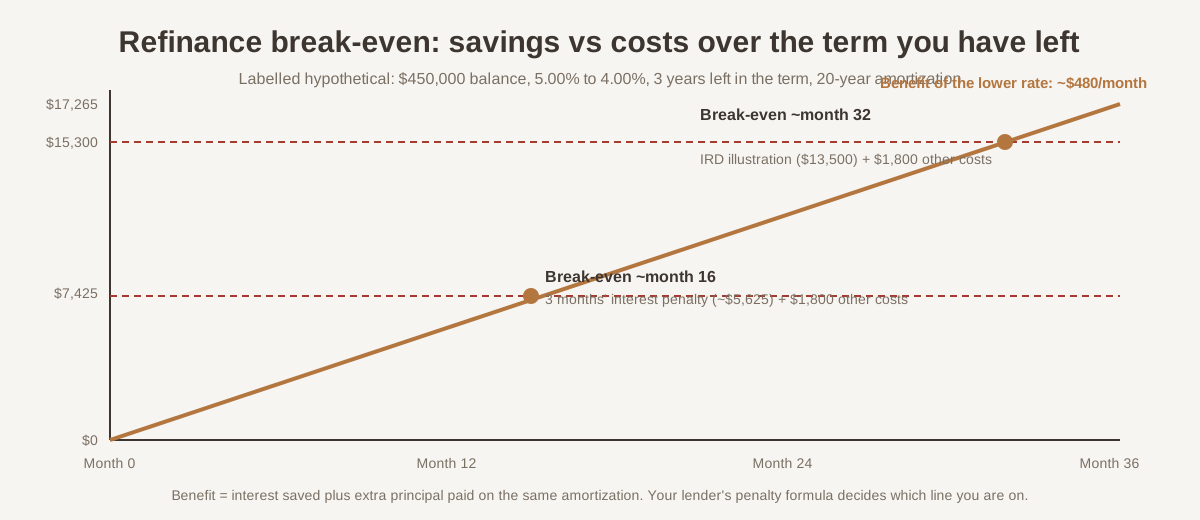
Refinancing replaces your mortgage with a new one: a bigger balance, a longer amortization, a different rate type, or some mix of the three. The federal ceiling is 80 percent of your home's value, you qualify from scratch at the stress-test rate, and if you refinance mid-term the prepayment penalty is usually the largest single cost. This guide prices a full refinance on a worked $450,000 example two ways (a three-months-interest penalty breaks even in about 16 months; an interest rate differential illustration takes about 32), works the cash-out ceiling on a $750,000 home, and shows why rolling card debt into a mortgage can raise your total interest even as the rate falls from 19.99 percent to 4 percent.
Refinancing a Mortgage in Canada (2026): The Break-Even Math, the Full Cost Stack, and the 80 Percent Ceiling
Short answer: A refinance is a new mortgage that pays out the old one. Because it is new, three things follow. You can borrow up to 80 percent of your home's appraised value in total, counting what you already owe. You qualify from scratch, income, debts and the federal stress test included, at the greater of your contract rate plus 2 percent or 5.25 percent. And if your current term has not ended, you pay to break it: usually three months' interest on a variable-rate mortgage, and the greater of three months' interest or the interest rate differential (IRD) on a closed fixed-rate mortgage. The penalty is the number that decides most refinances. On the worked example in this guide, a $450,000 balance moved from 5.00 percent to 4.00 percent with three years left in the term gains $17,265 over those three years before costs. Against a three-months-interest penalty the refinance clears its costs in about 16 months. Against an IRD-sized penalty it needs about 32 of the 36 months, which is a different decision entirely.
This is education only, not mortgage or financial advice. Penalty formulas, fees and qualification rules are set by your contract and your lender. Get the penalty as a written payout figure from your current lender before you sign anything with a new one.
Four transactions people call a refinance, and only one of them is
The word refinance gets used for four different moves, and the rules differ sharply between them. Sorting yours into the right row is the first step, because two of the four carry no penalty and no stress test, and the other two carry both.
| Move | What changes | Prepayment penalty | Stress test at a federally regulated lender |
|---|---|---|---|
| Renewal with your current lender | Rate and term only, at maturity | No, the term has ended | No new application in the usual case |
| Straight switch at renewal | Same balance, same remaining amortization, new lender | No, the term has ended | No set minimum qualifying rate since November 21, 2024 (OSFI), for insured and uninsured alike |
| Blend and extend | New rate blended with your old one, term extended, same lender, balance usually unchanged | Usually no, because the mortgage is not discharged | Treated as a new agreement by most lenders; ask |
| Refinance | Balance up, amortization longer, borrowers changed, or a mid-term break | Yes if mid-term; the subject of this guide | Yes, in full: greater of contract rate plus 2 percent or 5.25 percent |
Our switching lenders guide covers the straight switch in depth, including the rule that lets up to $3,000 of switching costs ride on the balance. Our blend and extend guide prices the third row. This guide is about the fourth row: the moves that actually change the loan. Taking cash out, stretching the amortization to cut the payment, consolidating other debts, removing a co-borrower after a separation, and breaking a term early for a lower rate are all refinances, and each one restarts your qualification from zero.
One boundary matters more than borrowers expect. The November 2024 OSFI change that freed straight switches from the set qualifying rate did nothing for refinances. OSFI's backgrounder is explicit that the exemption applies when a borrower switches lenders with no increase to the amortization period and no increase to the loan amount. Add a dollar of new money or a month of amortization and you are back under the full test. A borrower can be perfectly able to switch and unable to refinance the identical balance at a longer amortization, because the test is applied to the new structure, not the old payment.
The 80 percent ceiling, priced
The Financial Consumer Agency of Canada (FCAC) puts the general rule plainly: borrowing against your home's equity is usually limited to 80 percent of the home's value. That ceiling covers everything secured on the property at once: the first mortgage, any HELOC balance, and any other secured loan. It is a ceiling, not an entitlement. The appraised value is the lender's number, not your listing estimate, and you still have to qualify for the payment at the stress-test rate.
Worked example, labelled hypothetical throughout: a home appraised at $750,000 with a $420,000 mortgage balance and no other secured debt.
| Line | Amount |
|---|---|
| Appraised value | $750,000 |
| Maximum total secured debt (80 percent) | $600,000 |
| Current mortgage balance | $420,000 |
| Room to borrow before costs and qualification | $180,000 |
| Current loan-to-value | 56 percent |
Two qualifications ride on that $180,000. First, closing costs on a refinance are often paid out of the proceeds, so the cash that reaches you is the room minus the cost stack priced below. Second, qualification can bind before the ceiling does. A borrower whose ratios already sit near the standard 39 percent gross debt service and 44 percent total debt service limits may qualify for far less than the ceiling allows. Our GDS and TDS guide walks those ratios line by line.
The one exception above 80 percent. Since January 15, 2025, an insured refinance can reach 90 percent of the property's as-improved value for one purpose only: building a new self-contained secondary suite. The conditions are narrow. The as-improved value must be under $2 million, the property can hold at most four units in total, you or a close relative living rent-free must occupy an existing unit, the new units cannot be used as short-term rentals, the amortization can run to 30 years, and the added borrowing cannot exceed the project cost. There is no general cash-out version of this. Our secondary suite financing guide covers the program and its insurance premium.
Where a HELOC fits. A home equity line of credit is the main alternative to a cash-out refinance, and it lives under a second ceiling: at federally regulated lenders the HELOC portion on its own is capped at 65 percent of the home's value, while the mortgage and HELOC combined stay under the same 80 percent total. On the $750,000 example the HELOC ceiling is $487,500 on paper, but the combined cap is what binds: with a $420,000 mortgage in place, HELOC room is the same $180,000. The difference is structure, not room. A HELOC charges interest only on what you draw and lets you repay and redraw; a refinance hands you a lump sum inside an amortizing mortgage at a usually lower rate, and the clock starts on all of it at once. Our home equity borrowing guide compares the refinance, HELOC, home equity loan and reverse mortgage routes side by side.
The cost stack: every line, in the order it hits
A refinance has one large variable cost and a tail of smaller fixed ones. Budget for all of them, because the smaller lines are the ones that never appear in a rate advertisement.
The prepayment penalty (mid-term only). If your term has ended, this line is zero, which is why refinancing at renewal is a fundamentally cheaper transaction than refinancing mid-term. If it has not ended, FCAC's framework is: a closed variable-rate mortgage usually costs three months' interest; a closed fixed-rate mortgage usually costs the greater of three months' interest or the IRD. An open mortgage can generally be paid off at any time without a penalty, which is the entire reason open rates are higher. Our prepayment penalty guide works the IRD formulas, including the posted-rate method several large banks use, which compares your contract rate against a posted rate less your original discount and routinely produces a larger figure than the standard calculation. Two habits protect you here. Ask for the penalty as a dated payout statement, not a phone estimate, because it moves with rates and with your balance. And if you hold cash you were planning to put against the mortgage anyway, use your annual prepayment privilege first where your contract allows it: shrinking the balance shrinks the balance the penalty is calculated on.
Discharge and administration fees. Your current lender charges to close out the old mortgage and discharge it from title when you move to a new lender. The amount is set by the lender and, in some provinces, capped or shaped by provincial rules. Staying with the same lender can reduce or remove some of these lines, which is a real, if unglamorous, argument for pricing a same-lender refinance against the market.
Legal and registration costs. A refinance is a new charge on title. A lawyer or notary (in Quebec, a notary) handles the title search, the new registration, the discharge of the old charge and the payout of any debts being consolidated. Expect a flat-fee quote; get it before you commit, in writing, with disbursements included.
Appraisal. The lender needs a current value to apply the 80 percent ceiling, and orders an appraisal for most refinances. The borrower usually pays. Automated valuations are sometimes accepted on low-ratio files, which can reduce this line to zero; do not count on it in your budget.
Title insurance. Most lenders require a lender's policy on the new charge, and an owner's policy is usually offered alongside it. One-time premium, priced on the loan amount. Our title insurance guide explains what the two policies cover.
A new insurance premium, on insured files. If your mortgage is insured and the refinance changes the loan in ways the insurer treats as a new insured loan, a premium can apply to the new structure. The amount is insurer-specific. Ask the question directly: does this refinance trigger a new or top-up premium, and how much is it?
For the worked example below, the smaller lines are bundled as an assumed $1,800 covering legal, appraisal, discharge, registration and title costs. That figure is an assumption for the arithmetic, labelled as such, not a market quote. Your bundle will differ by province, lender and property, and getting it quoted is step two of the checklist at the end of this guide.
The break-even example, done properly
Most refinance math sold to borrowers compares monthly payments and stops. That understates the benefit of a lower rate, because part of every lower-rate payment goes to principal faster: at the end of any horizon, the lower-rate borrower also owes less. The correct comparison over the time you actually have left is interest saved plus the balance difference, against the full cost stack.
Labelled hypothetical, computed for this guide with Canadian semi-annual compounding: a $450,000 balance, 20 years of amortization remaining, three years left in the current term, moving from 5.00 percent to 4.00 percent with the amortization unchanged.
| Line | Stay at 5.00 percent | Refinance at 4.00 percent |
|---|---|---|
| Monthly payment | $2,957.06 | $2,719.11 |
| Interest paid over the next 36 months | $63,807.78 | $50,891.88 |
| Balance after 36 months | $407,353.52 | $403,003.95 |
| The benefit, over the 36 months you have left | Amount |
|---|---|
| Interest saved | $12,915.90 |
| Extra principal paid (balance difference) | $4,349.57 |
| Total benefit before costs | $17,265.47 |
| Average benefit per month | $479.60 |
Now the two penalty cases, with the assumed $1,800 of other costs from the section above.
| Case | Penalty | Other costs | Total costs | Break-even | Net gain over 36 months |
|---|---|---|---|---|---|
| Variable-rate shape: three months' interest | About $5,625 | $1,800 | $7,425 | About month 16 | $9,840 |
| Fixed-rate shape: IRD illustration | $13,500 | $1,800 | $15,300 | About month 32 | $1,965 |
The three-months-interest figure is the standard approximation, balance times contract rate times three-twelfths: $450,000 at 5.00 percent gives $5,625. The IRD figure is a simplified illustration, a 1.00 percentage point rate differential applied to the balance across the three remaining years, which gives $13,500. Real IRD calculations discount the payments and use your lender's comparison rate, and the posted-rate method used by several large banks can produce a figure well above the simplified one. Neither number in this table is your penalty. Both are there to show the shape of the decision: the same rate drop, on the same house, is a clear win under one penalty shape and a marginal one under the other, and the only way to know which file you hold is the written payout statement.
Three rules fall out of the arithmetic.
- The horizon is the months you will actually keep the new mortgage, not the new term. If you expect to move in two years, a break-even at month 32 fails even if the rate drop is real. Use the shorter of the time left in your current term and the time you expect to stay.
- A refinance that only cuts the payment by stretching the amortization has no break-even. It has a cost, priced in the next sections. Payment relief and savings are different products; buy the one you meant to buy.
- Rolling the costs into the new balance does not remove them. It finances them at the new rate for the new amortization, which raises the true break-even beyond the simple division above. If your quote adds the penalty to the loan, rerun the table with interest on the financed costs, or at minimum treat the break-even months as a floor, not an estimate.
The amortization stretch: the most expensive way to lower a payment
Extending the amortization is the most common refinance sold as relief, and the arithmetic deserves its own table because the monthly figure is genuinely seductive. Labelled hypothetical: the same $450,000 balance at 4.50 percent, three amortization choices, held to the end of each schedule.
| Amortization | Monthly payment | Total interest over the full schedule | Extra interest vs 20 years |
|---|---|---|---|
| 20 years | $2,836.82 | $230,838 | - |
| 25 years | $2,490.63 | $297,188 | $66,351 |
| 30 years | $2,268.97 | $366,829 | $135,992 |
Cutting the payment by $346 a month costs $66,351 of added interest if the 25-year schedule runs its course. Stretching to 30 years trades $568 a month for $135,992. Two limits apply before the table does. Insured mortgages face a 25-year amortization cap in most cases, with the secondary-suite refinance above and certain first-time-buyer and new-build purchase programs as the exceptions. And the stretch only delivers the full damage if you pay on schedule; a borrower who stretches for breathing room and then prepays aggressively when income recovers can land far from the right-hand column. What the table rules out is the passive version: stretch, relax, and pay the minimum for two decades. If cash flow is the problem and the income gap may not close, read our missed payment guide before this one: lender relief measures, including temporary amortization extension under a relief arrangement, exist for exactly that situation and do not require a new mortgage.
Consolidating card debt: the rate falls, the interest can rise
Rolling unsecured debt into a mortgage is the second most common reason to refinance, and it contains the guide's most counterintuitive result. The rate drops by sixteen points in this example and the borrower still pays more interest, because the repayment period stretches from three years to twenty.
Labelled hypothetical: $30,000 of credit card debt at 19.99 percent, paid off on a three-year plan, against the same $30,000 folded into a mortgage at 4.00 percent on a 20-year amortization. The card figures use simple monthly interest for illustration.
| Route | Monthly outlay for this debt | Total interest | Debt-free in |
|---|---|---|---|
| Card at 19.99 percent, three-year payoff | $1,114.75 | $10,131 | 36 months |
| Rolled into a mortgage at 4.00 percent, 20-year amortization | $181.27 | $13,506 | 240 months |
| Rolled in, but keep paying $1,114.75 a month against it | $1,114.75 | $1,472 | 29 months |
The middle row is the product as usually sold: the payment collapses by $933 a month, the budget breathes, and the debt quietly costs $3,375 more than the card plan while lasting seventeen years longer. The third row is the same refinance used properly. Keep paying what the cards were costing you, direct the difference at the mortgage as prepayments within your privilege limits, and the consolidated debt is gone in 29 months for $1,472 of interest, saving about $8,660 against the card plan and about $12,034 against the passive refinance.
Two non-arithmetic warnings belong with this table. Consolidation converts unsecured debt into debt secured by your home: miss payments after consolidating and the asset at risk is the house, which was never true of the card balance. And consolidation does nothing to the behaviour or the income gap that produced the balances. A borrower who clears the cards, keeps them, and spends back to the limit within two years now holds the card debt and the larger mortgage. Lenders know this pattern, which is why some require the accounts to be closed as a condition of the payout. If the unsecured debts, rather than the mortgage payment, are what broke the budget, a consumer proposal through a Licensed Insolvency Trustee settles unsecured debts without touching the mortgage at all, and our missed payment guide sets out how that tool fits a housing file.
The other reasons people refinance, graded by the math
Breaking early for a lower rate. Priced in full above. Works when the penalty shape is kind and the horizon is long; fails on posted-rate IRDs with short remaining terms. The blend-and-extend route with your current lender sometimes captures part of the drop with no discharge and no penalty, at the cost of a blended rate above the market rate. Price both before choosing.
Removing or adding a borrower. A separation buyout is a refinance whenever the departing spouse comes off title and the mortgage: the remaining borrower must qualify alone for the full balance at the stress-test rate, which is the step that fails most often in practice. Our spousal buyout guide works that file end to end, including the 95 percent insured buyout structure that exists for exactly this case.
Funding a renovation. A lump-sum refinance suits a single large project with a fixed contract price. A HELOC or a readvanceable combination suits staged draws. Either way, the borrowing is capped by the same 80 percent ceiling, and the renovation case is the one place the 90 percent secondary-suite exception can change the answer.
Switching rate type. Moving from variable to fixed, or the reverse, mid-term is a refinance if it discharges the old mortgage, and a simpler product conversion if your lender offers one inside the existing charge. Ask for the conversion price first; it is frequently the cheapest item on this entire page.
Investing the equity. Borrowing to invest makes the interest potentially tax-deductible in Canada when the borrowed money is used to earn income and the other Canada Revenue Agency conditions are met; our Smith Manoeuvre guide covers that structure and its record-keeping demands. The deduction does not reduce the risk: the mortgage payment is due whether the portfolio rises or falls, and the 80 percent ceiling still applies.
The collateral charge trap, checked before you apply
One feature of your current mortgage can quietly raise the cost of leaving it. If your mortgage was registered as a collateral charge rather than a standard charge, other debts registered under the same charge, and the charge itself, may have to be fully discharged and re-registered when you move lenders, which adds legal cost and can block a clean transfer. Collateral charges are common on readvanceable mortgage-and-HELOC combinations. Our collateral charge guide explains how to tell which registration you hold from your mortgage documents. Read it before you interpret a new lender's low switching quote: a file that cannot transfer cleanly is a refinance with full legal costs attached, whichever label the quote uses.
How a refinance closes: the sequence
- Get the payout statement. Balance, penalty to a specific date, discharge fee, and per-diem interest after that date. This document starts everything else; a refinance priced without it is priced on a guess.
- Run your own break-even. Use the method above: interest saved plus balance difference over your real horizon, against penalty plus every fee. If the net is thin, the answer is usually wait for renewal.
- Collect the qualification file. Income letters and pay stubs or, for the self-employed, two years of tax documents; a current mortgage statement; property tax bill; statements for every debt being consolidated. Our self-employed mortgage guide sets out how lenders read non-salaried income.
- Apply and appraise. The lender underwrites at the stress-test rate and orders the appraisal that fixes the 80 percent ceiling on your file.
- Get the fee bundle quoted. Legal, registration, title insurance and any lender administration fees, in writing, and whether costs are paid in cash at closing or added to the balance.
- Close through the lawyer or notary. The new mortgage is registered, the old one discharged, consolidated debts paid directly by the lawyer from the proceeds, and any cash difference paid to you.
- Confirm the old mortgage is discharged. A discharge confirmation should reach you after closing. Keep it with the payout statement. Errors here surface years later, at sale, at the worst possible time.
- Reset the payment plan. If you consolidated debt or stretched the amortization, set the prepayment that keeps you on the third row of the consolidation table, or the middle column of the amortization table stays a hope instead of a plan.
When refinancing is the wrong tool
- Your term ends within a few months. The penalty buys you almost nothing that patience does not deliver free at renewal, when the same move becomes a penalty-free switch or renewal.
- You plan to sell or move within the break-even window. Costs are paid up front and savings arrive monthly. A short stay cannot collect them.
- You cannot pass the stress test on the new structure. A refinance that fails underwriting after you have paid for an appraisal leaves you with the old mortgage and the bill. Pre-check the ratios before applying.
- The problem is income, not rate. If the payment does not fit even at the best available structure, a refinance rearranges the problem at a cost. The relief framework in our missed payment guide, or a trustee conversation, is the cheaper first step.
- You hold a collateral charge and the new lender's quote assumed a transfer. Recheck the legal line with the registration type in hand.
- The equity is for spending that produces nothing. The ceiling math does not care what the money funds. Your balance sheet does. Borrowing against the house to cover consumption converts a lifestyle gap into a secured, amortizing, house-backed obligation.
Frequently asked questions
What is the maximum I can refinance in Canada?
Usually 80 percent of your home's appraised value, counting everything secured on the property: the new mortgage plus any HELOC or other secured balances. FCAC states the general limit as 80 percent of the home's value. The exception is the insured secondary-suite refinance, which can reach 90 percent of the as-improved value when you are building a new self-contained suite and meet the program conditions, including an as-improved value under $2 million and no more than four units in total.
Do I have to pass the stress test to refinance?
Yes. A refinance is a new mortgage, so at a federally regulated lender you qualify at the greater of your contract rate plus 2 percent or 5.25 percent, with your income and debts fully underwritten. The exemption OSFI confirmed in November 2024 covers only straight switches at renewal, where the loan amount and the amortization period do not increase. Borrow more or stretch the amortization and the full test applies.
How much does it cost to refinance a mortgage in Canada?
The variable line is the prepayment penalty if you break mid-term: usually three months' interest on a variable-rate mortgage, and the greater of three months' interest or the interest rate differential on a closed fixed-rate mortgage. At renewal the penalty is zero. Around it sit discharge and administration fees, legal and registration costs, usually an appraisal, and title insurance. In this guide's worked example the smaller lines are bundled as an assumed $1,800; your bundle depends on your province and lender and should be quoted in writing before you commit.
Is refinancing the same as renewing?
No. A renewal continues your existing mortgage at the end of its term, with the same balance and remaining amortization, and no penalty. A refinance replaces the mortgage with a new one, changing the balance, the amortization, the borrowers or the lender in ways a renewal cannot, and it triggers a full new application. Changing only the lender at renewal, with the balance and amortization unchanged, is a straight switch, which sits between the two and, since November 2024, carries no set stress-test rate at federally regulated lenders.
Can I refinance if my mortgage is insured?
Yes, within the insured rules. The refinance must respect the insured loan-to-value limits, which in practice means the 80 percent ceiling for a standard refinance and the 90 percent as-improved structure for a qualifying secondary-suite project. Amortization on insured mortgages is capped at 25 years in most cases. A new or top-up insurance premium may apply depending on how the loan changes; ask the lender to confirm the premium treatment on your file before closing.
Does refinancing hurt my credit score?
A refinance application involves a hard credit inquiry and opens a new account while closing an old one, so a small, temporary score movement is normal. The larger credit risk is behavioural, not mechanical: consolidating card balances and then running them back up leaves you with both debts and a worse file than before. Our credit score guide sets out what lenders read from a score at application time.
Can I refinance to remove my ex-spouse from the mortgage?
Yes, and it is one of the most common refinance files. The departing borrower comes off title and off the mortgage at the same closing, and the remaining borrower must qualify alone for the full balance at the stress-test rate, which is where these files most often stall. The spousal buyout structure allows an insured refinance structured as a purchase between the separating spouses in qualifying cases; our spousal buyout guide works the full file.
Refinance or HELOC: which is cheaper for a renovation?
For a single project with a fixed price, a refinance usually wins on rate: mortgage rates sit below HELOC rates, and the amount is fixed from day one. For staged or uncertain costs, a HELOC charges interest only on drawn amounts and can cost less in total even at a higher rate. Both sit under the same combined 80 percent ceiling, and the HELOC portion alone is capped at 65 percent of value at federally regulated lenders. Compare the total interest on your actual draw schedule, not the two headline rates.
Sources and method
The 80 percent limit on borrowing against home equity, the treatment of refinancing as breaking one mortgage to arrange a new one, and the cost categories a borrower should expect are from the Financial Consumer Agency of Canada's mortgage guidance on Canada.ca, including its pages on refinancing and on borrowing against home equity. The penalty framework (three months' interest on closed variable-rate mortgages; the greater of three months' interest or the interest rate differential on closed fixed-rate mortgages) follows FCAC's prepayment penalty guidance and is worked in full in our prepayment penalty guide. The straight-switch exemption and its two conditions (no increase to the loan amount, no increase to the amortization period) are from the Office of the Superintendent of Financial Institutions, "Backgrounder: Minimum Qualifying Rate (MQR)", effective November 21, 2024; the qualifying rate for new mortgages is the greater of the contract rate plus 2 percent or 5.25 percent under OSFI's Guideline B-20 framework and the federal mortgage stress test rules. The 65 percent ceiling on the HELOC portion at federally regulated lenders, inside the combined 80 percent limit, follows the federal rules applied to home equity lines of credit since 2012. The secondary-suite refinance terms (90 percent of as-improved value, value under $2 million, maximum four units, occupancy by the owner or a close relative, no short-term rentals, amortization to 30 years, added borrowing limited to project cost, effective January 15, 2025) are from the federal government's fall 2024 mortgage insurance changes as published by the Department of Finance Canada and the mortgage insurers. All balances, rates, payments and fee bundles in the worked examples are labelled hypotheticals: payments and interest are computed with Canadian semi-annual compounding, the three-months-interest penalty uses the standard balance-times-rate-times-three-twelfths approximation, the interest rate differential figure is a simplified illustration rather than any lender's formula, and the $1,800 bundle of legal, appraisal, discharge, registration and title costs is an assumption for the arithmetic, not a quote. This guide is education only and is not mortgage, legal, tax or financial advice.
Advertisement

About David R. Chen, CFA
David R. Chen is a Chartered Financial Analyst and the Senior Housing Economist at BubbleWatch.ca. He brings 12+ years of experience in quantitative real estate analysis and mortgage underwriting. Formerly an analyst at a major Canadian bank, he specializes in modeling payment shock, regional affordability divergence, and private lending risk.
View David's professional bio & credentials →