Reverse Mortgage in Canada: How It Works, What It Costs, and When Staying Put Helps
A reverse mortgage lets a homeowner 55 or older borrow against the home with no required monthly payment, while interest is added to the balance. This guide prices that trade with worked balance paths: who qualifies, why the ceiling is 55% and not a promise, what the growing balance does to equity and an estate, how the no negative equity guarantee actually works, and how the product compares with a HELOC, a refinance, and downsizing on the same dollars.
Reverse Mortgage in Canada: How It Works, What It Costs, and When Staying Put Helps
Short answer: A reverse mortgage is a loan against your home for owners 55 or older that needs no required monthly payment. You can take the money as a lump sum, in instalments, or as regular advances, depending on the lender. Interest is added to what you owe, so the balance grows for as long as the loan is outstanding, and the full amount comes due when you sell, move out for good, the last borrower dies, or the contract is broken. You stay on title and you keep owning the home. The product solves a cash flow problem. It creates an equity problem that grows with time, and the rest of this guide prices both sides in dollars.
This guide is education only. It is not mortgage, financial, tax, or legal advice. Reverse mortgage contracts differ by lender and province, rates and fees change, and your home, age, and title decide your file. Get written quotes from licensed mortgage professionals who can quote more than one lender, independent legal advice before you sign, and tax advice where registered savings or benefits are part of the plan.
How the money actually moves
A regular mortgage sends money one way: you borrow once, then you pay the lender back every month until the balance falls. A reverse mortgage runs the first half in reverse and skips the second half while you live in the home.
- You receive advances. The lender advances a lump sum, a series of instalments, or regular amounts over time. You pay interest only on money actually advanced, so the timing of advances changes the total cost.
- You make no required payment. There is no monthly principal and interest payment to budget for. Most lenders let you pay interest or principal voluntarily, up to a contract limit, and that choice slows the balance growth.
- Interest joins the balance. Unpaid interest is added to the loan, and later interest is charged on a larger amount. That compounding is the engine of the product, and it is why the balance path matters more than the starting advance.
- The loan comes due on an event, not a date. Sale, a permanent move out, the death of the last borrower, or a contract default triggers repayment. Default grounds are contract matters such as unpaid property taxes or insurance, serious neglect of the home, or false information on the application. A fall in home prices by itself does not call the loan while you meet the contract terms.
Our home equity borrowing guide compares the four doors for borrowing against a home (HELOC, home equity loan, refinance, and reverse mortgage) in one place. This guide stays on the reverse mortgage door: its rules, its balance math, and the cases where the other doors price out better.
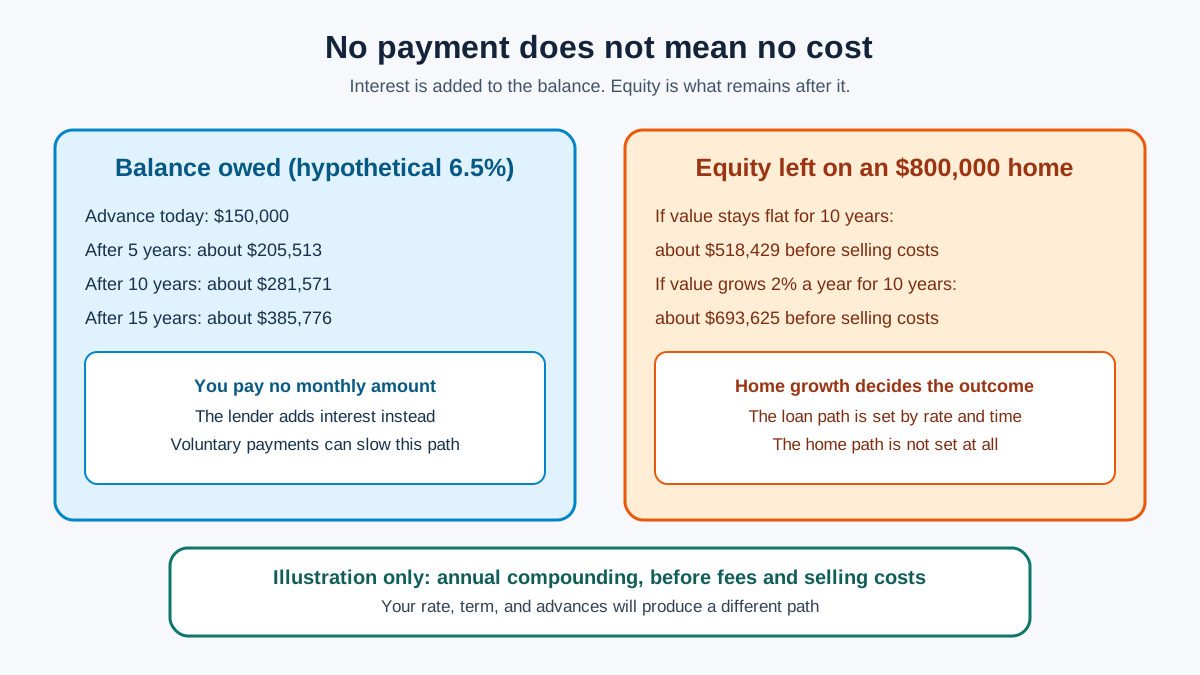
!Reverse mortgage balance growth and equity left on an $800,000 home at a hypothetical 6.5%
Who can get one, and what the 55% figure really means
The Financial Consumer Agency of Canada (FCAC) describes the usual Canadian eligibility frame. Lenders set their own contracts inside it, so treat each point as a question for the written quote, not as an approval.
Age 55 or older, for everyone on title. The age test applies to each owner on title, not only to the person applying. A 58 year old owner with a 52 year old spouse on title does not have a single applicant problem. The household has a title problem, and the available amount can fall or the application can wait until the younger owner reaches 55. Adult children on title for estate reasons create the same issue.
Your principal residence. The home is normally your main home, lived in at least six months a year. Second homes and rental properties do not fit the standard product. Property type, condition, and location feed the appraisal and the amount offered. A well kept detached home in a liquid market and a rural property with deferred repairs will not receive the same percentage of value.
Up to 55% of appraised value is a ceiling, not an entitlement. FCAC puts the usual maximum at up to 55% of the home current value. HomeEquity Bank, which sells the CHIP Reverse Mortgage, publishes the same up to 55% frame and a $250,000 minimum home value for that product. The percentage you are offered rises with age and falls with a younger co-owner, a lower appraised value, and property factors. On an $800,000 appraisal, 55% is $440,000. That is the top of the range before existing secured debt is cleared, not a cheque amount. A 62 year old will be offered a smaller share of value than an 80 year old on the same house, because the lender expects the older borrower loan to run for fewer years of compounding.
The reverse mortgage usually needs to sit first on title. FCAC notes that an existing mortgage or HELOC generally has to be paid out first, often from the reverse mortgage advance itself, and a new HELOC behind it is typically not available. If you owe $120,000 on a first mortgage and are approved for a $200,000 advance, $120,000 clears the old loan and $80,000 reaches you, before setup costs. Price the net advance, not the approved amount. Our second mortgage guide prices the opposite structure, a smaller loan behind a first mortgage you keep, and our collateral charge guide explains why the charge on title decides how lenders can share or take over position.
Income and credit are not the main gate. Reverse mortgage approval leans on age, equity, and the property. That is the reason the product is available to owners whose income would not pass a stress test for a refinance or a HELOC. It is also the reason to compare harder, not less: easier approval does not make the balance grow more slowly. Your ongoing duties continue either way. Property taxes, home insurance, and basic upkeep stay yours, and falling behind on them can breach the contract. Our property tax guide and home maintenance budget guide price those carrying costs, which do not pause because the mortgage payment did.
The balance path: worked math with the assumptions on the table
Every number in this section is a labelled illustration, not a quote. The arithmetic assumes a single advance on day one, annual compounding at the stated hypothetical rate, no voluntary payments, and no fees added to the balance. Your contract will compound on its own schedule and may add costs differently. The point of the table is the shape of the obligation over time.
Take a $150,000 advance. The balance grows like this:
| Years outstanding | At a hypothetical 5.5% | At a hypothetical 6.5% | At a hypothetical 7.5% |
|---|---|---|---|
| 5 | $196,044 | $205,513 | $215,344 |
| 10 | $256,222 | $281,571 | $309,155 |
| 15 | $334,871 | $385,776 | $443,832 |
| 20 | $437,664 | $528,547 | $637,178 |
Read the 6.5% column slowly. The advance doubles in about eleven years. Interest added over ten years is about $131,571, close to the amount borrowed. Over fifteen years the balance is about two and a half times the advance. That is not a flaw in the arithmetic. It is the contract working as written. A household that takes $150,000 at 70 and settles the loan at 85 should plan around a balance near $386,000 at that rate, not around the $150,000 it received.
Now put the loan against the home. Use an $800,000 home and the same $150,000 advance at a hypothetical 6.5%:
| After | Loan balance | Equity if home stays at $800,000 | Equity if home grows 2% a year |
|---|---|---|---|
| 5 years | $205,513 | $594,487 | $677,752 |
| 10 years | $281,571 | $518,429 | $693,625 |
| 15 years | $385,776 | $414,224 | $690,919 |
Equity here is home value minus loan balance, before selling costs, legal fees, and discharge costs. Two lessons sit inside the table. First, a flat home still leaves substantial equity after ten or fifteen years on these starting numbers, because the advance began at under 19% of value. Starting share decides a great deal of the outcome. A $300,000 advance on the same home at the same rate reaches about $563,000 after ten years, and a flat home leaves about $237,000. Second, modest home growth can hold equity roughly steady while the balance compounds, because the home base ($800,000) is much larger than the loan base ($150,000). Growth is not promised. The flat column is the planning case, and the growth column shows why some estates still receive a large amount while others, with larger advances or a soft market, do not.
Timing of advances changes the bill. Compare two ways to receive $120,000 over ten years at a hypothetical 6.5%:
- Lump sum on day one: $120,000 grows to about $225,256 after ten years. Interest is about $105,256.
- $1,000 a month for ten years: you receive the same $120,000 in total. At a monthly equivalent of the same hypothetical rate, the balance after ten years is about $168,403. Interest is about $48,403.
The monthly route costs roughly $57,000 less in interest on these assumptions because the average dollar is outstanding for about five years, not ten. If you need the money for a roof this year, a lump sum fits the expense. If you need it to top up monthly spending, taking it monthly is the cheaper way to receive the same total. Ask the lender to show both paths in writing for your advance schedule, with its own compounding and fees.
What it costs in full: rate, fees, and the exit
Price a reverse mortgage in four layers. The rate is only the first.
1. The interest rate, and the time it is given. FCAC states that reverse mortgage rates are usually higher than mortgage or HELOC rates, and HomeEquity Bank and other lenders publish fixed and variable options by term. Do not anchor on a single rate figure from an advertisement. Get the rate, whether it is fixed or variable, the term, the compounding, and the rate that applies if you repay early, all in writing. A one point difference on $150,000 is the gap between the 5.5% and 6.5% columns above: about $25,000 over ten years, before fees.
2. Setup costs. Expect an appraisal, a lender setup or closing fee, and independent legal advice from your own lawyer. The amounts are lender and province specific and can be deducted from the advance or added to the balance. Each $1,000 added to the balance on day one costs about $1,877 after ten years at a hypothetical 6.5%, so a fee paid from the advance and a fee financed into the loan are not the same price. Ask for the net advance after every deduction, in dollars.
3. Early repayment charges. Repaying in full before the loan is due can carry a prepayment charge, and the formula varies by lender and by how long the loan has run. This matters for the two most common changes of plan: a move to assisted living sooner than expected, and an estate that wants to keep the home by refinancing the balance into an heir name. Our prepayment penalty guide prices how Canadian mortgage penalties are built. The reverse mortgage version belongs in your written quote, with a dollar example at year three and year five.
4. Estate and selling costs at settlement. When the loan comes due, the balance is repaid from a sale or from other money. Selling carries commission, legal, and discharge costs. Keeping the home means an heir or the estate refinances or pays the balance in cash. Neither route is free, and both were decided, in effect, when the advance size and rate were chosen. Our seller closing costs guide prices the sale side of that settlement.
The no negative equity guarantee, with its conditions attached
Canadian reverse mortgage lenders market a no negative equity guarantee: if the home is sold and the balance is higher than the net sale proceeds, the borrower or estate does not pay the shortfall, provided the contract terms were kept. HomeEquity Bank publishes this guarantee for the CHIP product. Understand what it does and does not do.
- It caps the downside. It does not protect a target inheritance. The guarantee stops the debt at the value of the home on a proper sale. It does not promise that any set amount remains for children or other beneficiaries. On the flat home example above, $518,429 remains after ten years without any guarantee being needed. The guarantee becomes the outcome only where a large advance, a high rate, a long holding period, and a flat or falling home combine.
- It has conditions. Keeping taxes and insurance current, maintaining the home, living in it as your principal residence, and selling for fair value are contract duties. A neglected home that sells below market can put the guarantee in dispute. The duties are not fine print. They are part of the price of the cap.
- The estate works to a lender clock. After the last borrower dies or moves out for good, the lender sets a repayment window. Settling an estate, listing a home, or arranging an heir refinance can take longer than that window. The executor should contact the lender at the start of the process, in writing, and ask for the exact deadline and extension policy for the file. Starting that conversation early is worth more than any argument after a deadline passes.
Reverse mortgage beside the other doors, on the same $150,000
The fairest comparison holds the amount and the home steady and varies the structure. The home is $800,000, the amount is $150,000, and every rate is a labelled hypothetical, not a quote. Mortgage payments use Canadian semi-annual compounding. The HELOC payment is interest only on a steady balance. The reverse mortgage needs no payment and lets the balance compound.
| Door | Monthly payment on $150,000 | What you owe after 5 years | Main qualification gate | What ends the arrangement |
|---|---|---|---|---|
| Reverse mortgage at a hypothetical 6.5% | $0 required (voluntary payments allowed) | About $205,513, growing | Age 55+ for all on title, equity, principal residence | Sale, permanent move, last borrower death, or default |
| HELOC at a hypothetical 6.0%, interest only | About $750 | $150,000, plus the $45,000 of interest you paid along the way ($750 for 60 months) | Income, credit, and debt ratios; revolving room normally capped at 65% of value at federal lenders | Demand terms, renewal review, or your repayment |
| Refinance at a hypothetical 4.5%, 15 year amortization | About $1,144 (about $55,974 of interest over the full 15 years) | Falling balance on a set schedule | Income, credit, and the stress test on the full mortgage | The amortization schedule, sale, or a new refinance |
| Downsizing (sell the $800,000 home) | $0, and no new loan | $0 borrowed | A suitable smaller home exists at a price that leaves a useful surplus | The sale itself, plus moving and purchase costs |
Read the table by constraint, not by rate. The refinance has the lowest rate and the hardest monthly gate: about $1,144 a month on this slice, plus the rest of the mortgage if the $150,000 is part of a larger balance. Qualification runs through the stress test and the 39/44 debt ratio framework in our GDS and TDS guide and stress test guide. The HELOC halves the required payment but keeps a payment, can be reduced or called under its demand terms, and still needs income to approve. The reverse mortgage removes the payment and the income gate, and charges for both in the growing balance. Downsizing removes the debt entirely and is the only row that can leave the household mortgage free in a cheaper home, at the cost of leaving the current home and paying to sell, move, and buy. Our capital gains guide covers the principal residence rules that usually shelter a main home sale, with the reporting duties that still apply.
A common middle case deserves its own paragraph: using a reverse mortgage to clear an existing regular mortgage. Suppose $150,000 is still owed on a first mortgage at renewal, with payments the household no longer wants to carry. A reverse mortgage advance that pays out that balance ends the monthly payment and replaces a falling balance with a growing one. Cash flow improves on day one. Total interest over the following ten years will usually be higher, because the new balance compounds without payments at a higher rate. That trade can still be the right one where the payment was crowding out food, care, or tax payments. It should be made with the ten year balance in view, not only with the first payment-free month.
Taxes, pensions, and benefits: what the loan does not do
Borrowed money is not income. A reverse mortgage advance does not arrive as pension or employment income, and lender and FCAC material states that the advances do not reduce Old Age Security or the Guaranteed Income Supplement, because those programs test income and a loan is not income. The advance is also received tax free in the sense that no tax is withheld on borrowed funds. Get tax advice for your file, because what you do with the money can have its own tax results, and benefit rules change.
The contrast that matters in retirement planning is with registered withdrawals. Money taken from an RRSP or RRIF is taxable income in the year it is withdrawn, and a large withdrawal can raise a marginal rate or affect income tested amounts. A reverse mortgage advance does not create that taxable event, and it does not force a payment that then needs a further withdrawal to cover it. That is a genuine planning feature for a household trying to smooth taxable income. It is not a reason to borrow by itself. Interest compounding at a reverse mortgage rate can cost more than the tax saved, and only a side by side projection with your income, age, and estate wishes can price the difference. A fee only planner or a tax professional who does not sell the loan is the right person to run that projection.
One related caution: lending the advances to family, or using them to buy investments, does not change the loan terms, and investment returns are not promised. The balance compounds whether the use of the money works out or not. Treat any suggestion to borrow against the home to invest as a separate, higher risk decision that needs independent advice, not as a feature of the mortgage.
When staying put with a reverse mortgage fits
- The home is the right home for the next stage of life. One level living or a lift, a manageable yard or paid help priced into the plan, care and family nearby, and a home that can be kept insured and maintained. The loan works best where staying is itself the goal, not a delay before a move that is already needed.
- The advance is modest beside the value, and the purpose is dated. Clearing a $60,000 mortgage balance, funding a $40,000 accessibility renovation, or covering a known care cost leaves the starting share low, and the balance path stays a minority of the home value on flat home assumptions. Modest and dated is the strong case.
- The payment is the binding problem, not the balance. A household with solid equity, low income, and a payment that forces RRIF withdrawals or card debt can rationally trade a growing balance for a workable monthly budget, with eyes open about the estate result.
- The family has heard the plan from you, while you can explain it. A clear conversation, and a will and power of attorney that match the plan, prevent the estate window from becoming a family dispute. The mortgage broker versus bank guide maps how to shop a mortgage through different channels, and the same written quote discipline applies here, across every lender you can access.
When it backfires
- It is sized to the ceiling because the ceiling was offered. A $440,000 advance on an $800,000 home at a hypothetical 6.5% reaches about $825,000 in ten years, which is more than the flat home is worth. The guarantee would cap a proper sale at the home value, and the estate would receive selling costs protection only, not an inheritance. Offer size is lender risk management. It is not a spending recommendation.
- It funds a move that is coming anyway within a few years. Setup costs and early repayment charges are spread over too short a period, and the household pays them to borrow briefly before selling. If a move in two or three years is likely, price a HELOC, a short refinance, or an earlier sale beside it.
- It pays for upkeep the household can no longer manage. Borrowing to hire every repair and service can keep a home standing while the balance compounds. At some point the direct comparison is with a smaller, easier property. A reverse mortgage cannot fix a home that no longer fits the owner's health or budget. It can only finance the mismatch.
- The advances refill spending with no plan for year six. Monthly advances feel like income. They are debt arriving in small pieces, and the compounding on early advances runs for the full period. Set the purpose, the monthly amount, and the review date in writing, and revisit the balance statement every year, not at settlement.
- Co-owner and estate facts are discovered late. A younger spouse on title, an adult child on title, a home held with a family member, or a will that promises the home to one person can each change the approval or the settlement. A lawyer should review title and the will before the application, not after the advance.
Questions to get answered in writing before you sign
- What is my net advance after the existing mortgage or HELOC payout and after every fee, in dollars? Which fees are deducted, and which are added to the balance?
- What rate applies to my file (fixed or variable, term, compounding), and what is my projected balance after 5, 10, and 15 years with no voluntary payments, on my actual advance schedule?
- How much can I receive as a lump sum, in instalments, and as regular advances, and what does each schedule cost in projected interest over ten years?
- What voluntary payments may I make each year without charge, and what is the exact early repayment charge if I repay in full at year three and at year five? Show dollar examples.
- What are my duties for taxes, insurance, maintenance, and occupancy, and what notice and cure period applies before a default can be declared?
- How does the no negative equity guarantee work on my contract, what conditions can reduce it, and what repayment window will my estate receive? Will you confirm that window and your extension policy in writing?
- Who is the lender, is it federally or provincially regulated, and who do I contact each year for a balance statement and a change of advance schedule?
Compare the answers with a HELOC quote, a refinance quote, and a downsizing estimate priced in the same month. The Financial Consumer Agency of Canada publishes the federal reverse mortgage guide these questions follow. A lender who will not project your balance in writing is asking you to sign the one number that matters without showing it to you.
Frequently asked questions
Do I still own my home with a reverse mortgage?
Yes. You stay on title as owner, and the lender registers a mortgage against the home. You can sell at any time, subject to any early repayment charge in the contract, and you receive what is left after the loan and selling costs are paid. Ownership and owing money on the home exist together, as they do with any mortgage.
How much can I borrow with a reverse mortgage in Canada?
FCAC describes the usual ceiling as up to 55% of the home current appraised value. The offered amount depends on the age of every owner on title, the home value, type, condition, and location, and the lender program. Any existing mortgage or HELOC normally has to be paid from the advance, so the cash you receive is the approved amount minus that payout and setup costs.
Will a reverse mortgage affect my OAS or GIS?
Lender and FCAC material states that reverse mortgage advances do not affect Old Age Security or the Guaranteed Income Supplement, because a loan is not income. Your wider tax and benefit position can still change based on what you do with the money and on other income. Confirm your situation with a tax professional before you rely on this for a benefits plan.
Can I make payments on a reverse mortgage, or repay it early?
Most lenders allow voluntary payments toward interest or principal up to a contract limit, and you can normally repay in full early. An early repayment charge may apply, and the formula varies by lender and time outstanding. If you expect to make payments, compare the allowed amount and the charge schedule in writing before you sign, because voluntary payments are the main tool for slowing the balance path.
What happens to the loan when I die or move into care?
The balance comes due when the last borrower dies, sells, or moves out for good, which includes a permanent move into care. The estate then repays from a sale of the home, from other estate money, or through an heir refinance. The lender sets a repayment window for the file. The executor should contact the lender promptly, in writing, to confirm the deadline and any extension process.
Can I owe more than my home is worth?
Canadian reverse mortgage lenders offer a no negative equity guarantee: on a proper sale, you or your estate do not pay a shortfall if the balance is higher than the net sale value, provided the contract terms were kept. The guarantee caps the loss at the home. It does not promise that equity remains, and large advances at high rates over long periods can use the full value of the home.
Is a reverse mortgage better than a HELOC for a retiree?
It depends on the binding constraint. A HELOC normally carries a lower rate and a falling or steady balance if you pay it, but it needs income and credit approval and a monthly interest payment, and it can be reduced under its terms. A reverse mortgage needs no payment and leans on age and equity for approval, at a higher rate that compounds. If you can carry the HELOC payment comfortably, it is usually cheaper. If the payment itself is the problem, the reverse mortgage prices that relief in the balance.
Do both spouses need to be 55, and what if my child is on title?
The usual rule is that every owner on title must be 55 or older, and a younger co-owner can reduce the amount or block approval until they reach 55. An adult child on title for estate planning counts as an owner for this test. A lawyer can review title and your estate plan together, because removing or adding owners has tax and family law results beyond the mortgage.
Sources and method: Eligibility, payout, and cost framing follow Financial Consumer Agency of Canada reverse mortgage guidance retrieved October 10, 2026 (age 55 or older for owners on title, principal residence, usual ceiling up to 55% of appraised value with the amount set by age, value, property type and condition, and lender; interest added to the balance; rates usually higher than mortgage or HELOC rates; setup and early repayment costs; existing secured loans generally paid out first; advances do not affect OAS or GIS as loan proceeds). Product specifics follow HomeEquity Bank CHIP Reverse Mortgage material retrieved October 10, 2026 (homeowners 55+, up to 55% of value, $250,000 minimum home value, no required monthly payments, taxes and insurance to be kept current, no negative equity guarantee). All home values ($800,000), advances ($150,000, $120,000, $300,000, $440,000), rates (5.5%, 6.0%, 6.5%, 7.5%, 4.5%), and growth (0%, 2%) figures are labelled hypothetical illustrations, not quotes or appraisals: reverse mortgage balances use annual compounding ($150,000 at 6.5% is $205,513 after 5 years, $281,571 after 10, and $385,776 after 15); the monthly advance comparison uses a monthly equivalent rate ($1,000 a month for 10 years reaches about $168,403); HELOC interest is $150,000 at 6.0% interest only ($750 a month); refinance payments use Canadian semi-annual compounding ($150,000 at 4.5% over 15 years is about $1,144 a month and about $55,974 of interest). Program terms vary by lender and province. Confirm every rate, fee, guarantee condition, and estate deadline in writing for your file.

About David R. Chen, CFA
David R. Chen is a Chartered Financial Analyst and the Senior Housing Economist at BubbleWatch.ca. He brings 12+ years of experience in quantitative real estate analysis and mortgage underwriting. Formerly an analyst at a major Canadian bank, he specializes in modeling payment shock, regional affordability divergence, and private lending risk.
View David's professional bio & credentials →