Assignment Sale in Canada: How the Tax on the Markup Works, and the 365-Day Rule That Prices the Profit
An assignment sale sells the right to buy a pre-construction unit before it is built, not the unit itself. Since May 7, 2022, every such sale is taxable for GST/HST on the markup, and since 2023 the 365-day flipping rule usually taxes the profit in full as business income. This guide works through the two tax layers with priced examples, what the builder and the lawyers do, and checklists for the seller pricing the ask and the buyer paying the markup.
Assignment Sale in Canada: How the Tax on the Markup Works, and the 365-Day Rule That Prices the Profit
Short answer: An assignment sale is the sale of a buyer right to purchase a not-yet-built home, usually a pre-construction condo, before the builder closes. The seller (the assignor) transfers their agreement of purchase and sale to a new buyer (the assignee), who steps into the contract and closes with the builder. Two federal changes redrew the economics of this trade. Since May 7, 2022, effectively every assignment sale of a new or substantially renovated home is taxable for GST/HST, with the tax falling on the markup above the original price. Since 2023, the residential property flipping rule usually treats the profit as business income in full, not as a half-taxed capital gain, where the right to buy was held for under 365 days. The markup on the assignment agreement is not the profit. The profit is what is left after the HST and the income tax.
This guide is education only. It is not tax, legal, or investment advice. Assignment agreements, builder contracts, and tax positions vary by province and by file. Get independent tax and legal advice before signing or pricing an assignment.
What an assignment actually is, in one chain
Picture a buyer who signed a pre-construction condo purchase in 2022 at $600,000 and paid staged deposits totalling $100,000 to the builder. The building is not finished. Before closing, that buyer sells their position: the right to buy the unit under the original agreement. A new buyer pays the original buyer an assignment price, takes over the remaining obligations to the builder (the other $500,000 of the price plus the remaining deposits, if any), and closes the unit with the builder when it is done.
Four parties and documents matter:
- The original agreement of purchase and sale (APS). This is the assignor contract with the builder. Its assignment clause decides whether the sale is even possible: most builder agreements require the builder written consent, and many charge an assignment fee. Read it before pricing anything.
- The assignment agreement. The contract between the assignor and the assignee. It sets the assignment price, how the deposit already paid is credited, who bears the HST, and what happens if the builder refuses consent or the deal falls apart.
- The builder. The builder does not sell the unit twice. The builder consent to the transfer, collects the remaining purchase price from the assignee at closing, and keeps the deposits already paid.
- The lawyers. Both sides need their own lawyer. Assignment closings carry two closings in one: the transfer of the contract right, and the eventual closing with the builder.
The assignee is not buying a used condo. They are buying a contract position, and they inherit the original price, the original terms, and the original closing-date risk.
Tax layer one: GST/HST on the markup since May 7, 2022
Before 2022, whether HST applied to an assignment depended on why the original buyer had signed with the builder. A buyer who had genuinely intended to live in the unit could assign HST-free; a buyer who had signed to flip could not. That intent test was easy to game and hard to audit, and it produced uneven results. Budget 2022, tabled April 7, 2022, ended it. Effective for assignment agreements entered into after May 6, 2022, all assignment sales of newly constructed or substantially renovated residential housing are taxable for GST/HST purposes, regardless of the assignor original purpose. The CRA published the detailed position as GST/HST Notice 323.
The design of the tax is what matters for pricing:
- Taxable amount is the markup, not the whole price. The portion of the assignment price attributable to the deposit the assignor already paid the builder is excluded. Tax falls on the excess: the profit or premium the assignee pays for the position. (Under the old pre-May-7-2022 rules, a taxable assignment was taxed on the total amount including the deposit. The deposit exclusion is a feature of the current rule.)
- The assignor collects and remits. The assignor is making a taxable supply and is responsible for the HST on it. In practice the lawyers handle it as a closing adjustment: the assignee pays the HST on the markup, and the assignor remits it.
- The builder purchase is a separate supply. The assignee still closes the $600,000 unit with the builder under the original price, with the builder own HST treatment. The assignment HST is an additional layer on the premium, not a substitute.
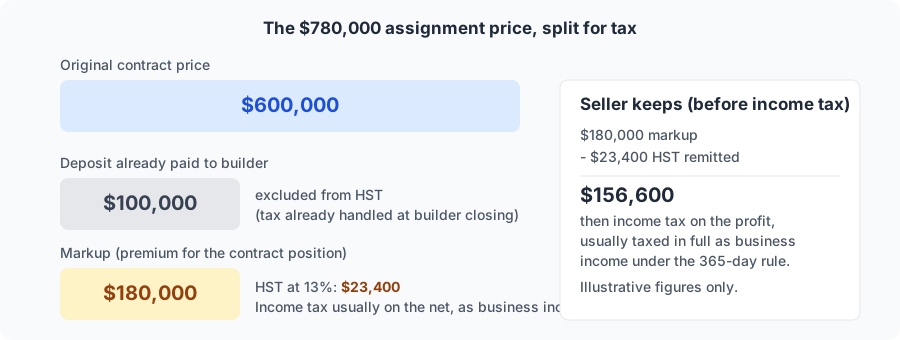
Worked example: the HST on a $180,000 markup
Take the $600,000 original price with $100,000 of deposits paid, in Ontario where the HST rate is 13%. The assignee agrees to an effective price of $780,000: they reimburse the $100,000 deposit, pay a $180,000 premium to the assignor, and assume the remaining $500,000 owed to the builder.
- Taxable consideration for the assignment supply: $780,000 minus the $600,000 original contract price = $180,000 markup. (Equivalently, the $280,000 paid to the assignor minus the $100,000 deposit reimbursement.)
- HST at 13%: $180,000 x 0.13 = $23,400.
- The assignee pays $780,000 plus $23,400 in HST on the assignment, before the builder closing costs. The assignor remits the $23,400.
Every rate and figure here is a labelled illustration of the arithmetic, not a quote. Your province HST rate, your markup, and your agreement terms decide the real number. But the structure is fixed: the bigger the premium, the bigger the HST bill, and the bill lands on top of the price the buyer agreed to.
One more point sellers miss: do not assume the small-supplier rules exempt a one-off assignment. The CRA position treats the assignor as making a taxable supply, and the obligation to collect and remit follows the supply, not the seller business size. How that obligation is discharged on a single transaction, including any registration question, belongs in a conversation with a tax professional before the assignment agreement is signed, not after the funds move.
Tax layer two: the profit is usually business income
The second layer decides what happens to the money left after the HST. Under the residential property flipping rule, in force for 2023 and later tax years, a housing unit (or a right to acquire a housing unit) held for less than 365 consecutive days before disposition is generally considered flipped property, and the resulting gain is taxable as business income in full. It does not get the 50% capital gains inclusion rate, and it does not get the principal residence exemption. The CRA states the rule expressly covers the resale of rights to purchase a property before its official sale, which is what an assignment is. The 12-month clock for a right to acquire runs from when the purchase agreement position was taken; life-event exceptions (death, household addition, separation, safety threat, serious illness or disability, involuntary job loss) can take a disposition out of the rule, but a voluntary flip for profit is the case the rule was written for.
Two qualifications keep this accurate:
- The rule is a deeming rule, not the whole law. Even where the 365-day rule does not apply, the CRA can still treat an assignment profit as business income under the general adventure-in-the-nature-of-trade analysis. The CRA audits real estate transactions, and assignments are a known audit target. A hold longer than a year helps, but intention and pattern still matter.
- Losses do not get the same treatment. Under the flipping rule, a loss on flipped property is deemed to be nil and cannot be used to reduce income. In a falling market, an assignor who sells the position at a loss can discover that the tax system recognizes neither a capital loss nor a business loss on the way down. Our look at how negative equity traps owners shows the market side of that same one-way door.
Worked example: business income vs capital gain on the same $180,000
Continue the example. The assignor $180,000 markup, minus the $23,400 HST remitted, leaves $156,600 before income tax. (Legal fees and the builder assignment fee would come off too; the agreement decides who pays the fee.)
- As business income (the usual result): the full $156,600 is taxable income. At an assumed 40% marginal rate, the tax is about $62,640. Net to the assignor: about $93,960.
- As a capital gain (the rare case, shown for contrast): half is included, so $78,300 is taxable. At the same assumed 40% rate, the tax is about $31,320. Net: about $125,280.
The gap between the two treatments is about $31,320 on these assumptions, which is why the classification question is worth more than most assignment negotiations. All figures are labelled hypothetical illustrations at an assumed marginal rate, not a tax calculation. Your rate, your province, and your filing position decide the real number.
The New Housing Rebate question, answered narrowly
A natural question from the assignee: does the GST/HST New Housing Rebate soften the HST? Treat the rebate as narrow. The rebate attaches to the purchase of a new home from a builder under the CRA published conditions, and it is generally the builder who credits it on the builder closing. Do not assume any rebate applies to the HST on the assignment markup, and do not price the assignment as if it does. Whether any rebate is available in an assignment transaction depends on the CRA conditions for the specific file. This is a verify-with-CRA-publications-or-an-accountant item, not a planning assumption. Our first-time buyer GST rebate guide covers the rebate where it clearly applies: a qualifying buyer purchasing a new home from the builder.
The builder side: consent, fees, and the terms that survive
The tax layers get the attention, but builder mechanics kill more assignment deals than tax does.
Consent is not automatic. Most builder APS agreements require the builder written consent before the buyer can assign, and the builder can attach conditions. Some agreements restrict assignments to a window (for example, only after a certain construction milestone), and some prohibit them outright in the early phases. Get the consent in writing before the assignment agreement goes firm.
Assignment fees are normal; the amount is in the contract. Builders commonly charge a fee for processing the assignment, and the APS sets it. The assignment agreement should say who pays it. Do not guess the figure from another project: it is whatever your contract says.
Deposits and terms transfer as written. The assignee inherits the original price, the deposit schedule, the closing date (and its extensions), the unit as specified, and any builder-side incentives or penalties in the APS. A buyer who would not have signed the original APS should not buy its assignment.
Tarion and occupancy follow the builder, not the seller. In Ontario, the new-home warranty framework runs through the builder. The assignee should confirm warranty registration and the occupancy and closing timeline directly, not through the assignor assurances.
The appraisal risk sits with the assignee. If the unit appraises below the effective price at closing, the assignee mortgage covers the appraised value, not the contract price, and the gap comes from the assignee pocket. In a soft pre-con market this is the dominant risk of buying an assignment, and it is priced in our assignment sales crisis piece, which walks through the 2026 appraisal-gap wave in Ontario pre-con. Read that before paying a premium for a position.
Seller checklist: price the ask after tax, not before
- Start from the markup, subtract the HST. On a $180,000 premium in Ontario, $23,400 goes to the CRA before income tax enters the picture. Quote the ask knowing the net.
- Assume business-income treatment for the income tax. Price the deal on the 100%-taxable case. If a professional later concludes capital treatment applies, that is upside, not the plan.
- Read the assignment clause first. Consent requirements, consent windows, and the fee decide whether the sale can happen at all and who pays for it.
- Put the HST treatment in the assignment agreement in writing. State the price as plus HST or HST-included, name who remits, and have the lawyers confirm the adjustment. Ambiguity here becomes a dispute at closing.
- Keep every record. The APS, deposit receipts, the builder correspondence, the assignment agreement, and the closing adjustments. The CRA audits this corner of the market. Our capital gains guide covers the parallel record-keeping and reporting duties for property sales, including the late-filing penalties that apply when designations are missed.
- Do not spend the markup before closing. Between the HST, the income tax, the builder fee, and legal costs, the cash that reaches the seller is a fraction of the headline premium.
Buyer checklist: verify before paying the premium
- Get the full APS and read it. Price, deposits paid and remaining, closing date and extension rights, assignment clause, and any builder incentives that do or do not transfer.
- Confirm builder consent in writing. A verbal okay from a sales office is not consent.
- Price the HST on the markup into your budget. It is on top of the price, and it is not financeable the way the purchase price is. Your down payment plan and closing-cost budget both need the real number.
- Check today value against the effective price. If comparable resales or the appraisal suggest the unit is worth less than the original price plus the premium, you are paying the gap in cash at closing. In a falling segment, the premium should be negative: the assignment should sell at a discount.
- Confirm your mortgage math at the effective price. Lenders qualify you on the numbers in front of them. Run the stress test and the GDS/TDS ratios on the price you will actually pay, not the 2022 price.
- Confirm the remaining deposit schedule. Some assignments transfer with deposits still owing to the builder on a timetable. Know the dates and amounts.
- Get your own lawyer before going firm. Not the seller lawyer, not the builder lawyer. Assignment agreements allocate the HST, the fee, and the failure modes, and the allocation needs to favour the person paying the premium.
When an assignment still makes sense, and when it does not
An assignment can be the right structure in a few cases. A buyer who missed the original sales phase can secure a unit and a price in a building they want without waiting for resale listings. A seller with a genuine change of plans can exit a contract they can no longer close. In a rising market, the premium can reflect real value the assignee cannot get elsewhere.
It is the wrong structure when the premium assumes a market that no longer exists. Paying a 2022-style markup for a contract position in a segment where resale prices have fallen means paying tax on a premium for value that evaporated, and financing a gap the lender will not cover. It is also the wrong structure as a tax plan: the two layers above mean the after-tax return on a flipped assignment is far thinner than the headline premium suggests, and the downside (a deemed-nil loss) is worse than most sellers model.
The through line of this guide is the same as the rest of our mortgage and tax coverage: price the structure, not the rate, and price the tax before you sign. Our prepayment penalty guide makes the same point for breaking a mortgage mid-term, and the mortgage renewal wave guide makes it for timing. On an assignment, the structure is the tax, and the tax is priced in dollars before the agreement goes firm.
Frequently asked questions
Is HST charged on an assignment sale in Canada?
Yes, for assignment agreements entered into after May 6, 2022. All assignment sales of newly constructed or substantially renovated residential housing are taxable for GST/HST purposes under the rule announced in Budget 2022 and detailed in CRA GST/HST Notice 323. The tax applies to the markup above the original contract price, because the deposit already paid to the builder is excluded from the taxable amount.
Who pays the HST on an assignment sale, and who remits it?
The assignee (the buyer of the contract position) pays the HST on the markup as part of the closing adjustments, and the assignor (the seller) is responsible for remitting it to the CRA. The lawyers on the file handle the collection and the remittance mechanics at closing.
Is the deposit I paid the builder taxed again on the assignment?
No. Under the current rule, the portion of the assignment price attributable to the deposit already paid to the builder is excluded from the HST calculation. Tax applies to the excess over the original contract price: the premium or markup. This differs from the pre-May-7-2022 treatment, where a taxable assignment was taxed on the total amount including the deposit.
Does the 365-day flipping rule apply to assignment sales?
Yes. The residential property flipping rule, in force for 2023 and later tax years, expressly covers the resale of rights to acquire a housing unit, which is what an assignment sale is. Where the right was held for fewer than 365 consecutive days and no life-event exception applies, the profit is deemed business income and taxed in full, with no capital gains inclusion rate and no principal residence exemption.
Is assignment profit a capital gain or business income?
Usually business income, taxed in full. The flipping rule deems it so for sub-365-day holds, and even outside the rule the CRA may treat an assignment profit as business income under the adventure-in-the-nature-of-trade analysis. Capital gains treatment is the exception, not the plan. Get professional advice for your file rather than assuming the better treatment.
Can I claim the GST/HST New Housing Rebate on an assignment?
Do not assume so. The rebate attaches to qualifying new-home purchases from a builder under the CRA published conditions, and whether any rebate is available in an assignment transaction depends on those conditions for the specific file. Verify against CRA publications or with an accountant before pricing it into the deal.
What happens if I sell my assignment at a loss?
Under the flipping rule, a loss on flipped property is deemed to be nil: it cannot be used to reduce income. An assignor who exits at a discount in a falling market should get tax advice on the loss treatment before assuming it offsets other income.
Do I need the builder permission to assign my pre-con purchase?
In most cases, yes. Builder agreements of purchase and sale commonly require the builder written consent to assign, often with an assignment fee and sometimes with timing restrictions. Read the assignment clause in your APS before marketing the position, and get consent in writing.
Rules and dates in this article reflect CRA GST/HST Notice 323 (Proposed GST/HST treatment of assignment sales, 2022) and the CRA Residential Property Flipping Rule guidance (canada.ca), as retrieved October 2026: the Budget 2022 measure making all assignment sales of newly constructed or substantially renovated residential housing taxable for GST/HST for assignment agreements entered into after May 6, 2022; the deposit-amount exclusion under the current rule; and the 2023-and-later deeming rule taxing flipped property, including rights to acquire a housing unit held under 365 days, as business income with life-event exceptions. All dollar figures, rates (including the 13% Ontario HST rate used illustratively), and marginal-rate math are labelled hypothetical illustrations of the arithmetic, not quotes, appraisals, or tax calculations. Provincial rules, builder contracts, and individual tax positions vary. This article is educational and informational only, and is not tax, legal, or financial advice. Speak with a qualified tax professional and a real estate lawyer about your specific situation before assigning or buying an assignment.

About David R. Chen, CFA
David R. Chen is a Chartered Financial Analyst and the Senior Housing Economist at BubbleWatch.ca. He brings 12+ years of experience in quantitative real estate analysis and mortgage underwriting. Formerly an analyst at a major Canadian bank, he specializes in modeling payment shock, regional affordability divergence, and private lending risk.
View David's professional bio & credentials →