Home Purchase Deposits in Canada 2026 Tool
A contract-and-cash guide to deposit amount, due date, trust custody, condition removal, down-payment credit, failed deals, release disputes, and payment fraud.
Home Purchase Deposits in Canada: Trace the Money and the Risk
A home purchase deposit is money delivered under an agreement of purchase and sale to support the buyer's contractual commitment. If the transaction closes, the deposit is normally credited toward the purchase price and forms part of the buyer's down payment. It is not a separate fee added on top of the down payment.
The contract decides the amount, due date, acceptable payment method, holder, interest treatment, credit on closing, and release process. There is no national rule that every deposit must equal 5% or 10%. Local expectations may influence negotiations, but the signed words create the obligation.
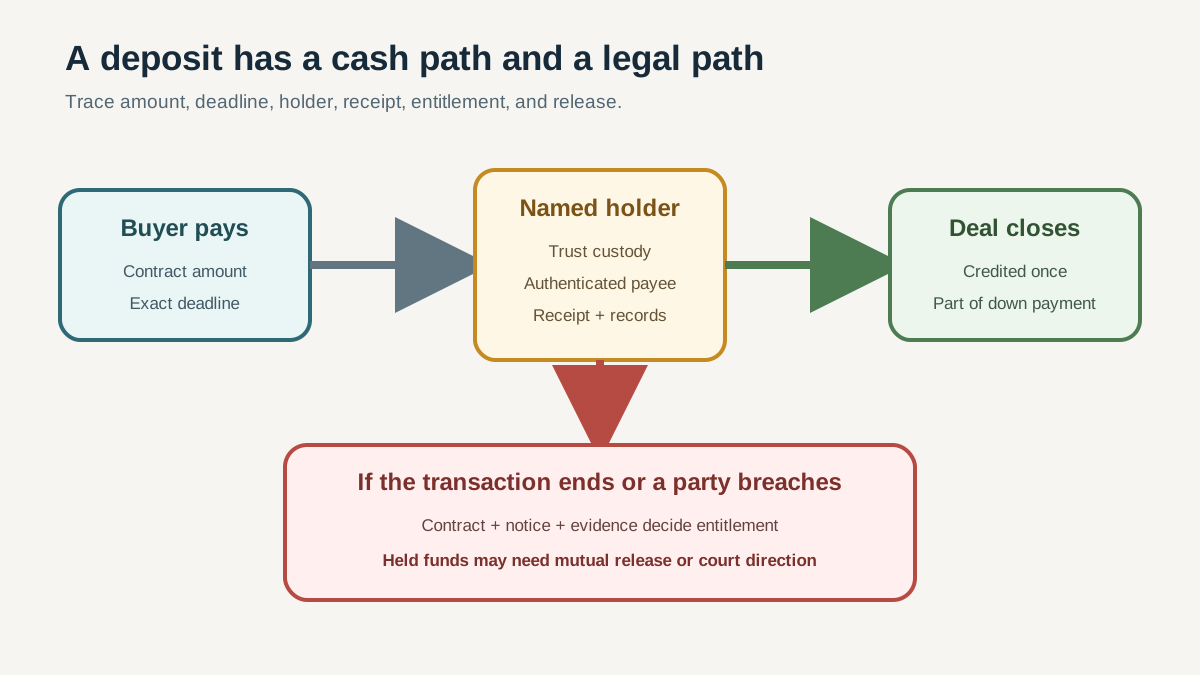
Short answer: verify six contract facts before sending money
Record these fields from the signed agreement:
| Field | Contract answer |
|---|---|
| Deposit amount | |
| Exact due date and time | |
| Calendar or business-day rule | |
| Named payee and trust holder | |
| Permitted payment method | |
| Release and closing-credit terms |
Then verify payment instructions through a known phone number, send the money using the agreed method, and obtain a receipt showing amount, date, payee, property, and file. Keep proof that the funds left the buyer's account and arrived where the contract required.
BCFSA's current consumer guide to deposits says deposit timing and amount are negotiated, the deposit often arrives on acceptance or after subject removal, and the deposit forms part of the down payment at completion. British Columbia practice is not a national rule, but the contract-first lesson applies everywhere.
Deposit versus down payment versus closing costs
Use a simple $750,000 example. The buyer plans a $150,000 total down payment and pays a $40,000 deposit after acceptance.
| Purchase money | Amount |
|---|---|
| Total down payment required by lender | $150,000 |
| Deposit already paid and credited | -$40,000 |
| Remaining down-payment cash on closing | $110,000 |
The buyer also needs transfer tax, legal funds, adjustments, insurance-related cash, and a post-closing reserve. Those are separate from the $150,000 price contribution. Use the cash-to-close worksheet to prevent both omissions and double counting.
A deposit can be less than, equal to, or greater than the final down payment planned with a lender. If a high-ratio buyer pays a deposit larger than the minimum down payment, it still needs to fit the approved sources and closing statement. If the deposit is borrowed, the debt and repayment obligation must be disclosed to the lender.
How much should a deposit be?
There is no one correct Canadian percentage. The amount is a negotiation between security for the seller and liquidity risk for the buyer.
Seller view
A larger deposit may signal that the buyer has liquid funds and gives the seller more security if the buyer later breaches. It can matter when the seller will remove the property from the market, buy another home, or reject other offers.
Buyer view
Money paid early is unavailable for an appraisal gap, inspection, moving, legal costs, or emergencies. A very large deposit may exceed a provincial insurance limit or sit frozen if the parties later dispute entitlement.
Better sizing questions
- What amount does the market expect for this property and offer structure?
- How long will the deposit be held?
- Are conditions still open when it is paid?
- Where will it be held, and under which trust protections?
- Does the buyer retain enough verified cash for closing and a reserve?
- What is the buyer's maximum contractual-loss exposure if the deal fails?
- Does a new-build or assignment agreement require scheduled deposits beyond the first one?
BCFSA says five to 10 per cent is typical in its market but confirms any amount can be negotiated. Do not import that range into a different province or treat “typical” as legally required.
When is the deposit due?
Common structures include:
- with the offer;
- on acceptance;
- within a stated number of hours after acceptance;
- by a specific date and time;
- after conditions are waived or fulfilled;
- in several installments for a new build.
Timing wording needs precision. “Within 24 hours” can produce a different deadline from “by 5 p.m. on the next business day.” A holiday, weekend, bank cutoff, wire delay, or rejected e-transfer does not necessarily extend a contractual deadline.
Ask before signing:
- Does the clock start at acceptance, notice, or delivery of the signed agreement?
- Are hours continuous or business hours?
- Which time zone applies?
- Is receipt required or is initiating payment enough?
- What happens if the bank places a hold?
- Who must be notified when funds arrive?
RECO's deposit enforcement case summary shows why non-delivery is material: sellers were not told that contract deposits had not arrived while condition extensions were discussed. Buyers should treat the deadline as a transaction obligation, not paperwork to finish later.
Who should hold the deposit?
The agreement names the stakeholder or trustee. Depending on province and deal, the holder may be a registered real-estate brokerage, lawyer or notary, builder's lawyer, seller's lawyer, or another agreed party.
Do not send funds to an individual agent's personal account or to a last-minute substitute payee without independent verification and legal advice. Confirm:
- exact legal name of the holder;
- regulated status and office contact;
- trust-account designation where applicable;
- property address and buyer name in the payment reference;
- written receipt and transaction record;
- which deposit-protection regime applies;
- whether the amount exceeds an insurance limit.
Ontario RECO's current consumer deposit insurance FAQ says its program can respond to covered brokerage theft, fraud, insolvency, or misappropriation. It does not insure an ordinary dispute about whether the buyer or seller is entitled to the deposit, and it does not cover deposits once properly paid to a builder or builder's lawyer under the agreement.
Protection varies by province, holder, property, and transaction. Ask the lawyer which regime applies before transferring a large sum.
Conditions and the deposit
A conditional agreement can still be legally binding. The conditions determine which obligations must be fulfilled and how the contract ends if a condition is not met.
A deposit is not automatically refundable merely because the agreement contains a financing, inspection, condo-document, insurance, title, lawyer-review, or sale-of-property condition. The buyer must follow the exact clause, deadline, notice process, and any duty to act in good faith or use reasonable efforts.
BCFSA's offers and subject-clauses guidance says subjects are not general escape clauses. It also explains that a brokerage holding the deposit may require both buyer and seller to sign a release before money can be returned, even where the buyer says a condition failed.
Use a condition log:
| Condition | Evidence required | Deadline | Notice method | Status |
|---|---|---|---|---|
| Financing | Property-specific lender decision | |||
| Inspection | Report and buyer decision | |||
| Condo/strata | Documents and legal review | |||
| Insurance | Acceptable quote or binder | |||
| Sale of home | Required sale contract status |
The financing-condition approval test explains why preapproval alone should not trigger waiver. If the lender has not accepted the property, valuation, insurer, and verified cash, the buyer still has material financing work open.
What happens when a condition is not satisfied?
The signed clause and provincial law decide. A properly invoked condition may end the agreement, but returning the deposit can still require a release or other process from the holder.
Do not assume the agent can simply send the money back on one party's instruction. In Ontario, RECO says a brokerage facing an entitlement dispute can disburse only under a mutual consent/release or court order. In BC, BCFSA similarly explains that both parties may need to sign the deposit release form.
If the seller disputes the buyer's efforts or notice, funds can remain in trust while the dispute is resolved. Keep:
- lender submissions and decline details;
- inspection invoice and report;
- document-review correspondence;
- notices delivered under the contract;
- proof of delivery and timing;
- all extension requests and responses.
Seek legal advice before the deadline if a condition may fail. The quality of the record can matter when the other party argues that the condition was used improperly.
What happens after the offer becomes firm?
Once conditions are removed or the agreement is unconditional, the buyer is expected to complete according to the contract. A mortgage decline, job change, low appraisal, inability to sell another property, or buyer's remorse does not automatically release the buyer.
If the buyer fails to close, possible consequences can include:
- dispute over the deposit;
- seller claim for a lower resale price;
- extra mortgage, tax, insurance, utility, and maintenance costs;
- additional representation and legal expense;
- moving or replacement-purchase losses;
- litigation and enforcement costs;
- buyer's own lender, legal, appraisal, and inspection costs already spent.
The deposit may be only part of claimed damage. If the seller later resells for $70,000 less and has $15,000 of other provable losses, a $40,000 deposit does not necessarily cap exposure at $40,000. Contract and legal advice are essential.
BCFSA warns in its subject-free offer guide that a buyer whose financing fails can face deposit forfeiture and/or a seller lawsuit. Competitive bidding does not change that downside.
A failed-closing example
A buyer signs a firm $900,000 agreement and pays a $50,000 deposit. Financing later fails after the appraisal and the buyer cannot close. The seller relists and sells for $835,000.
| Illustrative seller impact | Amount |
|---|---|
| Price difference | $65,000 |
| Extra carrying and relisting costs | $12,000 |
| Illustrative gross claimed loss before legal findings | $77,000 |
| Deposit held | $50,000 |
| Potential loss exceeding deposit | $27,000 |
This is not a damages formula. A court would consider the contract, causation, mitigation, sale circumstances, offsets, and evidence. The example shows why “I only lose my deposit” is not a safe assumption.
The seller also cannot assume it may immediately spend the $50,000. The stakeholder may need a signed release or court direction. Both parties should obtain legal advice and preserve the funds and records.
Deposit release is different from deposit protection
Three questions are often confused:
- Are the funds safely held? This concerns trust custody, fraud, insolvency, and the holder.
- Who is legally entitled to the funds? This concerns the purchase contract and what happened.
- How can the holder pay them out? This concerns a mutual release, closing direction, court order, or statutory process.
Ontario consumer deposit insurance addresses certain missing or misappropriated brokerage funds, subject to limits. RECO currently states a maximum of $200,000 per claim and $4 million for claims tied to one event, with pro-rating if the event limit is exceeded. It separately lists $25,000 of social-engineering fraud coverage.
Those limits can change and have exclusions. More importantly, the insurance does not decide a normal buyer-versus-seller entitlement dispute. Verify current coverage before relying on it, especially for a deposit above the per-claim limit.
Payment fraud controls
Deposit deadlines create urgency, and urgency helps fraudsters. A compromised agent, lawyer, buyer, or brokerage email account can send plausible payment instructions.
Use this protocol:
- Obtain instructions from the signed agreement or authenticated office channel.
- Look up the brokerage or law firm independently.
- Call a known number and read back the payee, account, amount, and property.
- Do not use a replacement phone number contained only in the payment-change email.
- Question urgency, secrecy, offshore accounts, crypto, personal payees, or unexplained split payments.
- Confirm receipt through the known office after sending.
- Keep the bank record and official trust receipt.
RECO specifically warns that last-minute calls, urgent requests, unexpected amount changes, and offshore accounts are hallmarks of social-engineering fraud. Insurance limits are not a reason to weaken verification.
If money is misdirected, contact the sending bank, receiving institution if known, police, lawyer, brokerage regulator, and applicable insurer immediately. Recovery becomes harder as funds move.
New-build deposits require a separate review
Pre-construction agreements can require several deposits over months or years. The recipient, trust terms, release to the builder, statutory protection, refund rules, interest, outside closing date, assignment, and purchaser default provisions can differ from a resale transaction.
Create a schedule:
| Installment | Amount | Due trigger | Holder | Protection confirmed? |
|---|---|---|---|---|
| Initial | Signing | |||
| Cooling-off balance | End of review period | |||
| Time-based installment | Stated date | |||
| Construction milestone | Contract event | |||
| Final purchase cash | Closing |
Have a new-construction lawyer review the agreement during any statutory cooling-off period. Ask what happens if financing is unavailable years later, the unit changes, occupancy is delayed, the project is cancelled, or the buyer wants to assign.
Do not assume resale brokerage deposit insurance covers money paid to a builder's lawyer. RECO expressly distinguishes that situation in Ontario and points consumers toward possible Tarion protection and legal advice.
British Columbia's rescission period is a separate right
BC has a statutory Home Buyer Rescission Period for many residential purchases, with exclusions. It is different from a financing subject and can require payment of a rescission fee to the seller.
Do not use a general Canada article to calculate the fee or eligibility. Check the current BCFSA home buyer rescission guidance and obtain BC legal advice. Property type, timing, notice, and excluded transactions matter.
If a buyer rescinds properly while a brokerage holds the deposit, BCFSA says the rescission fee can be paid to the seller and the remainder returned without the ordinary deposit release. That statutory process should not be confused with a failed subject clause.
Gifted and borrowed deposits
The contract may accept the payment, but the mortgage lender still needs to approve its source.
For a gift, the lender may request:
- gift letter in its form;
- donor relationship and identity;
- proof of funds leaving the donor;
- proof of receipt into the buyer or trust account;
- confirmation that repayment is not required.
For borrowed funds, the payment and debt may affect qualification. An undisclosed loan can invalidate the lender's affordability calculation. A family member expecting repayment has made a loan, regardless of the label used casually.
Keep an unbroken funds trail. Large cash deposits, transfers through several relatives, crypto liquidation without records, or money arriving after the lender's document deadline can delay approval.
Use the gifted down-payment evidence map to reconcile donor source, gift letter, transfer, deposit, closing cash, and reserve. If family help is repayable or depends on signing the mortgage, run the GDS/TDS effect and the co-borrower liability and exit test before the arrangement is documented.
Multiple offers and deposit strategy
A higher deposit can make an offer look stronger, but it does not repair weak financing or a low offer price. Before increasing it, score the tradeoff:
| Question | Yes/No |
|---|---|
| Funds are already liquid and documented | |
| Buyer retains full closing costs and reserve | |
| Holder and trust protection are verified | |
| Amount does not exceed an important insurance limit without advice | |
| Financing and appraisal risks are controlled | |
| Buyer understands firm-contract breach exposure | |
| Due date is operationally achievable |
The best offer is not the one that empties the buyer's account fastest. It is the one the buyer can close while preserving the conditions and cash needed to avoid a default.
Buyer deposit checklist
Before offering
- obtain proof of accessible funds;
- ask the lender to approve the source;
- decide the maximum safe deposit;
- identify closing-cost and appraisal-gap reserves;
- verify how the contract will name the holder;
- ask the lawyer about conditions and release risk.
After acceptance
- calculate the exact deadline;
- authenticate instructions;
- pay the named holder using the permitted method;
- obtain receipt and bank proof;
- tell the lender where the deposit came from;
- diarize every condition and notice date.
Before closing
- ensure the lawyer's statement credits the deposit once;
- reconcile the trust receipt to the agreement;
- confirm any deposit interest treatment;
- report changes or missing funds immediately;
- keep the receipt with closing records.
Seller deposit checklist
- verify the amount, timing, and holder in the offer;
- ask the brokerage to confirm receipt promptly;
- do not treat held money as spendable before closing or release;
- compare deposit strength with financing and other conditions;
- obtain advice before granting an extension after a missed deposit;
- preserve evidence and mitigate loss if the buyer defaults;
- do not direct the stakeholder to release disputed funds without authority.
A seller buying another home should not use the buyer's deposit as assumed bridge cash. Until the sale closes and the statement pays out, the seller's usable equity is uncertain. Use the bridge-financing cash map if closing order depends on those proceeds.
Frequently asked questions
Is a deposit required to buy a home in Canada?
Purchase agreements commonly require one, but there is no single national amount or timing rule. The contract and local law govern. BCFSA notes that a money deposit is not always legally necessary to form a binding contract in BC, though deposits are usual.
Is the deposit part of the down payment?
Yes, when the transaction closes it is normally credited toward the purchase price and forms part of the down payment. Subtract it once from the final down-payment cash; still track the earlier payment date.
How much should a home deposit be?
Negotiate an amount that gives the seller meaningful security without consuming closing costs, appraisal-gap cash, and emergency reserves. Local practice, property, competition, condition period, and deposit protection all matter.
When do I pay the deposit?
The agreement may require it with the offer, on acceptance, within stated hours, by a fixed deadline, after condition removal, or in installments. Read the exact clock and payment method before signing.
Who holds the deposit?
The contract names the holder, often a registered brokerage or lawyer/notary. New-build contracts may direct money to the builder's lawyer. Verify the legal payee, trust arrangement, receipt, and applicable protection.
Is a deposit automatically returned if financing fails?
No automatic national rule applies. The financing clause, buyer's efforts, notice, deadline, agreement, and provincial law decide. Even where the contract ends, a stakeholder may require both parties' release or a court order.
Does the seller automatically keep the deposit if the buyer cannot close?
Not necessarily through an immediate payment. Entitlement and any damages can be disputed, and the holder may need a signed release or court direction. The buyer's total exposure can also exceed the deposit.
Does deposit insurance cover a dispute with the seller?
Ontario RECO says its consumer deposit insurance does not decide entitlement disputes. It addresses listed events such as brokerage theft, fraud, insolvency, or misappropriation, subject to policy terms and limits.
Can I pay a deposit with borrowed money?
Only if the contract accepts the payment method and the mortgage lender accepts and includes the debt. Disclose the borrowing. Hidden repayment obligations can undermine final mortgage approval.
What if payment instructions change?
Stop and verify through a trusted phone number or in person. Do not use contact details supplied only in the change message. Notify the lawyer and brokerage of any suspicious request.
Method and source note
This guide was updated July 19, 2026. It uses current public guidance from BCFSA and RECO to illustrate deposit custody, conditions, release, and consumer protection. Provincial laws and contract forms differ, so it does not provide a national legal rule or contract clause.
The buyer and seller should obtain advice from a lawyer or notary qualified where the property is located. Verify any insurance limit, rescission rule, trust protection, or payment procedure at the transaction date.
What to read next
- Confirm the mortgage and address with the financing-condition approval test.
- Credit the deposit correctly in the Canadian cash-to-close worksheet.
- Set a firm-offer ceiling with the appraisal-gap risk model.
- Put deposit, condition, inspection, and legal dates into the home-buyer readiness sequence.
Advertisement

About David R. Chen, CFA
David R. Chen is a Chartered Financial Analyst and the Senior Housing Economist at BubbleWatch.ca. He brings 12+ years of experience in quantitative real estate analysis and mortgage underwriting. Formerly an analyst at a major Canadian bank, he specializes in modeling payment shock, regional affordability divergence, and private lending risk.
View David's professional bio & credentials →