Joint Tenancy vs Tenancy in Common in Canada: What the Title Choice Does at Death, at Tax Time, and When Owners Fall Out
Every Canadian co-purchase makes one quiet election on the transfer documents: joint tenancy or tenancy in common. The choice decides who owns the home the morning after an owner dies, whether probate fees apply, and whether a share can go to children from a first marriage. This guide compares the two forms across death, tax, control, and exit, prices probate on a $900,000 estate in Ontario and BC, works the tax on adding two adult children to a cottage title ($400,000 of gain triggered on a $900,000 cottage, labelled hypothetical), explains the Supreme Court's Pecore presumption that can pull a jointly held home back into the estate, and closes with a decision table by household type and a pre-signing checklist.
Joint Tenancy vs Tenancy in Common in Canada: What the Title Choice Does at Death, at Tax Time, and When Owners Fall Out
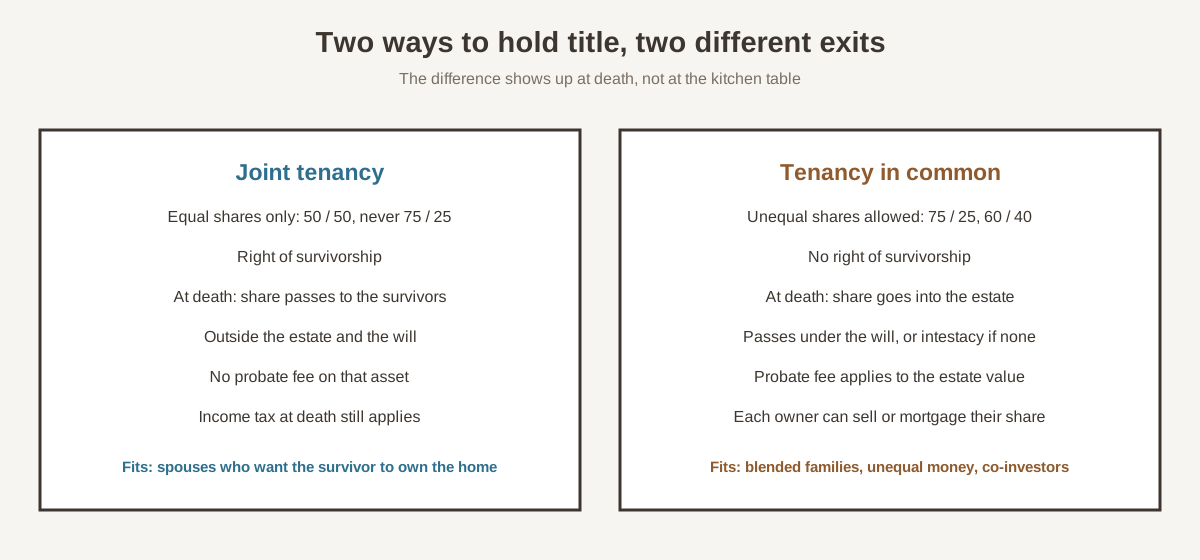
Short answer: Joint tenancy means equal shares and a right of survivorship. When one joint tenant dies, their interest ends and the surviving owners hold the whole home, outside the estate, outside the will, and outside the probate fee calculation. Tenancy in common means shares, and the shares can be unequal. When a tenant in common dies, their share becomes part of their estate and goes where their will says, or to their next of kin if there is no will, and probate fees apply to it. Spouses who want the survivor to own the home outright usually pick joint tenancy. Blended families, buyers who put in unequal money, and co-investors usually need tenancy in common. Adding an adult child to title as a probate shortcut is the one use of joint tenancy that regularly backfires: it can trigger capital gains tax today, and the Supreme Court's presumption of resulting trust can pull the home back into the estate anyway.
This guide is general education on how co-ownership works in Canada. It is not legal or tax advice. Title, estates, and family property are provincial law, the rules differ by province, and Quebec works on a different system entirely. A real estate or estates lawyer in your province should review any title choice that is meant to do estate planning work.
Choosing how to hold title, step by step
- Decide who should own the home if one owner dies tomorrow: the surviving co-owners, or the people named in each owner's will. That answer picks the form.
- Add up what each buyer is actually contributing. If the money is unequal and the shares should match the money, tenancy in common is the only form that can record that.
- Check the family picture. Children from an earlier relationship, a second marriage, or a co-owner who is not your spouse all push toward tenancy in common plus wills that match the title.
- Price both taxes before signing: the probate fee the estate would pay on a tenancy-in-common share, and the capital gains and land transfer tax a later title change would trigger if you get the form wrong now.
- Get the lender's position. Most mortgages require the lender's consent to add or remove an owner, and a new co-owner may have to sign the mortgage.
- Put the percentages on the transfer itself for tenancy in common. Shares that live only in a verbal understanding are shares a court has to reconstruct later.
- Sign a co-ownership agreement covering bills, repairs, buyout rights, and what happens if one owner wants out. Title sets the ownership; the agreement sets the operating rules.
- Update wills in the same week. A joint tenancy overrides a will for that property, and a tenancy in common only works as planned if the will actually deals with the share.
The two forms, side by side
| Question | Joint tenancy | Tenancy in common |
|---|---|---|
| Can shares be unequal? | No. Every joint tenant holds an equal interest | Yes. 75/25, 60/40, or any split the buyers choose |
| What happens when an owner dies? | The deceased's interest ends and the survivors hold the whole property | The deceased's share becomes part of their estate |
| Does the will control the home? | No, not for this property. Survivorship beats the will | Yes. The share passes under the will, or under intestacy rules if there is none |
| Probate fee on the home? | No fee on an asset that passes by survivorship | Yes, the share counts in the estate value the fee is charged on |
| Income tax at death? | Still applies. The deceased is deemed to dispose of their interest at fair market value, subject to the spousal rollover and the principal residence exemption | Same deemed disposition rule |
| Can one owner sell their interest alone? | Not a separate share, because there is no separate share to sell. Selling or transferring an interest can sever the joint tenancy | Yes. A tenant in common can sell, gift, or mortgage their share without the other owners joining |
| Can one owner end the arrangement alone? | In Ontario, yes, by severing the joint tenancy, including by registering a transfer of their own interest to themselves | There is nothing to sever. An owner who wants out sells their share or applies for partition or sale |
| Who uses it most? | Married and common-law spouses buying a home to share | Blended families, parents co-buying with children, siblings, friends, and investors |
One point in the table surprises buyers every time: tenancy in common does not divide the house physically. A 25 percent tenant in common does not own the spare bedroom. Every co-owner of either type has the right to use and occupy the whole home. What the percentage divides is the value, the proceeds on a sale, and the share that passes at death.
Joint tenancy: equal shares, and the survivor takes the home
A joint tenancy rests on what lawyers call the four unities: the owners must take their interests at the same time, from the same document, with identical interests, and each must be entitled to possess the whole property. Break one of the unities and the joint tenancy fails or is severed into a tenancy in common.
The practical consequences:
- Equal is mandatory. Two joint tenants hold 50/50. Three hold a third each, in law if not in those words. A couple where one partner paid 90 percent of the price still holds 50/50 as joint tenants, whatever they agreed at the kitchen table, unless a separate trust arrangement says otherwise.
- Survivorship is automatic. On the first death, nothing is transferred by the estate. The deceased owner is removed from title and the survivor is simply the owner. No probate application is needed for that property, and the property is not counted in the estate value that Ontario's estate administration tax or BC's probate fees are charged on.
- The will cannot override it. A joint tenant who writes "my share of the house goes to my daughter" in a will has written an instruction the title defeats, if the joint tenancy is still intact at death. This is the single most common estate plan failure in blended families: the will says one thing, the title does another, and the title wins.
- Ontario presumes against it. Section 13 of Ontario's Conveyancing and Law of Property Act presumes a tenancy in common unless the transfer clearly expresses a joint tenancy. Other common-law provinces have similar rules in their property statutes. If survivorship is what you want, the transfer has to say so expressly.
Tenancy in common: shares you can point to
Tenancy in common is the flexible form, and the flexibility is the point.
- Shares follow the money. Buyers who contribute 75 percent and 25 percent can hold 75/25, and the percentages go on the transfer. Those percentages govern the split of sale proceeds and each owner's stake from day one.
- Each share is its own property. A tenant in common can sell their share, leave it in a will, or use it as security, without the other owners' signatures on the transfer itself. A buyer of a partial share in a house is hard to find in practice, which is why the exit sections below matter, but the legal right exists.
- Death routes the share through the estate. The executor deals with it, probate fees apply to its value as part of the estate, and the will or the province's intestacy rules decide who ends up co-owning with the survivor. A surviving spouse can wake up owning a home with their stepchildren as co-owners. That is sometimes exactly the plan. It should never be a surprise.
- It pairs with a will, not against one. For a second marriage where each spouse wants their half of the home to eventually reach their own children, tenancy in common plus coordinated wills is the standard structure, often with a right for the surviving spouse to keep living in the home written into the will or a trust.
What probate actually costs on each form
Probate fees are charged by the province to confirm the will and the executor's authority, and they are charged on the value of the estate that passes under the will. A home, or a share of a home, that passes by survivorship is not in that value. A tenancy-in-common share is.
Labelled hypothetical, using published provincial fee schedules and an estate whose only asset is a home interest worth $900,000, with no debts deducted:
| Province | Fee schedule | Fee on a $900,000 estate value |
|---|---|---|
| Ontario (estate administration tax) | $0 on the first $50,000, then $15 per $1,000 (1.5 percent) above $50,000 | ($900,000 - $50,000) x 1.5% = $12,750 |
| British Columbia (probate fees) | $0 on the first $25,000, 0.6 percent on $25,000 to $50,000, 1.4 percent above $50,000, plus a $200 filing fee for estates over $25,000 | $150 + ($850,000 x 1.4%) = $12,050, plus the $200 filing fee |
| Alberta (court fees) | Tiered court fees, capped at $525 for estates over $250,000 | $525 |
| Manitoba | Probate fees abolished in November 2020 | $0 |
| Quebec | A notarial will does not go through probate | $0 in probate fees for a notarial will |
Read the table with the right weight. In Ontario and BC, routing a $900,000 home outside the estate saves roughly $12,000 to $13,000 in fees. That is real money, and it is also small next to the home's value and next to the tax and family consequences of choosing the wrong owner. The fee saving is a reason to prefer survivorship between spouses, where the survivor owning the home is the goal anyway. It is a weak reason to add other people to title, as the next sections show.
Two cautions on the math. First, Ontario's tax is charged on the estate's total value across all assets that pass under the will, not asset by asset, and the value of real estate can be reduced by mortgages and other encumbrances registered against it. The table isolates one asset to make the comparison readable. Second, probate is sometimes needed for other assets in the same estate even when the home passes by survivorship, in which case the fee is avoided only on the home's value, not on the estate as a whole.
For the full estate-sale process after a death, including the clearance certificate step, see this site's guide to selling an inherited home in Canada.
Survivorship avoids probate. It does not avoid income tax
The most persistent confusion in this area is between two different bills. Probate fees are provincial, charged on the estate, and survivorship removes the home from that calculation. Income tax is federal, charged on the deceased's final return, and survivorship does not touch it.
When a person dies, the Income Tax Act treats them as having disposed of their capital property at fair market value immediately before death. That deemed disposition applies to a joint tenant's interest just as it applies to a tenant in common's share. Two reliefs do most of the work in practice:
- The spousal rollover. Property that passes to a spouse or common-law partner, including a spouse who takes by survivorship, generally rolls over at the deceased's cost, so the gain is deferred until the spouse sells or dies. The tax is postponed, not forgiven, and the spouse inherits the original cost base.
- The principal residence exemption. A home the deceased ordinarily lived in can usually be designated as a principal residence for the years of ownership, sheltering the gain on it. The exemption is what makes the deemed disposition a non-event for most family homes, whichever title form was used. It does not shelter a cottage, a rental, or a second property for the same years, because a family unit gets one designation per year.
So for a principal home passing between spouses, joint tenancy and tenancy in common often produce the same income tax result, and joint tenancy wins on probate and simplicity. For a cottage or an investment property, the title form decides who faces the deemed disposition and when, and the exemption may not be there to absorb it. The mechanics of the exemption and the designation choice are worked through in this site's guide to capital gains tax on selling a home in Canada.
Adding an adult child to title: the probate shortcut, priced
The move usually goes like this. A parent owns a home or cottage alone. A neighbour, a bank employee, or an internet post suggests adding an adult child as a joint tenant so the property passes directly at death and the estate saves the probate fee. The fee saving is real. The side effects arrive first.
Side effect 1: a disposition today, if the child gets a real share. Tax turns on beneficial ownership, not just names on title. If adding the child is a true joint tenancy, with a real beneficial interest passing now, the parent is treated as having disposed of the share the child receives, at fair market value. Labelled hypothetical, computed in full:
| Step | Numbers |
|---|---|
| Cottage bought by the parent for | $300,000 |
| Cottage worth today | $900,000 |
| Parent adds two adult children as true joint tenants (three equal owners) | Parent keeps a one-third interest |
| Interest disposed of by the parent | Two-thirds: proceeds 2/3 x $900,000 = $600,000 |
| Cost of the part disposed of | 2/3 x $300,000 = $200,000 |
| Capital gain triggered in the year of the transfer | $600,000 - $200,000 = $400,000 |
| Taxable amount at the 50 percent inclusion rate | $200,000, added to the parent's income that year |
| Each child's cost base for their one-third | $300,000 |
The parent has received no cash. The tax bill has arrived anyway, unless the property is the parent's principal residence and the exemption is applied to it, which then spends exemption years that may be needed for the family home. And the bill is not finished. If the cottage is worth $1,050,000 when the parent later dies, the parent is deemed to dispose of the remaining one-third interest: $350,000 of value against a $100,000 cost base is a further $250,000 gain, $125,000 of it taxable in the final return. The cottage itself passes to the children by survivorship, outside the estate, but the tax on that last gain is an estate debt. The estate owes tax on a property it does not hold, and pays it from whatever else is left, which is often the share meant for other children.
Side effect 2: the Pecore presumption can undo the plan. In Pecore v. Pecore, 2007 SCC 17, the Supreme Court of Canada held that when a parent transfers property to an adult child for no payment, the law presumes the child holds it on a resulting trust for the parent. A gift has to be proven; it is not assumed. Applied to title, that means a child added as a joint tenant for convenience, with no real gift intended, is presumed to hold their interest for the parent's estate. If that presumption is not rebutted with evidence of an actual gift, the property is an estate asset after all: the probate fee the plan was built to avoid comes back, and the home is distributed under the will, not by survivorship. Families end up litigating what the parent intended, using bank records, lawyer's notes, and who paid the property tax as evidence. A plan that only works if nobody contests it is not much of a plan.
Side effect 3: the home is now exposed to the child's life. A beneficial joint owner has real rights. The home is exposed to the child's creditors, to a claim in the child's marriage breakdown, and to the child's own estate plan if the child dies first. The parent also cannot sell or refinance the whole property alone anymore; the child is a co-owner whose signature the transaction needs. Where the child was added as a bare name on title with no beneficial interest, these exposures are argued differently, but the family is then back in resulting-trust territory, with the probate saving in doubt.
None of this says a parent can never co-own with an adult child. It says the co-ownership should be the actual goal, documented as a gift or a trust at the time with a lawyer, with the tax priced before signing, not a fee-avoidance trick discovered at a dinner table. Compare what the related route costs in this site's explainer on co-borrowers and guarantors on a Canadian mortgage, which covers the Ontario co-ownership guide's framing, and the separation version of the same problem in the spousal buyout mortgage guide.
Changing title later costs more than choosing it now
Buyers sometimes treat the title form as a draft they can revise. Revisions are taxed.
- Adding a spouse is the cheap change. Transfers of capital property between spouses during their lifetimes generally roll over at cost under section 73 of the Income Tax Act unless the transferor elects to trigger a gain, and Ontario exempts most transfers between spouses from land transfer tax. The gain is deferred into the spouse's hands, not erased.
- Adding anyone else with a real share is a disposition of that share at fair market value, as priced above. In Ontario, land transfer tax can also apply where the new owner takes on debt: the tax is charged on consideration, and consideration includes the value of a mortgage the transferee assumes. Labelled example: a child added to title who assumes half of a $400,000 mortgage gives $200,000 of consideration, and Ontario land transfer tax on $200,000 is $275 on the first $55,000 at 0.5 percent plus $1,450 on the next $145,000 at 1 percent, for $1,725, before Toronto's additional municipal tax if the home is in Toronto.
- Removing an owner is also a disposition of their interest at fair market value, unless a spousal or separation rule applies. Separation has its own rollover and equalization machinery; do not price a buyout from this paragraph.
The full transfer tax picture by province is in this site's land transfer tax guide for Canada. The lesson for closing day is simpler: the form you pick when the money is already moving is usually the cheapest version of that decision you will ever be offered.
Severance: a joint tenancy can be ended by one owner
Joint tenancy is not locked in. It ends, and becomes a tenancy in common, by severance. Ontario law recognises three routes, and other common-law provinces are similar in structure:
- A unilateral act by one joint tenant against their own interest. In Ontario, a joint tenant can sever by registering a transfer of their interest to themselves. The Ontario Court of Appeal confirmed in Jackson v. Rosenberg, 2024 ONCA 875 that this works without notice to the other joint tenants and without their consent. The survivor-to-be can lose survivorship and not know it until after the death.
- A mutual agreement between the owners to hold in shares instead.
- A course of dealing that shows the owners have been treating their interests as separate shares, even without a formal document.
Severance matters most at two moments. The first is separation: a spouse who severs prevents the home from passing automatically to the other spouse if they die before the family case settles. The second is estate repair: severing is how a joint tenant whose will leaves everything to their own children makes the will effective for the home. Severance is a legal step with registration and tax review attached, not a form to improvise, and a severance registered by someone holding title only as a trustee can be challenged. Get advice before using it, and check for it after a death before assuming survivorship applied.
When owners fall out: partition and sale
Co-ownership has no ejection seat. An owner who wants out and cannot agree a buyout has one main lever: a court application to divide or sell the property.
In Ontario, the Partition Act lets any joint tenant or tenant in common ask the court to order partition or sale of the land, and the courts treat that as a presumptive right. In Ross v. Luypaert, 2025 ONCA 236, the Ontario Court of Appeal upheld a sale order for jointly owned property and confirmed that the owner resisting the sale has to show the application is malicious, vexatious, or oppressive, which is a high bar that disappointment and hardship alone do not clear. For a house, physical division is rarely possible, so the usual order is a sale with the proceeds split by ownership share. Most provinces have an equivalent partition statute, though the procedure and the court's discretion vary.
Price that endpoint into the decision to co-buy. A tenancy in common with a co-ownership agreement that sets a buyout formula, a right of first refusal, and a notice period gives owners a private exit that costs legal fees in the hundreds or low thousands to draft. A partition application gives them a public exit that costs court time and can force a sale at a bad moment. Friends and siblings who co-buy without an agreement are choosing the second exit by default.
Quebec does not use either label
Quebec is the exception to everything above. It is a civil law jurisdiction, and its co-ownership form is undivided co-ownership under the Civil Code of Quebec. Co-owners hold shares in the whole property, those shares can be unequal, and there is no common-law right of survivorship that sweeps a deceased co-owner's share to the survivors. A deceased co-owner's share forms part of their succession and is dealt with there, which is why Quebec practitioners put so much weight on an undivided co-ownership agreement that states what happens on a death, a departure, or a refusal to sell, including buyout and shot-clock clauses the agreement itself creates. A notarial will also avoids probate in Quebec, which removes the fee motive that drives joint-title planning elsewhere. If the property is in Quebec, take the plan to a notary and do not import an Ontario structure.
Which form fits which household
| Household | Form that usually fits | Why |
|---|---|---|
| Spouses or partners, first home together, survivor should own it | Joint tenancy | Survivorship matches the intent, probate on the home is avoided, and the spousal tax rollover defers the gain either way |
| Second marriage, each spouse wants their share to reach their own children | Tenancy in common, plus coordinated wills | Survivorship would disinherit one side of the family by title, whatever the wills say |
| Parent helping an adult child buy, contributing most of the deposit | Tenancy in common in matching shares, plus a co-ownership agreement | Shares can follow the money, and the child's share and the parent's share can each be dealt with separately |
| Parent thinking of adding an adult child to a home they own alone, only to save probate fees | Neither, without advice first | The disposition tax, the Pecore resulting-trust presumption, and creditor and family-law exposure can each cost more than the roughly 1.4 to 1.5 percent fee being avoided in BC and Ontario |
| Siblings inheriting or buying a cottage together | Tenancy in common, plus a cottage agreement | Shares pass to each sibling's own family, and the agreement handles scheduling, costs, and buyouts before they become disputes |
| Friends or investors co-buying a rental | Tenancy in common, plus a co-ownership agreement | Unequal shares, separate financing and exit rights, and no survivorship windfall to a co-investor's household |
| Any co-owners in Quebec | Undivided co-ownership, plus a co-ownership agreement, through a notary | The Civil Code system has no joint tenancy survivorship to elect |
Before you sign the transfer: a checklist
- The transfer document states the form in words, and for tenancy in common it states the percentages.
- Every owner's will, read this month, matches what the title will actually do at their death.
- Any owner being added for no payment has a lawyer's note on file saying whether a gift was intended, and the tax on that choice has been computed.
- The lender has consented to the ownership as structured, and every owner who must sign the mortgage has.
- A co-ownership agreement covers bills and repairs, insurance, who can trigger a sale, a buyout formula, and a right of first refusal.
- Spouses have checked how the family home is treated under their province's family property rules, which can give a spouse rights in the home that title alone does not describe.
- Quebec co-owners have a notary's agreement instead of a borrowed common-law form.
- Nobody's only reason for the structure is a probate fee they have not compared with the tax cost of creating it.
Sources
- Government of Ontario, Co-owning a home: Co-ownership arrangements: co-owners hold title as tenants in common or joint tenants; a tenant in common's share becomes part of their estate at death, while a joint tenant's share passes to the surviving co-owners.
- Conveyancing and Law of Property Act (Ontario), section 13: the presumption in favour of tenancy in common unless a joint tenancy is clearly expressed.
- Government of Ontario, Estate administration tax: no tax on the first $50,000 of estate value, and $15 per $1,000 (1.5 percent) on the value above $50,000.
- Government of British Columbia and the Probate Fee Act (BC): no probate fee on the first $25,000 of estate value, 0.6 percent on the portion between $25,000 and $50,000, and 1.4 percent on the portion above $50,000, with a court filing fee for estates over $25,000.
- Canada Revenue Agency, Prepare tax returns for someone who died: capital gains, and Income Tax Folio S6-F4-C1: a person is deemed to dispose of capital property at fair market value immediately before death, and the tax on property passing to a spouse or common-law partner can generally be deferred under the subsection 70(6) rollover.
- Canada Revenue Agency technical interpretations on transfers into joint tenancy, and Income Tax Act sections 43, 69, and 73: transferring property into a true joint tenancy with a spouse or child is a disposition of the interest transferred; between spouses the proceeds are generally deemed to be cost under the section 73 rollover unless an election is made to use fair market value.
- Pecore v. Pecore, 2007 SCC 17: a gratuitous transfer from a parent to an adult child is presumed to be held on resulting trust for the parent unless a gift is proven.
- Jackson v. Rosenberg, 2024 ONCA 875, and Ross v. Luypaert, 2025 ONCA 236: unilateral severance of a joint tenancy by a registered transfer in Ontario, and the presumptive right of a co-owner to partition or sale under the Partition Act unless the application is malicious, vexatious, or oppressive.
- Civil Code of Quebec, provisions on undivided co-ownership, and Educaloi guidance on Quebec successions: co-owners hold shares in undivided co-ownership, and a deceased co-owner's share is dealt with through their succession.
This article is general education about co-ownership structures in Canada. It is not legal, tax, or estate advice, and it does not settle how any specific property is held or taxed. Title, probate, and family property rules are provincial, they change, and the cost of unwinding a title choice is usually higher than the cost of reviewing it. Confirm your structure with a real estate or estates lawyer, and a tax professional where a property other than a principal home is involved, before you sign.
Advertisement

About David R. Chen, CFA
David R. Chen is a Chartered Financial Analyst and the Senior Housing Economist at BubbleWatch.ca. He brings 12+ years of experience in quantitative real estate analysis and mortgage underwriting. Formerly an analyst at a major Canadian bank, he specializes in modeling payment shock, regional affordability divergence, and private lending risk.
View David's professional bio & credentials →