Keeping the House After a Separation in Canada: The Spousal Buyout Mortgage, Priced Out
When a couple separates, the joint mortgage does not split in half. It stays whole until a lender lets one person go. This guide prices the route that lets one owner keep the home: an insured spousal buyout to 95% of value, treated as a purchase, with the equity math, the solo qualification test, the full cost stack, and the traps that kill buyouts after the agreement is signed.
Keeping the House After a Separation in Canada: The Spousal Buyout Mortgage, Priced Out
Short answer: A separation does not divide a joint mortgage. Both borrowers owe the whole payment until a lender releases one of them, and a separation agreement by itself does not release anybody. The workable route for one owner to keep the home is usually a spousal buyout mortgage: Canada's three mortgage insurers (CMHC, Sagen, and Canada Guaranty) let a staying owner borrow up to 95% of the appraised value to pay out the departing owner's share, treating the deal as a purchase rather than a refinance. That purchase label is the whole point, because a standard refinance stops at 80% and cannot be default-insured. The staying owner must qualify alone, at the stress-test rate, with a signed separation agreement setting the buyout amount, and the loan proceeds can pay the departing share plus joint debts listed in that agreement, nothing else.
This guide is education only. It is not legal, family-law, tax, or mortgage advice. Family property law differs by province, common-law property rights differ from married rights in most provinces, and your agreement controls your deal. Get independent legal advice before you sign, and a licensed mortgage professional to run your file before the agreement fixes numbers you cannot borrow.
The three doors when a joint mortgage meets a separation
Every separated couple with a mortgage and a house lands on one of three doors. The mortgage math differs sharply by door, which is why the choice belongs in the agreement, not after it.
| Door | What happens to the house | What happens to the mortgage | The binding constraint |
|---|---|---|---|
| Sell and split | Sold on the market; proceeds split per the agreement after costs | Paid out in full on closing; both borrowers released | Market price, selling costs, and timing |
| One owner keeps it (buyout) | Title transfers to the staying owner; departing owner paid their equity share | New mortgage in the staying owner's name alone (or with a co-signer), old mortgage discharged | Staying owner qualifies alone for a larger loan |
| Hold jointly for now | Both stay on title under a co-ownership plan in the agreement | Joint mortgage continues; both remain liable for every payment | Trust, carrying costs, and both credit files stay linked |
Selling is the cleanest exit and the most expensive move in a weak market: commission, legal fees, a possible prepayment penalty, and two households then paying rent or new purchase costs. Our seller closing costs guide prices that exit stack. Holding jointly avoids a forced sale and keeps children in place, but it leaves both borrowers exposed: a missed payment damages both credit reports, and a new lender counts the full joint payment against the departed owner when they try to buy elsewhere, not half of it. The buyout door removes that link, at the price of one income carrying a bigger mortgage. The rest of this guide prices that door.
Why the buyout can reach 95% when a refinance stops at 80%
Two federal guardrails create the wall the buyout walks around:
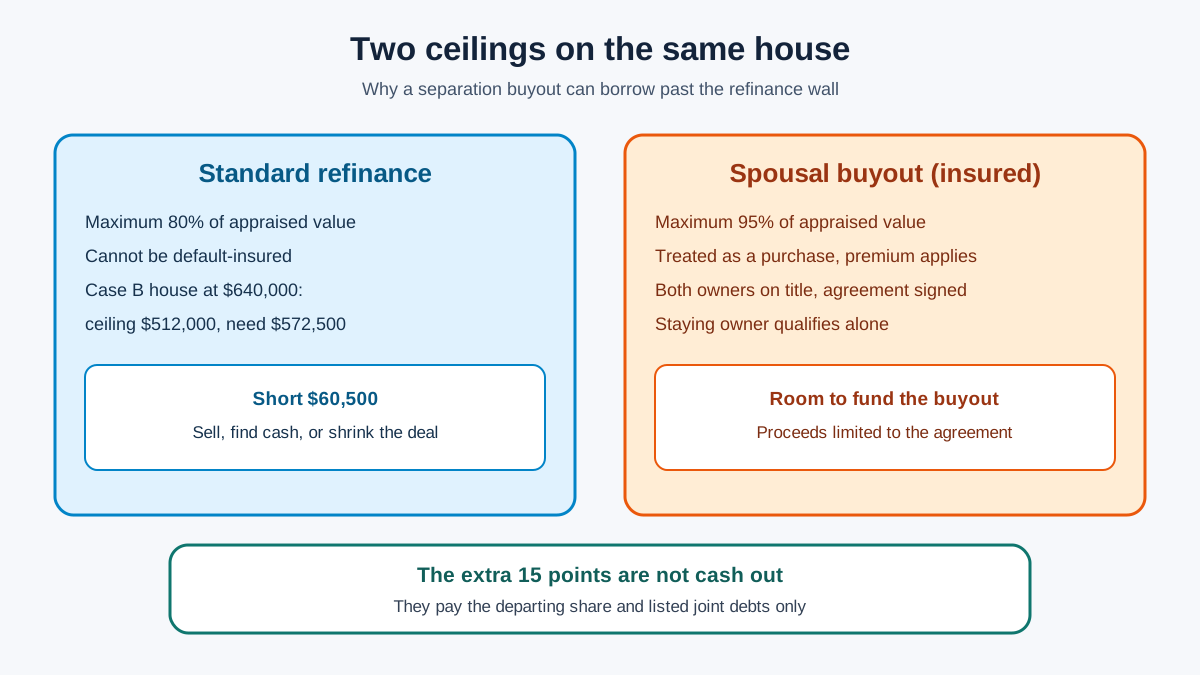
- A conventional refinance maxes out at 80% of the home's value, and a refinance cannot carry borrower-paid mortgage default insurance. If the departing share does not fit inside the 20% equity slice, a refinance cannot fund the buyout, full stop.
- An insured purchase can reach 95% loan-to-value on an owner-occupied home priced at or below $1.5 million, with default insurance priced on tiers (4.00% at 90.01% to 95%, 3.10% at 85.01% to 90%, 2.80% at 80.01% to 85% for a 25-year amortization). Our CMHC premium guide publishes the full table.
Insurer spousal buyout programs classify a separation buyout as a purchase transaction for insurance purposes. The staying owner effectively buys the departing owner's interest, so the high-ratio purchase ceiling applies instead of the refinance ceiling. Sagen's published equity buyout policy, for example, describes purchase treatment up to 95% loan-to-value where one borrower on title buys out another borrower's interest, with the deal documented by a purchase agreement, a finalized separation agreement, or a court order (Sagen lender update, February 5, 2019). Program details vary by insurer and lender, and one insurer may allow listed joint debts in the proceeds while another restricts proceeds to the equity share alone. Treat any program summary, including this one, as a map to questions for your lender, not as an approval.
The five gates every buyout has to pass
Lenders and insurers describe the same five gates in different words. Fail one and the file stops, however fair the agreement feels.
- Both owners are on title now. The buyout programs insure a transfer between current registered owners. A solicitor's title search confirms it. If only one partner is on title, there is no buyout program to use; the transaction becomes an ordinary purchase or refinance and the 80% wall returns. Whether a non-titled spouse or partner holds property rights is a family-law question that title alone does not answer, which is one more reason the legal advice comes first.
- The home is the staying owner's principal residence. These are owner-occupied homeowner programs. A rental property or a home the staying owner will not live in follows rental or conventional rules instead.
- A signed separation agreement (or court order) fixes the number. The agreement must state who keeps the home, the agreed value or valuation method, the exact buyout amount, and child or spousal support. Lenders will not fund against a draft, a verbal split, or a mediator's notes without a signed agreement behind them. Most lenders also require a purchase agreement between the two owners documenting the interest transfer.
- A fresh appraisal supports the value. Because the transfer price is set between former partners rather than by the market, insurers require a physical appraisal from an approved appraiser. Budget a few hundred dollars and confirm the fee with your lender. If the appraisal lands below the value in the agreement, the borrowable ceiling drops with it (see the appraisal trap below).
- The staying owner qualifies alone. Full underwriting on one income: stress test at the higher of contract rate plus 2 points or 5.25%, gross and total debt service inside insurer limits (39% and 44% for insured files), acceptable credit, and documented income. Our stress test guide and GDS and TDS guide reproduce those worksheets line by line.
One boundary follows from the purchase treatment: the insured route needs a value at or below $1.5 million. Above that cap, default insurance is unavailable at any down payment, so a high-value home buyout must fit inside an 80% conventional refinance or another uninsured structure. Our insured versus insurable guide maps that ceiling and the bands around it.
The equity math: what the departing share actually costs to borrow
The buyout amount is not half the house. It is the departing owner's share of the equity, after the existing mortgage, as the agreement defines that share. Agreements do not always split equity 50/50: equalization can net the home against pensions, investments, vehicles, and debts, so the home share can be larger, smaller, or settled partly with other assets. The formula the lender funds is:
New loan = existing mortgage balance + departing share of equity + joint debts the agreement directs the loan to retire
capped at the lesser of 95% of appraised value and the amount the agreement requires. Three labelled examples show how the cap binds. All use a hypothetical 4.50% contract rate and a 25-year amortization to price payments; the rate is an illustration, not a quote, and your lender's numbers will differ.
| Case | Appraised value | Mortgage balance | Equity | Departing share (50% shown) | New loan needed | Loan-to-value | Insurer premium | Standard refinance ceiling (80%) | Shortfall without the buyout route |
|---|---|---|---|---|---|---|---|---|---|
| A | $850,000 | $560,000 | $290,000 | $145,000 | $705,000 | 82.94% | 2.80% = $19,740 | $680,000 | $25,000 |
| B | $640,000 | $505,000 | $135,000 | $67,500 | $572,500 | 89.45% | 3.10% = $17,748 | $512,000 | $60,500 |
| C | $520,000 | $455,000 | $65,000 | $32,500 | $487,500 | 93.75% | 4.00% = $19,500 | $416,000 | $71,500 |
Read the last column first. In Case B, a standard refinance releases at most $512,000 against a $572,500 requirement: the staying owner would need $60,500 in cash or a smaller settlement to keep the home without the buyout program. In Case C, thin equity makes the refinance shortfall ($71,500) larger than the departing share itself. The program earns its premium exactly in this band, where the house has enough value to carry the buyout but not enough equity to fit under 80%.
The premium is financed into the loan in nearly every file, so the balance you actually carry is the new loan plus the premium: $724,740 in Case A, about $590,248 in Case B, and $507,000 in Case C. At the hypothetical 4.50%, the monthly payments on those financed balances are $4,011 (A), $3,267 (B), and $2,806 (C). Financing the premium alone adds about $109 a month in Case A and about $4,146 of extra interest over the first five years. Paying the premium in cash at closing removes that drag but competes with legal fees and moving money; few separating households have the spare cash, which is why the financed column is the realistic default.
The joint-debt variant, and the tier cliff hiding in it
Where the insurer and lender allow it, the agreement can direct part of the proceeds to retire joint debts (cards, lines, loans) alongside the equity share. That is useful surgery: it removes debts both names carry and can repair the staying owner's total debt service ratio. It also moves the premium tier. Add $18,000 of listed joint debts to Case A and the required loan rises to $723,000, loan-to-value to 85.06%, and the premium rate steps from 2.80% to 3.10% ($22,413 on the larger loan). The financed balance becomes $745,413 and the hypothetical payment $4,126 a month. A few thousand dollars of extra borrowing near a tier boundary reprices the premium on the entire loan, the same cliff our CMHC premium guide flags for purchases. Price the with-debts and without-debts versions side by side before the agreement locks a debt list in.
Qualifying alone: the test that decides most buyouts
The equity math says whether the loan can be big enough. Qualification says whether one income can carry it. Lenders run the same stress test as any insured purchase: payments calculated at the higher of your contract rate plus 2 points or 5.25%, then housing costs inside 39% of gross income (GDS) and all debts inside 44% (TDS) for insured underwriting.
Take Case B at the hypothetical rates. The contract payment is $3,267 a month at 4.50%, but qualification uses the 6.50% stress payment of about $3,954. Add property tax at an assumed $400 a month and heat at an assumed $150 a month (labelled assumptions; your bills will differ) and housing costs reach about $4,504. Inside a 39% GDS, that housing stack alone requires gross income of about $11,548 a month, roughly $138,600 a year, before any other debt is counted. Add $900 a month of support paid and a $420 car payment, and the 44% TDS ceiling pushes the required gross income to about $13,236 a month, roughly $158,800 a year. Those are illustration outputs from stated assumptions, not approval thresholds for your file, but they explain the common outcome: a mortgage that two incomes carried comfortably can fail on one income even though the buyout loan fits under 95%.
Three income and debt treatments decide borderline files:
- Support you receive can count as qualifying income when it is set out in the signed agreement or court order and the lender can see a deposit history; the required history and any haircut vary by lender and insurer. Undocumented or brand-new support may count for less or not at all.
- Support you pay is treated as a debt obligation in total debt service. It reduces what you can borrow dollar for dollar at the ratio, which is why the support number belongs in the qualification run before the agreement is signed, not after.
- Joint debts stay yours until they are gone or refinanced away. While your name sits on a joint card, loan, or the old mortgage, a lender counts its payment against you. The departing owner faces the mirror problem: until the buyout funds and the old mortgage is discharged, a new lender counts the full joint mortgage payment in their ratios, which can block their next purchase even if the agreement says the staying owner pays it.
Run the solo qualification before the agreement fixes the buyout price, support, and debt list. An agreement that assumes a loan you cannot get forces a renegotiation from weakness. Your credit score decides which pricing tier you land in once qualified, and a co-signer or guarantor is the structured fallback when one income falls short and a family member is willing to add theirs.
The cost stack beyond the premium
Budget these lines explicitly. Amounts vary by province, lender, and property, so confirm each with quotes rather than averages:
- Appraisal fee ordered through the lender, a few hundred dollars, paid up front.
- Mortgage default insurance premium at the tier rate on the new loan, normally financed, plus provincial sales tax on the premium in cash at closing where it applies: Ontario 8%, Quebec 9.975%, Saskatchewan 6%, Manitoba 7% (Case A's $19,740 premium carries $1,579 of Ontario tax, due in cash, not financed).
- Legal fees and disbursements for the transfer, new mortgage registration, and title work. Some lenders permit one lawyer for an amicable private transfer with independent advice waivers or separate advice where required; others require separate counsel. Ask before you assume one bill.
- Prepayment penalty on the old mortgage if you break mid-term. Fixed-rate penalties (the greater of three months' interest or an interest rate differential calculation) can reach several percent of the balance. Our prepayment penalty guide prices that formula. Timing the buyout to a renewal date or an open window can remove this line entirely.
- Title insurance and registration charges, plus any discharge fee on the old charge.
Compare that stack with the sell door before committing (commission on a sale usually dwarfs this list) and with the hold-jointly door (near zero transaction cost today, continuing joint liability as the price). The buyout is rarely the cheapest door in fees; it is the door that trades fees for sole ownership and a released former partner.
Seven traps that kill buyouts after the agreement is signed
- The appraisal lands under the agreed value. Proceeds cap at 95% of appraised value, not 95% of the number in the agreement. A $30,000 valuation gap on a 95% loan cuts borrowable proceeds by $28,500, and the shortfall is cash or a renegotiated price. Order qualification and valuation thinking early, and write a valuation method into the agreement rather than a fixed price pulled from a listing portal.
- The old mortgage penalty eats the equity. Breaking a closed fixed mortgage at month 30 to fund a buyout can add a five-figure penalty that nobody budgeted, shrinking the equity both sides split. Get the payout statement with the penalty before the agreement divides proceeds.
- Nobody is released until the new money funds. A signed agreement reallocates responsibility between the two of you; it does not bind the current lender. Until the buyout closes and the old mortgage discharges, both borrowers owe every payment and both credit files carry the account. Keep payments on automatic debit through closing and verify the discharge afterwards.
- The secured line quietly grows. A home equity line or readvanceable segment registered against the home forms part of the secured debt the buyout must clear. Freeze draws by agreement at separation, confirm the full secured balance (mortgage plus line plus collateral registrations), and price the buyout against the total, not the mortgage statement alone. Our home equity borrowing guide explains how those registrations stack.
- Support terms are written for fairness, then fail underwriting. Support set without a qualification run can push total debt service past 44% and collapse the approval the agreement depends on. Model support, buyout, and debts as one system with your mortgage professional and lawyer together.
- Tax and transfer assumptions go unchecked. Whether a spousal title transfer attracts land transfer tax depends on the province, the agreement, and how the transfer is structured; exemptions exist in defined circumstances and are not automatic. Principal residence designations between separated spouses have their own Canada Revenue Agency rules. Our capital gains guide maps the designation mechanics; a tax professional should confirm your years before either party buys again.
- Negative or thin equity makes the share negative too. If the balance exceeds the value, there is no equity to split and a 95% ceiling cannot manufacture any. The workable doors become a negotiated sale with a shortfall plan, a hold-jointly period, or a buyout funded partly from other assets under legal advice. Signing an agreement that assumes equity the appraisal will not find repeats trap one with worse numbers.
Keep or sell: a decision frame that respects both math and life
| Question | Points toward keeping (buyout) | Points toward selling |
|---|---|---|
| Solo payment at your real rate | Fits with room after tax, heat, insurance, and maintenance | Only fits by cutting savings or safety margin |
| Remaining equity after the buyout loan | Comfortable buffer under 95%, resilient to a price dip | Loan at or near 95% with no buffer |
| Time horizon in the home | Five years or more, so fees amortize | Likely move inside two to three years |
| Market and property | Sound property, no deferred repairs priced in | Major repairs due that the budget cannot fund |
| Both households after the split | Departing share funds a workable next home | Keeping the house starves the departing side's restart |
| Non-financial weight | School, care network, work location anchored to this address | No anchor that a move would break |
A buyout that passes the lender can still fail the household. If the solo payment only works with no repairs, no savings, and no margin for a rate reset at renewal, selling and splitting real equity can leave both sides stronger than one house-poor owner and one underfunded departure. The table does not make that call; it keeps the call from being made on the rate quote alone. Price your actual payment with our mortgage payment calculator and test the qualification payment with the stress test calculator before you run the frame.
The sequence that works: qualify, value, agree, fund
- Protect the joint file first. Agree in writing who pays the mortgage, tax, and insurance during separation, keep payments automatic, and freeze joint secured borrowing. This protects both credit reports while the rest runs.
- Pre-qualify the staying owner alone. One-income stress test, support in and out, joint debts counted, before any buyout number is promised. If the solo file fails, this is when a co-signer, a smaller buyout using other assets, or the sell door enters the discussion.
- Value the home properly. Approved appraisal or the valuation method the agreement will use, plus a payout statement that includes the prepayment penalty and all secured balances.
- Draft the agreement around borrable numbers. Buyout amount, support, debt list, transfer timing, and tax wording set with lawyer and mortgage input together. For RRSP Home Buyers' Plan money, each person's plan is their own: repayments continue to the borrower's own RRSP, and separation can restore plan eligibility after at least 90 days living apart, subject to Canada Revenue Agency conditions including a zero prior plan balance. Confirm with the Agency or your accountant before counting it as buyout cash.
- Submit as an insured purchase and close the loop. Insurer approval, lawyer transfer and new registration, funding to the departing owner and listed creditors exactly as the agreement directs, then written confirmation that the old mortgage discharged and the departing borrower is released.
- Rebuild single-owner paperwork. Home insurance in sole name, property tax and utility accounts updated, wills and beneficiaries revised under legal advice, and the departing owner's release letter kept on file for their next lender.
Frequently asked questions
Can I keep the house with only 5% equity left after the buyout?
That is the top of the insured buyout range: a new loan at 95% of appraised value leaves 5% equity, priced at the 4.00% premium tier on a 25-year amortization, provided the value is at or below $1.5 million, both owners are on title, the home is your principal residence, and you qualify alone at the stress-test rate. Case C in this guide shows the shape: a $487,500 loan on a $520,000 home plus a $19,500 premium. Loans above 95% are not available under these programs, so if the required amount passes 95%, the gap is cash, other assets in equalization, or a different door.
Do both of us need to be on title for a spousal buyout mortgage?
Yes for the insured buyout programs. Insurers describe the transaction as one current registered owner buying out another current registered owner, confirmed by a title search. Sagen's equity buyout policy extends the same purchase treatment to borrowers on title regardless of their relationship, with insurer approval and documentation of the interest sale in place of a separation agreement. If your partner is not on title, the buyout program does not apply; a lawyer should also confirm any property rights that exist off title before anyone assumes the house belongs to one person alone.
Is a signed separation agreement required before mortgage approval?
In practice, yes. Lenders require the finalized, signed agreement (or a court order) plus a purchase agreement between the owners before funding, because the agreement sets the buyout amount, the support figures used in debt service, and any joint debts the proceeds may retire. Brokers and lenders can pre-qualify your solo income earlier on draft numbers, and they should, but the approval firms up only against the signed document. An agreement signed before anyone ran your solo qualification is the most common cause of a buyout that must be renegotiated.
Can the buyout loan also pay off our joint credit cards and loans?
Only joint debts written into the signed separation agreement, only up to the 95% ceiling, and only where your insurer and lender allow debts in the proceeds. One insurer may restrict proceeds to the equity share while another allows listed debts, so this is a file-specific confirmation, not a program promise. Any listed debt must be retired from the proceeds on closing. Borrowing past the agreement amount for renovations, cash back, or new spending is not available under buyout treatment; that request returns the file to an 80% refinance test. Watch the premium tier when you add debts, as Case A's variant shows.
When does my former partner stop being responsible for the mortgage?
When the buyout funds, the old mortgage is discharged, and their name comes off title, confirmed in writing. Not when the agreement is signed, not when they move out, and not when you agree between yourselves that you will pay. Until discharge, both borrowers remain liable for every payment, missed payments report on both credit files, and lenders count the full payment against the departing owner on a new application. Keep joint payments current through closing and get the discharge or release confirmation from the lender afterwards.
Will I pay land transfer tax or capital gains tax on the transfer?
It depends on province, agreement wording, and property history, so treat any general answer as a flag to verify, not a clearance. Some provinces exempt defined transfers between spouses or former spouses under a separation agreement, others tax part or all of the transfer, and municipal tax can apply on top in Toronto. For income tax, transfers between spouses generally occur on a rollover basis unless an election is made, and separated spouses who live apart for at least 90 days can each designate a principal residence for separation years under Canada Revenue Agency rules. Our capital gains guide linked in the traps section maps the designation math. Have your lawyer and a tax professional confirm your transfer before closing, in writing.
What happens if the appraisal comes in below the value in our agreement?
Your borrowable maximum falls with it, because the ceiling is 95% of appraised value. The staying owner must cover the gap in cash, the parties renegotiate the buyout price or share, other assets in equalization absorb the difference, or the deal moves to the sell or hold doors. Writing the valuation method (approved appraisal, with a gap-sharing rule) into the agreement before the appraisal exists prevents the most damaging version of this surprise. A real estate agent's market evaluation or an online estimate does not set the lender's number.
What if I cannot qualify alone for the buyout loan?
The main structured options are a qualified co-signer or guarantor added to the new mortgage, a smaller buyout funded partly from other assets in the equalization split, waiting and reapplying after income or debts improve, holding the home jointly under a detailed co-ownership agreement until qualification is realistic, or selling and splitting the proceeds. Alternative or private short-term borrowing can bridge a deadline but prices far above insured purchase rates and needs a credible exit to a prime loan. Our co-signer and guarantor guide explains what that signature obligates, and a mortgage broker or your bank can compare the doors on your actual income, debts, and support figures.
Sources and method: Insurer program structure (purchase treatment to 95% loan-to-value, both owners on title, documented interest transfer, proceeds limited to the departing share and agreement-listed joint debts, principal-residence requirement) described from insurer and lender program material retrieved October 9, 2026, including Sagen's Equity Buyout Policy lender update of February 5, 2019 (purchase transactions to 95% LTV, borrowers on title, purchase agreement, finalized separation agreement, or court order as documentation), insurer spousal buyout program summaries published by CMHC, Sagen, and Canada Guaranty market participants, and the Financial Consumer Agency of Canada mortgage guidance reflected in this site's porting guide. Premium tiers (2.80% to 4.00% at 25 years, $1.5 million insured cap, provincial sales tax on premiums in Ontario, Quebec, Saskatchewan, and Manitoba) follow this site's CMHC premium guide of October 1, 2026. Debt-service limits (39% GDS, 44% TDS) and stress-test mechanics (higher of contract plus 2 points or 5.25%) follow CMHC underwriting guidance and this site's stress test and GDS/TDS guides. Home Buyers' Plan separation summary follows Canada Revenue Agency plan rules as reported in Canadian personal-finance coverage retrieved October 9, 2026; confirm your eligibility with the Agency. All home values, balances, payments, incomes, taxes, and the 4.50% contract rate are labelled hypothetical illustrations computed with Canadian semi-annual compounding (Case A: $724,740 financed at 4.50% over 25 years = $4,011 a month; Case B: about $590,248 = $3,267; Case C: $507,000 = $2,806). They are not quotes, appraisals, approvals, or legal determinations. Property division, support, and tax outcomes vary by province and by your agreement; obtain independent legal, tax, and mortgage advice for your file.

About David R. Chen, CFA
David R. Chen is a Chartered Financial Analyst and the Senior Housing Economist at BubbleWatch.ca. He brings 12+ years of experience in quantitative real estate analysis and mortgage underwriting. Formerly an analyst at a major Canadian bank, he specializes in modeling payment shock, regional affordability divergence, and private lending risk.
View David's professional bio & credentials →