Land Transfer Tax in Canada (2026) 2026 Tool
A source-grounded Canadian buyer method for estimating transfer tax, testing first-time-buyer eligibility, identifying stacked municipal charges, and protecting closing cash before an offer becomes firm.
Land Transfer Tax in Canada (2026): Buyer Cash and Rebate Guide
Land transfer tax can consume thousands of dollars at closing even though it does not increase the down payment or reduce the mortgage balance. The amount depends on the province, municipality, property value or other statutory tax base, buyer status, ownership shares, property use, and registration date. Toronto buyers can face both Ontario land transfer tax and Toronto's municipal land transfer tax. British Columbia generally uses fair market value. Quebec municipalities calculate a transfer duty using the highest of specified values and may adopt higher brackets for expensive property. Manitoba adds land transfer tax and a registration fee at title registration.
Short answer: ask the lawyer or notary for a written transfer-tax estimate before removing financing and due-diligence conditions. Give them the complete buyer names, spousal history, citizenship or permanent-resident status where relevant, intended occupancy, ownership percentages, property type, location, price, assumed debt, registration date, and any non-open-market feature. Treat a rebate as conditional until eligibility is confirmed. Keep the gross tax, municipal tax, rebate, legal disbursements, title-registration charges, and speculation or foreign-buyer taxes as separate lines in the cash-to-close plan.
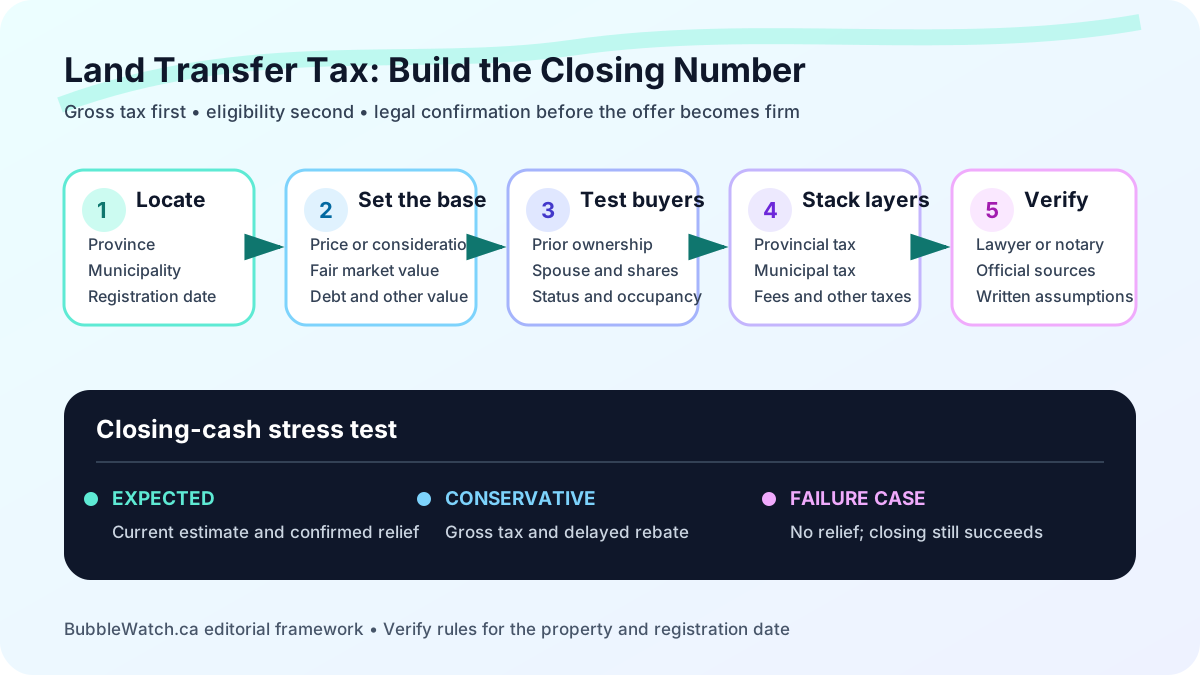
Scope: This guide summarizes official pages available on July 19, 2026. It is educational, not legal or tax advice. Transfer-tax rules, thresholds, municipal bylaws, exemptions, forms, and administrative fees can change. Your lawyer, Quebec notary, or other authorized closing professional should calculate the transaction under the law and official guidance that apply on the registration date.
Start with the right question
“How much is land transfer tax in Canada?” does not have one national answer. A useful estimate begins with five questions:
- Where is the land? Province and municipality can both matter.
- What value does the law tax? Purchase price is not always the only input.
- Who is acquiring the interest? Eligibility can change by buyer, spouse, ownership share, residency status, and prior ownership.
- What is being acquired? Residential, commercial, mixed-use, farm, vacant, newly built, and non-open-market transfers can be treated differently.
- When will it register? Rates and thresholds may be tied to registration or transfer dates, not merely the offer date.
This is why an online calculator is a planning tool rather than closing authority. A calculator cannot discover an unmentioned spouse, beneficial interest, related-party transfer, non-residential component, property larger than an exemption limit, or municipal layer.
The one-page buyer workflow
| Stage | Buyer task | Evidence to retain | Stop-and-confirm trigger |
|---|---|---|---|
| Property search | Identify province, municipality, price range, property type, and intended use | Listing, municipal boundary, tax-page links | Address may sit outside the assumed municipality |
| Pre-approval | Add a conservative transfer-tax line outside the down payment | Lender cash requirement and personal closing budget | Funds are sufficient for down payment but not closing |
| Offer preparation | Ask for a lawyer or notary estimate using the intended buyers and shares | Written estimate and assumptions | Parent, spouse, corporation, trust, or co-buyer may join title |
| Conditional period | Confirm value basis, rebate criteria, occupancy timing, and other taxes | Official program pages and professional advice | Non-open-market deal, assignment, assumed debt, or mixed use |
| Before firm | Stress-test loss or reduction of any expected rebate | Gross-tax scenario and reserve | Buyer needs rebate proceeds to close |
| Lawyer intake | Provide complete identity, status, ownership, property, and transaction facts | Intake form, agreement, amendments, lender instructions | Facts differ from the initial estimate |
| Closing statement | Reconcile tax, rebate, municipal layer, fees, adjustments, and funds | Trust statement and registered documents | A line is missing, duplicated, or inconsistent |
| After closing | Complete occupancy or refund evidence and retain deadlines | Proof of occupancy and submitted forms | Refund was not claimed at registration |
The workflow is deliberately repetitive about written assumptions. Most closing surprises are not arithmetic failures. They are classification or eligibility failures.
What land transfer tax is - and is not
Transfer tax is generally a charge triggered when land or an interest in land changes hands or is registered, subject to the governing law. It is different from:
- annual municipal property tax;
- a deposit held under the purchase contract;
- the buyer's down payment;
- mortgage default insurance;
- legal fees and disbursements;
- title insurance;
- appraisal and inspection charges;
- GST/HST on a taxable new-home transaction;
- adjustments for prepaid property tax, utilities, fuel, rent, or condominium expenses;
- speculation, vacancy, foreign-buyer, or non-resident taxes that may apply separately.
The distinction matters because a buyer may hear that “closing costs are about 1.5%” and assume one percentage covers everything. It does not. A Toronto purchase can have provincial and municipal transfer tax before legal fees, adjustments, title insurance, and other applicable charges. A Quebec transfer duty may be invoiced by the municipality after the notarial closing rather than appearing exactly like an Ontario registration-time payment. The cash plan must follow the local process.
Build the cash-to-close stack
Create one worksheet with separate rows:
| Cash item | Planning estimate | Confirmed by | Due date | Source or document |
|---|---|---|---|---|
| Purchase deposit already paid | Brokerage or lawyer | Offer schedule | Receipt and agreement | |
| Remaining down payment | Lender and lawyer | Closing | Mortgage instructions | |
| Provincial transfer tax or duty | Lawyer or notary | Registration or invoice | Official rate page | |
| Municipal transfer tax or duty | Lawyer, notary, municipality | Closing or invoice | Municipal page | |
| Less confirmed rebate or exemption | Closing professional | Registration or later claim | Eligibility record | |
| Legal or notarial fees and disbursements | Professional quote | Closing | Retainer or estimate | |
| Title insurance and registrations | Lawyer or notary | Closing | Closing estimate | |
| Statement-of-adjustments balance | Lawyer or notary | Closing | Draft statement | |
| GST/HST or new-home adjustments | Builder and lawyer | Contract-specific | Agreement and tax advice | |
| Inspection, appraisal, insurance, moving | Providers | Various | Quotes and invoices | |
| Emergency reserve after closing | Buyer | Remains liquid | Savings record |
Do not net an expected refund against the gross tax unless the closing professional confirms it will be claimed at registration and accepted in the closing calculation. If the refund must be claimed later, the buyer may need to fund the gross amount first.
Ontario land transfer tax in 2026
Ontario states that land transfer tax is normally paid when land or a beneficial interest is acquired. The province's official calculation page, updated April 22, 2026, lists these general brackets for transactions governed by the post-November 14, 2016 rules:
| Portion of value of consideration | Ontario rate |
|---|---|
| Up to and including $55,000 | 0.5% |
| Over $55,000 to $250,000 | 1.0% |
| Over $250,000 to $400,000 | 1.5% |
| Over $400,000 | 2.0% |
| Portion over $2,000,000 when the land contains one or two single-family residences | 2.5% |
The tax is marginal. A $700,000 qualifying residential purchase is not taxed at 2% on every dollar. The bands are applied sequentially:
- first $55,000 × 0.5% = $275;
- next $195,000 × 1.0% = $1,950;
- next $150,000 × 1.5% = $2,250;
- remaining $300,000 × 2.0% = $6,000;
- illustrative Ontario total = $10,475 before any refund or other tax.
This worked example assumes the value of consideration is $700,000, the ordinary residential brackets apply, and no special circumstance changes the base or tax. It is not a closing quote. To price the tax on your own purchase price and province, use a land transfer tax calculator for a first estimate, then confirm the figure with your closing lawyer.
Ontario value of consideration is a legal input
The official Ontario material explains that value of consideration can include the amount paid plus liabilities assumed and other benefits provided as part of the arrangement. Some transfers use fair market value rules. Gifts, transfers between related people, beneficial interests, trust arrangements, foreclosures, unregistered dispositions, new-home arrangements, and mixed uses can require analysis that a purchase-price calculator does not perform.
Ask the closing lawyer:
- What value of consideration will be reported?
- Does assumed mortgage or other debt affect it?
- Is any part non-residential or outside the single-family-residence definition?
- Is the transfer registered or an unregistered beneficial disposition?
- Does an exemption, rebate, transitional rule, or additional tax require a separate filing?
Ontario first-time-homebuyer refund
Ontario's first-time-homebuyer refund page says an eligible first-time purchaser may receive up to $4,000 for conveyances or dispositions on or after January 1, 2017. Its published requirements include being at least 18, occupying the home as a principal residence within nine months, never having owned an eligible home or interest in one anywhere in the world, meeting the spousal history rule, and meeting citizenship or permanent-residence requirements or the stated later-eligibility process.
The definition is not interchangeable with every other first-time-buyer program. Ontario explicitly notes that a buyer cannot re-qualify after prior home ownership merely because a federal program uses a different look-back test. A parent on title, a non-qualifying co-owner, or a spouse's ownership history can change the refund. Ownership shares matter.
For the illustrative $700,000 purchase above, a fully eligible purchaser receiving the maximum $4,000 refund would have an illustrative net Ontario land transfer tax of $6,475. That subtraction is only valid after eligibility and claim timing are confirmed.
Toronto buyers: provincial and municipal layers
The City of Toronto states that its Municipal Land Transfer Tax applies to property purchases in Toronto in addition to Ontario land transfer tax. The City's rates and fees page says revised high-value residential rates took effect April 1, 2026.
For a property containing at least one and not more than two single-family residences, the City's published bands are:
| Portion of value of consideration | Toronto MLTT rate |
|---|---|
| Up to and including $55,000 | 0.5% |
| Over $55,000 to $250,000 | 1.0% |
| Over $250,000 to $400,000 | 1.5% |
| Over $400,000 to $2,000,000 | 2.0% |
| Over $2,000,000 to $3,000,000 | 2.5% |
| Over $3,000,000 to $4,000,000, effective April 1, 2026 | 4.40% |
| Over $4,000,000 to $5,000,000, effective April 1, 2026 | 5.45% |
| Over $5,000,000 to $10,000,000, effective April 1, 2026 | 6.50% |
| Over $10,000,000 to $20,000,000, effective April 1, 2026 | 7.55% |
| Over $20,000,000, effective April 1, 2026 | 8.60% |
For the same illustrative $700,000 ordinary residential purchase, the Toronto municipal marginal calculation through the $2 million band is also $10,475. Before rebates and other charges, the combined illustrative provincial and municipal transfer tax would therefore be $20,950.
Toronto's rebate page publishes a first-time-homebuyer rebate of up to $4,475 for an eligible home. It lists age, occupancy within nine months, worldwide prior-ownership, spousal, and citizenship or permanent-residence conditions. If the hypothetical buyer qualifies for the maximum Ontario and Toronto amounts, the combined illustrative net becomes:
| Line | Amount |
|---|---|
| Gross Ontario LTT | $10,475 |
| Gross Toronto MLTT | $10,475 |
| Less maximum Ontario refund, if fully eligible | ($4,000) |
| Less maximum Toronto rebate, if fully eligible | ($4,475) |
| Illustrative net transfer taxes | $12,475 |
That is not the complete closing cost. Toronto also publishes administration or refund-processing fees, and other transaction charges may apply. The purpose of the table is to show why “I am a first-time buyer” does not mean “I pay no land transfer tax” at a common Toronto price.
Toronto boundary check
Do not infer municipal tax from a Toronto mailing label, brokerage market name, transit station, or proximity to the city. Confirm the property's legal municipality. A property in Mississauga, Markham, Vaughan, Pickering, or another surrounding municipality may be marketed as part of the Greater Toronto Area but is not in the City of Toronto. Conversely, a neighbourhood name does not remove a property from Toronto.
Keep the municipal tax question separate from the Ontario tax question. The lawyer should confirm both.
British Columbia property transfer tax
British Columbia's property transfer tax page says the tax is generally based on the fair market value of the land and improvements on the registration date, unless an exemption or special rule applies. The published general rates are:
| Portion of fair market value | B.C. general rate |
|---|---|
| Up to and including $200,000 | 1% |
| Over $200,000 to $2,000,000 | 2% |
| Over $2,000,000 | 3% |
| Residential portion over $3,000,000 | Further 2% |
The province also identifies an additional property transfer tax for foreign nationals, foreign corporations, or taxable trustees acquiring residential property in specified areas. This is a separate eligibility and status question; do not fold it silently into the general-rate estimate.
B.C. worked example
For an open-market home with a $900,000 fair market value at registration, assuming the ordinary general rates and no additional tax or exemption:
- first $200,000 × 1% = $2,000;
- remaining $700,000 × 2% = $14,000;
- illustrative B.C. general property transfer tax = $16,000.
If the contract price and registration-date fair market value may differ materially - because of a long completion, assignment, related-party transaction, changed property condition, rezoning, or unusual terms - ask the legal professional which value will be reported and what evidence is needed.
B.C. first-time-homebuyers' exemption
B.C.'s current exemption-amount page says that, for qualifying property below 0.5 hectares where the whole transfer is eligible, the exemption is:
- equal to the full ordinary tax at fair market value of $500,000 or less;
- $8,000 for fair market value over $500,000 and no more than $835,000;
- proportionally reduced over $835,000 and under $860,000;
- unavailable under that value schedule at $860,000.
The page also explains that buyer eligibility percentage, property size, and non-residential improvements can change the exemption. A rural property larger than 0.5 hectares should not be estimated from the simple urban table. A co-buyer who does not qualify can reduce the eligible portion.
The $900,000 worked example is above the published phase-out range, so the table should not assume a first-time-homebuyer exemption. That result illustrates a broader lesson: the first-time label never replaces the price, land-area, property-use, and ownership-share tests.
Quebec real-estate transfer duties
Quebec's official 2026 transfer-duty page says a municipality must generally collect a duty from a new property owner, subject to exemptions. The taxable base is the highest of:
- the price paid, including the value of property exchanged;
- the sale price stated in the transfer instrument; or
- the market value produced from the municipal assessment multiplied by the year's comparative factor.
For the 2026 fiscal year, Quebec publishes these base brackets:
| Portion of taxable base | 2026 base rate |
|---|---|
| First $62,900 | 0.5% |
| $62,900.01 to $315,000 | 1.0% |
| Amount over $315,000 | 1.5% |
The province notes that municipalities may set a higher rate on a bracket above $500,000, generally subject to a 3% ceiling, while Montréal may set a higher rate. Therefore the base table is not a universal final quote for every Quebec municipality.
Quebec worked example from the official method
Suppose the stated sale price is $700,000 and the assessment-times-factor market value is $735,000. The taxable base is $735,000 because it is the higher amount. Using only the province's published base brackets:
- first $62,900 × 0.5% = $314.50;
- next $252,100 × 1.0% = $2,521;
- remaining $420,000 × 1.5% = $6,300;
- illustrative base duty = $9,135.50 before any municipality-specific higher bracket or other amount.
Ask the notary to confirm the comparative factor, municipal bylaw, invoice timing, exemptions, and disclosure duties. Quebec states that the duty becomes payable from the transfer and generally must be paid before the 31st day after the municipality sends the account, unless an authorized instalment rule applies. This timing differs from a buyer assumption that every tax is simply deducted on the notarial closing date.
Quebec exemptions are not casual gifts
The official page lists certain family, spousal, agricultural, low-base, and entity-related situations among possible exemptions, but each has legal conditions. An exempt transfer can still require disclosure, and a municipality may impose a supplementary duty in some cases. A family transfer should be documented through the notary before anyone assumes that no duty, tax consequence, creditor issue, or later obligation exists.
Manitoba land transfer tax
Manitoba's official land transfer tax page says transferees generally pay land transfer tax, with some exceptions, plus a registration fee when the transfer of title is registered. The published tax uses fair market value on the registration date:
| Portion of fair market value | Manitoba rate |
|---|---|
| First $30,000 | 0% |
| $30,001 to $90,000 | 0.5% |
| $90,001 to $150,000 | 1.0% |
| $150,001 to $200,000 | 1.5% |
| Amount over $200,000 | 2.0% |
For a $450,000 fair-market-value transfer, assuming the ordinary brackets:
- first $30,000 × 0% = $0;
- next $60,000 × 0.5% = $300;
- next $60,000 × 1.0% = $600;
- next $50,000 × 1.5% = $750;
- remaining $250,000 × 2.0% = $5,000;
- illustrative Manitoba land transfer tax = $6,650, plus the applicable registration fee.
The registration fee should remain a separate cash line. Do not call every land-title charge “land transfer tax” or the estimate becomes difficult to reconcile with the lawyer's trust statement.
What about the other provinces and territories?
The absence of a section here is not evidence that a purchase has no transfer, deed, registration, municipal, non-resident, or other closing charge. Canadian jurisdictions use different names and systems. Municipal taxes can vary inside a province. Rules for new construction, non-residents, related transfers, farms, corporations, trusts, leases, and beneficial interests can change the result.
For a purchase in Alberta, Saskatchewan, Nova Scotia, New Brunswick, Prince Edward Island, Newfoundland and Labrador, Yukon, Northwest Territories, or Nunavut:
- ask the closing lawyer for the official provincial, territorial, land-title, and municipal sources;
- confirm whether the charge is a tax, registration fee, assurance fee, deed-transfer tax, municipal tax, or combination;
- confirm the base - price, fair market value, mortgage amount, or another statutory measure;
- confirm whether rates vary by municipality or property class;
- ask whether first-time, new-home, family, Indigenous land, farm, non-resident, or other rules apply;
- record the page date and the expected registration date;
- keep a reserve until the professional closing statement is final.
Do not reuse an Ontario or B.C. calculator for another jurisdiction simply because the purchase price is similar.
First-time-buyer eligibility audit
Before counting a refund or exemption, complete this table for every intended registered and beneficial owner:
| Question | Buyer 1 | Buyer 2 | Other owner or trustee | Evidence or professional note |
|---|---|---|---|---|
| Full legal name and status | ||||
| Intended ownership percentage | ||||
| Ever owned a home or interest anywhere? | ||||
| Method of prior acquisition - purchase, gift, inheritance, trust? | ||||
| Current and prior spouse or partner facts relevant to the rule | ||||
| Citizenship or permanent-resident requirement met? | ||||
| Principal-residence occupancy deadline feasible? | ||||
| Property value and land-area threshold met? | ||||
| Residential and non-residential portions identified? | ||||
| Claim made at registration or after closing? |
The table is a disclosure aid, not a self-certification. Terms such as owner, home, spouse, principal residence, transferee, and beneficial interest are defined by the applicable program. Give the facts to the professional rather than reverse-engineering the answer you want.
Parent on title, gifted funds, and ownership shares
A parent can assist with funds without necessarily taking an ownership interest, but the lender and lawyer must know the actual arrangement. If a parent becomes a registered or beneficial owner, transfer-tax and first-time-buyer consequences may change. Ontario's official refund page gives an example where a qualifying child acquiring a 50% interest with a non-qualifying parent may claim only the qualifying proportion, subject to the program rules. It also discusses evidence where a parent is on title as trustee for mortgage purposes.
Do not create a hidden trust or nominee arrangement to preserve a rebate. The mortgage application, title, beneficial ownership, source of funds, tax reporting, estate plan, and family agreement need to tell the same story. Use the gifted down-payment guide to document funds and the co-borrower and guarantor guide to separate credit support from ownership.
Non-open-market and family transfers
A nominal sale price does not necessarily create nominal transfer tax. Depending on the jurisdiction, fair market value, assumed debt, comparative factors, beneficial interests, or anti-avoidance rules may determine the base. Common situations needing advance legal and tax analysis include:
- parent-to-child transfer;
- adding or removing a spouse from title;
- transfer after separation or death;
- transfer into or out of a trust;
- corporate reorganization;
- gift subject to a mortgage;
- life estate or remainder interest;
- foreclosure or power-of-sale result;
- lease or assignment with a taxable interest;
- acquisition of an unregistered beneficial interest;
- property with farm, commercial, rental, or mixed use.
Transfer tax is only one consequence. Capital gains, principal-residence reporting, GST/HST, attribution, estate, creditor, family-law, mortgage-consent, insurance, and property-tax issues may also exist. The right professional team depends on the transaction.
New construction and assignment purchases
New-home contracts can contain adjustments, development charges, levies, utility connections, Tarion or warranty amounts, legal review charges, and GST/HST provisions that sit beside transfer tax. An assignment can change the parties, price components, deposits, taxable base, lender approval, builder consent, and closing sequence.
For a new build, ask the lawyer to identify:
- original purchase price and all amendments;
- upgrades and extras;
- assignment consideration and deposits;
- builder adjustments and caps;
- expected transfer-tax base;
- GST/HST treatment and rebate assignment;
- first-time or new-home transfer-tax relief;
- municipal or non-resident layers;
- interim occupancy versus final registration;
- funds required at each stage.
Do not use the resale calculator alone. Provide the complete agreement and schedules.
Mortgage qualification versus closing cash
A lender can approve a mortgage amount while the buyer still lacks enough money to close. Transfer tax normally does not become part of the mortgage principal simply because it is a mandatory cost. Lender rules for proving closing funds, borrowed down payments, gifts, lines of credit, reserves, and source-of-funds documentation vary.
Run three scenarios:
| Scenario | Tax assumption | Rebate assumption | Reserve assumption |
|---|---|---|---|
| Expected | Lawyer's current estimate | Only confirmed claim-at-registration relief | Normal repair and moving reserve |
| Conservative | Higher plausible value or municipal layer | Rebate delayed until after closing | Larger adjustment and repair reserve |
| Failure case | Gross tax plus professional correction | No rebate | Closing still succeeds without emergency borrowing |
If the failure case cannot close, the offer price, buyer structure, closing date, or financing plan needs revision before the deal becomes firm.
Offer-stage questions for the lawyer or notary
Send a concise package:
- property address and municipality;
- purchase price and deposit schedule;
- expected closing and registration date;
- property type, size, and intended use;
- buyer legal names and ownership shares;
- citizenship or permanent-resident facts where relevant;
- worldwide home-ownership history;
- spousal history relevant to the program;
- intended principal-residence occupancy date;
- lender, guarantor, co-borrower, trust, or corporate involvement;
- related-party, assignment, assumed-debt, or non-open-market facts;
- builder agreement, schedules, amendments, and incentives;
- the rebate or exemption being considered.
Ask for written answers to:
- What is the gross provincial or territorial transfer charge?
- What municipal charge applies?
- What value or consideration is used?
- Which rebate or exemption appears available, and to what share?
- Will it be claimed at registration or after closing?
- What evidence and occupancy deadline apply?
- What additional non-resident, speculation, registration, or administration charge may apply?
- What amount should be added for legal fees, disbursements, title insurance, and adjustments?
- What change in facts would invalidate this estimate?
- When will the estimate be refreshed?
Worked comparison: the same price is not the same cash need
Consider three hypothetical $700,000 open-market homes, each assumed to meet the ordinary residential conditions described below. These are teaching examples, not quotes.
| Location | Illustrative gross transfer charge | Important missing decision |
|---|---|---|
| Ontario outside Toronto | $10,475 Ontario LTT | Does the buyer qualify for up to $4,000 refund? |
| City of Toronto | $20,950 combined Ontario plus Toronto MLTT | Does the buyer qualify for both programs, and what fees remain? |
| B.C. | $12,000 general PTT at $700,000 fair market value | Does the buyer qualify for the $8,000 first-time exemption and meet all property tests? |
For B.C., the ordinary general tax calculation is $2,000 on the first $200,000 plus $10,000 on the next $500,000. For Ontario, the marginal calculation is shown earlier. Toronto adds the matching municipal bands at this price.
The table proves why a buyer relocating between provinces should rebuild closing cash from zero. The same price and down payment do not create the same transfer-tax requirement.
Common mistakes
Mistake 1: applying the top rate to the full price
Ontario, Toronto, B.C., Quebec's base system, and Manitoba use marginal bands in the examples above. Apply each rate only to its band unless the official rule says otherwise.
Mistake 2: assuming purchase price is always the tax base
B.C. and Manitoba describe fair market value. Quebec uses the highest of specified values. Ontario's value of consideration can include more than the cash price. Give the professional the transaction facts.
Mistake 3: forgetting a municipal layer
Toronto is the clearest stacked example. Quebec municipalities administer the duty and can have higher brackets. Other provinces may have municipal deed-transfer taxes or local differences.
Mistake 4: treating every first-time program as the same
An FHSA, Home Buyers' Plan, land-transfer refund, provincial exemption, and municipal rebate can use different definitions and deadlines. Qualifying for one does not prove another.
Mistake 5: ignoring the spouse or co-owner test
Programs can examine worldwide ownership, spousal history, ownership percentages, and beneficial interest. Test every buyer before counting relief.
Mistake 6: using a rebate needed to fund the deposit
The deposit is usually due under the purchase contract before closing. A registration-time or post-closing tax rebate is not deposit cash.
Mistake 7: using stale thresholds
Quebec indexes base thresholds annually. Toronto changed high-value rates effective April 1, 2026. Record the source date and recheck before registration.
Mistake 8: budgeting only tax
Registration fees, administration fees, legal or notarial costs, title insurance, adjustments, new-home charges, and other taxes remain separate.
Turn transfer tax into a maximum-offer decision
Transfer tax is a stepped closing cost, not a reason to bid irrationally below a bracket. Crossing a threshold normally applies the higher marginal rate only to the portion above that threshold. The more useful question is whether the next dollar of price also increases the down payment, mortgage qualification need, transfer tax, sales tax or builder adjustment, appraisal-gap exposure, insurance, and required reserve.
Build a marginal-offer table before bidding:
| Offer input | Current offer | Next offer | Change in cash required |
|---|---|---|---|
| Purchase price | |||
| Deposit due under the offer | |||
| Down payment required by lender | |||
| Provincial transfer tax | |||
| Municipal transfer tax or duty | |||
| Rebate or exemption | |||
| Appraisal-gap reserve | |||
| Closing-cost and repair reserve | |||
| Total additional liquid cash |
For example, increasing an Ontario-outside-Toronto offer from $700,000 to $710,000 adds $200 of ordinary Ontario land transfer tax because the extra $10,000 sits in the 2% band. That does not mean the full cash effect is $200. The buyer may also need a larger down payment, a higher mortgage, more income to qualify, or more cash if the appraisal does not support the increase. In Toronto, the same increment within the ordinary 2% provincial and 2% municipal bands adds an illustrative $400 across the two transfer taxes before other effects.
Do not bid to “use up” a rebate. Ontario's maximum first-time refund and Toronto's maximum first-time rebate are caps, not matching grants that make a higher price economical. Likewise, B.C.'s first-time exemption schedule can remain fixed or phase out as value rises; the official calculator and lawyer should model the exact fair market value and eligible share.
Set the maximum offer from the full household constraint:
- preserve the minimum down payment and lender-required closing funds;
- reserve gross transfer tax unless claim-at-registration relief is confirmed;
- include municipal and registration layers;
- preserve an appraisal-gap boundary appropriate to the offer and market;
- retain post-closing emergency and repair cash;
- stop where any one constraint fails.
The offer ceiling is the lowest result produced by financing, cash, appraisal, condition, and household-budget limits. A tax refund should not be used to erase the weakest limit.
Relocation comparison: rebuild the model, do not translate it
A household selling in one province and buying in another often carries the old jurisdiction's mental model into the new purchase. That creates errors even when the buyer previously owned several homes. Use this relocation file:
| Question | Sale location | Purchase location | Professional confirmation |
|---|---|---|---|
| Which transfer or deed tax exists? | |||
| Is there a municipal layer? | |||
| Is the base price, consideration, or fair market value? | |||
| Does prior ownership eliminate first-time relief? | |||
| Does spouse history matter? | |||
| Are non-resident rules triggered before the move? | |||
| When is the tax paid? | |||
| What registration or administration fee is separate? | |||
| What occupancy evidence is required? | |||
| Which sale proceeds will actually be available on closing day? |
The timing column matters. Sale proceeds can be delayed by mortgage discharge, payout verification, holdback, bridge financing, closing adjustments, or different closing dates. A buyer may have enough net worth but insufficient same-day liquidity. Use the bridge-financing guide and seller net-proceeds guide to reconcile the two transactions.
If the buyer intends to claim first-time relief after years without ownership, verify the program definition. Some federal programs use a look-back period, while Ontario's land-transfer refund says prior ownership of an eligible home anywhere in the world prevents requalification. Never transfer a definition from one program to another.
Source-freshness record
Tax content ages quickly because a page can remain online after a threshold, fee, effective date, or municipal bylaw changes. Add this record to the closing file:
| Source | Page date | Date checked | Registration date | Change trigger | Owner |
|---|---|---|---|---|---|
| Provincial rate page | Budget or law announcement | Buyer/lawyer | |||
| Municipal rate page | Council amendment or boundary issue | Buyer/lawyer | |||
| Rebate or exemption page | Buyer, spouse, value, occupancy, or status changes | Buyer/lawyer | |||
| Official calculator result | Price or fair-market-value change | Buyer | |||
| Lawyer or notary estimate | Agreement, lender, or title change | Professional |
Refresh the estimate at four moments: before offer, before condition removal, when the lawyer receives the final agreement and buyer facts, and when the closing funds request is prepared. If an official page and a third-party calculator disagree, use the discrepancy as a question for the closing professional rather than choosing the cheaper result.
Save the source page as well as the number. A bare screenshot of “$12,475” does not show jurisdiction, input value, registration date, buyer share, rebate assumption, or whether a municipal layer was included. A reproducible estimate states every input.
Seven-day pre-offer verification plan
Day 1: locate the property legally
Confirm province, territory, municipality, legal description, property type, and whether the marketed location matches the taxing jurisdiction.
Day 2: model gross tax
Use the current official page or calculator. Save a PDF or screenshot showing the date, value, and assumptions. Keep gross tax before rebate.
Day 3: test every buyer
Complete the eligibility audit for registered and beneficial owners, spouses, trustees, guarantors who may join title, and any corporation.
Day 4: ask the professional
Send the transaction package to the lawyer or notary. Request the gross amount, net amount, value basis, claim timing, evidence, and uncertainty.
Day 5: reconcile with the lender
Confirm down payment, source-of-funds evidence, closing-cost requirement, debt treatment, and minimum liquid funds.
Day 6: run the failure case
Remove the rebate, add a reasonable adjustment buffer, and confirm closing still works. If not, reduce the offer or change the plan.
Day 7: write the decision
Record the maximum offer, assumed gross tax, verified relief, remaining reserve, and conditions that require recalculation.
Closing-week reconciliation
When the draft trust statement or funds request arrives, compare it with the pre-offer worksheet:
- purchase price and credits;
- deposits received;
- mortgage advance;
- ownership names and shares;
- provincial or territorial transfer tax;
- municipal transfer tax or duty;
- rebate or exemption;
- non-resident or speculation tax;
- registration and administration fees;
- legal or notarial fees and disbursements;
- title insurance;
- statement-of-adjustments items;
- GST/HST or builder amounts;
- balance required and payment instructions.
Do not send funds using instructions changed only by email without following the law firm's independent verification procedure. Transfer-tax accuracy does not protect against payment fraud.
After-closing evidence file
Keep:
- registered transfer or deed;
- lawyer's or notary's final statement;
- tax return, affidavit, or electronic registration record;
- rebate or exemption claim;
- proof of payment;
- proof of occupancy accepted by the program;
- citizenship or permanent-residence evidence submitted;
- correspondence about ownership shares or trust status;
- municipal invoice and payment;
- refund decision and deposit record;
- source pages used for the estimate.
Calendar occupancy and application deadlines. Ontario and Toronto publish 18-month later-claim periods in their first-time-buyer material, but do not wait simply because a maximum period exists. Missing evidence becomes harder to reconstruct.
Frequently asked questions
Is land transfer tax included in my mortgage?
Usually it is a separate closing-cash requirement rather than an automatic addition to mortgage principal. Ask the lender and lawyer how much verified cash must be available. The closing-cost cash guide shows how to keep it separate from the down payment and deposit.
Do first-time homebuyers pay land transfer tax in Ontario?
They can. Ontario's official program offers a refund up to $4,000 to qualifying purchasers, not a universal exemption from every dollar at every price. Toronto has a separate municipal rebate up to $4,475 for qualifying purchases. Review the Ontario refund rules and Toronto rebate rules with the closing lawyer.
Do Toronto buyers pay land transfer tax twice?
Toronto states that MLTT applies in addition to provincial land transfer tax. They are separate charges with separate administration and first-time-buyer relief. Use the City's current MLTT rates page and Ontario's official calculation page.
Is B.C. property transfer tax based on price or assessed value?
B.C. says property transfer tax is generally based on fair market value at registration. In an ordinary open-market purchase, price is often the best indicator, but long completions, changed conditions, related transactions, or other facts can require evidence. Read the province's fair-market-value and tax page and ask the legal professional which value applies.
Is Quebec's welcome tax based only on sale price?
No. Quebec's official page says the base is the highest of the price paid, the price stated in the transfer instrument, and the market value calculated from the municipal assessment and comparative factor. Municipal higher brackets can also apply. Verify the 2026 Quebec transfer-duty rules and the municipality's bylaw.
If my parent is on title, do I lose the first-time-buyer rebate?
The answer depends on beneficial ownership, program definitions, shares, and evidence. Ontario gives examples of proportional relief and a parent acting as trustee for mortgage purposes, but those examples are not permission to misstate ownership. Give the lender and lawyer the actual arrangement before the offer becomes firm.
Can I use a land transfer tax calculator as my final number?
Use it to plan, then obtain the transaction-specific legal calculation. A calculator cannot determine every value-of-consideration, fair-market-value, spousal, trust, non-resident, mixed-use, land-area, municipal, or exemption issue.
When should I recheck the estimate?
Recheck when buyers, ownership shares, price, credits, property use, closing date, assignment structure, appraisal, immigration status, municipality, or law changes. Refresh it again when the lawyer receives lender instructions and prepares the final funds request.
Sources and verification
Official sources checked July 19, 2026:
- Ontario Ministry of Finance: Calculating Land Transfer Tax - provincial brackets, value-of-consideration framework, examples, and registration guidance; page updated April 22, 2026.
- Ontario Ministry of Finance: Land Transfer Tax Refunds for First-Time Homebuyers - maximum refund, eligibility, proportional interests, evidence, and deadlines.
- City of Toronto: MLTT Rates and Fees - municipal brackets, April 1, 2026 high-value changes, additional municipal tax, and administration fees.
- City of Toronto: MLTT Rebate Opportunities - first-time-homebuyer rebate amount, eligibility, proof, later application, and municipal non-resident tax context.
- Government of British Columbia: Property Transfer Tax - general and further residential rates, fair market value, additional tax, and official calculator.
- Government of British Columbia: First-Time Homebuyers' Exemption Amount - value phase-out, ownership percentage, land area, and non-residential improvement rules.
- Gouvernement du Québec: Droits sur les mutations immobilières - 2026 thresholds, highest-value tax base, municipal higher rates, payment timing, exemptions, and disclosure.
- Government of Manitoba: Land Transfer Tax - fair-market-value brackets and separate registration-fee context.
What to read next
- Closing Costs in Canada: Build the Cash-to-Close File
- Home-Purchase Deposits in Canada: Rules and Risk
- Gifted Down Payments: Lender, Family, and Evidence Guide
- Financing Conditions in Canadian Home Offers
- Co-Borrower and Guarantor Mortgage Guide
The practical rule is simple: calculate gross tax first, prove relief second, and keep enough cash to close if the relief is reduced or delayed. That sequence turns a volatile closing estimate into a documented buyer decision.
Advertisement

About David R. Chen, CFA
David R. Chen is a Chartered Financial Analyst and the Senior Housing Economist at BubbleWatch.ca. He brings 12+ years of experience in quantitative real estate analysis and mortgage underwriting. Formerly an analyst at a major Canadian bank, he specializes in modeling payment shock, regional affordability divergence, and private lending risk.
View David's professional bio & credentials →