Rent-to-Own Homes in Canada (2026): The Option Fee, the Rent Credits, and the 7 Ways the Deal Falls Apart
Rent-to-own lets you live in a home while building toward buying it, but you own nothing until the option closes. The option fee and rent credits are real money at risk, and the mortgage at the end is a separate test you still have to pass.
On this page(13 sections)ShowHide
- Rent-to-Own Homes in Canada (2026): The Option Fee, the Rent Credits, and the 7 Ways the Deal Falls Apart
- Short answer: two contracts, and you own nothing until the second one closes
- The deal in 8 steps
- The money, priced on a $650,000 home
- What the lender asks for when the term ends
- The appraisal gap: the price you locked in is not the price the bank uses
- The 7 ways the deal falls apart
- Ontario: the rules, and the gap in them
- The other provinces, in brief
- The federal angle: Ottawa has noticed, but has not regulated the deal
- Rent-to-own versus the alternatives
- Before you sign: the checklist
- Frequently asked questions
Rent-to-Own Homes in Canada (2026): The Option Fee, the Rent Credits, and the 7 Ways the Deal Falls Apart
Rent-to-own sounds like a shortcut around the two things that keep most first-time buyers out of the market: the down payment and the mortgage approval. You move into the house now, part of each month's rent counts toward buying it later, and the price is locked in today. For a buyer with steady income, bruised credit, or a down payment that is close but not quite there, it can look like the only door that is open.
It is a door, but it is not a shortcut. A rent-to-own deal is two contracts, not one: a lease that makes you a tenant, and an option to purchase that gives you the right to buy later at a price set now. Until the option closes, you own nothing. The option fee you pay upfront and the rent credits you build month by month are money at risk, and the mortgage at the end of the term is a separate test you still have to pass, at whatever rates and rules apply then. The Financial Consumer Agency of Canada (FCAC) puts the core warning in one line: with rent-to-own, you only own the home if you meet all the conditions in your agreement.
This guide prices a real deal, shows what a lender asks for when the term ends, and walks through the seven ways these deals fall apart, so you can tell a workable one from a trap before you sign anything.
Short answer: two contracts, and you own nothing until the second one closes
A rent-to-own arrangement is a residential lease plus a separate option to purchase. The lease governs the rental side: you live in the home, pay rent, and keep the tenant rights your province gives you. The option governs the purchase side: it sets the price, the date, and the money you have already put toward it. The two contracts live under different laws, and that split is the whole story.
In Ontario, the lease falls under the Residential Tenancies Act, 2006, with its rent rules, maintenance duties, and access to the Landlord and Tenant Board. The option is a real estate contract under general contract law, and the Statute of Frauds requires it to be in writing and signed. Ontario has no law written specifically for rent-to-own, so the purchase side has no dedicated consumer protection framework. The same split holds in the other provinces: the tenancy act governs the rent, contract law governs the option, and the tribunal that hears a rent dispute cannot fix a broken option.
Three streams of money move through the deal. The option fee is paid upfront for the right to buy, commonly 2% to 5% of the agreed purchase price, and it is usually non-refundable. The rent credit is the portion of each month's above-market rent that is tracked toward your future down payment. The purchase price is agreed today for a sale that closes years from now. At the end of the term you still need to qualify for a regular mortgage. Your option fee and credits count toward the down payment only as far as the agreement, and your lender, allow. If you decide not to buy, or you cannot get financing, you usually lose the option fee and the credits.
| Rent-to-own | Renting while you save | Buying now | |
|---|---|---|---|
| You live in the home | Yes, from day one | Yes, but not the home you will buy | Yes, and you own it |
| Price locked today | Yes, in the option | No | Yes, at closing |
| Money at risk if you walk away | Option fee plus all rent credits | Nothing beyond rent paid | Deposit, and possibly damages |
| Mortgage needed | At the end of the term | When you are ready to buy | At closing |
| Who owns the home meanwhile | The seller | Your landlord | You |
| Best for | A buyer who will qualify within 2 to 5 years and has a plan to get there | A buyer who needs time and flexibility | A buyer who qualifies today |
If you can already qualify for a mortgage today, buying directly is almost always the better deal. Rent-to-own exists for the buyer who cannot qualify yet but has a realistic plan to fix that within a few years: credit still healing, a down payment not fully saved, or self-employment income that is hard to document today.
The deal in 8 steps
- Find the home and agree the price. The purchase price is set at the start, in writing, in the option. It does not move with the market later.
- Sign two separate documents. A lease for the rental side and an option to purchase for the buy side. Keep them separate: combining them into one document creates legal confusion about which rules apply.
- Pay the option fee. Commonly 2% to 5% of the price, upfront, usually non-refundable. It is separate from any rent deposit under the tenancy act.
- Move in and pay above-market rent. The extra above market rent is tracked as a rent credit toward your future down payment.
- Register the option on title. Your lawyer records the option at the land registry, so the seller cannot sell the home out from under you or mortgage it away without the option showing.
- Spend the term fixing the reason you could not buy. Rebuild credit, document income, save the rest of the down payment, and keep every monthly bank statement.
- Apply for the mortgage before the option expires. The lender underwrites you fresh, on the appraised value, under the rules in force at that date.
- Close at the agreed price, or walk away and lose the fee and the credits. There is no third outcome that keeps your money.
Advertisement
The money, priced on a $650,000 home
The numbers below are a labelled hypothetical, worked from the rules above, so you can see what the deal actually costs. The home is priced at $650,000, the term is three years, and the rate used for the mortgage math is 4.49% on a 25-year amortization with Canadian semi-annual compounding. Your deal will differ; the structure will not.
| Item | Amount | What it is |
|---|---|---|
| Agreed purchase price | $650,000 | Locked in the option at the start |
| Option fee, 3% | $19,500 | Paid upfront, usually non-refundable |
| Monthly payment | $2,600 | Rent plus the credit portion |
| Market rent for the home | $2,200 | What the same home would rent for without the deal |
| Rent credit, $400 a month for 36 months | $14,400 | The above-market portion, tracked toward the purchase |
| Total paid over three years | $93,600 | Versus $79,200 renting the same home at market rent |
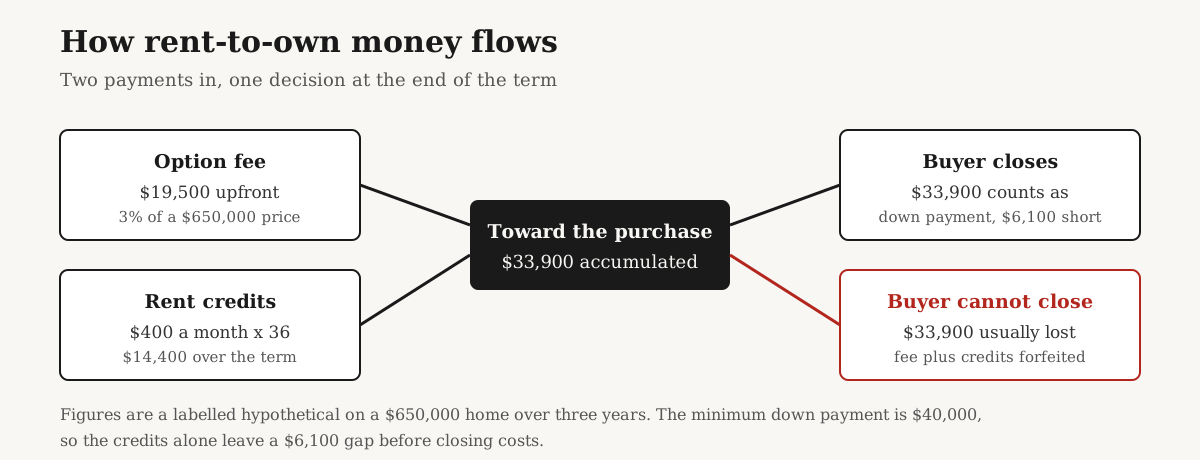
| Accumulated toward the purchase | $33,900 | Option fee plus rent credits |
Three facts fall out of that table. First, the buyer pays $14,400 more than market rent over the term, and that premium is exactly the rent credit. It is not free money: it is the buyer paying extra now to build a down payment. Second, the total at risk if the deal fails is $33,900, the fee plus the credits. Third, $33,900 is not enough to close.
The minimum down payment on a $650,000 home is $40,000: 5% of the first $500,000 plus 10% of the remaining $150,000. The buyer's accumulated $33,900 leaves a $6,100 gap before closing costs, land transfer tax, and legal fees, which are all extra. A rent-to-own buyer who treats the credits as the whole down payment arrives at the closing table short.
At closing, the mortgage math runs like this. The loan before insurance is $650,000 minus $33,900, or $616,100. That is a 94.8% loan-to-value ratio, so mortgage default insurance applies, at the standard 4.00% premium for a 95% loan-to-value mortgage: $24,644, added to the loan. The total mortgage is $640,744, and the monthly payment at 4.49% over 25 years is $3,542.78. The buyer also has to pass the federal stress test at the end of the term, qualifying at the higher of the contract rate plus 2% or the Bank of Canada benchmark rate, on whatever income and debts they have then.
None of that is a reason to reject the structure outright. It is a reason to run the numbers before signing, and to know that the deal only works if the buyer can save the extra $6,100 plus closing costs during the term, and can qualify for a $640,744 mortgage when it ends.
What the lender asks for when the term ends
The closing is where most rent-to-own deals die, and it dies on paperwork as often as on credit. A lender and a mortgage insurer do not take the agreement at face value. They want proof that the down payment is real, that the rent was real, and that the price was real. Mortgage professionals who work these files list the same requirements again and again, and a deal drafted without them can be unfinanceable even if the buyer is ready.
- Market rent, documented. The base rent has to be at least market rent, supported by a market rent letter from a designated member of the Appraisal Institute of Canada, obtained at the start of the term. If the rent in the agreement is below market, the insurer questions whether the credits are genuine savings or an inflated price in disguise.
- Separate payments, every month. The rent and the option consideration should move as two separate payments, from the same account, every month, so the paper trail shows what was rent and what was down payment. One combined payment blurs the two, and the insurer may refuse to count the credits.
- A refundable portion. Insured files typically need a clause making part of the deposit refundable if the buyer cannot qualify for financing at the end of the term. A contract that forfeits everything, with no refund path at all, is harder to insure.
- Price and date fixed from the beginning. The purchase price and the purchase date must be set in the original option, not renegotiated at the end. A price that floats, or a date that slides, reads as a new deal rather than the completion of the old one.
- The option registered on title. The option to purchase should be registered at the land registry from the start, so it shows against the property and the seller cannot deal with the home as if the option did not exist.
- Every monthly bank statement. The buyer should keep the bank statements for every month of the term, from the account the rent and option payments came out of. Lenders ask for them to confirm the total down payment actually paid.
None of these is exotic. All of them have to be in place from the start, not assembled at the end. A buyer who discovers at month 34 that the option was never registered, or that the rent was never split from the credits, has a problem no amount of good credit fixes in time.
The appraisal gap: the price you locked in is not the price the bank uses
The second closing-table risk is the appraisal. When the term ends and you apply for a mortgage, the lender lends against the appraised value, not your contract price. If your agreement says $650,000 but the appraisal comes in at $600,000, the bank finances against $600,000, and you cover the $50,000 difference yourself, or the mortgage does not close and the option lapses.
Run it on the same hypothetical. The appraised value is $600,000. The maximum insured loan is 95% of the appraised value, or $570,000, with a 4.00% premium of $22,800 added to the loan for a total mortgage of $592,800 and a monthly payment of $3,277.69 at 4.49% over 25 years. But the cash the buyer must bring is the purchase price minus the loan: $650,000 minus $570,000, or $80,000. The buyer has $33,900 in credits. The shortfall is $46,100, due at closing, on top of legal fees and land transfer tax.
The gap cuts both ways, which is why the locked price is a gamble rather than a gift. If the market rises above the locked price by the end of the term, you keep the upside and buy below market. If it falls below, the structure works against you, and you are locked into paying more than the home is worth. In a flat or falling market, the buyer pays the locked price and still has to fund the gap. In a rising market, the seller may regret the lock and look for a way out of the option, which is another reason to have it registered on title and reviewed by a lawyer before signing.
The 7 ways the deal falls apart
1. You cannot qualify when the term ends. This is the common failure, and it is not exotic: credit, income, debt ratios, or savings have not improved enough, or financial conditions have shifted under you. If you still cannot get a mortgage when the purchase date arrives, or you walk away, the option fee and the rent credits are usually forfeited, potentially tens of thousands of dollars. The deal only makes sense with a written plan for the term: what score you need, what income you need documented, and what you will do if you fall short six months before the deadline.
2. The appraisal comes in below the locked price. Covered above. A $50,000 appraisal gap on a $650,000 price needs $46,100 in extra cash. Few rent-to-own buyers have it, because the deal was chosen precisely by people short on cash.
3. The seller runs into trouble. During the term, the seller still owns the home. If the seller defaults on their own mortgage, or the property goes through power of sale, the tenant-buyer is left trying to recover money through the courts rather than moving ahead with the purchase. Registering the option on title gives you a claim that shows up in the process, but it does not make you the owner, and it does not guarantee your money back. Check the seller's mortgage standing before you sign, and have your lawyer confirm what happens to your option if the seller's lender moves first.
4. One late payment voids the option. Some contracts are written so that a single late rent payment, or a single missed option payment, ends the purchase option entirely, even if the tenancy continues. The buyer keeps paying rent as a tenant and loses the right to buy. Read the default clauses line by line: what counts as a default, whether there is a cure period, and whether a late payment kills the option or just attracts a fee.
5. The price was inflated at the start. A rent-to-own price set above the market at signing bakes the appraisal gap in from day one. Get an independent appraisal or a comparative market analysis before you agree the price, not at the end of the term when it is too late to renegotiate. If the seller will not accept a price tied to a real valuation, that is your answer.
6. The maintenance is yours, but the home is not. You live in the home but you are not yet the owner. The contract may push repairs, upkeep, even upgrades onto you, while the landlord keeps the owner's rights. A leaking roof or a failed furnace during the term can cost you thousands on a home you do not own, and if the deal later fails, that money is gone with the fee and the credits. The lease side still gives you the tenant's rights, including the landlord's duty to maintain, so do not sign those rights away in the option.
7. You signed a lease purchase, not a lease option. In a lease option, you have the right to buy at the end of the term but no obligation. If you decide not to buy, the deal ends and you lose the fee and the credits. In a lease purchase, you are contractually required to buy, and if you cannot or will not close, the seller can sue for damages, including the difference between the agreed price and the property's value if it has dropped. Lease purchase is rare in Ontario, because lenders do not generally require that level of commitment and most buyers will not lock themselves in for years, but you must know which one you signed. The two words change everything about your exit.
Ontario: the rules, and the gap in them
Ontario is where most Canadian rent-to-own deals are written, and it is also where the legal gap is clearest. There is no Ontario statute written for rent-to-own. The arrangement sits between two laws that were never designed for it, and the buyer has to live in the seam.
The rental side is governed by the Residential Tenancies Act, 2006. The tenant has the rights of any other tenant: security of tenure, rent increase protections, and access to the Landlord and Tenant Board. For most units the 2026 rent increase guideline is 2.1%, with at least 90 days' written notice and no more than one increase per 12 months. Units first occupied for residential purposes after November 15, 2018 are exempt from the guideline cap, though the notice and 12-month rules still apply. The landlord's maintenance duties apply too, and a clause in the option that tries to hand them to the tenant does not erase them.
The purchase side is governed by contract law, and the Statute of Frauds requires every contract for the sale of land to be in writing and signed. A verbal option is unenforceable. If the seller breaches the option, the buyer is not at the Landlord and Tenant Board. The buyer is in Superior Court, which is slower, more expensive, and the reason the option should be registered on title and reviewed by a real estate lawyer before signing, not after.
Two practical points follow. First, the lease and the option must be kept as separate documents. Combining them into a single document creates legal confusion about which rules apply, and that confusion usually lands on the buyer. Second, the option fee is not a rent deposit. Ontario landlords can only take a last month's rent deposit under the Act. The option fee is a separate payment under a separate contract, which is exactly why its forfeiture is governed by the contract rather than by tenancy law.
If you are working with a real estate agent, the Real Estate Council of Ontario requires the agent to provide the RECO Information Guide before offering services or assistance. A rent-to-own operator who is not a registrant, and who pressures you to sign without independent legal advice, is a red flag on its own. FCAC's advice is the same in every province: the rules vary, some operators are lightly regulated, and you should contact your provincial Consumer Affairs office and have a real estate lawyer review the contract before you sign.
The other provinces, in brief
The two-contract frame holds across Canada. What changes is which tenancy law governs the lease side, and which tribunal hears a rent dispute.
- British Columbia. The lease falls under the Residential Tenancy Act and the Residential Tenancy Branch. Rent increases are capped at the provincial guideline, and the purchase option is still a separate contract outside the Branch's reach. A seller who breaches the option is a court matter, not a Branch matter.
- Alberta. The lease falls under the Residential Tenancies Act and the Residential Tenancy Dispute Resolution Service. Fixed-term leases and periodic tenancies have different end rules, and the option does not change them. The buyer still needs the option in writing and registered.
- Quebec. The lease falls under the Civil Code of Quebec and the Tribunal administratif du logement. Rent-to-own is uncommon in Quebec, and the civil-law framing of the promise to purchase makes the paperwork different again, which is one more reason the contract needs a Quebec lawyer rather than an Ontario template.
In every province, the same three questions decide whether the deal is workable: is the option in writing, is it registered on title, and does the buyer have a realistic path to a mortgage before the expiry date.
The federal angle: Ottawa has noticed, but has not regulated the deal
Budget 2022 dedicated $200 million to rent-to-own through the Affordable Housing Innovation Fund, with $100 million of it going to non-profits, developers, co-ops, and rent-to-own companies to build rent-to-own properties. The program was built on three principles: the landlord charges below-market rent so the tenant can save for a down payment, the landlord commits to ownership for up to a five-year term, and safeguards are in place to protect the future homeowner. Funded projects had to show how a tenant becomes a homeowner within five years.
That is a housing-supply program, not a consumer protection law. It funds projects. It does not regulate the private contracts most buyers will actually sign, and it does not change the fact that a private rent-to-own deal is a lease plus an option, governed by the province's tenancy law and by contract law. The federal consumer warning still stands as the best summary of the private market: you only own the home if you meet all the conditions, the rules vary by province, some operators are unregulated, and the agreement may carry a penalty fee for breaking it.
Rent-to-own versus the alternatives
| Path | What it costs upfront | What you risk | When you own |
|---|---|---|---|
| Rent-to-own | Option fee, 2% to 5%, plus above-market rent | Fee plus credits if you cannot close | At the end of the term, if you qualify |
| Rent while you save | First and last month's rent | Nothing beyond rent paid | When you are ready to buy |
| Gifted down payment | Nothing, if family can help | Family friction, and the gift must be documented for the lender | At closing |
| FHSA and the Home Buyers' Plan | Your own savings, tax-sheltered | Your own money, in your own accounts | At closing |
| Private mortgage | Higher rate and fees, often for a year or two | The rate, and the exit test at renewal | At closing |
Our gifted down payment guide covers what lenders ask for when family helps, and the FHSA versus RRSP guide covers the tax-sheltered routes, which keep your money in your name while you save. A private mortgage is the other bridge for a buyer who cannot qualify at a bank today: it costs more, but you own the home from day one, and the exit test at renewal is the same kind of test rent-to-own puts at the end of its term. For most buyers who are close to qualifying, one of these paths beats paying a non-refundable fee to rent a home they do not own.
Advertisement
Before you sign: the checklist
- Get independent legal advice first. Have a real estate lawyer review both documents before you sign. Not after. Before.
- Get a mortgage pre-assessment. Ask a mortgage broker or lender whether you could qualify at the end of the term, and what would have to change. If the answer is no, or nobody can say, the deal is a gamble, not a plan.
- Verify the price. Get an independent appraisal or a comparative market analysis before you agree the locked price.
- Verify the seller. Confirm the seller owns the home, what mortgages sit on it, and whether the seller is current on them. Have your lawyer confirm the option can be registered on title.
- Read the forfeiture clauses. What exactly do you lose if you cannot close, if you are late once, or if you walk away? What, if anything, is refundable?
- Check the rent. Is the base rent at or above market rent, and is there a market rent letter? Is the credit portion written down, month by month?
- Check the maintenance split. Who pays for the roof, the furnace, and the appliances during the term? If the answer is you, price that in.
- Check the expiry and the exit. What is the exact purchase date, what happens the day after, and is there an extension clause? A deal with no extension and no refund is a cliff.
- Keep the paper trail from day one. Separate payments for rent and option consideration, from one account, with every monthly bank statement kept.
- Plan the term, not just the signing. Credit repair, income documentation, and the extra savings for the down payment gap and closing costs all have to happen during the term, on a schedule, with a check six months before the deadline.
Frequently asked questions
Is rent-to-own legal in Canada?
Yes. It is a private arrangement, usually a lease plus an option to purchase. No province has a law written specifically for rent-to-own, but the rental side is covered by the province's tenancy act and the purchase side by contract law. Rules vary by province, and some operators are lightly regulated.
How much is the option fee on a rent-to-own home?
Commonly 2% to 5% of the agreed purchase price, paid upfront, and usually non-refundable if you do not buy. On a $650,000 home, 3% is $19,500. Some operators ask for more. Confirm in writing how it is credited if you do buy.
Do rent credits count as a down payment?
They can, but only as far as the agreement and your lender allow. The lender and the insurer want the credits documented as separate payments on top of market rent, the price and date fixed from the start, and the option registered on title. Credits alone rarely reach the minimum down payment: on a $650,000 home the minimum is $40,000, and a typical three-year deal accumulates about $33,900.
What happens if I cannot get a mortgage at the end of the term?
In most Ontario contracts, you lose the option fee and the rent credits, and the option lapses. Insured files typically need a clause making part of the deposit refundable if the buyer cannot qualify, but the rest is usually forfeited. This is the single biggest risk in the deal, and the reason to get a mortgage pre-assessment before signing.
What happens if the home appraises below the locked price?
The lender lends on the appraised value, not the contract price. If your agreement says $650,000 and the appraisal is $600,000, the maximum insured loan is $570,000 and you need $80,000 in cash at closing. On the worked example in this guide, that leaves a $46,100 shortfall against the credits accumulated.
Does the landlord have to maintain the home during a rent-to-own term?
On the lease side, yes: the landlord keeps the maintenance duties the tenancy act imposes. Some option contracts try to push repairs onto the tenant-buyer. Do not sign those duties away without a lawyer checking what the lease still requires of the landlord.
Can the seller sell the home to someone else during the term?
Not cleanly, if the option is registered on title. Registration is what stops the seller from dealing with the home as if the option did not exist. An unregistered option leaves you arguing about a private contract while the home changes hands.
Is rent-to-own better than renting while I save?
Usually not, unless you have a specific reason to lock in this home at this price and a realistic plan to qualify within the term. Renting while you save keeps your money in your own accounts, your options open, and your exit free. Rent-to-own trades all three for a locked price and a home you do not own yet. Run the worked example in this guide on your own numbers before you decide.
This article is general information about Canadian rent-to-own arrangements, not legal, tax, or financial advice for any specific situation. Tenancy rules, lending rules, and insurer requirements change, and the right structure depends on the province, the property, and your finances. Have the documents reviewed by a real estate lawyer and a mortgage professional before you sign.
About the BubbleWatch editorial team
BubbleWatch is written and checked by its editorial team under the site brand. Figures come from public sources such as CREA, Statistics Canada, CMHC and the Bank of Canada, and each article links the sources it uses. BubbleWatch is independent of realtor boards and lenders.
Read our full editorial methodology →