Asbestos Testing When Buying a Home in Canada
A buyer's evidence workflow for locating suspect building materials, arranging safe professional sampling, connecting laboratory results to planned renovations, and pricing the full abatement and restoration scope.
Asbestos Testing When Buying a Home in Canada: From Suspect Material to Renovation Budget
Asbestos due diligence is not answered by a home's age or by one negative sample. A house can contain many visually similar materials installed at different times, and only properly planned sampling and laboratory analysis can reliably establish the asbestos content of a particular material.
The buyer's financial question is also narrower than “does this house have asbestos?” Material that is stable and left undisturbed presents a different project from material that a planned kitchen, bathroom, basement, mechanical, roofing, or electrical renovation will cut, sand, break, or remove.
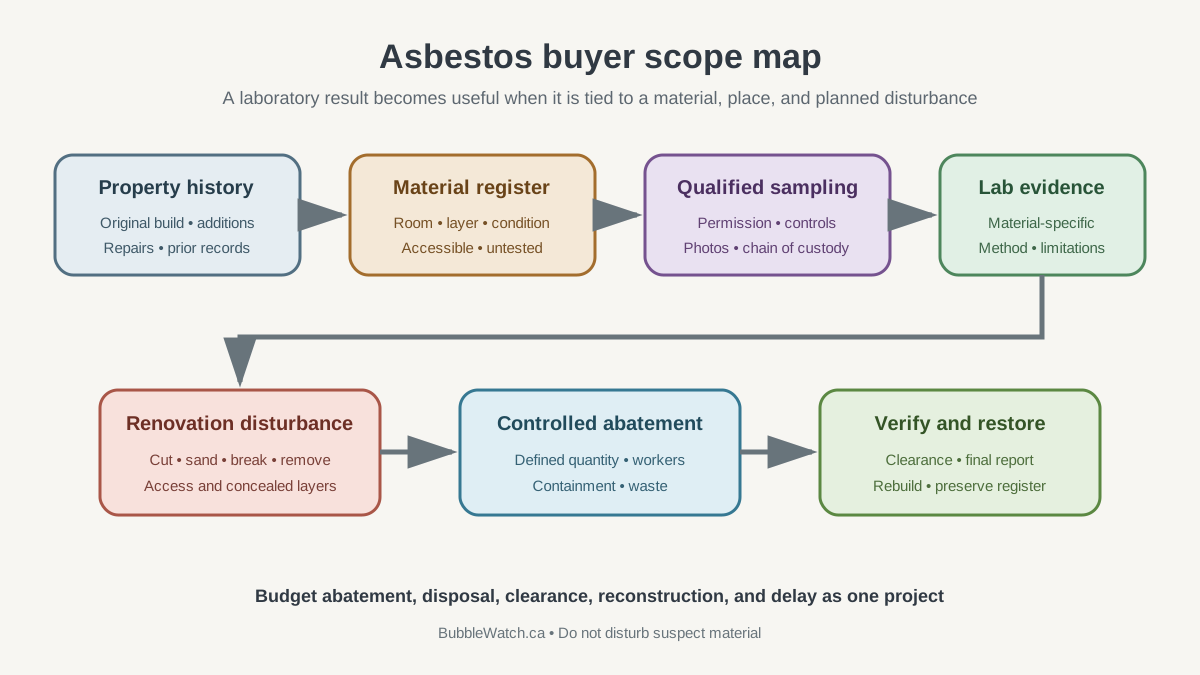
A useful purchase file connects four things: a room-by-room material register, a qualified person's sampling plan, the buyer's actual renovation scope, and an abatement-plus-restoration budget. That file supports an informed offer without encouraging anyone to disturb suspect material during a viewing.
Short answer: test the materials your project may disturb
Use this sequence:
- Build a history of the original building and later renovations.
- Have a qualified person identify homogeneous suspect materials in every area within the proposed work.
- Obtain seller permission and a safe sampling plan.
- Use a capable laboratory and retain the complete analytical report.
- Map positive, negative, assumed, and untested materials onto demolition and trade work.
- Price containment, removal or other control, disposal, clearance, and restoration.
- Put access, decision rights, work, records, and deadlines into locally reviewed contract terms.
Do not chip a ceiling, lift flooring, scrape compound, open a pipe wrap, or collect a sample yourself during a showing. The act of investigating can release fibres and create contamination.
What Health Canada says about household risk
Health Canada's asbestos guidance explains that airborne fibres can be released when asbestos-containing building materials are disturbed during renovation or demolition. It advises hiring a professional to test before remodelling and a qualified removal specialist when asbestos is found.
The same guidance distinguishes material that is undisturbed, isolated, sealed behind finishes, or tightly bound and in good condition. This matters because discovery does not automatically mean every material must be removed before occupancy.
Condition, location, accessibility, friability, air movement, planned work, and governing rules determine the response. A qualified asbestos consultant should make the site-specific assessment.
Do not rely on a universal construction-year cutoff
Older homes deserve careful review, but a single year cannot clear a building. Materials may have been stored, reused, repaired, imported, or installed during renovations at different dates. A newer addition does not prove the original wing is free of suspect material, and a recently renovated room may conceal earlier layers.
Build a chronology instead:
| Building element | Original year | Alteration dates | Records | Suspect layers or systems |
|---|---|---|---|---|
| Main structure | ||||
| Addition/garage | ||||
| Basement finish | ||||
| Kitchen/baths | ||||
| Roof/exterior | ||||
| Heating/plumbing |
Ask for permits, drawings, invoices, prior hazardous-material surveys, abatement reports, laboratory results, waste records, and clearance documentation. Verify renovation claims with the unpermitted-renovation workflow.
Create a suspect-material register
The register is an investigation map, not a diagnosis. A qualified person can adapt it to the building and province.
Common areas of inquiry can include:
- sprayed fireproofing or textured coatings;
- thermal insulation around pipes, boilers, ducts, tanks, and fittings;
- vermiculite insulation;
- drywall joint compound and some plaster systems;
- resilient floor tile, sheet flooring, backing, and adhesive;
- ceiling tile and acoustic products;
- cement board, panels, siding, shingles, and pipe;
- roofing felts, mastics, flashing compounds, and sealants;
- mechanical gaskets and heat-resistant components;
- older door, furnace, fireplace, or appliance insulation;
- other location-specific products identified by the consultant.
Record each visually uniform material separately by location, colour, texture, layer, condition, accessibility, and likely disturbance.
| ID | Room/area | Material/layer | Condition | Planned disturbance | Sample/result | Action |
|---|---|---|---|---|---|---|
Two white ceiling textures are not necessarily the same material. Flooring may have a surface layer, backing, adhesive, levelling compound, and underlying earlier floor. A negative result for one layer does not decide the others.
Start with the buyer's renovation drawings
A generic whole-home question can produce a generic answer. Mark the exact work:
- walls and ceilings to be opened;
- flooring and underlayment to be removed;
- plumbing, duct, wiring, or structural routes;
- cabinets, tile, and fixtures to be demolished;
- attic or crawl-space access;
- exterior penetrations and cladding work;
- roof, boiler, furnace, chimney, or pipe replacement;
- demolition needed for mould, water, fire, or pest repair.
Then ask the qualified person to survey the work zone plus any material that could be affected by access, vibration, dust control, or waste movement. This turns a laboratory result into a usable project scope.
A buyer who plans no immediate renovation still needs to understand damaged or accessible material and foreseeable maintenance. A leaking pipe wrapped in suspect insulation creates a different decision from intact flooring beneath a finished floor.
Use a qualified person and a capable laboratory
Provincial occupational-safety and environmental rules differ. In British Columbia, the Occupational Health and Safety Regulation requires a qualified-person hazardous-material inspection before covered renovation or demolition work begins. BC also requires licensing and certification for asbestos abatement contractors and workers.
Ontario's asbestos regulation for construction projects and buildings defines asbestos-containing material, examination, friable material, and competent-worker duties for covered work. Private-home exemptions and project duties are technical; ownership alone should not be treated as permission for unsafe work.
Ask the consultant to document:
- qualifications, insurance, and independence;
- survey objective and areas accessed;
- inaccessible and excluded areas;
- method for defining homogeneous material;
- sample count, location, photographs, and repair;
- protective and contamination controls;
- laboratory name, method, accreditation or capability;
- chain of custody and unique identifiers;
- detection and reporting approach;
- limitations and recommended next steps.
Do not hire solely from a low sample price. An incomplete survey can shift risk into the demolition contract, where delays and change orders become expensive.
Get written permission before sampling
The seller controls access before closing. Sampling is intrusive even when the physical mark is small. The parties should agree in writing on:
- consultant identity and insurance;
- areas and approximate number of samples;
- safe work method;
- date, access, occupants, pets, and supervision;
- sample-point repair and appearance;
- who pays;
- who receives reports;
- what happens after a positive result or accidental damage;
- confidentiality and disclosure questions for future marketing;
- deadline under the purchase condition.
Use the inspection-clause guide to coordinate specialist access and restoration duties. Do not assume a general right to inspect authorizes destructive sampling.
Read the report as a scope document
For every result, match the laboratory ID to the consultant's photo, plan, room, material, and layer. Classify it as:
- confirmed asbestos-containing;
- reported below the laboratory or regulatory threshold used;
- assumed asbestos-containing without sampling;
- suspect and untested;
- not suspect within the survey method;
- inaccessible or outside scope.
Do not convert “none detected in submitted sample” into “room has no asbestos.” The laboratory analyses what it receives. The surveyor establishes the extent to which submitted samples represent materials in the work area.
Classify the report as a limited sampling visit, pre-renovation survey, management survey, or clearance report. These documents answer different questions.
Positive does not always mean immediate whole-house removal
The response options may include leaving stable material in place with a management record, enclosure, encapsulation, repair, targeted abatement, or removal. The correct method depends on condition, friability, occupancy, access, future disturbance, and local rules.
A purchase decision should state which assumption it uses. If a buyer prices removal but later chooses management in place, preserve the material register for future owners and contractors. If the plan leaves material behind walls, label and document it so a plumber does not drill into an unknown hazard years later.
No buyer should use this article to select an abatement method. That choice belongs to qualified local professionals working under current rules.
Price the entire project boundary
An abatement quote can exclude much of the cost needed to return the home to use. Ask for a cost stack:
| Cost layer | Scope questions |
|---|---|
| Survey/testing | Remaining rooms, samples, laboratory, rush fees, destructive access |
| Preparation | Permits, notices, move-out, contents, isolation, utilities |
| Abatement | Method, quantity, access, containment, workers, equipment |
| Waste | Packaging, transport, disposal facility, manifests or receipts |
| Verification | Visual review, air clearance where required, final report |
| Restoration | Insulation, drywall, flooring, roofing, paint, millwork |
| Secondary work | Electrical, plumbing, HVAC, structural, firestopping |
| Delay | Temporary housing, storage, financing carry, schedule contingency |
Quantities deserve measurement. “Basement asbestos” does not tell the contractor how many square metres, pipe elbows, layers, rooms, or access points are involved.
Some contractors quote abatement only after a consultant defines the scope. Others may include sampling but create a conflict if the same party benefits from a larger removal scope. Ask who writes specifications, bids the work, monitors containment, and performs clearance.
Connect asbestos to the renovation budget
Suppose a buyer plans to remove 60 square metres of basement ceiling. The visible ceiling board tests negative, but joint compound is positive and pipe insulation above it is untested. The demolition price cannot be based on the board result alone.
The budget should include the positive compound, investigation above the ceiling, safe access, any positive mechanical insulation, waste, clearance, and clean reconstruction. It should also allow for the possibility that concealed layers change quantities once controlled access begins.
Add the full amount to the home-maintenance and capital budget rather than treating abatement as a cosmetic renovation line.
Insurance, lending, and contractor availability
Ask the property insurer in writing about known asbestos, damaged material, renovation vacancy, contractor requirements, exclusions, and claims involving release. Do not assume a standard binder covers a major unoccupied abatement project.
A lender may care about habitability, property condition, work required after closing, construction advances, or appraisal assumptions. Tell the lender what the report and intended work actually say.
Check qualified consultant, licensed-contractor, laboratory, disposal, and clearance availability before agreeing to a short deadline. Remote locations and busy construction seasons can extend schedules.
Condos, strata properties, and attached housing
The unit boundary may divide responsibility for ceilings, drywall, mechanical insulation, exterior panels, shafts, corridors, or shared systems. The corporation may hold a hazardous-material inventory, but it may cover only common areas.
Request:
- unit-specific renovation and abatement reports;
- common-property asbestos inventory;
- alteration agreements and approval rules;
- contractor insurance and qualification requirements;
- work-hour, elevator, containment, and waste-route rules;
- responsibility for testing penetrated common elements;
- notices, claims, reserve projects, and planned demolition.
Review the records through the relevant condo or strata process. For Ontario buyers, the status-certificate workflow helps organize corporation documents, but unit-specific sampling can still be necessary.
Seller disclosure and document integrity
Use the property-disclosure verification method to distinguish seller knowledge from professional testing. “Unknown” may be accurate when no survey exists. “Removed” needs a defined area, contractor, method, date, waste record, clearance, and remaining-material statement.
Ask for original PDFs rather than retyped summaries. Preserve pages, appendices, floor plans, photographs, laboratory certificates, revisions, and signatures. Verify that addresses and sample IDs match the home.
If a prior report covers only a furnace room, do not describe the whole property as tested. If a positive survey exists, local legal advice may be needed on disclosure and contract representations.
Contract structures for professional review
Local counsel should adapt any clause to provincial law and the transaction. Points that may need drafting include:
- buyer approval of a named survey and all appendices;
- access for a named qualified consultant and laboratory sampling;
- seller consent to controlled openings and agreed restoration;
- deadline for reports and buyer notice;
- who pays testing, abatement, clearance, and reconstruction;
- right to terminate, waive, amend price, or require defined work;
- required contractor licence, worker certification, permits, and insurance;
- exact materials and rooms included;
- waste documentation and independent clearance;
- treatment of concealed additional material;
- completion timing, access, holdback, and dispute procedure.
“Seller to remove all asbestos” is hard to administer because no finite survey can promise every concealed material everywhere. A defined scope and evidence package is more measurable.
If completion extends past closing, the closing-holdback guide shows the controls lawyers may need. Never assume the deposit can be informally retained for repair work.
Final walkthrough limits
At the walkthrough, confirm that agreed work areas, enclosures, labels, access panels, and finishes remain as promised. Collect the final survey, change orders, abatement report, waste receipts, clearance evidence, permits, and warranties required by the contract.
Do not open containment, peel labels, enter a restricted work zone, or disturb suspect material. If work is unfinished or the site is unsafe, contact the lawyer and qualified professional before proceeding under the contract.
A clean-looking room does not prove controlled removal or clearance. Documents and professional verification matter.
Worked example: renovation-triggered exposure
A 1970s house has intact sheet flooring under newer laminate. The seller never tested it and reports no known asbestos. The buyer plans to remove both layers immediately for a kitchen expansion.
With written permission, a qualified consultant identifies the sheet flooring, backing, adhesive, adjacent drywall compound, and duct wrap within the work zone. Samples show asbestos in the backing and duct wrap but not the adhesive or compound.
The buyer obtains a defined abatement quote, adds cabinet removal, contents protection, waste, clearance, duct replacement, subfloor preparation, and temporary accommodation, and adjusts the renovation schedule. The seller's “unknown” answer did not clear the materials; it directed the buyer to the right investigation.
Buyer checklist
Property and materials
- Original and renovation chronology built
- Prior surveys, laboratory reports, and abatement records obtained
- Room-by-room suspect-material register created
- Planned renovation and maintenance disturbance marked
- Inaccessible and untested areas recorded
Professional evidence
- Qualified consultant credentials and insurance checked
- Written sampling permission obtained
- Homogeneous materials and sample locations mapped
- Full laboratory report and chain of custody retained
- Results matched to rooms, layers, and photos
Cost and transaction
- Abatement scope measured
- Waste, clearance, and restoration included
- Insurer and lender informed where relevant
- Contractor and laboratory timing checked
- Contract terms reviewed by local lawyer
- Concealed-material contingency budgeted
Normalize competing abatement bids
Two prices are comparable only when their boundaries match. Give bidders the same consultant survey, drawings, quantity schedule, access assumptions, and required deliverables. Ask each contractor to mark exclusions and unit rates for additional material.
Compare:
- exact rooms, material IDs, layers, and measured quantities;
- risk classification and work method used under local rules;
- isolation, negative pressure, decontamination, and air management;
- contents movement, protection, and cleaning;
- electrical, water, heat, and fire-alarm arrangements;
- openings made for access and who repairs them;
- waste packaging, transport, facility, and records;
- consultant monitoring and final visual review;
- air testing or other clearance required by the specification;
- work hours, duration, mobilization, and remobilization;
- change-order rates for concealed materials;
- taxes, permits, notices, insurance, and bonding where required.
If one bid includes demolition and another starts after demolition, the lower total may reflect missing scope. If one contractor proposes leaving material in place, confirm that the consultant and renovation team agree it will not be disturbed.
Ask how failed clearance or damaged containment is handled and who pays for recleaning and retesting. Identify the independent party authorized to accept the work. A contractor's completion invoice and an independent clearance document serve different purposes.
Preserve a remaining-material register after work
Removal often addresses only the current project area. The final file should show both what was removed and what remains assumed or confirmed elsewhere.
Update floor plans and photographs with material IDs, inaccessible spaces, encapsulated areas, labels, and access restrictions. Attach maintenance instructions and the next point at which professional reassessment is needed. Give this file to future contractors before they quote drilling, cabling, plumbing, roofing, flooring, or demolition.
For a rental or multi-unit property, establish who controls the register and how workers receive it. Occupational duties can apply even where a private owner exemption affected earlier work. A buyer planning to hire anyone should obtain province-specific advice before possession work begins.
This continuing record prevents a successful kitchen abatement from being misdescribed as whole-building removal. It also reduces the chance that a later minor repair turns retained, stable material into an uncontrolled disturbance that exposes workers, occupants, and adjoining rooms.
Frequently asked questions
Can a home inspector identify asbestos by sight?
An inspector can identify suspect material and recommend further review, but visual appearance does not establish asbestos content. A qualified sampling plan and laboratory analysis are needed for a defensible material result.
Does intact asbestos-containing material have to be removed before closing?
Not automatically. Health Canada distinguishes stable, undisturbed material from fibres released through disturbance. A qualified professional should assess condition, occupancy, planned work, and local legal requirements.
Is one negative sample enough for a room?
Only if a qualified person determines it represents the relevant homogeneous material under the applicable method. Different layers, repairs, textures, and installation periods may require separate treatment.
Can I take a sample myself to save time?
Do not disturb suspect material during purchase due diligence. Health Canada recommends professional testing, and provincial work, transport, and waste rules can apply. Obtain seller permission and use qualified help.
Is vermiculite automatically asbestos-containing?
No visual assumption establishes the laboratory result. Health Canada advises avoiding disturbance of vermiculite-based insulation and obtaining professional advice. Treat it as suspect until properly assessed.
What records should remain with the property?
Keep surveys, plans, photos, sample tables, laboratory reports, specifications, contractor credentials, permits, daily or final reports, waste records, clearance evidence, invoices, and a register of material left in place.
What to do next
Mark every area you plan to renovate during the first ownership years. Request the seller's complete hazardous-material file, then retain a qualified local professional to turn those plans into a material and sampling scope. Price abatement together with waste, verification, reconstruction, delay, and concealed-work contingency.
Use lawyer-reviewed transaction terms if access, testing, work, price, or a post-closing holdback matters to the purchase. The strongest decision is based on a traceable material map and project boundary, not a construction-year guess.
This article provides general Canadian home-purchase information, not medical, occupational-hygiene, environmental, legal, insurance, or construction advice. Requirements vary by province, municipality, property, work type, and contractor status. Do not disturb suspect material; use current official guidance and qualified local professionals.
Advertisement

About David R. Chen, CFA
David R. Chen is a Chartered Financial Analyst and the Senior Housing Economist at BubbleWatch.ca. He brings 12+ years of experience in quantitative real estate analysis and mortgage underwriting. Formerly an analyst at a major Canadian bank, he specializes in modeling payment shock, regional affordability divergence, and private lending risk.
View David's professional bio & credentials →