Property Disclosure Statements in Canada
A question-by-question evidence method for using a seller disclosure as a lead map rather than a warranty, while preserving accurate seller knowledge and directing buyers to the right records and specialists.
Property Disclosure Statements in Canada: Verify Every Answer Before You Buy or Sell
A property disclosure statement is a seller-completed form or written record about known property facts. Its name, availability, legal effect, incorporation into the purchase contract, questions, and professional obligations differ across provinces and transactions.
It is useful as an inquiry map, not a substitute for inspection, title search, permit review, insurance, or legal advice. “No” can mean the seller believes an issue does not exist, while “unknown” can mean the seller lacks evidence. Neither tells a buyer what a specialist will find.
Sellers should answer from actual knowledge and records without guessing. Buyers should convert every material answer, blank, qualification, inconsistency, and omitted period into a document or professional follow-up before conditions expire.
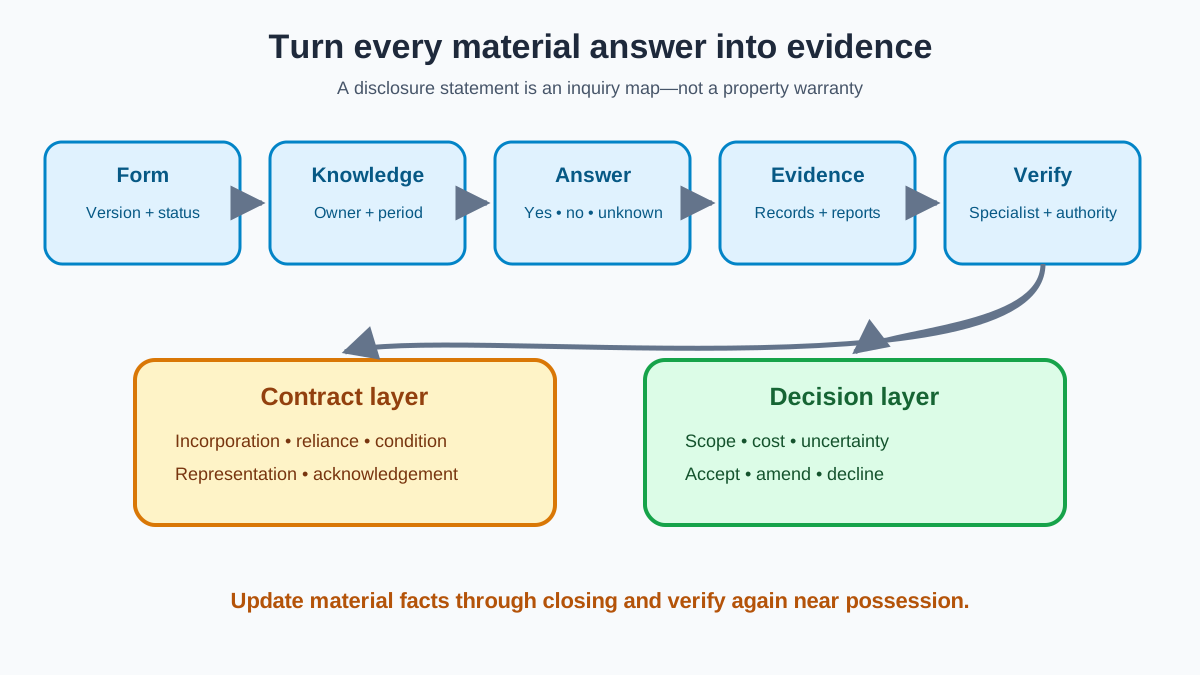
Short answer: create an answer-to-evidence ledger
For every material disclosure question, record:
| Question/topic | Seller answer | Knowledge period | Supporting record | Buyer verification | Conflict/change |
|---|---|---|---|---|---|
| Water/moisture | |||||
| Structure/foundation | |||||
| Roof/exterior | |||||
| Electrical/mechanical | |||||
| Plumbing/sewer/septic | |||||
| Permits/renovations | |||||
| Environmental/pests | |||||
| Title/access/encroachment | |||||
| Tenancy/occupancy | |||||
| Notices/claims/disputes |
The buyer does not need proof for a trivial answer, but high-consequence topics should not close on a checkbox alone.
Disclosure forms and duties are not uniform across Canada
Ontario's regulator calls the document a property information statement or Seller Property Information Statement and explains its possible uses. RECO says sellers should be clear whether a statement is for their agent's internal use or intended for interested buyers.
British Columbia's regulator says in its material latent defects guidance that a Property Disclosure Statement is a common voluntary form. It also warns that choosing not to make representations does not erase risk from knowingly failing to disclose a latent defect.
Other provinces, territories, boards, brokerages, property types, estates, foreclosures, powers of sale, and new-home sales can use other forms or no form. Obtain the correct current document and local legal advice.
Identify the exact form and its status
Before reading answers, record:
- document title and version/date;
- property address and legal description;
- seller legal names and signatures;
- date completed and updated;
- pages and schedules present;
- seller's ownership and occupancy period;
- whether seller personally occupied the property;
- knowledge qualifiers and definitions;
- “yes,” “no,” “unknown,” and “not applicable” meaning;
- buyer acknowledgement fields;
- whether it is incorporated into the purchase agreement;
- amendments, separate disclosures, and attachments;
- who received it and when.
A disclosure completed before a later leak or renovation is not current. A page missing from a scan can contain definitions or signature terms that change how answers are read.
BCFSA's current contract clause library shows that incorporation and buyer-approval treatment can be explicit contract issues in BC. Buyers elsewhere must use local drafting.
Map the seller's knowledge window
The seller may have owned for 20 years, inherited six months ago, rented the home, never entered one unit, or acted as estate trustee or corporation director. Knowledge differs.
Create a timeline:
| Period | Owner/occupant | Property manager/tenant | Material work/events | Records available |
|---|---|---|---|---|
Ask who lived in each unit, managed repairs, received authority notices, filed insurance claims, and held invoices. An executor answering “unknown” may be accurate, but it signals a need for more buyer investigation.
Do not pressure a seller to convert unknown into no. Do not let a buyer interpret a no outside the seller's knowledge period as a professional opinion.
Seller workflow: answer from a source file
Before completing the form, gather:
- purchase and prior disclosure documents;
- surveys, title reports, and agreements;
- building permits, drawings, inspections, and occupancy records;
- contractor invoices and warranties;
- insurance claims and adjuster reports;
- water, sewer, septic, well, fuel, and utility records;
- environmental, mould, pest, and remediation reports;
- engineering and inspection reports;
- tenancy and property-management files;
- condo/strata notices and alteration approvals;
- municipal, health, fire, conservation, or other authority notices;
- neighbour disputes and legal correspondence.
Answer the question asked and attach a concise explanation where needed. Distinguish observation, professional conclusion, completed repair, and unresolved cause.
Example:
Water staining observed on basement north wall in April 2024 after snowmelt. Contractor installed exterior downspout extension and sealed a visible crack. Invoice attached. No engineering report or destructive investigation completed; seller observed no further staining through July 2026.
That is more useful than “leak fixed” because it preserves what was observed, done, not done, and monitored.
Buyer workflow: verify rather than cross-examine
For each material answer, ask:
- What exactly happened?
- When, how often, and under what weather or use?
- Who observed it?
- What diagnosis was made, by whom, and within what scope?
- What repair occurred and was it permitted?
- What evidence shows completion and performance?
- What remains unknown or excluded?
- Which inspector, engineer, trade, lawyer, authority, lender, or insurer should review it?
Send focused written questions through the agreed channel. Avoid arguing that a seller's answer proves liability; the goal during due diligence is a purchasing decision.
Use the inspection-clause workflow to preserve time and specialist access.
Water and moisture answers need event details
“Any water?” can cover roof, window, plumbing, sewer, groundwater, storm, ice dam, condensation, appliance, pool, or neighbouring drainage.
Request:
- exact location and date;
- weather, snow, freeze, occupancy, and plumbing conditions;
- photographs before repair;
- source diagnosis;
- drying and material removal;
- mould or air testing where appropriate;
- contractor and insurer records;
- recurrence monitoring;
- grading, drainage, roof, foundation, sewer, sump, and backwater evidence;
- warranty and transferable claim.
Fresh paint is not proof of concealment, but it is a reason to ask what was repaired and inspect the underlying system. Moisture meters and thermal cameras have limitations; qualified inspectors interpret them in context.
When water appears at a foundation crack, use the foundation movement-and-water workflow to keep structural diagnosis separate from drainage repair. For backup or recurring root history, request the original media and apply the sewer-lateral camera evidence chain rather than accepting “line cleaned” as proof of downstream condition.
For any finished-basement loss, build the full basement-flood event and water-path file. It separates overland entry, foundation seepage, groundwater, private pipe restriction, municipal surcharge, and indoor plumbing so one pump or valve is not presented as proof that every source was corrected.
Renovations and permits require authority evidence
A disclosure may ask about additions, structural changes, suites, plumbing, electrical, gas, pools, decks, finished basements, or permits. Build a renovation register:
| Project | Year | Contractor | Permit/approval | Inspection/final | Drawings/invoice |
|---|---|---|---|---|---|
Do not infer that “professionally renovated” means permitted, code-compliant, licensed, or inspected. Obtain the authority file and use the unpermitted-renovation guide for gaps.
A permit issued is not necessarily closed. A final inspection does not certify work outside the permit scope.
Structure, roof, and exterior
For settlement, cracks, movement, foundation repair, retaining walls, roof leaks, cladding, decks, balconies, windows, and drainage, ask for condition over time and the professional scope.
The deck, porch, and balcony inspection guide traces structural load, wall attachment, water drainage, guards, stairs, added loads, permits, and shared responsibility. Match surface replacement claims to the retained frame and foundations.
Distinguish:
- cosmetic patch from structural repair;
- roofer repair from full replacement;
- age estimate from invoice;
- visual inspection from engineering assessment;
- warranty from transferable warranty;
- permit from final closeout;
- dry weather observation from storm performance.
If a report recommends monitoring, obtain the baseline measurements and updates. “No movement noticed” is not the same as measured stability.
Use the roof inspection evidence map to match replacement claims to each actual roof section, then use the attic insulation and ventilation guide to check concealed moisture, exhaust, air leakage, insulation, and access limitations. Roof age and insulation depth cannot answer those condition questions alone.
Electrical, mechanical, and fuel systems
Ask about:
- service size and panel changes;
- aluminum or knob-and-tube wiring;
- recalled or discontinued equipment;
- DIY circuits and extensions;
- heating/cooling fuel, age, service, rental, and failures;
- oil or propane tanks and leaks;
- fireplaces and solid-fuel systems;
- solar, battery, generator, and EV charger;
- permits and safety inspections;
- insurance limitations;
- utility shutoffs or notices.
Use licensed trades for safety and code questions. A disclosure answer does not bind an insurer or guarantee replacement parts.
Use the heating and cooling system evidence map to identify every zone, equipment item, fuel, backup, distribution path, rental, and service limitation. “Furnace serviced” does not describe cooling, ducts, venting, combustion measurements, or room comfort.
Sewer, septic, well, and plumbing
For municipal sewer, ask about backups, root intrusion, pipe material, repairs, backwater valve, shared line, and claims. For private services, obtain system-specific evidence.
The septic inspection guide covers permits, tanks, field, use, pumping, setbacks, and replacement. The well-water guide separates laboratory quality, well yield, equipment, and legal access.
Identify polybutylene, lead service, galvanized, Kitec, cross-connections, private pumps, sewage ejectors, and water-treatment systems through qualified review. Do not diagnose solely from a seller's material name.
The plumbing and water-heater buyer guide maps service, distribution, fixtures, drains, heater ownership, rentals, leak history, access, and restoration. “Plumbing updated” should be matched to exact pipe routes and invoice scope.
Environmental, pest, and health topics
Potential form questions include asbestos, mould, radon, lead, underground tanks, contamination, grow operations, termites, rodents, insects, urea-formaldehyde foam insulation, pyrite, or other regional issues.
For termites, carpenter ants, rodents, wildlife, or repeated household pests, use the pest and termite buyer workflow to separate identification, activity, source conditions, building damage, lawful treatment, cleanup, and monitoring. A treatment receipt does not answer all seven.
For a yes or concern, obtain:
- location and material;
- sampling method and accredited laboratory where applicable;
- consultant scope;
- removal, containment, or monitoring plan;
- waste manifests and clearance evidence;
- authority and insurance correspondence;
- recurrence or remaining material;
- future renovation implications.
A negative test covers its sample, method, date, and area. It does not prove the whole property is free of every hazard.
For radon, verify duration and placement rather than accepting a short displayed average; the radon transaction guide explains the current 91-day minimum. For planned demolition, use the asbestos material-and-renovation map. A former oil system requires the separate fuel-tank closure evidence workflow because a removal invoice may not address soil, groundwater, or authority status.
Visible growth, old paint, and copper visible at a meter also require careful wording. The mould evidence guide ties cleanup to the water source and recurrence history. The lead buyer workflow distinguishes painted components from public and private service-line segments instead of treating construction age as a result.
Insurance and warranty history
Ask whether the property has had a claim, denied claim, cancelled policy, non-renewal, special inspection, required repair, higher deductible, or coverage exclusion. The seller should obtain advice before sharing personal policy information, while material property facts still need appropriate disclosure.
Useful evidence can include:
- date and type of loss;
- cause and affected area;
- emergency mitigation;
- adjuster, engineer, or restoration report;
- amount and scope accepted by insurer;
- contractor completion and permit;
- depreciation or unpaid portion;
- subrogation or open recovery;
- warranty claim;
- policy condition imposed afterward;
- recurrence and monitoring.
A closed insurance claim means the insurer completed its claim process, not that every buyer concern was repaired to a particular standard. Compare the paid scope, actual invoices, and current condition.
The buyer should give relevant facts to its own insurer and obtain an insurability decision before waiving conditions. The seller's premium or policy is not transferable evidence of the buyer's coverage.
Condominium and strata disclosure
A unit disclosure statement cannot replace corporation or strata records. Compare seller answers with:
- status certificate, Form B, estoppel, or local equivalent;
- bylaws, rules, declaration, and plan;
- alteration agreements and approvals;
- unit chargebacks and arrears;
- insurance claims and deductibles;
- water, envelope, balcony, window, plumbing, or electrical incidents;
- pest treatment;
- noise and enforcement correspondence;
- parking and locker rights;
- short-term-rental or tenancy restrictions;
- special assessment and litigation notices.
Distinguish a unit event from a common-property cause. A seller may know water entered the unit but not have the engineer's building-envelope diagnosis.
Ask whether the seller served on the board or received confidential material. The lawyer can advise what may be disclosed and what additional corporation records should be requested.
Estates, powers of attorney, and corporate sellers
The signing seller may have limited personal knowledge. Identify legal capacity and information sources:
- executor or estate trustee;
- attorney under power of attorney;
- receiver, mortgagee, or public authority;
- relocation company;
- corporation and responsible director/officer;
- trustee or beneficial owner;
- non-resident owner with property manager.
Ask for records held by the estate, former occupant, property manager, insurer, contractor, condo/strata corporation, and authority where lawful. Do not expect the signer to certify facts beyond knowledge and authority.
Limited representations should change the buyer's inspection, search, reserve, and pricing, not produce invented certainty.
Title, access, boundaries, and shared rights
Disclosure answers about fences, driveways, easements, encroachments, shared services, waterfront, parking, and disputes must be checked against current title and survey evidence.
Ask for:
- title and registered instruments;
- survey or real property report;
- maintenance agreements;
- neighbour correspondence;
- shared driveway, well, septic, dock, wall, or drainage records;
- access and cost history;
- authority licences or encroachment agreements.
Use the property-survey buyer audit rather than relying on seller recollection of a boundary.
Tenancy, occupancy, and use
Verify every unit, room, parking space, locker, storage area, short-term booking, seller stay, commercial use, and informal occupant. Obtain leases, licences, notices, agreements, deposits, and lawful vacancy evidence through advisers.
The vacant-possession guide distinguishes title transfer from physical vacancy. A disclosure that a tenant “plans to leave” is not a possession order or completed move.
Tell the lender and insurer the actual occupancy and rental use.
Authority notices, claims, and disputes
Ask whether any municipality, fire department, health unit, conservation body, utility, condo/strata corporation, insurer, warranty provider, neighbour, court, or tribunal has issued a notice or demand.
Obtain the whole file:
- notice and legal basis;
- recipient and service date;
- response deadline;
- inspection/report;
- work order or charge;
- appeal or hearing;
- compliance evidence;
- remaining condition;
- cost and security registration;
- seller representation at closing.
Do not accept “resolved” without a written closure or lawyer's explanation of what remains.
No disclosure statement is a risk signal, not a verdict
A seller may lawfully decline a voluntary form in some transactions, lack knowledge, act through an estate, or receive legal advice not to make broad representations. Absence does not prove a defect.
The buyer should respond by expanding evidence:
- longer inspection and specialist conditions;
- permit and authority searches;
- title and survey review;
- insurance claim and insurability questions where available;
- utility and service records;
- seller-specific written inquiries;
- representations drafted by the lawyer;
- larger repair and uncertainty reserve;
- lower price or declining the property.
Do not pressure an executor to guess. Price the information gap.
Disclosure does not transfer unlimited risk automatically
A seller stating a defect exists does not tell the buyer its scope, cost, safety, lender effect, or legal consequences. Buyer acknowledgement may prove receipt without accepting every risk; contract language can change the result.
Have the buyer's lawyer review:
- separate disclosure versus contract representation;
- incorporation of the form;
- reliance and verification clauses;
- survival after closing;
- “as is” terms;
- known-defect insurance exclusions;
- repair covenant or price allocation;
- release, waiver, or indemnity;
- future claim effect.
BCFSA's consumer guide says material latent defect disclosure by a licensee must be in writing and separate before the party agrees to the transaction in its BC context. Local requirements elsewhere differ.
Update duty through closing
Property facts can change after the form is signed. Contract and law determine obligations, but sellers should promptly tell advisers about material new leaks, failures, damage, notices, insurance claims, occupancy changes, or repairs.
Keep an update log:
| Date | New fact | Immediate protection | Professional notified | Buyer/lender/insurer response |
|---|---|---|---|---|
At the final walkthrough, compare current condition with disclosure, inspection, repair promises, and prior photographs. Report differences to the lawyer rather than renegotiating at the door.
A buyer's triage matrix
| Answer pattern | Meaning to test | Next step |
|---|---|---|
| Yes + full records | Known event | Specialist validates scope and repair |
| Yes + no records | Known event, weak evidence | Broader inspection and cost case |
| No + visible clue | Inconsistency | Written question and specialist |
| Unknown | Knowledge gap | Independent records/testing |
| Blank | Incomplete | Clarify before approval |
| Old form | Stale | Updated confirmation and site check |
| Seller never occupied | Limited knowledge | Manager/tenant/authority evidence |
| No statement | No form evidence | Expand conditions and reserve |
Worked example: recurring attic staining
The seller answers no to current roof leakage but adds that a bathroom fan was vented into the attic until 2023. The invoice shows a contractor extended the duct outdoors and added insulation. An old photograph shows dark roof sheathing; no mould assessment or roof review exists.
The buyer should not treat the no answer as proof the attic is dry or accuse the seller of a false statement. The form question may concern current leakage, while the note reveals a past condensation event.
The evidence plan should include attic access, moisture and sheathing review, ventilation and duct termination, roof condition, insulation, bathroom fan performance, past weather, repair scope, and insurer questions. If access is limited, document the limitation and price further investigation.
The final purchasing decision should state:
- observed condition;
- likely and alternative causes;
- urgent work;
- base and adverse cost;
- health/safety uncertainty;
- contract representation or repair;
- lender and insurer response;
- post-closing monitoring.
That process extracts useful information from the disclosure without making the form do work it cannot do.
Seller completion checklist
- Correct current form and full pages
- Legal names, property, date, and signatures accurate
- Knowledge period and occupancy understood
- Records gathered before answering
- Unknown used instead of guessing
- Repairs described by event, scope, and evidence
- Permits and final inspections distinguished
- Claims, notices, disputes, and tenancies reviewed with lawyer
- Required separate disclosure handled
- Changes through closing reported promptly
Buyer review checklist
- Form version, status, incorporation, and date reviewed
- Material answers converted into evidence requests
- Blanks, unknowns, and inconsistencies triaged
- Inspector and specialists receive the form
- Permit, title, survey, tenancy, and authority records searched
- Lender and insurer receive material facts
- Repair cost and uncertainty reserve built
- Contract rights and acknowledgements reviewed by lawyer
- Final walkthrough compares updated facts
What to do next
- Obtain the complete signed form and attachments early.
- Build the answer-to-evidence ledger.
- Send focused questions through the transaction channel.
- Give disclosures to inspectors, specialists, lawyer, lender, and insurer as relevant.
- Verify permits, title, services, tenancy, and authority notices independently.
- Price known repairs and unresolved uncertainty separately.
- Review incorporation, reliance, representations, and acknowledgements with the lawyer.
- Update the file and compare condition again near closing.
Frequently asked questions
Is a property disclosure statement mandatory in Canada?
There is no single national rule or form. Requirements, customary forms, seller and licensee duties, and contract effects vary by province and transaction.
Can a buyer rely on the seller's disclosure statement?
It is useful evidence, but buyers should verify material facts through inspection, records, title, permits, authorities, lender, insurer, and legal advice. Contract language can affect reliance.
What does “unknown” mean on a disclosure?
It generally signals the seller lacks sufficient knowledge to answer yes or no under the form. The buyer should investigate rather than treating it as a negative answer.
Should a seller answer no if a repair was completed?
The correct answer depends on the exact question and form. Disclose the event and repair accurately where required, attach evidence, and obtain advice rather than hiding history behind a repair.
Does a home inspection verify every disclosure answer?
No. A general inspection is visual and scope-limited. Title, permits, concealed systems, environmental issues, tenancy, and specialist questions require other evidence.
What if the seller refuses to provide a disclosure statement?
Absence does not prove a defect, but it increases the information gap. Use stronger conditions, searches, inspections, written questions, reserves, pricing, and legal review.
Does disclosure of a defect mean the buyer accepts it?
Receipt and acceptance are different legal questions. The purchase agreement, acknowledgements, conditions, representations, waivers, and local law determine consequences.
Must the seller update the statement before closing?
Contract and local law govern, but material new facts should be taken to the seller's lawyer and real-estate professional promptly. Buyers should also use updates and final verification.
This article is educational and does not provide legal, inspection, engineering, environmental, mortgage, insurance, tenancy, or real-estate advice. Disclosure duties and forms vary across Canada. Sellers and buyers should obtain qualified local advice for the actual property and contract.
Advertisement

About David R. Chen, CFA
David R. Chen is a Chartered Financial Analyst and the Senior Housing Economist at BubbleWatch.ca. He brings 12+ years of experience in quantitative real estate analysis and mortgage underwriting. Formerly an analyst at a major Canadian bank, he specializes in modeling payment shock, regional affordability divergence, and private lending risk.
View David's professional bio & credentials →