Bank of Canada Hikes to 2.5%: What the October 28, 2026 Decision Does to Your Mortgage
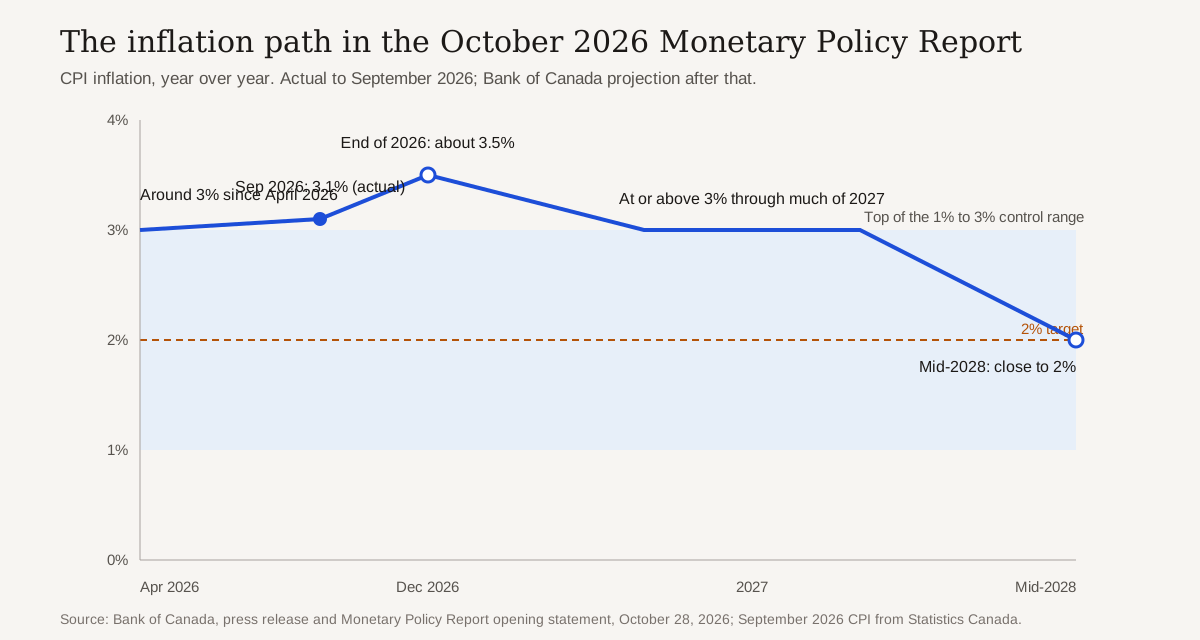
The Bank of Canada raised its target for the overnight rate by 25 basis points to 2.50% on Wednesday, October 28, 2026, with the Bank Rate at 2.75% and the deposit rate at 2.45%. It is the first increase since July 2023 and the first move of any kind since the cut of October 29, 2025 ended the easing cycle at 2.25%. The October Monetary Policy Report, published with the decision, lifted the inflation outlook by a full point for 2027: CPI is expected to rise to about 3.5% by the end of 2026, average 3% in 2027, and return close to 2% only by the middle of 2028. Governor Tiff Macklem said there could be a need to increase the rate further, while agreeing to proceed carefully and take future decisions one meeting at a time. This article prices the hike for variable borrowers, HELOC holders, renewers and buyers using Canadian semi-annual compounding, and sets out the December 9 decision path the Bank itself described.
On this page(12 sections)ShowHide
- Bank of Canada Hikes to 2.5%: What the October 28, 2026 Decision Does to Your Mortgage
- What to do now, step by step
- The decision, in one table
- Why the Bank hiked: the argument it made, in its own framing
- The forecast that came with it
- The payment math, now that the hike is real
- Fixed rates: the channel that was already moving
- Renewers: your pricing window just changed
- Buyers: the stress test just took back about $13,700 of room
- Housing, in the Bank's own outlook
- What decides December 9
- Sources
Bank of Canada Hikes to 2.5%: What the October 28, 2026 Decision Does to Your Mortgage
Short answer: The Bank of Canada raised its policy rate by 25 basis points to 2.50% on Wednesday, October 28, 2026. It is the first rate increase since July 2023, and it ends a full year at 2.25% that covered seven straight holds. Big-bank prime, at 4.45% going in, followed the policy rate to 4.70%: RBC, TD, BMO, CIBC, Scotiabank and National Bank all posted 4.70% effective Thursday, October 29, 2026. On an adjustable-payment variable mortgage priced at prime minus 0.50%, the quarter point adds about $54 a month on a $400,000 balance and about $82 a month on $600,000, on a 25-year amortization. A HELOC at prime costs about $21 a month more per $100,000 drawn. Fixed-rate borrowers see nothing change inside their current term. The bigger news for anyone renewing or buying in 2027 sits in the forecast published with the decision: the Bank now expects inflation of about 3.5% by the end of 2026, an average of 3% through 2027, and a return close to 2% only by the middle of 2028. It also said housing is expected to remain relatively weak, and that a further increase is possible at the next decision on December 9, 2026.
This article is general education about how the decision reaches a mortgage. It is not financial advice. Payment examples are labelled hypotheticals computed from stated balances and rates, not quotes from any lender.
What to do now, step by step
- Check which kind of borrower you are. An adjustable-payment variable mortgage reprices with prime. A static-payment variable mortgage keeps the same payment and stretches the amortization. A fixed mortgage does not change until renewal.
- Price the hike on your own balance with the table below: about $13.61 a month per $100,000 of variable balance for this quarter point, on a 25-year amortization at the example discount to prime.
- Price a HELOC separately. At prime, a drawn balance is usually interest-only, so the full quarter point reaches you in the first cycle: about $20.84 a month per $100,000 drawn.
- Price December before you relax. The Bank said a further increase is possible and that it will take decisions one meeting at a time. A second quarter point would double the per-$100,000 figure to about $27.39 a month against the pre-October rate.
- If you hold a static-payment variable mortgage, open your lender portal this week and read two numbers: the interest share of your last payment, and your current amortization estimate. Those two numbers tell you what the hike did.
- If your renewal falls before the end of April 2027, get at least one written offer from a lender other than your current one, and record its rate, its expiry date, and whether a lower offer can be substituted before closing.
- If you are buying with a pre-approval, ask your lender or broker to confirm in writing that the approval still carries your purchase price at the new qualifying rate. The stress test math below shows why the room shrinks.
- Put December 9, 2026 on the calendar. It is the last decision of the year, it comes with no new Monetary Policy Report, and the November inflation and jobs reports are the data the Bank will be reading into it.
Advertisement
The decision, in one table
The announcement came at 9:45 a.m. ET, with the quarterly Monetary Policy Report and a press conference by Governor Tiff Macklem and Senior Deputy Governor Carolyn Rogers.
| Item | Before October 28 | After October 28 |
|---|---|---|
| Policy rate (target for the overnight rate) | 2.25% | 2.50% |
| Bank Rate | 2.50% | 2.75% |
| Deposit rate | 2.20% | 2.45% |
| Big-bank prime rate | 4.45% | 4.70%, effective October 29, 2026 (all six big banks) |
| Decisions at the old rate | 7 straight holds | Sequence ended |
| Last rate increase before this one | July 2023 | - |
| Next decision | - | December 9, 2026 |
| Next Monetary Policy Report | - | January 27, 2027 |
Source: Bank of Canada press release, October 28, 2026. Prime is set by each bank, not by the Bank of Canada; the 2.20-point spread between prime and the policy rate is the convention the big banks held through this cycle, and prime notices normally appear the same day or within a day or two, effective the following business day.
Our decision preview, published October 26, priced both outcomes in advance. The scoreboard, for the record: the Reuters poll of October 21 to 23 had 19 of 34 economists expecting this hike, and interest-rate futures put the odds at roughly three in four. The C.D. Howe Institute Monetary Policy Council voted six to one the other way, for a hold. The hike camp was right, and the reason it was right is the forecast revision below, which was larger than a routine update.
Why the Bank hiked: the argument it made, in its own framing
Governor Macklem's opening statement laid out the choice as hold versus hike, and gave both arguments before explaining the decision. Reproducing that structure matters, because it tells you what data would have to change for December to go the other way.
The case for holding, as the Bank stated it. The rise in inflation so far has been concentrated in energy prices and in services that rely heavily on energy, such as airfares. CPI excluding gasoline was 2.2% in September. The Bank's core measures of inflation remain close to 2%. Growth has beaten expectations, but some excess supply remains in the economy, and new US tariffs will weigh on growth in the fourth quarter.
The case for hiking, as the Bank stated it. Energy prices are higher and are expected to stay higher for longer, with the conflict in the Middle East now in its eighth month and no clear path to resolution. Gasoline, diesel and heating oil prices are considerably higher than in July. Those prices raise production and transportation costs directly. Imported industrial and electronics input prices have also increased. Businesses have mostly absorbed the higher costs so far, but Bank surveys point to more pass-through over the next year, and past experience points the same way. Near-term inflation expectations among households and businesses have risen, even though longer-term expectations remain anchored.
The deciding sentence. With the inflation outlook substantially higher and the economy showing resilience, Governing Council judged that an increase was needed to reduce the risk that elevated energy prices spill over and become generalized inflation. Council also agreed there was less scope for monetary accommodation than before. On what comes next, the statement is deliberately two-handed: there could be a need to increase the policy rate further, but given the uncertainties, Council will proceed carefully and take future decisions one meeting at a time.
Read that as a conditional path, not a promise in either direction. A central bank that intended to stop here usually finds a way to say the level is now appropriate. This one instead named the condition for another move (energy costs passing through into broader prices) and the condition for patience (the uncertainties around trade and the Middle East). December will be decided by which of those two shows up in the November data.
The forecast that came with it
Rate decisions move payments. Forecast revisions move fixed mortgage offers, renewal pricing, and the odds on the next decision. The October report revised both sides of the outlook.
| Measure | October 2026 Monetary Policy Report |
|---|---|
| CPI inflation, recent path | Around 3% since April 2026 |
| CPI inflation, end of 2026 | About 3.5% |
| CPI inflation, 2027 average | 3%, one point above the July projection |
| CPI inflation, return close to 2% | Middle of 2028 |
| Real GDP growth, second quarter 2026 | 3.3% |
| Real GDP growth, third quarter 2026 | About 2%, on recent indicators |
| Real GDP growth, full year 2026 | 1% |
| Real GDP growth, 2027 and 2028 | 2% in each year |
| Unemployment rate | Around 6.5% for several months |
| Housing activity | Expected to remain relatively weak |
| Consumption growth | Expected to moderate |
Sources: Bank of Canada press release and Monetary Policy Report press conference opening statement, October 28, 2026. The September CPI details behind the recent path (all-items 3.1%, gasoline up 27.8%, CPI excluding gasoline up 2.2%) are from Statistics Canada, released October 19, 2026.
Two points deserve a plain reading. First, the growth upgrade is real but narrow: the Bank expects a fourth-quarter slowdown as new US tariffs bite, then a 2027 pickup supported by business investment, exports and fiscal measures. Second, the inflation revision is the story. A full percentage point added to the 2027 average, in one report, is the Bank saying the energy shock is no longer a one-quarter problem in its models. That is the fact pattern fixed-rate pricing has to digest this week, and it is why a borrower shopping for a fixed term should not assume that one-and-done language is coming to pull offers down.
Our guide to how mortgage rates are set in Canada explains the two pricing channels in full: prime for variable products, Government of Canada bond yields for fixed terms.
The payment math, now that the hike is real
The examples below use the same assumptions as the preview, so the numbers you may have priced on Monday are the numbers that now apply. They assume an adjustable-payment variable mortgage at prime minus 0.50%: 3.95% at the old prime of 4.45%, and 4.20% at the new prime of 4.70%, which the big banks posted effective October 29. Payments use the Canadian convention, a nominal rate with semi-annual compounding converted to a monthly rate, over a 25-year amortization. Your discount to prime, balance and remaining amortization will move your own figure; the per-$100,000 row is the portable one.
| Variable balance | Payment at 3.95% (before) | Payment at 4.20% (after) | Monthly change |
|---|---|---|---|
| Per $100,000 | $523.31 | $536.92 | +$13.61 |
| $400,000 | $2,093.25 | $2,147.67 | +$54.42 |
| $600,000 | $3,139.88 | $3,221.51 | +$81.63 |
| $800,000 | $4,186.50 | $4,295.34 | +$108.84 |
Over a five-year term, if the new rate simply stayed put, the $600,000 example at 4.20% pays about $117,419 in interest and ends the term owing about $524,128. At the old 3.95% it would have paid about $110,260 and ended near $521,868. One quarter point, held for a full term, is about $7,159 of extra interest on that balance, plus a balance about $2,260 higher at renewal. On $400,000 the five-year interest gap is about $4,772. Rates will not simply stay put for five years, in either direction. The term figures exist to size the decision, not to forecast it.
If December adds a second quarter point, the same example at prime minus 0.50% becomes 4.45%. The payment on $600,000 rises to $3,304.18, which is $164.30 a month above the pre-October payment and $82.67 above the new one. Five-year interest at a constant 4.45% would be about $124,592, or about $14,332 more than at the pre-October rate. Budgeting for the second hike costs nothing today. Being surprised by it in December costs a scramble.
HELOCs reprice in full, right away. A home equity line of credit priced at prime charges interest on the drawn balance, usually with interest-only minimum payments. On $100,000 drawn, interest at prime of 4.45% is $370.83 a month. At 4.70% it is $391.67, up $20.84 a month, about $250 over a year if neither the balance nor the rate changes again. A second hike to a 4.95% prime would take the same balance to $412.50 a month. Our home equity borrowing guide covers how HELOC pricing differs from a home equity loan and a reverse mortgage.
Static-payment variable mortgages hide the change. If your payment is fixed by contract, this hike does not raise it. It raises the interest inside it, slows the fall in your balance, and stretches your amortization. Push far enough and the contract's trigger rate can force a payment increase or a lump sum later, on the lender's schedule rather than yours. The two portal numbers in step 5 above are the early warning. A voluntary payment increase now, sized to hold your original amortization, is the standard response, and it stays voluntary only while you make it before the trigger does. Our variable-rate cliff analysis works through the trigger mechanics.
Fixed rates: the channel that was already moving
Nothing about Wednesday changes a fixed payment inside its term. For anyone signing a new fixed term this fall, the relevant facts sit outside the policy rate itself. The Bank's press release notes that global financial conditions have tightened since July and that advanced-economy sovereign bond yields are higher. Fixed mortgage offers are priced off Government of Canada yields for the matching term, plus a lender spread. A Monetary Policy Report that adds a point to next year's inflation forecast, and a Governor who leaves a further hike open, give bond markets no reason to price relief into those yields this week.
That does not mean every fixed offer rises tomorrow. Lenders reprice on their own schedules, competitive pressure varies by week, and an offer already issued in writing is governed by its rate-hold terms, not by the headline. The practical checks are unglamorous and they work: how many days the hold lasts, whether it can be substituted with a lower offer from the same lender before closing, and whether the offer survives if your closing date slips. The fixed versus variable comparison on this site sets out the break-even arithmetic between the two at today's kind of spread, and it should be run on this week's offers rather than September's.
Renewers: your pricing window just changed
If your term ends in the next six months, Wednesday matters through three routes.
Your current lender's renewal offer is priced off the same bond market described above, and offers carry expiry dates. An offer that lapses this week can be reissued at different pricing next week without any further Bank decision. The expiry date on the letter is a deadline, not a formality.
A straight switch still avoids a new stress test. Since November 21, 2024, a borrower who switches lenders at renewal for the same balance and the same or shorter amortization is not stress-tested again. That exemption is what makes shopping the renewal practical. It does not cover a refinance that raises the balance or extends the amortization; those are qualified at the greater of the contract rate plus two points or 5.25%. Our switching lenders at renewal guide has the eligibility checklist, and the renewal wave guide sets the order to work the options: renewal offer, blend, switch, refinance.
Run the blend numbers before breaking a term early. A blend-and-extend averages your current contract rate into a new term and, in many contracts, avoids a prepayment charge. Breaking and refinancing can trigger a penalty large enough to erase the gain. After a hike, the blend arithmetic changes because the new-money portion is priced higher, which makes getting the lender's actual blended figure in writing, rather than estimating it, more valuable this month than last.
Buyers: the stress test just took back about $13,700 of room
Buyers qualify at the greater of the contract rate plus two percentage points or the 5.25% benchmark. On the example variable pricing, the contract rate moves from 3.95% to 4.20%, so the qualifying rate moves from 5.95% to 6.20%. The qualifying payment on $600,000 over 25 years rises from $3,821.03 to $3,910.46. A buyer whose income supported exactly that first payment supports about $586,279 at the new qualifying rate: roughly $13,700 of borrowing room gone, with no change in the home, the income or the down payment.
If December adds a second quarter point, the qualifying rate on the same example becomes 6.45%, the qualifying payment on $600,000 becomes $4,000.77, and the same original income supports about $573,044. Two hikes in one fall would remove about $27,000 of room from a file that qualified in September. The full rules, including the insured and uninsured split, are in our mortgage stress test guide. The action is one written confirmation from your lender or broker that your pre-approval still carries the price you are shopping at. A pre-approval that quietly lost its room is a failed closing in slow motion, and fall purchases are exactly where it surfaces.
Advertisement
Housing, in the Bank's own outlook
The report does not offer home sellers or builders much comfort. With consumption growth expected to moderate and housing expected to remain relatively weak, the Bank's base case has the housing sector as a soft spot inside an economy it otherwise upgraded. That combination, stronger overall growth with weak housing, is also why this hike should not be read as a verdict that the housing correction is over. The Bank raised rates because of energy-driven inflation risk, in an economy resilient enough, in its judgement, to absorb the move. Sectors already carrying high borrowing costs, housing first among them, absorb it anyway.
For sellers, the transmission is the buyer math above: every quarter point removes qualifying room at the margin, and the December risk argues for pricing to the buyers who qualify now rather than to a spring rate cut nobody in the October report is promising. For buyers, the same math argues for locking down the file, not the forecast: a written pre-approval rechecked at 6.20%, a rate hold with a real expiry date, and a closing buffer that survives one more decision.
What decides December 9
The Bank named its own tests. Between now and December 9 it will read the November inflation and jobs reports, the pass-through evidence in its survey work, and any change in energy prices or in Canada-US trade measures. The fourth-quarter tariff slowdown the Bank expects is the counterweight: if it arrives larger than projected, the hold case that lost in October gets stronger. If October and November inflation print at or above 3% with broader price categories joining energy, the careful language in this statement becomes the setup for a second hike.
Either way, the era this decision ends is worth naming. From the cut of October 29, 2025 to today, a borrower could plan around a policy rate that had stopped falling but was not rising. That planning assumption is gone. The rate can now move up at a regular meeting, on six weeks of data, with the Bank saying so in advance. Mortgage decisions made this fall should be built to survive the next decision, not just to price the last one.
Sources
Primary and official sources read for this article:
Big-bank prime: the six big banks (RBC, TD, BMO, CIBC, Scotiabank, National Bank) raised prime to 4.70% effective October 29, 2026 (National Bank press release, October 28, 2026; Mortgage Professional (mpamag.com), "Prime rate hits 4.70% today as big banks act on BoC hike," October 29, 2026). Checked November 12, 2026.
Bank of Canada, press release, October 28, 2026, "Bank of Canada raises the policy rate by 25 basis points to 2.5%": the target for the overnight rate at 2.50%, the Bank Rate at 2.75%, the deposit rate at 2.45%, CPI inflation around 3% since April and expected to rise to about 3.5% by the end of the year, CPI excluding gasoline at 2.2% in September, core measures close to 2%, average inflation of 3% expected in 2027 and a return to 2% in the middle of 2028, GDP growth of 3.3% in the second quarter and about 2% in the third, growth of 1% in 2026 and 2% in 2027 and 2028, unemployment around 6.5%, housing expected to remain relatively weak, the further-increase-with-care language, the December 9, 2026 next decision date, and the January 27, 2027 date for the next Monetary Policy Report.
Bank of Canada, Monetary Policy Report press conference opening statement, October 28, 2026: the first increase since July 2023, the hold-versus-hike framing with the argument for each side, the pass-through evidence from Bank surveys, and the decision to take future decisions one meeting at a time.
Statistics Canada, The Daily, Consumer Price Index, September 2026 (released October 19, 2026): all-items inflation of 3.1% and gasoline up 27.8%, as detailed in the preview article linked above.
Reuters poll of economists, October 21 to 23, 2026, and C.D. Howe Institute Monetary Policy Council recommendation of October 22, 2026, as reported in the October 26 preview: 19 of 34 economists expecting a hike, futures pricing near three in four, and the shadow council voting six to one for a hold.
Payment and qualifying examples are hypothetical, computed from the stated balances, rates and a 25-year amortization under the Canadian semi-annual compounding convention. They are not rate quotes. Prime rate changes are announced by each bank and take effect on each bank's stated schedule. This article is general education about monetary policy and mortgages in Canada. It is not financial, mortgage or investment advice. For a decision on your own mortgage, use a licensed mortgage professional and your lender's current documents.
Frequently asked questions
What did the Bank of Canada do on October 28, 2026?
It raised its target for the overnight rate by 25 basis points, to 2.50%, with the Bank Rate at 2.75% and the deposit rate at 2.45%. The decision came with the quarterly Monetary Policy Report. It is the first rate increase since July 2023 and the first change of any kind since the cut of October 29, 2025, after seven consecutive holds at 2.25%.
Why did the Bank of Canada raise rates when core inflation is close to 2%?
The Bank's stated reason is persistence risk. CPI inflation has been around 3% since April 2026 and is expected to reach about 3.5% by the end of the year, driven by energy prices that are higher and expected to stay higher. CPI excluding gasoline was 2.2% in September and core measures remain close to 2%, which was the Bank's own argument for holding. Governing Council decided the risk that energy costs pass through into broader prices, supported by rising near-term inflation expectations and survey evidence of coming pass-through, outweighed the case for waiting.
How much does the October 2026 hike add to a variable mortgage payment?
On an adjustable-payment variable mortgage, about $13.61 a month per $100,000 of balance for this quarter point, at the example pricing in this article (prime minus 0.50%, 25-year amortization). That is $54.42 a month on a $400,000 balance, with the payment rising from $2,093.25 at 3.95% to $2,147.67 at 4.20%, and $81.63 a month on $600,000, from $3,139.88 to $3,221.51. A HELOC at prime costs about $20.84 a month more per $100,000 drawn. If your variable payment is fixed by contract, the payment itself does not rise; the interest share inside it does, and your amortization stretches.
When does the rate hike reach my mortgage payment or HELOC?
Variable products price off bank prime, not directly off the Bank of Canada. Prime was 4.45% going into the decision, and the six big banks raised it to 4.70% effective October 29, 2026, the business day after the decision. Each bank announces its own prime change; smaller lenders may move on their own dates. Adjustable mortgage payments then adjust on the schedule in your contract, and HELOC interest follows prime on the same timeline. Check your own lender's notice rather than assuming the date.
What is the Bank of Canada forecasting for inflation and growth now?
The October 2026 Monetary Policy Report expects CPI inflation to rise to about 3.5% by the end of 2026, average 3% in 2027 (one percentage point above the July projection), and return close to the 2% target by the middle of 2028. For growth, the Bank recorded 3.3% GDP growth in the second quarter of 2026 and about 2% in the third, expects a fourth-quarter slowdown as new US tariffs weigh, and projects growth of 1% in 2026 and 2% in each of 2027 and 2028. It expects consumption growth to moderate and housing to remain relatively weak.
Will the Bank of Canada raise rates again in December 2026?
It left the door open without committing. The October statement says there could be a need to increase the policy rate further, that Governing Council will proceed carefully, and that future decisions will be taken one meeting at a time. The next decision is December 9, 2026, with no new Monetary Policy Report. The November inflation and jobs reports, and any sign that energy costs are passing through into broader prices, are the evidence the Bank said it is watching.
Does the hike change how much a buyer can qualify for?
Yes, through the stress test. Buyers qualify at the greater of the contract rate plus two percentage points or 5.25%. On the article's example variable pricing, the contract rate rising from 3.95% to 4.20% lifts the qualifying rate from 5.95% to 6.20%. The qualifying payment on $600,000 over 25 years rises from $3,821.03 to $3,910.46, and a buyer capped at the old payment supports about $586,279 instead of $600,000, roughly $13,700 less borrowing room. A second hike in December would cut the same file to about $573,044.
Should I switch from variable to fixed after this hike?
This article does not give personal advice, and the answer depends on your balance, remaining term, payment tolerance, and the specific fixed offer in front of you, including its rate-hold expiry. The framework: price this hike and one more on your own balance using the per-$100,000 figures, compare that cost against the fixed offer's cost over the full term, and check whether the offer can be substituted if pricing improves before closing. A licensed mortgage professional can run the same arithmetic on your actual contract.
About the BubbleWatch editorial team
BubbleWatch is written and checked by its editorial team under the site brand. Figures come from public sources such as CREA, Statistics Canada, CMHC and the Bank of Canada, and each article links the sources it uses. BubbleWatch is independent of realtor boards and lenders.
Read our full editorial methodology →