Heating and Cooling System Inspections When
A system-level buyer method for inventorying heat and cooling equipment, verifying fuel and ownership, commissioning safe tests, interpreting service and utility records, and pricing distribution, electrical, venting, controls, and backup together.
Heating and Cooling System Inspections When Buying a Home in Canada
The manufacture date on a furnace or heat pump is not a performance test. Buyers need to know which equipment serves each room, who owns it, what fuel and power it needs, how heat or cooling is distributed, what happens in extreme weather, and which defects a normal home inspection cannot evaluate.
A system can start during a showing and still have unsafe venting, poor refrigerant performance, short cycling, failed backup heat, leaking hydronic components, restricted airflow, damaged heat exchanger, condensate risk, or rooms outside its effective reach. Conversely, old equipment can be operating safely while the buyer plans a measured replacement.
The purchase decision should connect equipment condition with the building enclosure. Air leakage, insulation, windows, solar gain, humidity, and duct location affect comfort and sizing.
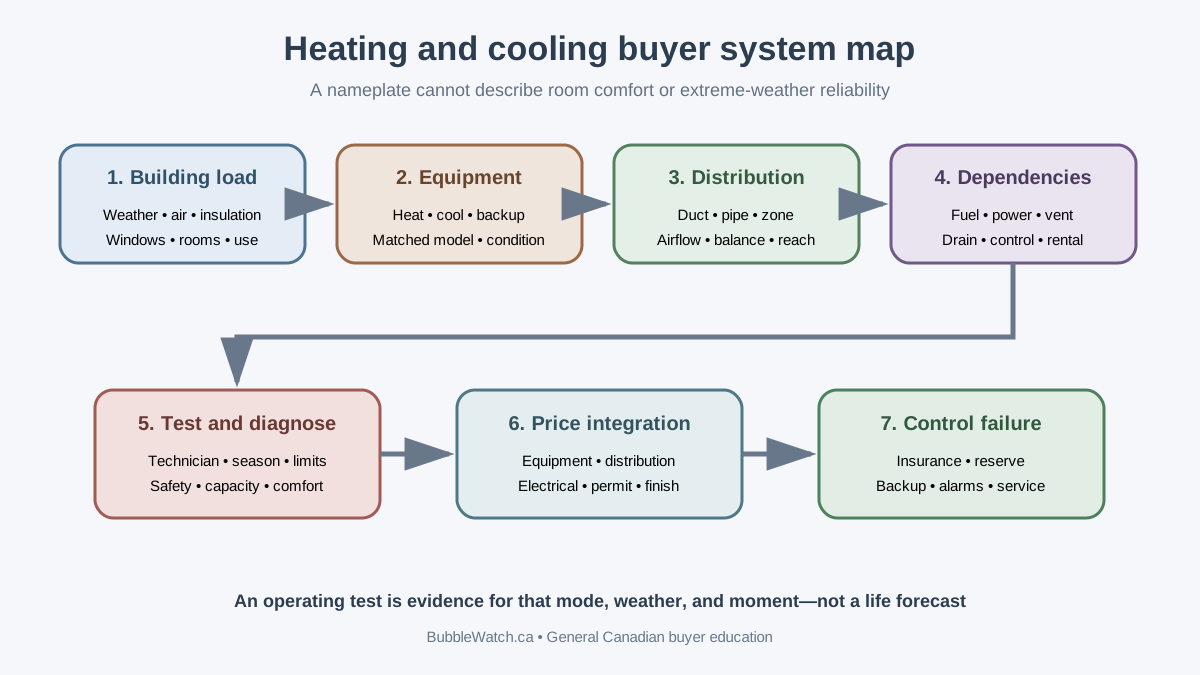
Short answer: map service before estimating life
Build a zone-and-equipment schedule:
| Area/zone | Heating source | Cooling source | Distribution | Control | Backup | Ownership |
|---|---|---|---|---|---|---|
| Main floor | ||||||
| Upper floor | ||||||
| Basement/suite | ||||||
| Addition/garage |
Then identify five evidence layers:
- equipment identity and installation record;
- safe operating and combustion or refrigerant assessment;
- distribution, controls, drainage, and ventilation;
- whole-house load, comfort, and utility context;
- replacement, insurance, rental, and contract consequences.
Know what a general home inspection establishes
Innovation, Science and Economic Development Canada's home-inspection guide says inspectors visually assess accessible heating and cooling systems. Scope, standards, weather, fuel, utilities, safety, and access affect operation.
A general inspector can identify equipment, visible defects, unusual operation, corrosion, leakage, inaccessible parts, and need for service. The inspection is normally not a combustion analysis, heat-exchanger integrity test, refrigerant circuit diagnosis, hydronic balance, duct leakage test, design heat-loss calculation, chimney inspection, or guarantee of remaining life.
Ask whether each mode will be operated. Air conditioning and heat-pump cooling may not be tested in cold conditions because operation can damage equipment or produce misleading results. A vacant home may have fuel or utilities off.
Record “not tested,” “limited,” and “specialist recommended” as decision items, not favourable results.
Inventory every component and fuel
Include:
- furnace, boiler, air handler, fan coil, heat pump, air conditioner, baseboard, radiator, radiant floor, fireplace, stove, and unit heater;
- indoor and outdoor coils or units;
- fuel source, meter, tank, regulator, line, shutoff, and utility;
- electrical disconnect, breaker, service capacity, panel space, and backup supply;
- chimney, liner, vent connector, sidewall termination, and combustion-air path;
- ductwork, plenums, returns, dampers, filters, registers, and grilles;
- hydronic piping, pumps, valves, tanks, manifolds, vents, and glycol;
- condensate drain, pump, trap, pan, neutralizer, freeze protection, and alarm;
- thermostat, sensor, zoning control, gateway, app, and subscription;
- humidifier, dehumidifier, HRV, ERV, air cleaner, and ultraviolet device;
- rental, lease, maintenance, warranty, or financing contract.
Photograph nameplates without guessing obscured characters. Record model, serial, rated input or output, refrigerant where visible, voltage, installation date evidence, and service label.
Verify ownership and contracts
Heating, cooling, water-heating, thermostat, and protection equipment can be rented or financed. Ask for the complete current agreement, not only a monthly bill.
Check:
- legal owner and account holder;
- monthly amount, tax, escalation, and remaining term;
- transfer requirements and buyer consent;
- buyout schedule and calculation;
- included service, parts, replacement, and exclusions;
- lien, security interest, or property registration questions for legal review;
- cancellation, disconnection, removal, and damage terms;
- equipment condition at transfer;
- whether the purchase contract lists the obligation clearly.
The Competition Bureau's rental-appliance disclosure submission supports prominent disclosure of key terms and a copy of the contract. Local law and the actual agreement govern the transaction.
Do not call a rental “included” as though the seller owns it. Ask the lawyer how assumption or payout is documented at closing.
Reconstruct installation, service, and failure history
Request:
- purchase and installation invoice;
- permit, fuel-safety, electrical, and final inspection records where applicable;
- commissioning sheet and startup measurements;
- load calculation, equipment selection, and duct or hydronic design;
- product registration and transferable warranty;
- annual or periodic service reports, including deficiencies;
- parts, refrigerant, leak, combustion, venting, drain, and control repairs;
- utility interruption, red tag, unsafe-condition, or insurer notices;
- insurance claims and water damage from equipment;
- comfort complaints, frozen pipes, portable-heater use, and room closures;
- smart thermostat histories where the seller voluntarily provides them.
An invoice saying “new HVAC” may cover one outdoor unit connected to old ducts, air handler, line set, electrical supply, or controls. Identify retained components and approved combinations.
Test operation safely and seasonally
Use a qualified technician for technical testing. Agree with the seller on fuel, thermostat changes, panels, combustion equipment, and duration.
For each mode, record:
- startup, shutdown, ignition, staging, and delay;
- thermostat call and response;
- unusual noise, vibration, odour, or cycling;
- supply and return observations;
- room distribution and closed dampers;
- condensate movement and leakage;
- error codes, lockouts, and resets;
- outdoor unit condition and clearance;
- interaction with exhaust fans and combustion appliances;
- backup or auxiliary heat operation.
A brief temperature rise or drop does not prove capacity under design weather. The technician should state which measurements were taken, accepted basis, and limitations.
Do not test fuel-burning equipment with blocked vents, suspected gas leak, active alarm, flooding, or unsafe electrical conditions. Follow emergency and utility instructions.
Furnaces and combustion equipment
A furnace review can include burner, ignition, flame, heat exchanger assessment method, blower, filter, cabinet, temperature rise, fuel pressure where authorized, venting, combustion air, condensate, safeties, and carbon-monoxide measurement under the technician's protocol.
Visible rust or flame appearance alone does not establish heat-exchanger integrity. Ask what test was performed and which surfaces remained inaccessible.
Check return-air paths, filter fit, bypass openings, flexible connections, and ducts in unconditioned spaces. Restricted airflow can affect comfort, noise, equipment temperature, efficiency, and service life.
For chimney-vented systems, review liner compatibility, connector slope and condition, draft, termination, and shared venting. A chimney may need separate qualified inspection.
Carbon-monoxide alarms are essential safety devices but do not certify an appliance. Verify current local placement and replacement requirements with the applicable authority.
Boilers and hydronic systems
Inventory boiler, burner, venting, pumps, expansion tank, pressure and temperature controls, relief discharge, fill and backflow components, air separator, zones, radiators, baseboards, radiant manifolds, glycol, and domestic-water interaction.
Look for leakage, corrosion, mineral deposits, damaged insulation, stuck valves, noisy pumps, uneven heat, abandoned lines, concealed piping, freeze history, and patched slabs or ceilings.
Ask the technician to distinguish appliance condition from distribution condition. A new boiler does not renew old buried radiant tubing or corroded zone piping.
If domestic hot water comes from the boiler, map summer operation, storage tank, mixing, controls, and loss of both services if the boiler fails.
Heat pumps need climate and system context
Natural Resources Canada's current heat-pump primer explains air-source and ground-source systems, ducted and ductless delivery, and efficiency that changes with source and sink temperatures. Correct sizing is central to seasonal performance.
Identify:
- air-source, cold-climate air-source, ground-source, water-source, or hybrid system;
- rated model combination, not one component alone;
- balance point and backup heat strategy;
- capacity and efficiency at relevant low temperatures;
- defrost operation and outdoor drainage;
- base-pan or drain-pan heating where designed;
- snow, ice, roof runoff, wind, and service clearances;
- line-set insulation, penetrations, branch boxes, and covers;
- indoor-head placement, condensate, filters, and room reach;
- electrical demand and backup strip heat;
- ground loop, wells, pumps, fluid, and records for ground-source systems.
“Works to -30°C” can describe operation, not delivered capacity, efficiency, or whole-house comfort at that temperature. Ask for manufacturer data for the exact matched system and a house-specific heat-loss calculation.
Air conditioners and refrigerant systems
Record indoor coil, outdoor unit, line set, metering, drain, filter, controls, and electrical disconnect. Look for oil staining, corrosion, damaged fins, vegetation, unstable pad or bracket, missing insulation, icing evidence, water damage, and repeated refrigerant additions.
Refrigerant should not be treated as a consumable that needs routine topping up. Repeated addition can signal an unresolved leak. Ask for leak diagnosis, repair, evacuation, charge method, and service record.
Older refrigerants can affect service options and replacement planning. A qualified technician should explain current availability and legal handling without turning refrigerant age into an automatic failure claim.
NRCan's air-conditioning guide covers equipment selection, installation, operation, and maintenance. Sizing too large can create short cycling and weak humidity control; sizing is not a simple floor-area rule.
Ducts and room-by-room distribution
Map supplies and returns by room. Note closed or blocked grilles, rooms without return paths, additions served by small branches, basement registers cut into trunks, ducts in attics or crawl spaces, and balancing dampers.
Ask about:
- leakage testing or sealing;
- insulation and vapour control on ducts outside conditioned space;
- crushed, disconnected, corroded, or contaminated ducts;
- fire and smoke dampers where applicable;
- asbestos-containing duct wrap or tape;
- zoning bypass and static pressure;
- filter location and replacement access;
- noise, odour, and comfort complaints.
Duct cleaning is not a repair for leakage, poor sizing, moisture source, or damaged material. Define the problem first.
The attic inspection guide explains how attic ducts and air handlers interact with condensation, insulation, access, and roof moisture.
Ventilation and humidity are separate systems
Heating and cooling equipment may affect humidity, but bath fans, kitchen exhaust, dryer exhaust, HRV or ERV, air leakage, basement moisture, and occupant loads also matter.
Identify ventilation equipment, outdoor intake and exhaust locations, filters, drains, balancing records, controls, frost strategy, and maintenance. Confirm ducts connect as labelled.
Portable dehumidifiers and window air conditioners can reveal comfort gaps. Ask which rooms need them, during which weather, and why.
Do not disable ventilation merely to reduce heating use. A building-science or ventilation professional should balance indoor-air, moisture, combustion, and energy needs.
Evaluate filters and indoor-air accessories by purpose
Ask what problem each filter, purifier, humidifier, dehumidifier, ultraviolet device, or electronic cleaner is meant to address. Obtain the model, installation record, maintenance schedule, replacement media, safety listing, and operating status.
A high-resistance filter can reduce airflow if the blower and duct system were not designed for it. A bypass humidifier can leak, scale, or add too much winter moisture. An ultraviolet lamp needs shielding, correct placement, cleaning, safe service, and timely replacement; a blue glow does not prove useful treatment.
Check cabinets, drains, pads, reservoirs, wiring, interlocks, and nearby material for water or deposits. Ask whether the accessory is included, rented, disabled, or abandoned.
Health symptoms and air-cleaner selection belong with medical and qualified indoor-environment advice. Equipment marketing does not replace source control, ventilation, moisture correction, and appropriate filtration.
Plan for failure during extreme weather
The financial effect of failure depends on season, occupants, pipes, pets, tenants, remote location, and service availability. Create an outage plan before deciding how much reserve is enough.
Record:
- safe temporary heat or cooling options;
- fuel and electrical capacity for backup;
- freeze-prone plumbing and rooms;
- generator connection and safe operation, if present;
- alarm, remote temperature, and caretaker arrangements;
- technician availability and proprietary parts;
- temporary accommodation and tenant duties;
- expected time from failure to installed replacement.
Portable combustion heaters should never be improvised indoors. Portable electric heat can overload circuits or leave distant plumbing cold. Use qualified safety guidance.
A replacement fund should include diagnostic visit, emergency premium, temporary service, permits, electrical or vent changes, and accommodation - not only the equipment price from a planned spring installation.
Treat oil, propane, and solid fuel as separate risk files
For oil or propane, map tank, fill, vent, regulator, lines, supports, barriers, inspection, delivery access, leak history, environmental risk, and insurer requirements. The fuel-tank due-diligence guide covers active, abandoned, removed, and buried systems.
For fireplaces and stoves, use the solid-fuel inspection map for appliance, connector, chimney, clearances, sweeping, report level, and insurer acceptance. A central HVAC inspection does not certify a wood appliance.
If the buyer plans conversion, price safe decommissioning, remaining backup, tank or line removal, environmental records, chimney closure, electrical capacity, and finish restoration. “Switch to heat pump” does not describe those dependencies.
Use utility bills as context, not a rating
Collect at least a full seasonal cycle where the seller agrees. Record fuel type, billing period, estimated versus actual reads, weather, occupancy, vacancies, setpoints, fireplaces, electric vehicles, pools, hot tubs, workshops, and included water heating. Once you have a year of bills, compare what the existing system costs to run against the alternative using heat pump vs gas furnace operating costs, which works from delivered-heat cost rather than fuel price alone.
Normalize cautiously. A retired couple heating two rooms cannot predict a family's use. One warm winter cannot establish design-day capacity.
If bills are unexpectedly low, check wood heat, tenant meters, solar generation, long vacancies, closed rooms, and separate fuel purchases. If high, investigate enclosure, equipment, ducts, setpoints, hot water, and non-HVAC loads.
Connect enclosure and load calculation
Replacement should follow a room-by-room or accepted house-specific load method under qualified practice. Prior equipment size may include oversizing, earlier insulation levels, or an addition.
Provide the designer with attic, wall, basement, window, door, air-leakage, orientation, occupancy, ventilation, and climate facts. The window and door buyer guide and attic guide help document two major enclosure inputs.
Ask the quote to show design conditions, loads, selected capacity, modulation, distribution changes, backup, controls, and assumptions. A sales proposal based only on the old nameplate can repeat the old mismatch.
Price replacement as an integrated project
Include:
- removal, refrigerant recovery, fuel or electrical disconnection, and disposal;
- equipment and matched components;
- duct, hydronic, chimney, liner, vent, condensate, and drainage changes;
- electrical service, panel, breaker, disconnect, wire, and utility work;
- fuel line, tank, meter, regulator, or decommissioning;
- structural pad, bracket, roof, wall, or ground-loop work;
- thermostats, zones, sensors, gateways, and subscription decisions;
- ventilation, filtration, humidification, and indoor-air accessories;
- permits, authority inspection, commissioning, balancing, and training;
- drywall, paint, flooring, landscaping, hazardous material, and cleanup;
- temporary heat or cooling and accommodation;
- tax, warranty, maintenance, and hidden-condition allowance.
Compare delivered system, not equipment headline. Confirm who designs, installs, commissions, registers, services, and resolves comfort deficiencies.
Avoid incentive and savings assumptions
Programs change by date, province, income, fuel, equipment, evaluation, installer, and funding. Verify current rules directly before relying on assistance. Do not assume eligibility transfers with the house.
Model cash flow without the incentive until approval and payment conditions are understood. Some programs require pre-work assessment or approved products and may exclude work begun too early.
Savings estimates should state weather, energy price, efficiency, backup use, setpoint, distribution, and enclosure assumptions. Compare ranges rather than one payback date.
Insurance, lender, and contract evidence
Use the home-insurance-before-closing guide for old equipment, fuel tanks, solid fuel, rentals, unfinished correction, and water damage. Give the insurer exact facts and ask which repairs or reports are binding conditions.
Ask the lender whether required repairs, rented equipment, major retrofit financing, or an unheated area affects its property decision. Mortgage approval does not certify mechanical condition, and an HVAC quote does not confirm financing.
Electrical upgrades may determine whether a heat pump or backup system is feasible. Use the electrical buyer workflow before accepting a quote that assumes spare capacity.
Local counsel should adapt terms for technician access, seasonal retest, fuel and utilities, documents, rental payout, insurer acceptance, exact seller work, permit, commissioning, reinspection, price, holdback, extension, or termination.
Avoid “HVAC to be working.” Name every mode, zone, equipment item, required professional, measurement or report, correction, permit, and acceptance evidence.
Worked example: new heat pump, old distribution
A listing advertises a two-year-old cold-climate heat pump. The invoice confirms matched outdoor and indoor equipment but excludes duct changes. Upstairs bedrooms are cold, and the seller uses portable heaters.
The technician finds the heat pump operating within its observed test conditions. Static-pressure and room review find restrictive return paths and undersized branches to the upper floor. Electrical review shows the portable heaters share overloaded circuits. The backup furnace also lacks a recent combustion report.
The buyer prices duct redesign, targeted enclosure work, electrical correction, furnace service, balancing, and post-work measurement. Replacing the nearly new heat pump would not have corrected the distribution problem.
Buyer checklist
- Every zone, equipment item, fuel, control, and backup mapped
- Ownership, rental, buyout, warranty, and transfer verified
- Installation, permit, commissioning, service, and failure records obtained
- General inspection limits escalated to qualified technicians
- Combustion, venting, refrigerant, hydronic, and condensate risks checked
- Heat-pump low-temperature capacity and backup understood
- Duct or hydronic distribution assessed room by room
- Utility history normalized for occupancy and weather
- Replacement quote includes power, fuel, distribution, permits, and finishes
- Insurance, lender, contract, and final-walkthrough evidence secured
Frequently asked questions
Does old HVAC equipment need immediate replacement?
Not solely because of age. Safety, condition, performance, serviceability, efficiency, repair history, insurance, and failure consequences determine timing.
Can a home inspector test a heat exchanger?
General scope varies and may identify warning signs, but technical integrity assessment usually belongs with a qualified HVAC professional using stated methods and limitations.
Can a heat pump heat a Canadian home in winter?
Many systems can, but capacity and efficiency vary with temperature, model, sizing, distribution, enclosure, and backup design. Review the exact matched equipment and house load.
Is a recent furnace service proof it is safe?
Only to the extent of the documented scope and date. Read measurements, findings, inaccessible areas, repairs, and recommendations.
Should a buyer assume a rented furnace contract?
Not without the complete agreement, cost, term, transfer and buyout rules, legal review, and clear purchase-contract treatment.
Do low utility bills prove efficient equipment?
No. Weather, occupancy, setpoints, vacancies, other fuels, solar generation, and non-HVAC loads influence bills.
What to read next
Use the electrical inspection guide to test service capacity, circuits, permits, and insurer requirements for replacement equipment. Use the attic air-and-moisture guide when ducts, air handlers, exhaust, or enclosure work crosses the roof space.
This article provides general Canadian home-purchase information, not HVAC, fuel, refrigerant, combustion, electrical, building-science, safety, code, legal, insurance, or contracting advice. Requirements vary by system, climate, jurisdiction, utility, and authority. Use current official guidance and qualified local professionals.
Retain the zone schedule, commissioning records, model combinations, permit evidence, and technician reports for service, warranty, insurer, and future replacement decisions.
Advertisement

About David R. Chen, CFA
David R. Chen is a Chartered Financial Analyst and the Senior Housing Economist at BubbleWatch.ca. He brings 12+ years of experience in quantitative real estate analysis and mortgage underwriting. Formerly an analyst at a major Canadian bank, he specializes in modeling payment shock, regional affordability divergence, and private lending risk.
View David's professional bio & credentials →