Missed a Mortgage Payment in Canada (2026): The First 90 Days, and the Relief Your Lender Is Expected to Offer
Missing one mortgage payment puts a Canadian borrower in default on paper, but the consequences arrive on a schedule, not all at once. Federal rules set what happens at each stage: the Financial Consumer Agency of Canada expects federally regulated lenders to contact at-risk borrowers proactively and offer tailored relief, a missed payment generally reaches a credit report only after 30 days, and Ontario law sets the fastest enforcement clock in the country at 15 days of default before a notice of sale and at least 35 days after that notice before a sale. This guide walks the first 90 days stage by stage, prices every relief measure on a worked $500,000 example, and separates the moves that cure arrears from the moves that deepen them.
Missed a Mortgage Payment in Canada (2026): The First 90 Days, and the Relief Your Lender Is Expected to Offer
Short answer: One missed payment is a mortgage default under your contract, and the Financial Consumer Agency of Canada (FCAC) defines it in exactly those terms: default happens when you do not follow the terms of the agreement, like missing a regular payment. Default is a status, not an eviction. Three separate clocks start running. Your lender's arrears process starts at once, and FCAC expects a federally regulated lender to be working with you on tailored relief during this window, not just billing you. The credit bureau clock runs about 30 days: a late payment generally does not land on your credit report until it is at least 30 days past due, so a payment caught up inside a month usually leaves no bureau record. The legal clock depends on your province. In Ontario, a lender can serve a notice of sale after 15 days of default and cannot sell until at least 35 days after that notice. In court-process provinces the legal road runs months longer. The borrowers who keep their homes are almost always the ones who treat the first two weeks as the working window, because that is when the cheapest fixes are still open.
This is education only, not mortgage, legal or financial advice. Relief is approved case by case, contract language varies by lender, and enforcement law varies by province. A non-profit credit counselling agency or a Licensed Insolvency Trustee can review your full position at no cost or low cost, and a real estate lawyer in your province can read a notice you have received.
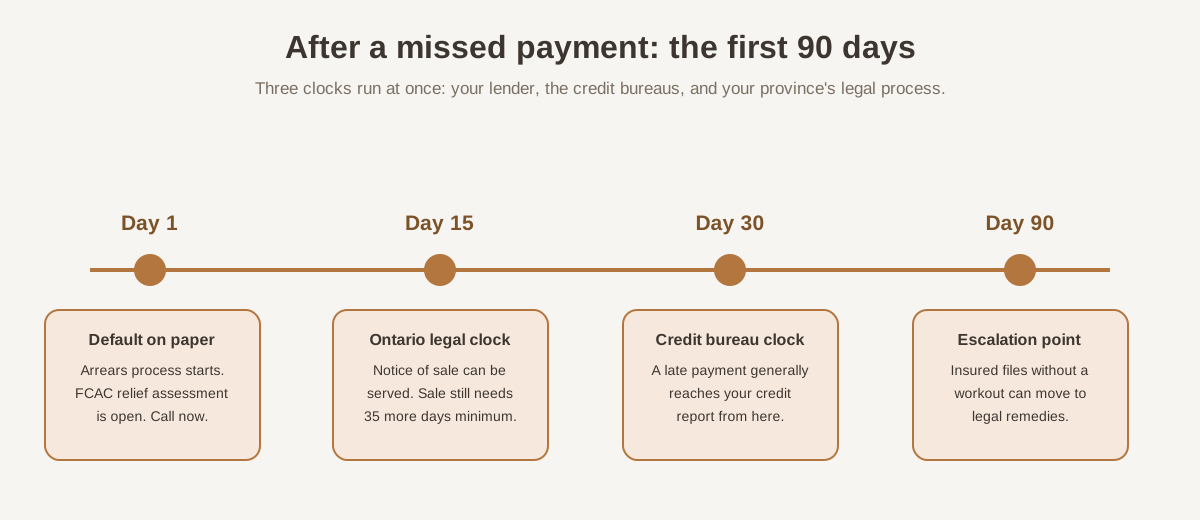
The first 90 days at a glance
| Stage | What happens | The number that matters | Your strongest move |
|---|---|---|---|
| Day 1 to 14 | You are in default under the contract. The lender's arrears unit takes the file. FCAC expects federally regulated lenders to monitor for early signs of default and contact at-risk borrowers proactively | One payment behind. On the worked example below, $2,767 | Call before the second payment date. Ask for the relief assessment in writing |
| Day 15 (Ontario) | Shortest legal clock in Canada: a notice of sale can be served after 15 days of default under the Ontario Mortgages Act | Sale still cannot happen for at least 35 days after the notice | Treat any notice as a deadline document, not junk mail. Get provincial legal advice |
| Day 30 | A late payment generally reaches Equifax and TransUnion reporting at 30 days past due | A partial payment generally still counts as late | Catch up in full before day 30 if you can do it without skipping another bill that also reports |
| Day 31 to 60 | Second missed payment. Insurer workout tools come into the file on insured mortgages. Relief terms get narrower and documentation gets heavier | Two payments behind: $5,535 on the example | Put a signed relief arrangement in place. Agreed missed payments under a relief arrangement should not be reported as late |
| Day 61 to 90 | Third missed payment. On insured files, CMHC requires lenders to take all reasonable and appropriate measures to manage the default; after about three months of default the file can move to legal remedies if no workout holds | Three payments behind: $8,302 on the example | If the payment no longer fits the income, price the exit options (sale by borrower, proposal) while you still control the timing |
Every dollar figure in the worked example is a labelled hypothetical: a $500,000 mortgage at 4.50% with a 25-year amortization, monthly payment $2,767.36, computed with Canadian semi-annual compounding. It is an arithmetic illustration, not a quote and not your file.
Default is wider than one missed payment
The missed payment is the default most people picture. Your contract lists others, and FCAC's own relief material names the items lenders treat as arrears to cure: unpaid property taxes, utility arrears the lender has paid to protect the property, property repair costs, and unpaid condo fees can all be added to what you owe under a capitalization arrangement. Lapsed home insurance is a standard contract breach as well, because the home is the lender's security. A borrower can be current on every mortgage payment and still be in default on the file. When you call the lender, ask for the full arrears figure, not just the payment count. The tax and condo items are often the surprise entries, and they change which relief tool fits.
There is one more default-adjacent state worth naming, because it arrives without any missed payment: negative amortization on a variable-rate mortgage with fixed payments. FCAC describes the trigger rate as the rate at which your payment covers only interest. Past it, unpaid interest is added to your balance and the amount you owe grows. FCAC expects lenders, for a limited period in relief cases, to stop charging interest on that capitalized interest, and to waive prepayment penalties on a lump sum you make to pull the balance back under the original amortization. If your statement shows a growing balance, that expectation is the text to cite on the call.
The call that changes the file: what FCAC expects your lender to do
Since July 2023, FCAC's Guideline on Existing Consumer Mortgage Loans in Exceptional Circumstances has set expectations for federally regulated financial institutions, meaning banks and other federal lenders, for borrowers with a mortgage on their principal residence who are at risk of default. The expectations do not guarantee any single measure. They do set the shape of the conversation, and most borrowers never learn they exist.
- Proactive contact. Banks are expected to monitor for early signs of default, establish criteria for offering relief, and contact you proactively if you are at risk. If the first call comes from you, you are still inside the window the guideline was written for.
- A tailored assessment. The bank is expected to assess which measures fit your circumstances and offer the most appropriate ones as soon as possible, with similar treatment for borrowers in similar circumstances.
- Disclosure before consent. Before you accept a measure, the bank must give you, in clear and simple terms: what you owed before the measure, its impact on the total cost of your mortgage in dollars, its impact on your amortization, your new payment amount, due date and frequency, your new rate and rate type, and the date the change takes effect. Relief requires your express consent. Nothing is supposed to be applied silently.
- Credit reporting protection inside an arrangement. If the bank agrees you may miss payments as part of a relief arrangement, FCAC expects the bank not to report those agreed missed payments to the credit bureaus as late. This is the single most valuable clause for a borrower who needs two or three months: an arrangement signed before day 30 can keep the file clean in a way that silent arrears cannot.
- Temporary fee and penalty relief. For a limited period, banks are expected to waive internal fees or costs of activating relief, waive prepayment penalties when you make a lump sum to avoid negative amortization or when you sell your principal residence, and avoid charging interest on interest where relief produces negative amortization.
- Renewal protection. If you are at risk and renewing, the bank is expected not to offer you a less advantageous rate because you cannot adjust your agreement or qualify elsewhere. Our renewal wave guide covers the 2026 renewal wall that is pushing many borrowers into this exact conversation.
Two scope limits matter. The guideline covers your principal residence, not a rental property or a cottage. And it binds federally regulated lenders. Credit unions are provincially regulated and run their own relief practices, which follow a similar outline in many cases but are not the FCAC text. Private and B-lender mortgages sit outside it entirely, which is one reason the rate gap on alternative paper is only half the story. Whoever your lender is, the call costs nothing and the written summary of what was offered is the document to keep.
The relief menu, priced
FCAC publishes the standard menu of mortgage relief options on Canada.ca. Each one trades present cash flow for future cost, and the trade is worth doing with the arithmetic in front of you. The prices below use the worked example: $500,000 at 4.50%, 25-year amortization, $2,767.36 a month, of which $1,857.66 is interest and $909.70 is principal at the start.
Skip a payment. Many contracts include a skip-a-payment feature (also called a payment pause), often with a cap on how many payments you can skip in a calendar year, and some lenders require that you have prepaid earlier to qualify, applying the prepaid amount to the skipped payment. Where no prepayment backs it, the skipped payment is deferred and its interest keeps accruing. Price of one skip on the example: the $2,767.36 stays in the balance and, repaid over the remaining 24 years at the same rate, costs $4,512 in total payments, of which $1,744 is interest for the use of one month's room. A skip is a bridge measured in weeks. Used as a standing habit, it is an expensive loan you take from yourself without noticing.
Payment deferral. A formal agreement to delay payments for a set period, usually up to 4 months, per FCAC. After the deferral you resume payments and repay the deferred amounts, so the balance, the payment, or the amortization grows. FCAC also describes extended deferrals that run until a preset dollar amount, for example $10,000, is reached. A deferral differs from drifting: it is signed, dated, and carries the credit-reporting protection described above. Get the end date and the post-deferral payment in the disclosure package, not verbally.
Capitalization. The lender adds what you owe to the principal: missed payments and their interest, and potentially property tax payments, utility bills, property repair costs, condo fees and other outstanding charges, in FCAC's list. Your payment is then recalculated on the higher balance. This is the standard cure for a file that is behind but has income again, and it is priced in the full worked example below: three missed payments capitalized at month 12 raise the payment by about $47 a month and add about $5,253 of interest beyond the arrears themselves over the remaining 24 years. Capitalization cures the default status. It does not reduce what you owe by a cent.
Special payment arrangement. Reduced payments for an agreed period, with FCAC's framing that the lender recovers the late amounts over the shortest period your finances allow. This is the bespoke option, and it is where the disclosure rules earn their keep: insist on seeing the recovery schedule and the total cost in dollars before you consent.
Interest-only payments. You pay the interest portion and defer principal. FCAC positions this after amortization extension or capitalization have already been used, and puts the usual shape at up to $10,000 of deferred principal, repaid over a set period, usually within 2 years. CMHC's default management tools for lenders set the same $10,000 cumulative figure for interest-only arrangements on insured mortgages. On the example, interest-only drops the monthly outlay from $2,767.36 to $1,857.66, freeing $909.70 a month of cash flow, and every month on it leaves the balance exactly where it was. It buys calendar time at full carrying cost, which is the right trade for a dated event (a return to work, a closing on another property) and the wrong trade for an open-ended income gap.
Amortization extension. Stretching the repayment period lowers the payment and raises lifetime interest by a lot, which is why FCAC expects the bank to build a plan with you to restore the original amortization, extend for the shortest reasonable period, and spell out the long-term cost. On a $400,000 balance at 4.50%:
| Amortization | Monthly payment | Total interest over the period | Change vs 20 years |
|---|---|---|---|
| 20 years remaining | $2,521.62 | $205,189 | Baseline |
| 25 years | $2,213.89 | $264,168 | Payment down $307.73 a month, interest up $58,979 |
| 30 years | $2,016.86 | $326,070 | Payment down $504.76 a month, interest up $120,881 |
Read the last column as the price list for breathing room. Going from 20 to 30 years buys $505 a month of relief at a six-figure interest cost if the extension runs to term. The restoration plan is what keeps that from happening: prepayment privileges used in good years pull the schedule back, which is also why our blend and extend guide treats term restructuring and amortization as separate decisions with separate math.
Renegotiation inside the term. FCAC lists converting a variable rate to fixed, and blended options (blend-to-term or blend-and-extend), as renegotiation routes where rates have moved in your favour. A borrower in arrears will rarely be offered the best version of this, but a borrower who calls at risk, before a miss, sometimes is.
Prepay and re-borrow. If you made lump-sum prepayments earlier in the term, the lender may let you re-borrow the prepaid amount to cover current payments, adding it back to principal. It is the cheapest bridge on the menu when it exists, because the room is already earned. Ask for the prepaid balance on the first call; many borrowers do not know theirs.
Mortgage credit insurance claim. If you bought optional creditor insurance on the mortgage (the lender-sold product our mortgage protection insurance guide compares with term life), a job loss, critical illness or disability may qualify for claim payments. FCAC's consumer page puts the usual shape at a 1 to 2 month wait before payments start and a maximum monthly benefit usually around $3,000, for a limited period. Claims have filing deadlines in the certificate. A borrower who misses the deadline while waiting for a severance decision loses coverage they paid for.
One tool that is not on the menu, flagged by FCAC itself: paying the mortgage from a HELOC. FCAC warns that using a home equity line of credit to make mortgage payments puts you at risk, because the lender can lower the limit or demand full repayment of the line at any time. The swap also converts an amortizing debt into a revolving one with no required principal repayment. Our home equity borrowing guide prices the four equity products against each other; none of them fixes an income gap, and a second mortgage taken to cure first-mortgage arrears stacks the most expensive debt in the house on top of the problem that caused the arrears.
Worked example: three missed payments, three exits
Same hypothetical throughout: $500,000 borrowed at 4.50%, 25-year amortization, $2,767.36 a month. The borrower pays normally for 9 months, then misses months 10, 11 and 12 after a job loss, and is back at work in month 13 with the old income restored.
| Line | Amount |
|---|---|
| Three missed payments (arrears) | $8,302.09 |
| Balance after 12 months, all payments made | $488,857.68 |
| Balance after 12 months, months 10 to 12 missed | $497,190.66 |
| Extra balance created by the three misses | $8,332.98 |
The extra balance is $30.89 more than the arrears themselves. That sliver is interest that accrued because no principal was paid down for three months and the full balance kept compounding. It is small here and grows with every additional missed month, which is the arithmetic version of the advice to call early.
Exit 1: catch up from cash. Repay the $8,302.09 and resume $2,767.36. Total damage is the $30.89 of extra compounding plus any contract late fees, provided the arrears are cured before the file hardens. This is the cheapest exit by a wide margin and the reason an emergency fund, a tax refund, or a family loan at any reasonable price beats every structured option below.
Exit 2: capitalize and re-amortize. The lender folds the $497,190.66 balance into a fresh schedule over the remaining 24 years at the same rate. The payment becomes $2,814.54, up $47.17 a month. Over the remaining 24 years the borrower pays about $13,586 more in total payments than the no-miss path, of which $8,332.98 is the arrears and extra balance coming back, leaving about $5,253 as the pure interest cost of the three-month hole. File cured, one signature, no cash needed. That is a fair price, and knowing it in advance is what lets you judge the offer on the phone.
Exit 3: capitalize and extend to 30 years. The payment falls below the original $2,767.36, and the interest cost balloons along the lines of the extension table above. This exit fits a permanent income reduction, not a three-month gap. If your income is back, Exit 3 solves a problem you no longer have at the highest price on the page.
If your mortgage is insured, a second file opens at the insurer
A mortgage with less than 20% down carries default insurance from CMHC, Sagen or Canada Guaranty, arranged by the lender. Borrowers tend to think of the insurer as the lender's problem. In arrears, the insurer is a second decision-maker in your file, and mostly a useful one. CMHC's published position is that for its insured loans a lender must take all reasonable and appropriate measures to manage borrower default situations. Its default management framework gives lenders a defined tool set for workouts: capitalization of arrears, amortization extension combined with capitalization, interest-only payments up to a cumulative $10,000 of deferred principal with repayment inside two years, conversion of a variable rate to fixed, and re-borrowing prepaid amounts. Some tools the lender can approve on its own authority; others run through the insurer. Practically, an insured borrower in arrears is more likely, not less, to be offered a structured workout, because the insurer prefers a cured loan to a claim.
The other edge of insurance shows at the end of a failed file. If the home sells for less than the debt, the shortfall does not vanish. Alberta and Saskatchewan law limits a lender's ability to chase a shortfall on an uninsured conventional mortgage, but where an insurer has paid a claim, the insurer steps into the claim and can pursue the borrower for the deficiency. Insurance protected the lender at origination. It does not cap the borrower's exposure at the end.
Credit score: what one miss does, and what it does not
Equifax's consumer guidance is that late payments generally will not end up on credit reports for at least 30 days after the missed payment date, and that paying in full before that point may keep the late payment off the report entirely. Two qualifications ride with it. A partial payment generally still gets reported as late, so half a payment made in week two does not protect the file the way borrowers expect. And once a late payment is reported, bureau retention runs in years, not months: negative information is generally kept for about six years in Canada, counted from the reporting date at Equifax and from the first delinquency at TransUnion. Our credit score guide sets out what 600, 680 and 760 buy at application time; the arrears version of that lesson is that the 30-day window is worth real money at your next renewal or switch, which is a second reason the signed-relief route matters: payments missed under an agreed relief arrangement are not supposed to be reported as delinquencies at all.
When the payment no longer fits: exits you choose vs exits that choose you
Relief assumes the income comes back or the payment can be reshaped to meet it. When neither holds, the decision changes from curing arrears to choosing the exit with the most equity left at the end.
Sale by borrower. FCAC describes this plan directly: the lender lets you sell the home yourself at fair market value while you continue to live in it, typically for a period of 90 days or less, maintaining the home and possibly making full or partial payments during the sale window. You pick the listing price, the agent and the closing date. Compare that with a lender-run sale after enforcement, where the property is sold as-is by a seller whose only goal is covering the debt, and the costs of the process land in the claim against you. Our power of sale guide prices that difference on a worked Ontario file: legal fees, arrears interest and selling costs came to $55,218 deducted before the borrower saw a dollar. Every month of arrears before a voluntary sale shrinks the same equity, just more slowly and under your control.
Consumer proposal. A proposal is a legal settlement of unsecured debts (credit cards, lines of credit, personal loans, tax debt) filed through a Licensed Insolvency Trustee under the Bankruptcy and Insolvency Act. The eligibility ceiling is $250,000 of unsecured debt, excluding the mortgage on your principal residence. Two rules decide its place in a mortgage problem. First, secured debts sit outside the proposal: the mortgage is not reduced, rewritten or stayed as long as you keep paying it, and if you stop paying it the lender keeps every right it had. Second, because the unsecured payments shrink to one proposal payment, a proposal can free the cash flow that makes the mortgage payable again. It is the right tool when the cards and lines, not the house payment itself, are what broke the budget. It also affects renewal: a mortgage that auto-renews usually rolls on, while a refinance during a proposal often requires the proposal to be paid out first, so sequence the two with the trustee before your term end, not after.
Bankruptcy. The heavier version of the same logic: unsecured debts are discharged, secured debts are not. A bankrupt homeowner who keeps the mortgage current can often keep the home, subject to provincial exemption limits on home equity and the trustee's interest in any equity above them. This is trustee territory, not article territory. The first consultation with a Licensed Insolvency Trustee is typically free, and it is the correct next step when arrears exist on both the mortgage and unsecured debts at once.
Doing nothing. The default exit, and the only one where every clock runs against you: bureau reporting at 30 days, insurer and legal escalation after roughly 90 days of default on insured files, and in Ontario a sale process that can legally complete while a file is still young. Silence also forfeits the FCAC framework, which is built around contact. No relief measure in this guide is available to a borrower the lender cannot reach.
Your first week: a checklist
- Find the exact arrears figure. Payments missed, plus any property tax, condo fee or insurance amounts the lender has advanced. Ask for it as a number, in writing or by email summary after the call.
- Pull your mortgage contract's default and fee clauses: late fees, the skip-a-payment feature and its annual cap, your prepaid balance, and whether your charge is standard or collateral (it decides your switch options later; see our collateral charge guide).
- Call the lender's arrears or financial hardship line, not the branch, and use the FCAC words: you are a borrower at risk of default on your principal residence asking for an assessment of mortgage relief measures under the FCAC guideline. Take the agent's name and a reference number.
- Ask for the disclosure package before consenting to anything: balance before the measure, dollar impact on total cost, impact on amortization, new payment and dates, new rate, effective date. FCAC expects you to receive all of it in clear and simple terms.
- Ask the credit reporting question directly: confirm that payments missed under the arrangement will not be reported as delinquencies.
- Check the insurance certificate if you bought creditor insurance at origination. Job loss and disability claims have filing windows.
- Freeze the leaks that report monthly: minimum payments on cards and lines protect your bureau file while the mortgage arrangement is negotiated, and they are the debts a proposal would settle if it comes to that.
- Diarize day 30 from the first missed due date and the date of any notice you receive. In Ontario, count the redemption window from the notice, and get a lawyer to read any notice before its window closes.
- Book the free conversations in parallel if the gap looks longer than 90 days: a non-profit credit counselling agency for the budget, a Licensed Insolvency Trustee for the legal options. Neither obliges you to file anything.
Frequently asked questions
Is one missed payment really a mortgage default?
Yes, in contract terms. FCAC defines mortgage default as not following the terms of your mortgage agreement, and gives missing a regular payment as the example. Default is the status that starts the lender's arrears process and, after the statutory waiting periods in your province, its legal remedies. It is not the same thing as losing the home: the same FCAC framework expects the lender to offer tailored relief first.
How long before a missed mortgage payment hits my credit report?
Generally at least 30 days. Equifax's consumer guidance says late payments generally will not appear on credit reports until at least 30 days after the missed payment, and catching up in full inside that window may keep it off your report. A partial payment generally still counts as late. Once reported, negative information is generally retained for about six years. If your missed payments are inside a signed relief arrangement with your bank, FCAC expects them not to be reported as delinquencies.
Can my lender sell my home after one missed payment?
Not immediately, and the speed limit is provincial. In Ontario, a notice of sale can be served after 15 days of default, and the lender cannot sell until at least 35 days after the notice, with the borrower able to cure by paying the arrears and costs inside that window. Foreclosure provinces and Quebec run through the courts and take months longer. Over all of it sits the FCAC expectation that federally regulated lenders work with at-risk borrowers on relief. The legal minimums are worst-case clocks, not the normal timeline, but they are the reason a notice is never junk mail.
What is capitalization of arrears?
The lender adds what you owe to your mortgage principal: missed payments and interest, and potentially property taxes, utilities, repair costs and condo fees. Your payment is recalculated on the higher balance and the default is cured. On this guide's worked example, capitalizing three missed payments ($8,302) at month 12 raised the payment by about $47 a month and cost about $5,253 in interest beyond the arrears themselves over the remaining 24 years.
How long can I defer mortgage payments in Canada?
FCAC describes a standard payment deferral as an agreement to delay payments for a specific period, usually up to 4 months, with the deferred amounts repayable afterward through a higher payment, a higher balance or a longer amortization. Extended deferrals exist that run to a preset dollar amount, for example $10,000. Your lender's offer on your file governs, and the deferral should come with the FCAC disclosure package: total cost impact, amortization impact, and the new payment after the deferral ends.
Does skipping a mortgage payment cost anything?
Yes. The skipped amount stays in your balance and accrues interest. On the worked example, one skipped payment of $2,767.36, repaid over the remaining 24 years at 4.50%, costs $4,512 in total payments, so about $1,744 of interest for one month of room. Some contracts also cap how many payments can be skipped per calendar year or require earlier prepayments to qualify.
Will a consumer proposal stop my lender from taking my home?
A proposal settles unsecured debts and stays most unsecured collection action. It does not change your mortgage: secured debts sit outside it, and the lender keeps its rights if mortgage payments stop. Homeowners use proposals to free up cash flow by shrinking card and line payments so the mortgage becomes payable again. Eligibility runs to $250,000 of unsecured debt excluding the mortgage on your principal residence, and only a Licensed Insolvency Trustee can file one.
My mortgage is with a credit union or a private lender. Do the FCAC expectations apply?
The FCAC guideline binds federally regulated financial institutions, such as banks, for mortgages on a principal residence. Credit unions answer to provincial regulators and run their own relief practices, which often look similar but are not the federal text. Private lenders are outside the framework, and their contracts set the process. In all three cases the first call is the same, and getting the offered terms in writing costs nothing.
Sources and method
The definition of mortgage default, the expectations for proactive contact, tailored assessment, pre-consent disclosure and credit reporting inside relief arrangements, the renewal-rate expectation, and the trigger rate and negative amortization descriptions are from the Financial Consumer Agency of Canada: "Paying your mortgage when experiencing financial difficulties" and the Guideline on Existing Consumer Mortgage Loans in Exceptional Circumstances (Canada.ca). The relief menu (skip a payment, deferral usually up to 4 months, extended deferral to a preset amount, special payment arrangements, capitalization items, interest-only with deferred principal usually up to $10,000 repaid usually within 2 years, credit insurance claim shape, and the sale by borrower plan at typically 90 days or less) is from FCAC's "Mortgage relief options" (Canada.ca). CMHC's requirement that lenders take all reasonable and appropriate measures on insured defaults and its default management tool set, including the $10,000 cumulative interest-only figure, are from CMHC's Default Management Tool Selector and CMHC statements on insured-loan default management. Credit reporting timing and the partial payment rule are from Equifax's consumer guidance on when late payments post to credit reports. Ontario enforcement timing (notice of sale after 15 days of default, sale no earlier than 35 days after notice) follows the Ontario Mortgages Act as set out in our power of sale guide. Consumer proposal structure, the $250,000 unsecured debt ceiling excluding the principal-residence mortgage, and the treatment of secured debts are from the Bankruptcy and Insolvency Act framework as administered by Licensed Insolvency Trustees. All mortgage balances, rates and payments in the worked examples are labelled hypotheticals computed for this guide with Canadian semi-annual compounding, rounded to the nearest cent in the tables. This guide is education only and is not mortgage, legal, tax or financial advice.
Advertisement

About David R. Chen, CFA
David R. Chen is a Chartered Financial Analyst and the Senior Housing Economist at BubbleWatch.ca. He brings 12+ years of experience in quantitative real estate analysis and mortgage underwriting. Formerly an analyst at a major Canadian bank, he specializes in modeling payment shock, regional affordability divergence, and private lending risk.
View David's professional bio & credentials →