Second Mortgage in Canada: What It Costs, Who It Suits, and When It Backfires
A second mortgage lets you borrow against your home without touching a good first mortgage. It also sits behind that first mortgage in the payout line, which is why it costs more, renews sooner, and punishes a missed exit. This guide prices the full stack: position on title, lender types, setup fees, interest-only versus amortizing payments, blended-rate math, the refinance interaction, and the questions to answer before you sign.
Second Mortgage in Canada: What It Costs, Who It Suits, and When It Backfires
Short answer: A second mortgage is a separate loan registered behind your first mortgage on the same home. Your first mortgage stays exactly as it is: same rate, same payment, same renewal date. The second loan is smaller, shorter, and priced higher, because if the home is ever sold under pressure, the first lender is paid in full before the second lender receives anything. That payout order is the whole product. A second mortgage can be the right tool when your first mortgage is worth keeping and the amount you need is modest and short-lived. It backfires when it becomes a permanent second payment stacked on top of the first, with no dated plan to retire it.
This guide is education only. It is not mortgage, legal, or financial advice. Second-mortgage terms vary widely by lender type and province, and private-lending rules differ from bank rules. Get the full cost in writing from a licensed mortgage professional, and legal advice where the contract is not a standard institutional one, before you sign.
What second position actually means
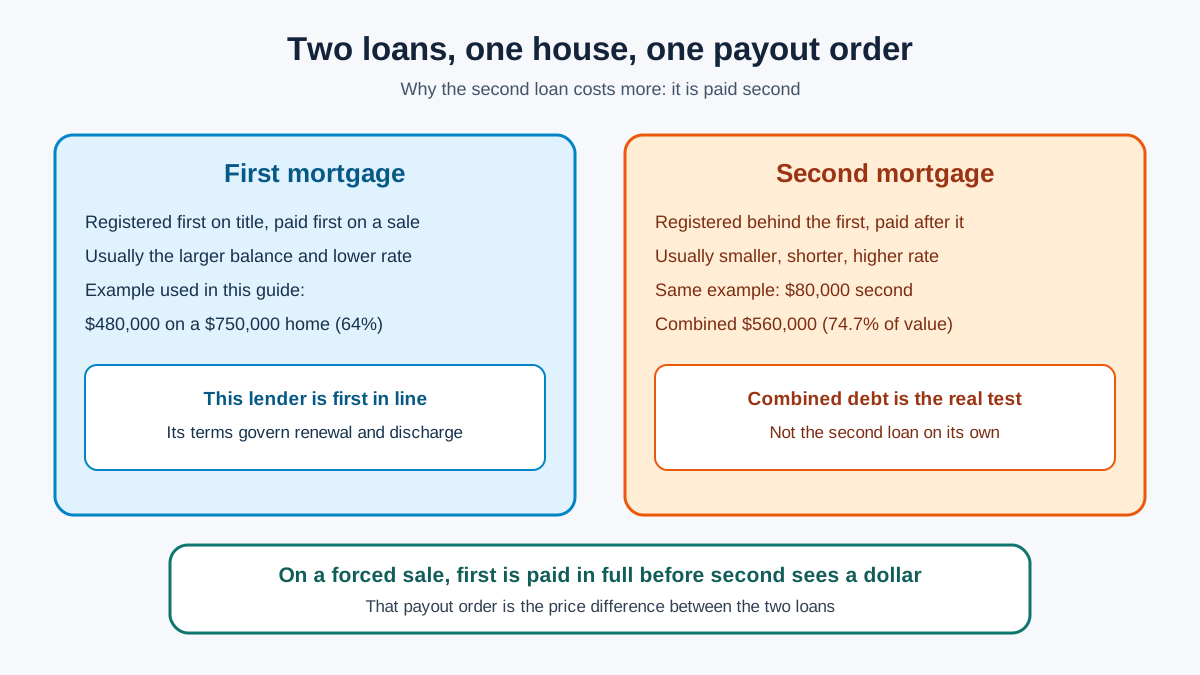
Mortgages are paid from a home's sale proceeds in the order they were registered on title. First registered, first paid. A second mortgage is registered after the first, so it is repaid only after the first mortgage, plus accrued interest and enforcement costs, are cleared.
Three consequences follow from that single fact:
- The rate is higher. The second lender takes the loss first if the sale falls short. The premium over first-mortgage pricing is payment for standing second in line, not a penalty for being a risky person, although weaker credit widens the gap further.
- The loan is smaller and shorter. Second lenders limit their exposure behind someone else's loan. Institutional seconds commonly run one to five years; private seconds are often written for six to twenty-four months with a renewal decision at the end.
- Your first lender's contract still governs the house. Renewal, porting, discharge, and prepayment rules on the first mortgage do not change because a second loan exists, but refinancing the first mortgage usually requires the second lender's written consent to stay in second position (a postponement), and many first lenders require the second to be paid out instead. Price that interaction before you need it, not during a renewal.
A second mortgage can be a lump-sum loan or a home equity line of credit registered in second position. Our home equity borrowing guide compares the four doors (HELOC, home equity loan, refinance, and reverse mortgage) side by side. This guide stays on the lump-sum and institutional second: when it beats those doors, and when it quietly becomes the most expensive one.
Who lends in second position, and why the quotes look nothing alike
Second-position lending is not one market. It is three, with different pricing logic, different paperwork, and different exits.
| Lender type | How it typically prices | What it underwrites hardest | Typical term shape | Watch for |
|---|---|---|---|---|
| Bank or credit union (second-position HELOC or loan) | Closest to prime-based pricing | Income, credit, debt ratios at the stress test | Revolving line or amortizing loan, reviewable | Combined limits, demand features on lines |
| B-lender or alternative institutional lender | Above prime first-mortgage pricing, by a visible margin | Equity, property type, and exit, plus income | 1 to 3 year terms, amortizing or interest-only | Renewal fees, minimum-interest clauses |
| Private lender (individual, syndicate, or mortgage investment corporation) | Set mainly by equity and location, not by your credit score | Appraised value, combined loan-to-value, saleability of the home | 6 to 24 months, frequently interest-only | Lender and broker fees on top of the rate, renewal repricing |
Two federal guardrails shape what institutional lenders can offer. The Office of the Superintendent of Financial Institutions (OSFI) limits the revolving home equity line portion at federally regulated lenders to 65% of the home's value, and total secured borrowing reaches about 80% only when the portion above 65% is an amortizing mortgage, not revolving credit (OSFI Guideline B-20; Financial Consumer Agency of Canada home-equity guidance). Private lenders and provincially regulated lenders are not bound by the same guideline, which is why a private second can be quoted where a bank second cannot. That flexibility is real. So is the price.
Do not compare quotes by rate alone across these three rows. A private quote at a lower rate with a 2% lender fee and a 1% broker fee on a one-year term costs more than a higher-rate institutional quote with no lender fee. The cost stack section below converts every quote to the same dollars.
How much room is actually there: the combined loan-to-value test
Lenders do not size a second mortgage off the second loan alone. They size it off the combined loan-to-value: first mortgage balance plus the new second, divided by the appraised value. Equity is what is left.
Work one house through the arithmetic. The values and rates in this section are labelled illustrations, not quotes.
- Home value (appraised): $750,000
- First mortgage balance: $480,000 (64.0% of value)
- Room to an 80% combined ceiling: $600,000 minus $480,000 = $120,000
- Room to a 65% revolving limit: $487,500 minus $480,000 = $7,500, which is why a fresh HELOC is often quoted as a small limit on a house that feels equity-rich
Borrow an $80,000 second and the combined balance is $560,000, or 74.7% of value. That fits under an 80% combined ceiling with $40,000 of appraisal room to spare. It also means a 6% dip in value (to $705,000) puts the combined loans at 79.4%, and a 12% dip puts them underwater on paper. The second loan did not create that fragility by itself. The combined stack did. Our stress test guide shows how qualification payments are calculated when an institutional lender is involved, and our GDS and TDS guide works the ratio worksheets the underwriter will use.
The full cost stack: rate, fees, and the renewal you have not met yet
Price a second mortgage in four layers. Borrowers who price only the first layer routinely discover the other three at renewal.
1. Interest. On an $80,000 second at a hypothetical 9.99%, interest-only payments are $666 a month, or $7,992 over a one-year term, and the balance is still $80,000 at the end. The same loan amortized over five years at a hypothetical 9.99% costs $1,691 a month and carries about $21,486 of interest across the five years. Interest-only is cheaper per month and more expensive per outcome: nothing is repaid, so the exit has to come from somewhere else. (Payments computed with Canadian semi-annual compounding; interest-only shown at the nominal monthly equivalent. Your contract rate and compounding will differ.)
2. Setup fees. Expect an appraisal, legal and registration costs to put the charge on title, and, where a broker or private lender is involved, lender and broker fees that are frequently quoted as a percentage of the loan. On an $80,000 loan, each 1% is $800. Ask for every fee in dollars, who receives it, and whether it is deducted from the advance. Net advance, not gross loan, is what lands in your account.
3. First mortgage side effects. Registering a second can require notice to, or consent from, the first lender under some first-mortgage contracts, and it can limit a future port or blend. Our collateral charge guide explains why the charge type on your first mortgage decides how easily another lender can take over or share position later.
4. Renewal and exit costs. A one or two year second renews into whatever market exists then. Private seconds may renew at a higher rate plus a renewal fee, or not renew at all, which forces a refinance, a sale, or a payoff from savings on a deadline set by the lender, not by you. Discharge fees and legal costs apply again on the way out.
Now blend the rate, because that blended figure is the real comparison with refinancing. With a $480,000 first at a hypothetical 4.50% and an $80,000 second at a hypothetical 9.99%, the weighted average rate on $560,000 of combined debt is about 5.28%. If a full refinance of $560,000 were available at a hypothetical 4.75% with no penalty, the refinance wins on rate. The second mortgage wins only when the refinance is blocked or expensive: a large prepayment penalty on the first (priced in our prepayment penalty guide), income that no longer qualifies at the stress test, or a first-mortgage rate so low that breaking it to borrow $80,000 more reprices the whole $480,000. That last point is the second mortgage's best case, and it is a rate-preservation argument, not a cheap-money argument.
The debt-consolidation case, priced without the sales pitch
The most common pitch for a second mortgage is killing credit card balances. The math can work. It can also move unsecured debt, which cannot take your house, onto your house, where it can.
Take $30,000 of card debt. At a hypothetical 20.99% repaid over five years, payments are about $811 a month and total interest is about $18,686. A $30,000 second mortgage amortized over five years at a hypothetical 9.99% costs about $634 a month and about $8,057 of interest, a saving of roughly $10,629 before second-mortgage fees. (Card interest shown at a nominal monthly rate; mortgage payments use Canadian semi-annual compounding. Both are illustrations, not quotes.)
Three conditions decide whether that saving survives contact with real life:
- The cards stay at zero. Consolidation that frees card limits, which then refill, leaves the household with the second mortgage plus new card balances. The classic failure is not the rate. It is the refill.
- Fees do not eat the gap. If setup, lender, and broker fees total $3,000 on this $30,000 loan, the net saving falls to roughly $7,629, and the break-even point moves out. On a one-year interest-only second rolled twice, fees are paid three times.
- The exit exists. Consolidation seconds are often written short and interest-only, which pays none of the $30,000 down. A consolidation that does not amortize is a postponement with a fee, unless a dated refinance or repayment plan retires it. Our credit score guide shows what the payoff does to utilization and score over the following months, which is part of the refinance exit for many borrowers.
If the debt exists because income fell, also run the alternative doors before signing: a consumer proposal or a nonprofit credit counselling plan attacks unsecured debt without putting the home behind it. A second mortgage is a secured loan. Missed payments risk enforcement against the house itself, up to and including the power of sale process mapped in our seller closing costs and enforcement coverage. That risk transfer is the price of the lower rate, and it should be named in the decision, not discovered later.
When a second mortgage is the right tool
- Your first mortgage is cheap and breaking it is not. A low fixed rate with years left and a five-figure penalty can make a short, priced second cheaper than repricing the whole balance. Run both with the penalty included.
- The need is specific, dated, and smaller than the room. A renovation with a fixed contract price, tax arrears that stop enforcement, or a bridge to a known event (a sale closing, a maturing investment, a return to work) with a payoff date.
- You qualify for the institutional version. A bank or B-lender second with an amortizing payment, no lender fee, and a term of two years or more is a different product from a one-year private interest-only loan. The first is a tool. The second is a countdown.
- The combined ratio stays sane. Combined debt under 75% of a conservative value, with both payments fitting the household budget at the stress-tested payment, not just the contract payment.
When it backfires
- It funds consumption with no end date. Borrowed against the house for spending that is gone in a year, while the loan renews for three.
- It stacks arrears on arrears. A second taken to catch up a first mortgage that the household still cannot carry buys months, then delivers a worse default with two lenders involved. Talk to the first lender about its own arrears options first; lenders would rather modify than enforce.
- It is sized off an optimistic appraisal. Private approvals lean on value. If the appraisal is generous and the market softens, the renewal math fails first, because the second lender re-prices the new, higher combined ratio.
- The renewal is assumed. Short seconds are underwritten to an exit. If the exit is (in two years my credit or income will be better), that is a hope, not an underwriting fact. Price the no-renewal case: refinance both loans, sell, or pay out. If none of those work today, they are the plan's real terms.
- It quietly blocks the first mortgage's next move. A renewal switch, port, or refinance that needs the second gone or postponed can stall weeks before closing. Our mortgage broker versus bank guide maps how those channels handle layered files, and our porting guide prices the move case directly.
Questions to get answered in writing before you sign
- What is the net advance after every fee is deducted, in dollars?
- Is the payment interest-only or amortizing, and what is the balance on the last day of the term in each case?
- What happens at renewal: is renewal guaranteed, repriced, or at the lender's option? What is the renewal fee?
- Can the loan be prepaid, in part or in full, and at what cost? Is there a minimum-interest period?
- What consent does my first lender require, and have you confirmed the second will not block a renewal switch, port, or refinance of the first? Will you postpone to a future first lender, and for what fee?
- Which appraisal firm sets the value, and can I see the report my fees paid for?
- What triggers enforcement, how much notice do I get, and what are the discharge and legal costs to get out early?
Compare the answers against two live alternatives priced the same week: a refinance quote with the penalty included, and the institutional HELOC or second quote if you qualify. The Financial Consumer Agency of Canada publishes the home-equity and mortgage guides these questions are drawn from. A lender who will not answer in writing has answered.
Frequently asked questions
Is a HELOC a second mortgage?
A standalone home equity line of credit is registered on title, frequently in second position behind a first mortgage, and is often grouped with second mortgages for that reason. The mechanics differ: a HELOC is revolving credit you can redraw, while a lump-sum second mortgage is a fixed advance on a repayment schedule. Federally regulated lenders cap the revolving portion at 65% of value, with total secured borrowing to about 80% only where the portion above 65% amortizes. Our home equity borrowing guide compares the two directly.
How much can I borrow with a second mortgage in Canada?
The sizing test is combined loan-to-value: first balance plus the second, divided by appraised value. Institutional lenders commonly work to about 80% combined, with the revolving portion capped at 65%. On the $750,000 example in this guide, an $80,000 second reaches 74.7% combined. Private lenders set their own ceilings and fees, which is why the written quote, not a general range, decides your file.
Will a second mortgage affect renewing or refinancing my first mortgage?
Yes, plan for it. A new first lender taking over at renewal or refinance needs the second lender to agree to remain in second position (a postponement) or requires the second to be discharged from the proceeds. Either step takes time and may carry a fee, and some first lenders decline layered files. Confirm the postponement terms in your second-mortgage contract before you sign it.
Are second mortgage rates always higher than first mortgage rates?
In practice, yes, because the second lender is repaid only after the first. The size of the gap depends on lender type, combined loan-to-value, property, and credit. A bank second-position line prices closest to prime-based lending; a private one-year interest-only loan prices for equity risk. Compare total dollars over the term, including fees, not the rate alone.
Can I get a second mortgage with poor credit or non-traditional income?
Private and some alternative lenders underwrite mainly to equity and the property, so approval is possible where a bank declines. The trade is price and time: higher rates, lender and broker fees, and short terms with a renewal decision you do not control. Treat that version as a bridge to a dated exit (an amortizing institutional loan, a sale, or restored qualification), not as a long-term mortgage.
What happens if I miss payments on a second mortgage?
The second lender can enforce its security, including starting a power of sale or foreclosure process under provincial law, even though it stands behind the first mortgage. Enforcement costs are added to what you owe, and a default also puts the first mortgage at risk, because first-mortgage contracts treat other secured defaults seriously. Contact both lenders at the first missed payment, not after notices accumulate.
Is a second mortgage better than refinancing?
Only in specific cases: when breaking the first mortgage triggers a large penalty, when the first rate is low enough that repricing the whole balance costs more than a priced second on the smaller amount, or when you no longer qualify to refinance the full balance. The blended-rate test in this guide is the comparison to run, with the penalty and all fees inside it. If the refinance is available at a similar blended cost with one payment and a longer term, it is usually the cleaner structure.
Do I need my first lender's permission to register a second mortgage?
It depends on your first-mortgage contract. Some contracts require notice or consent for further encumbrances, and collateral-charge structures can complicate second-position registrations. Your lawyer checks the existing charge terms before registering the second. Skipping that check can put you in breach of the first mortgage even if every payment is current.
Sources and method: Position and payout order, second-position registration, and HELOC structure follow Financial Consumer Agency of Canada home-equity and mortgage guidance and OSFI Guideline B-20 summaries retrieved October 9, 2026 (revolving HELOC portion to 65% of value at federally regulated lenders; total secured borrowing to about 80% with the portion above 65% amortizing). Lender-type descriptions reflect published institutional and private second-mortgage program material retrieved October 9, 2026; program terms vary by lender and province and are described here as typical structures to verify, not as offers. All home values, balances, rates (4.50%, 9.99%, 20.99%), fees, and payments are labelled hypothetical illustrations: amortizing mortgage payments computed with Canadian semi-annual compounding ($480,000 at 4.50% over 25 years; $80,000 at 9.99% over 5 years = $1,691 a month and about $21,486 of interest; $30,000 at 9.99% over 5 years = $634 a month), interest-only shown at the nominal monthly equivalent ($80,000 at 9.99% = $666 a month), card repayment at a nominal monthly rate ($30,000 at 20.99% over 5 years = about $811 a month). They are not quotes, approvals, or appraisals. Confirm every rate, fee, and renewal term in writing for your file, and get independent legal advice for private-lending contracts.

About David R. Chen, CFA
David R. Chen is a Chartered Financial Analyst and the Senior Housing Economist at BubbleWatch.ca. He brings 12+ years of experience in quantitative real estate analysis and mortgage underwriting. Formerly an analyst at a major Canadian bank, he specializes in modeling payment shock, regional affordability divergence, and private lending risk.
View David's professional bio & credentials →