Open vs Closed Mortgage in Canada (2026): The Price of Flexibility, Priced in Months
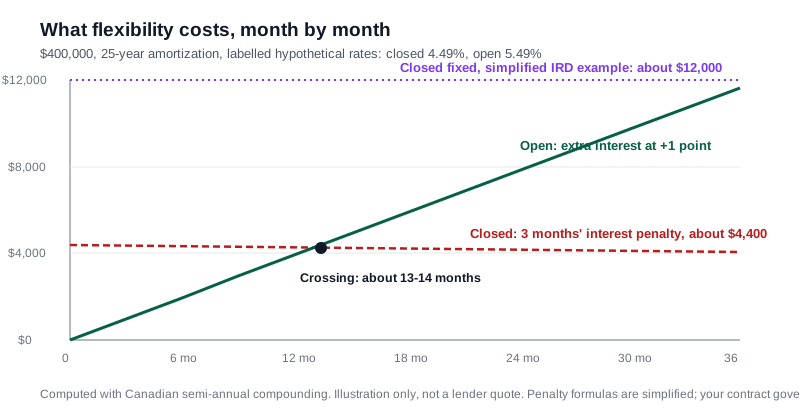
Open and closed are the least explained words in a Canadian mortgage offer, and they decide what it costs to leave. An open mortgage can be repaid in full at any time with no prepayment penalty, and charges a higher rate for that right. A closed mortgage charges a lower rate, limits extra payments to the prepayment privileges in the contract, and charges a penalty if you break it early: usually three months of interest on a variable-rate loan, and the greater of three months of interest or an interest rate differential on a fixed-rate loan. This guide prices the trade on a labelled hypothetical $400,000 mortgage. At a one-point premium, the open mortgage costs about $3,908 of extra interest in the first year, while the closed mortgage's three-month penalty sits near $4,400, so the two lines cross at about 13 to 14 months. Exit sooner and the open mortgage is usually cheaper. Stay longer, with only a three-month penalty waiting, and the closed mortgage pulls ahead. Face a fixed-rate differential penalty and the crossing moves out past three years.
On this page(13 sections)ShowHide
- Open vs Closed Mortgage in Canada (2026): The Price of Flexibility, Priced in Months
- What to do now, step by step
- Two separate choices, often confused
- What each side actually promises
- The premium, priced
- The penalty you are buying your way out of
- The crossing point, in three cases
- The middle option most borrowers actually need
- Who each product suits, stated as tests
- Questions to put to the lender, in writing
- Pre-signing checklist
- Frequently asked questions
- Sources
Open vs Closed Mortgage in Canada (2026): The Price of Flexibility, Priced in Months
Short answer: Open and closed describe how freely you can pay a mortgage off early, and the two words have nothing to do with whether the rate is fixed or variable. The Financial Consumer Agency of Canada (FCAC) puts the difference in one line: the main difference is the flexibility you have in making extra payments or paying off your mortgage. An open mortgage lets you pay any amount, up to the full balance, at any time, with no prepayment penalty. The price of that freedom is a higher interest rate. A closed mortgage carries a lower rate, caps the extra amount you can pay each year at the prepayment privileges written into your contract, and charges a prepayment penalty if you pay more than that, move the mortgage, or pay it off before the term ends. Most Canadian borrowers hold closed mortgages, most of the time for good reason. The open mortgage wins in a specific, priceable situation: you expect to exit soon, and soon has a number.
This is education only, not mortgage advice. Rates in the worked examples are labelled hypotheticals, chosen to show how the arithmetic behaves. Your contract, not this page, sets your privileges and your penalty.
What to do now, step by step
- Find the word open or closed in your mortgage commitment or renewal offer. It sits beside the rate type, and it is a separate choice from fixed or variable.
- Write down the rate gap. Get the closed rate and the open rate for a comparable term from the same lender, on the same day.
- Name your likely exit date. A planned sale, an expected inheritance or bonus, a move for work, or a refinance you already intend all count. "Maybe someday" does not.
- Price the premium. Multiply the gap by your balance for each year you expect to hold the mortgage. The tables below do this properly, with Canadian compounding.
- Price the penalty you would avoid. Three months of interest is balance times rate divided by four. A fixed-rate differential penalty can be several times that; get the lender's own estimate in writing.
- Compare the two totals at your exit date, not at the end of the term. The cheaper line at your date is the answer.
- Check the middle option before you decide. A closed mortgage with generous prepayment privileges covers most households' real extra-payment plans at the lower rate.
- Confirm the exit fees that apply either way. A discharge fee and registration costs are charged on a payout whether the mortgage is open or closed. Open removes the penalty, not every fee.
Two separate choices, often confused
A Canadian mortgage offer asks you two independent questions. Confusing them is the most common reason borrowers buy flexibility they do not need, or give up flexibility they did.
| Fixed rate | Variable rate | |
|---|---|---|
| Closed | Rate and payment stay the same all term. Break penalty is the greater of three months of interest or an interest rate differential. This is the standard Canadian mortgage. | Payment or amortization moves with prime. Break penalty is usually three months of interest. |
| Open | Rate stays the same all term, at a higher level than the closed fixed rate. Repay in full at any time, no penalty. | Rate moves with prime, usually at a premium to the closed variable rate. Repay in full at any time, no penalty. |
Read the table by rows for the exit question and by columns for the payment question. Our fixed vs variable guide works through the columns. This guide works through the rows.
One more distinction matters. Open and closed are about prepayment, not about the other features lenders bundle into an offer. Portability (taking the mortgage to a new home), assumability (a buyer taking it over), and the charge type (standard or collateral) are separate contract terms. A closed mortgage can be portable, and porting is often the cheaper way out of one: our porting guide sets out how that works and where it fails. Check each feature on its own line of the contract instead of assuming the open or closed label covers it.
Advertisement
What each side actually promises
The open promise
The FCAC describes open mortgages this way: they typically have higher interest rates than a closed mortgage with a similar term, and they allow more flexibility if you plan to put extra money toward your mortgage. The agency lists the households an open mortgage may suit: you plan to pay off your mortgage soon, you plan to sell your home soon, or you expect extra money to put toward the mortgage from time to time.
Three limits on that promise deserve plain statement. First, no penalty does not mean no cost at exit. The FCAC's page on breaking a mortgage contract lists the charges to ask about on any early exit: administration fees, appraisal fees, reinvestment fees where they apply, and a discharge fee to remove the charge from title. An open mortgage removes the first and largest item on most bills, the prepayment penalty. The rest of the list still exists. Second, open products are usually offered on shorter terms than the standard five-year closed term, so a borrower who stays has to renew sooner, at whatever rate is then available. Third, the premium is paid every month, in advance, for an exit that may never happen. That timing is the whole economics of the product, and the next sections price it.
The closed promise
The closed side of the bargain is a lower rate in exchange for a cap. The FCAC: closed mortgages typically have lower interest rates than open mortgages with similar terms, and there is usually a limit on the amount of extra money you may put toward your mortgage each year. Your lender writes that limit into the contract as a prepayment privilege. Not all lenders allow prepayment privileges on closed mortgages, and the privileges vary from lender to lender.
In return for breaking the cap, or for ending the contract early, the closed borrower pays a prepayment penalty. The FCAC lists the events that can trigger one: paying more than the allowed additional amount, breaking the contract, transferring the mortgage to another lender before the end of the term, or paying the mortgage back in full before the term ends, including when you sell your home. Our prepayment penalty guide works through the two calculation methods in full. The short version: on a closed variable-rate mortgage the charge is usually three months of interest; on a closed fixed-rate mortgage it is the greater of three months of interest or an interest rate differential, and the differential grows when market rates have fallen below your contract rate and shrinks as your remaining term shortens.
Federally regulated lenders have to show you the machinery before you sign. The FCAC's prepayment rights page states that a federally regulated lender must outline prepayment privileges, charges and other key details in a single prominently displayed information box in your mortgage agreement, and must tell you how it will calculate the charges, with an example or a simplified method where the calculation is complex. If the box is not in front of you, ask for it. It is the page of the contract this entire decision runs on.
The premium, priced
Take a labelled hypothetical $400,000 mortgage with a 25-year amortization. The closed rate is 4.49%. Payments below are monthly, computed with Canadian semi-annual compounding, the basis Canadian fixed rates use.
| Product (all labelled hypothetical) | Rate | Monthly payment | Interest in year 1 | Balance after 12 months |
|---|---|---|---|---|
| Closed | 4.49% | $2,211.67 | $17,613.73 | $391,073.70 |
| Open, half a point higher | 4.99% | $2,324.14 | $19,568.93 | $391,679.21 |
| Open, one point higher | 5.49% | $2,439.24 | $21,522.07 | $392,251.21 |
| Open, two points higher | 6.49% | $2,676.87 | $25,421.39 | $393,298.94 |
Read the interest column as the rent on flexibility. At a half-point gap, flexibility costs $1,955.20 in the first year. At one point, $3,908.34. At two points, $7,807.66. The balance column moves the same way: the higher payment on the open mortgage is mostly interest, so the balance falls more slowly, and a borrower who sells mid-term owes a little more on exit day as well as having paid more along the way.
Two features of this table drive every real decision. The premium scales with the balance: the same one-point gap on an $800,000 mortgage costs roughly twice the dollars, and on a $150,000 mortgage roughly a third as much. And the premium accrues with time. It is small in month three and large by year three. A penalty, by contrast, is a single charge assessed once, on the balance and the date you leave. A cost that grows monthly against a cost that is charged once will cross. Finding the crossing date for your numbers is the decision.
The penalty you are buying your way out of
Price the other side with the same care. Three months of interest on the $400,000 example at 4.49% is $400,000 times 4.49% divided by four, which is $4,490 at the start of the term, falling slowly as the balance falls: about $4,415 after nine months, about $4,338 after 18 months. That is the whole penalty on most closed variable-rate mortgages, and the floor under a closed fixed-rate penalty.
The fixed-rate ceiling is the differential. A simplified differential estimate is balance times rate difference times years remaining, divided as the months run. On the same $400,000, if rates for your remaining term sit one point below your contract rate and three years remain, the simplified estimate is $400,000 times 1% times 3, which is $12,000. Real lender formulas differ: some compare against posted rates, which can produce a larger figure, and the number moves as rates move. Treat $12,000 here as an illustration of the scale, not a quote. The scale is the point. A differential penalty can be two to three times the three-month figure on the same mortgage, and it is largest exactly when rates have fallen, which is exactly when borrowers most want to refinance or when a move becomes attractive.
So the open mortgage is insurance against two different losses of very different sizes. Against a variable-rate exit, it insures a loss of about $4,400 on this balance. Against a fixed-rate exit after a rate fall, it insures a loss that can pass $12,000. The same premium buys both policies. Whether it is well bought depends on which penalty your contract would actually charge, which is a question only your lender's written estimate answers.
The crossing point, in three cases
Same $400,000 mortgage, same rates: closed at 4.49%, open at 5.49%, a one-point premium. Only the exit date changes.
Case A: the home is sold in month 9
| Closed, then break | Open, then repay | |
|---|---|---|
| Interest paid over 9 months | $13,247.59 | $16,181.07 |
| Extra interest paid for flexibility | - | $2,933.48 |
| Penalty at exit | $4,415.27 (three months) | $0 |
| Total cost of the exit path | $4,415.27 in penalty | $2,933.48 in extra interest |
The open mortgage comes out about $1,482 ahead if the closed penalty is the three-month charge, and further ahead by the amount of any differential above that floor. Discharge and registration costs are charged on a sale either way, so they do not change the comparison. A sale, a relocation, or a separation settlement with a date inside roughly the first year is the open mortgage's home ground.
Case B: the exit happens in month 18
| Closed, then break | Open, then repay | |
|---|---|---|
| Interest paid over 18 months | $26,269.74 | $32,122.85 |
| Extra interest paid for flexibility | - | $5,853.11 |
| Penalty at exit | $4,338.01 (three months) | $0 |
| Total cost of the exit path | $4,338.01 in penalty | $5,853.11 in extra interest |
Now the closed mortgage is about $1,515 ahead, if the penalty stays at three months of interest. The premium had 18 months to accumulate and passed the penalty between months 13 and 14. But the conditional clause is doing real work: if this exit is a fixed-rate refinance after rates fell, and the lender's differential estimate comes back at $9,000 or $12,000 instead of $4,338, the open mortgage wins Case B by a wide margin. Month 18 has no single answer. The penalty formula in your contract supplies it.
Case C: no exit at all
If the one-point gap persisted for a full five years, the open borrower pays $103,051.10 of interest against $83,827.50 on the closed mortgage, a difference of $19,223.60, and still owes $5,569.43 more at the end of it. Open terms rarely run five years, so treat this as the limiting case rather than a product quote: flexibility bought and never used is the most expensive option on the table, by a large margin. This is why "I might move someday" is not a reason to pay the premium. A move with a season, a job search with a city named, a property already listed, an estate already in probate: those are reasons. A general feeling that life is uncertain is priced at about $3,900 a year on this balance.
The rule the three cases produce
Divide the penalty you expect by the premium you pay per year. That quotient is roughly how long you can hold the open mortgage before the closed mortgage becomes cheaper: about $4,400 divided by about $3,900 a year gives a little over one year against a three-month penalty; about $12,000 divided by about $3,900 gives a little over three years against the illustrated differential. If your expected exit sits well inside the quotient, price the open mortgage seriously. If it sits well outside, take the closed rate and use the privileges. If it sits near the line, the tie-breakers are the size of your balance (the premium scales, fees do not), the direction rates are moving (a falling-rate path raises the fixed penalty you are insuring), and how firm the exit date really is.
The middle option most borrowers actually need
Households rarely need unlimited prepayment. They need to put a bonus, a tax refund, or a few hundred extra dollars a month against the principal. A closed mortgage's prepayment privileges are built for exactly that, and they are larger than most borrowers use. Privileges are set by each contract, and our prepayment privileges guide sets out the common forms: a lump-sum allowance stated as a percentage of the original principal each year, a payment-increase allowance, and double-up or accelerated payment options. On a $400,000 original principal, a 15% lump-sum privilege is $60,000 a year of penalty-free prepayment room, and a 20% privilege is $80,000. A household expecting a $25,000 inheritance or a $10,000 annual bonus does not need an open mortgage to use that money. It needs to read its privilege line.
The privilege route fails in only two situations. The first is a full payout: privileges never let you repay the whole balance mid-term without a penalty. The second is a prepayment larger than the annual allowance in a single year, where the excess is charged. Both failures are about complete exits and very large lump sums. If neither describes your plan, the closed mortgage at the lower rate, with its privileges used on schedule, is the cheaper machine, and it is not close.
Two neighbouring options also solve some exits without an open term. Blend and extend lets you renegotiate early with your current lender at a blended rate, usually without a prepayment penalty, though administration fees can apply; the FCAC describes the mechanism and our blend and extend guide prices it. Porting, covered above, moves a closed mortgage to a new property. Neither helps a borrower who is leaving housing or leaving a lender entirely, which is the residue of cases where open terms or a priced penalty remain the real choice. At renewal itself, of course, a closed mortgage ends with no penalty at all, and our switching lenders guide covers how to use that free exit.
Who each product suits, stated as tests
The open mortgage passes its test when the exit is dated and near (a sale expected inside about a year at a typical premium), the money to clear the mortgage is in transit (an estate, a business sale, an overseas transfer with a timeline), the term is a bridge between two known events (a purchase closing before a sale, a short posting, a separation agreement being finalized), or the balance is small enough that the premium in dollars is minor while the penalty would not be. Small balances deserve emphasis: at a $120,000 balance, a one-point premium costs roughly $1,170 in the first year, against a three-month penalty of about $1,350 at the same rate. The insurance is close to fairly priced even for an exit in year two.
The closed mortgage passes its test when you expect to serve the term, your extra payments fit inside the privileges, or your exit, if it happens, is a port or a renewal rather than a payout. That describes most borrowers in most terms, which is why closed is the default product and why the rate sheets lead with it. The closed mortgage fails its test when a household signs a five-year closed fixed term weeks before listing the house, or while a relocation the employer has already announced is pending. Those are not bad luck. They are a mismatch between a dated plan and a contract that charges for it.
One trap runs in the other direction. A borrower who does nothing at maturity can be renewed automatically into a short term, often an open term, at the lender's posted rate for that product. The open label there is not flexibility you chose or priced; it is a high rate you drifted into. If your renewal paperwork shows an open term you did not shop for, treat it as a temporary landing spot with a free exit, and use the exit: shop the switch described in our switching guide instead of letting the drift run.
Questions to put to the lender, in writing
- Is this offer open or closed, and where in the commitment does it say so?
- What is the rate on the open version of this same term, quoted today, so the premium is a number and not a guess?
- What are my prepayment privileges on the closed offer: lump-sum percentage, payment-increase percentage, and the dates they reset?
- If I paid this mortgage off in full 12 months from now, what would the penalty be, in dollars, and how is it calculated?
- Which formula applies to the fixed closed offer if I break it: three months of interest, or the greater of that and a differential, and against which comparison rate?
- What fees are charged on a full payout either way: discharge, administration, reinvestment, and any cash-back repayment if I took cash back at origination?
- Is the mortgage portable, and assumable, and is the charge standard or collateral? Our collateral charge guide explains why the last answer changes what a later switch costs.
- Does the qualification change? Both open and closed mortgages are qualified under the same stress test; our stress test guide sets out the qualifying rate. The open label buys prepayment freedom, not easier approval.
Pre-signing checklist
- Open or closed confirmed from the commitment document, not from memory of a conversation.
- Premium measured in dollars per year on your balance, at today's quoted gap.
- Expected exit date written down, with the event that sets it. No event, no premium.
- Penalty priced both ways where both could apply: three months of interest, and the lender's differential estimate for a fixed term.
- Crossing date computed (penalty divided by annual premium) and compared with the exit date.
- Privileges checked against your actual extra-payment plans before paying for unlimited prepayment.
- Portability, assumability and blend-and-extend availability confirmed as separate lines.
- Payout fees that apply either way listed, so the open mortgage is credited only with the penalty it actually removes.
- If renewing into an open term by default rather than by choice, a switch application started instead of a signature.
Advertisement
Frequently asked questions
What is the difference between an open and a closed mortgage in Canada?
An open mortgage can be repaid in part or in full at any time with no prepayment penalty, and it carries a higher interest rate. A closed mortgage carries a lower rate, limits penalty-free extra payments to the prepayment privileges in the contract, and charges a penalty if you exceed them or end the contract early. The choice is separate from fixed versus variable: all four combinations exist.
Is an open mortgage worth it?
It is worth it when a dated exit sits inside the crossing point for your numbers. On a labelled hypothetical $400,000 mortgage with a one-point premium, the open mortgage costs about $3,908 of extra interest in year one, while the closed mortgage's three-month penalty is about $4,400, so an exit inside about 13 to 14 months favours open, and a fixed-rate differential penalty, which can be far larger, extends that window past three years. With no exit planned, the premium is pure cost: about $19,224 over five years if a one-point gap persisted.
How much more does an open mortgage cost per month?
At a one-point rate gap on a $400,000 mortgage with a 25-year amortization, the payment is $2,439.24 against $2,211.67 closed, a difference of $227.57 a month, of which about $3,908 is extra interest over the first year. At a half-point gap the extra interest is about $1,955 in year one; at two points, about $7,808. All figures are labelled hypotheticals computed with Canadian semi-annual compounding.
Can I switch from a closed mortgage to an open mortgage mid-term?
Not by relabelling. Changing the contract before the term ends is breaking the mortgage, which on a closed mortgage triggers the prepayment penalty, plus the other payout costs the FCAC lists. The penalty-free moments to change the open or closed choice are at renewal or on a new purchase. Mid-term, the alternatives are the ones your contract already contains: your prepayment privileges, porting, assumability, or a blend and extend with the same lender.
Does an open mortgage have any fees when I pay it off?
It has no prepayment penalty, but a payout still carries the ordinary exit costs. The FCAC's guidance on breaking a mortgage contract lists administration fees, appraisal fees, possible reinvestment fees, and a discharge fee to remove the charge from title, plus repayment of any cash back received at origination. Open removes the largest and least predictable item, the penalty. It does not make leaving free.
What penalty do I pay if I break a closed mortgage?
On a closed variable-rate mortgage, usually three months of interest on the balance: about $4,490 on $400,000 at 4.49% at the start of a term. On a closed fixed-rate mortgage, the greater of three months of interest or an interest rate differential. A simplified differential estimate on the same balance, with rates one point below the contract rate and three years remaining, is about $12,000. Lender formulas vary and some use posted rates, so get your lender's figure in writing.
If I have a closed mortgage, how much extra can I pay each year without a penalty?
Whatever your prepayment privileges say, and only that. Privileges are set in each contract and vary by lender; common forms are a lump sum each year stated as a percentage of the original principal, plus a payment-increase allowance. On a $400,000 original principal, a 15% privilege is $60,000 a year. Federally regulated lenders must set the privileges and charges out in an information box in your agreement, and in the annual statement. Our prepayment privileges guide explains how to use them on schedule.
Should I take an open mortgage because I might sell in a few years?
Price the might. A one-point premium on $400,000 costs about $3,900 a year, every year, against a three-month penalty of about $4,400 charged once. A sale in year three or four usually makes the closed mortgage the cheaper path even after paying that penalty, unless a fixed-rate differential applies. An open mortgage fits a sale that is planned and near, not a sale that is possible and distant. If the home is listed, a transfer is approved, or a closing is scheduled, the case changes; run the crossing calculation with that date.
Sources
Rules and definitions in this guide were taken from the sources below, read in October 2026. Your mortgage contract and your lender's current schedules govern your file.
- Financial Consumer Agency of Canada (FCAC), Choosing a mortgage that is right for you: the open and closed definitions, the rate relationship between them, the households each may suit, portability, assumability, and standard versus collateral charges: https://www.canada.ca/en/financial-consumer-agency/services/mortgages/choose-mortgage.html
- Financial Consumer Agency of Canada (FCAC), Breaking your mortgage contract: an open mortgage allows you to break the contract without a prepayment penalty, a closed mortgage normally charges one, and the administration, appraisal, reinvestment, discharge and cash-back items to price on any early exit; blend and extend described as an early-renewal option without a prepayment penalty: https://www.canada.ca/en/financial-consumer-agency/services/mortgages/break-mortgage-contract.html
- Financial Consumer Agency of Canada (FCAC), Mortgage prepayment: know your rights: the events that trigger a prepayment penalty, the information box a federally regulated lender must provide, and the annual statement and written-statement rights under the bank code of conduct on prepayments: https://www.canada.ca/en/financial-consumer-agency/services/rights-responsibilities/rights-mortgages/rights-prepayments.html
Worked examples were computed for this guide from the stated balances, rates and amortizations using Canadian semi-annual compounding. They are illustrations of how the arithmetic behaves, not rate quotes, penalty quotes, or a recommendation for any household.
About the BubbleWatch editorial team
BubbleWatch is written and checked by its editorial team under the site brand. Figures come from public sources such as CREA, Statistics Canada, CMHC and the Bank of Canada, and each article links the sources it uses. BubbleWatch is independent of realtor boards and lenders.
Read our full editorial methodology →