Well Water Testing When Buying a Home in Canada
A transaction-ready private-well workflow that separates drinking-water quality, reliable quantity, physical well condition, treatment performance, records, and post-closing monitoring.
Well Water Testing When Buying a Home in Canada: Test Quality, Supply, and Equipment
A private-well purchase needs four separate answers: Is the water safe under the correct laboratory tests? Can the well reliably supply the intended household? Are the well, pump, pressure, storage, and treatment systems in acceptable condition? Do the location, records, rights, and responsibilities fit the title and local rules?
A clear glass of pleasant-tasting water does not answer any of them. Neither does one seller-provided bacteria result. Put water sampling, well inspection, supply testing, record review, and any specialist follow-up inside a condition with enough time for the laboratory and lender.
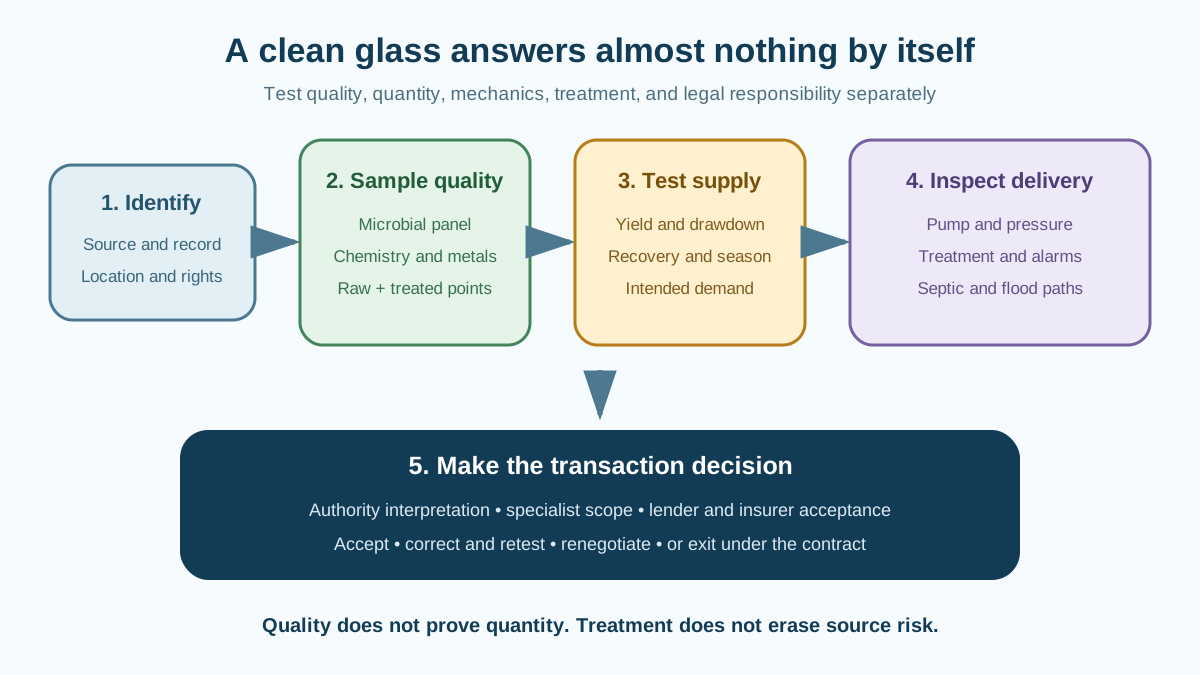
Short answer: test the source, delivery system, and treated water
Use this sequence:
- Identify the source: drilled well, dug well, sand point, spring, surface intake, shared well, or cistern.
- Obtain the well record, location, construction, repair, treatment, and past laboratory history.
- Ask the local public-health or drinking-water authority which microbial and chemical parameters apply.
- Collect samples exactly as the laboratory instructs, with custody and timing documented.
- Where treatment exists, sample raw water and finished water as directed.
- Inspect the wellhead, pump, pressure, storage, treatment, drainage, and nearby contamination risks.
- Test supply or recovery under a defined specialist method where quantity matters.
- Resolve adverse or uncertain results before waiving the condition.
Health Canada's current private-well overview estimates about four million Canadians rely on a private well and states that owners are responsible for monitoring and maintaining quality. Provinces, territories, health authorities, and laboratories provide the local requirements.
Quality, quantity, and mechanics are different tests
| Question | Evidence | What it cannot prove |
|---|---|---|
| Is sampled water microbiologically acceptable? | Accredited/approved lab microbial result | Future safety, chemical quality, well yield |
| Are tested chemicals within applicable guidance? | Correct chemistry/metals panel | Bacteria result, reliable flow |
| Can the well support demand? | Defined yield/recovery or flow test | Drinking-water safety |
| Does equipment operate normally? | Well/pump/plumbing specialist assessment | Aquifer capacity or complete water chemistry |
| Does treatment work? | Raw and treated samples plus equipment review | Source protection without raw result |
| Is the well legally and physically acceptable? | Record, title/survey, local authority, inspection | Lab safety on another date |
A faucet flow demonstration mainly shows that the pump and stored pressure delivered water for that moment. A high-yield test does not make contaminated water potable. A clean bacterial sample does not show that arsenic, manganese, nitrate, uranium, salt, fuel compounds, or another location-specific parameter is acceptable.
Identify exactly what supplies the house
Ask the seller to show, not only describe:
- wellhead, casing, cap, and identification tag where applicable;
- pump, electrical controls, pressure tank, storage, and shutoffs;
- sediment filters, softener, iron or manganese treatment, carbon, reverse osmosis, ultraviolet unit, chlorination, or other equipment;
- untreated sampling point and treated sampling point;
- septic tank and field relative to the well;
- fuel tanks, livestock areas, manure, chemical storage, former dump, flood path, and surface drainage;
- shared lines, easements, agreements, meters, or neighbour access;
- backup cistern or hauled-water connection.
Match those observations to the well record and survey. Ontario's well-owner page covers location, construction, maintenance, and abandonment rules for residential wells. Other provinces use their own systems.
If the seller cannot locate the well, do not sample an indoor tap and assume the legal or physical source is understood. A buried wellhead, abandoned well, cross-connection, or shared source needs specialist and legal review.
Collect the records before the sample
Request:
- original well log or construction record;
- drilling depth, casing, screen, static water level, and reported yield;
- pump model, depth, installation, and service invoices;
- prior flow, recovery, or drawdown tests;
- past microbial, chemistry, and metals results with dates;
- treatment design, settings, media changes, lamp and sleeve service;
- disinfection, shock-chlorination, repair, and contamination history;
- flood, drought, dry-well, hauling, or water-shortage history;
- shared-well agreement and bills;
- permits, tags, variance, or abandonment record;
- septic layout and pumping/inspection history.
Older records are useful trends, but they do not replace a current transaction sample. A clean test from winter may not describe spring runoff. A test taken just after disinfection may not show stable conditions.
Choose tests with the local authority, not a sales package
Health Canada's well-testing guidance says to test at least every six months for microbial contamination and to ask the local authority about chemical frequency. It recommends general water-quality parameters every two years and additional testing where a contaminant risk exists.
Its examples include testing after flooding, heavy rain, extended dry periods, repairs, changes in taste/odour/colour, illness concern, or nearby fuel spill. This federal guidance supports a baseline; local authorities can recommend different panels or frequency.
Microbial testing
Laboratories commonly analyze indicator organisms such as E. coli and total coliforms under the applicable program. Use the result language and action instructions from the issuing authority.
Microbial results can change rapidly. A negative result means the specified organisms were not detected under that method in that sample; it is not a lifetime guarantee.
General chemistry and metals
The panel should follow regional geology, land use, well type, source history, and public-health advice. Possible parameters include pH, hardness, alkalinity, turbidity, conductivity or dissolved solids, nitrate/nitrite, iron, manganese, arsenic, uranium, lead, sodium, chloride, sulphate, fluoride, and others.
Do not select a contaminant by colour alone. Some health-relevant chemicals have no obvious taste, smell, or appearance.
Event- or site-specific testing
Nearby agriculture, a former fuel tank, fire, flooding, landfill, industrial activity, mining, road salt, septic failure, pesticide storage, or other source may justify a specialist-selected panel. Broad testing without a conceptual site model can still miss the relevant compound.
Ask an environmental or drinking-water professional which analytes, detection limits, methods, and sampling locations fit the concern. Do not let a water-treatment salesperson define the health test and sell the remedy without independent confirmation.
Follow the laboratory's sample instructions exactly
Sampling errors can make a result unreliable. Obtain bottles from the approved laboratory or authority and follow its current instructions.
Confirm:
- correct sterile or preserved container for each analysis;
- tap location and whether aerator, hose, filter, or treatment is removed or bypassed;
- required flushing time;
- whether the sample is raw or treated;
- date and exact time collected;
- collector identity;
- temperature/cooling requirements;
- holding time and delivery cutoff;
- chain-of-custody form and property identifier;
- recent disinfection, repair, vacancy, or treatment service;
- laboratory accreditation or approval for the requested method.
Do not rinse a sterile bacteria bottle. Do not transfer water from another container. Do not use an old food jar. If the sample misses its holding time, resample rather than asking the lab to bless it.
For a purchase, arrange custody so both parties can trust that the sample came from the subject property. A qualified neutral sampler or laboratory collection service can reduce disputes.
Sample raw and treated water for different questions
Treatment can make finished water acceptable while hiding poor source quality or a maintenance burden. A raw-water sample describes the source at that location and time. A post-treatment sample tests performance at a specified outlet.
Nova Scotia's current private-well real-estate checklist directs buyers using treatment to sample before and after the system. It also calls for transaction-specific bacteria and full chemistry/metals testing under that province's process.
Use this layout:
| Sampling point | Purpose | Label clearly |
|---|---|---|
| Raw water before treatment | Source quality and treatment need | “Raw/source” |
| After whole-house treatment | Treatment performance | Equipment and last service |
| Drinking tap after point-of-use unit | Delivered drinking water | “Finished/POU” |
| Other building or line | Distribution or shared-system question | Exact location |
Do not bypass treatment without a specialist if doing so can damage equipment, release contamination, or create unsafe plumbing conditions.
Interpret a result with the issuing authority
A laboratory report contains units, detection limits, methods, qualifiers, and reference values. Ask the local public-health or drinking-water authority to interpret health significance and actions.
Use a result ledger:
| Parameter | Raw result | Treated result | Applicable value | Authority interpretation | Action |
|---|---|---|---|---|---|
| E. coli | |||||
| Total coliforms | |||||
| Nitrate/nitrite | |||||
| Arsenic | |||||
| Manganese | |||||
| Uranium | |||||
| Lead | |||||
| pH/hardness/turbidity |
Units matter. Milligrams per litre and micrograms per litre differ by a factor of 1,000. A laboratory's aesthetic or operational flag is not necessarily a health exceedance, and an unflagged parameter is not proof that an untested contaminant is absent.
Health Canada's drinking-water guideline tables distinguish health-based maximum acceptable concentrations and aesthetic or operational guidance. Local adoption and actions belong to the responsible jurisdiction.
If a bacteria result is adverse
Follow local instructions immediately. Depending on the organism, users, and circumstances, the authority may advise stopping consumption, boiling, using another water source, resampling, inspecting the well, correcting entry paths, disinfecting, or investigating septic/flood contamination.
Health Canada's well-treatment guidance says to contact the local authority if E. coli or total coliform results continue and to resume usual use after testing shows the water is no longer contaminated under the recommended process.
For a transaction, do not accept “we shocked it and it passed once” as a complete diagnosis. Ask:
- What likely caused the result?
- Was the sample valid?
- Was the casing, cap, grading, plumbing, treatment, septic, or flood path inspected?
- What correction was completed?
- How much time passed after disinfectant was flushed?
- How many follow-up samples does the authority recommend?
- What ongoing monitoring is required?
Disinfection can address organisms present at the time. It does not repair a cracked casing, flooded wellhead, failed septic field, or persistent contaminant pathway.
Chemical treatment needs proof and lifetime cost
If a chemical result requires action, obtain independent advice on source correction, treatment feasibility, waste stream, maintenance, verification, and health.
Price the full system:
- equipment and professional design;
- plumbing, electrical, drain, ventilation, and space;
- consumables, media, salt, filters, lamps, membranes, and chemicals;
- power and water waste;
- backwash or reject-water disposal compatibility with septic;
- service visits and replacement intervals;
- raw and treated verification testing;
- alarms, bypass prevention, and failure response;
- effect on taste, corrosion, scaling, and appliances;
- future buyer, lender, and insurance disclosure.
A treatment quote is not evidence that the proposed unit is certified, sized, installed, and effective for the exact water chemistry. Ask the authority or qualified professional what performance evidence is required.
Test water quantity under a defined method
Households need enough supply for peak use and recovery, including seasonal low-water conditions. Well records may show an original yield, but aquifer, equipment, usage, and nearby withdrawals can change.
Ask a qualified well contractor what test fits the well and jurisdiction. Record:
- static water level before pumping;
- pumping rate and duration;
- drawdown during test;
- water level recovery after pumping;
- storage capacity and pressure-tank contribution;
- season, recent precipitation, and drought context;
- turbidity, sand, air, or pump cycling observations;
- whether the test assesses well yield, pump delivery, or only household flow.
A five-minute faucet test can be supported by stored pressure and does not establish long-run well recovery. Conversely, a low indoor flow may result from a clogged filter or failing pressure tank rather than the aquifer.
Model the intended household, livestock, irrigation, pool, rental unit, and fire-protection needs separately. Confirm that proposed use is legally permitted and physically supportable.
Inspect the wellhead and equipment
Health Canada's well-protection guidance recommends inspecting the well at least annually and watching for changes in colour, taste, or smell.
A transaction inspection can include, within specialist scope:
- accessible casing, cap, seal, vent, and electrical entry;
- height and grading relative to surface runoff;
- damage, corrosion, loose fittings, insects, or openings;
- distance from septic, fuel, animals, drainage, and contamination sources under local rules;
- pump operation and electrical controls;
- pressure tank, switch, gauge, cycling, and leaks;
- treatment equipment, bypasses, drains, settings, and alarms;
- abandoned or unused wells;
- freeze protection and backup supply;
- signs of flooding or vehicle damage.
Do not open electrical or pressurized equipment without qualification. Do not enter a well, cistern, or confined space.
Shared wells require an agreement audit
A shared well adds service and legal dependency. Have the lawyer review registered and unregistered arrangements.
Confirm:
- ownership of well, land, pump, line, and electrical service;
- legal easements for access, pipe, repair, and replacement;
- permitted users and maximum demand;
- cost allocation for power, testing, treatment, repair, and new capital;
- control of shutoff and emergency access;
- sampling responsibility and result sharing;
- insurance and liability;
- dispute and non-payment process;
- effect of subdivision, sale, vacancy, or additional unit;
- backup when the relationship or equipment fails.
A friendly history between current neighbours is not a durable operating agreement for future owners.
Connect the well and septic reviews
The water source and wastewater system share the site. Septic location, soil, slope, groundwater, surface drainage, flood exposure, loading, and failure can affect the well.
Coordinate the specialists so each receives:
- well and septic records and locations;
- survey or site sketch;
- laboratory history;
- flood and drainage observations;
- proposed household size and extra units;
- inspection findings and limitations.
The septic system inspection guide separates records, tank condition, field performance, legal capacity, access, and replacement feasibility. Do not approve one system while ignoring the other.
Write a usable water condition
The purchase condition should be drafted for the property and jurisdiction with legal advice. Consider whether it needs to cover:
- well and equipment inspection by a qualified person;
- specified microbial and chemical testing;
- raw and treated samples;
- quantity/recovery testing;
- access, utilities, treatment operation, and seller authorization;
- seller records and disclosures;
- buyer satisfaction or defined professional standard;
- specialist follow-up after an adverse result;
- enough time for laboratory turnaround and repeat samples;
- allocation of cost;
- restoration after testing;
- buyer's contractual options and notice deadline.
A condition saying only “water potability” may not cover quantity, equipment, treatment expense, or legal access. Ask the lawyer to align the wording with lender and insurer requirements.
Worked buyer file
Assume a rural Ontario home has a drilled well, UV unit, softener, iron filter, pressure tank, and septic system. The seller provides one clean bacteria result from 18 months ago and no chemistry report.
The buyer's evidence plan could be:
| Question | Test or record | Decision effect |
|---|---|---|
| Source identity | Well record, tag, location | Match property and construction |
| Current microbes | Correct raw and treated samples | Health authority interpretation |
| Chemistry/metals | Local-authority panel | Treatment and suitability |
| Supply | Contractor-defined recovery/yield test | Intended household demand |
| Equipment | Pump, pressure, UV, filter assessment | Repair and operating budget |
| Septic relationship | Layout and specialist inspection | Contamination and capacity risk |
| Treatment cost | Consumables/service history and quote | Annual ownership cash |
If treated water passes but raw water has a health-relevant contaminant, the buyer should determine whether the treatment is designed and verified for it, what happens on power or equipment failure, how often to test, and whether the lender and household accept ongoing dependence.
Post-closing monitoring calendar
Transfer the laboratory and equipment plan into the home maintenance reserve.
At minimum, schedule under current local guidance:
- microbial samples at the jurisdiction's routine frequency and after risk events;
- chemistry/metals at the advised interval;
- annual visible well inspection;
- treatment service, media, lamp, filter, and calibration dates;
- raw and treated verification after material treatment work;
- septic maintenance and inspection;
- pump, pressure, alarm, and backup checks;
- record retention for future sale.
Health Canada's national baseline is at least six-monthly microbial testing and general water-quality parameters every two years, with contaminant-specific advice from local authorities. Nova Scotia currently advises at least annual bacteria and five-year chemical testing on its general page, illustrating why owners must follow their jurisdiction rather than copy a schedule from another province.
Common well-purchase mistakes
- relying on taste, colour, smell, or clarity;
- accepting one bacteria test as full chemistry;
- sampling only after treatment;
- confusing indoor flow with sustainable well yield;
- taking a sample in the seller's unlabelled bottle;
- missing holding time or chain of custody;
- testing immediately after disinfection without disclosure;
- ignoring seasonal, flood, drought, agricultural, or fuel risks;
- buying treatment before identifying the contaminant;
- overlooking annual consumables and septic discharge impact;
- failing to locate abandoned or shared wells;
- waiving the condition before repeat results arrive.
Frequently asked questions
How often should a private well be tested in Canada?
Health Canada advises at least every six months for microbial contamination and general water-quality parameters every two years, with chemical frequency based on local risk and authority advice. Provincial recommendations differ, so follow the responsible local authority.
Is a bacteria test enough before buying?
No. It does not assess many chemical contaminants, water quantity, pump condition, treatment operation, construction, location, or legal rights. Ask the local authority which tests and inspections fit the property.
Should water be sampled before or after treatment?
Often both, under laboratory and authority instructions. Raw water describes the source; post-treatment water tests delivered performance. Label the points and equipment state.
Does a clean water test prove the well will not run dry?
No. Quality and quantity are different. A qualified well contractor can advise on a yield, recovery, drawdown, or other supply test suitable for the well.
Can I trust an old seller test?
Use it as history, not a current transaction result. Confirm sample point, method, laboratory, date, recent treatment, and event context, then obtain current buyer-controlled testing.
Does a failed bacteria test mean the property cannot be bought?
It requires prompt authority guidance and diagnosis. Some causes are correctable; others indicate persistent source, construction, flood, or septic risk. Resolve the cause, correction, repeat-testing protocol, cost, and acceptance before becoming firm.
Is boiling a permanent solution?
No. Boiling may be part of temporary microbial advice from an authority, but it does not remove many chemicals and does not repair the well or contamination pathway.
Who should interpret the laboratory report?
Use the local public-health or drinking-water authority and qualified professionals. A laboratory reports results, while the authority connects them to applicable health guidance and actions.
What to read next
- Coordinate well, septic, access, title, and land-use due diligence
- Inspect septic performance and future replacement feasibility
- Keep specialist access inside the home-inspection condition
- Add treatment and equipment to the maintenance reserve
Method and sources
This guide was updated July 19, 2026. It uses current Health Canada private-well testing, treatment, maintenance, and drinking-water guidance; current Ontario and Nova Scotia owner and transaction resources; and local-authority-first sampling principles. Health actions and required parameters are property- and jurisdiction-specific. Obtain current public-health, laboratory, well-contractor, legal, lender, insurance, and environmental advice before acting.
Advertisement

About David R. Chen, CFA
David R. Chen is a Chartered Financial Analyst and the Senior Housing Economist at BubbleWatch.ca. He brings 12+ years of experience in quantitative real estate analysis and mortgage underwriting. Formerly an analyst at a major Canadian bank, he specializes in modeling payment shock, regional affordability divergence, and private lending risk.
View David's professional bio & credentials →