Cooling-Off Periods When Buying a Home in Canada: BC's 3 Days, the New-Build 10-Day Windows, and Everywhere With None
Whether you can change your mind after signing for a home in Canada depends on the province and on what you bought, and the differences are total. A BC buyer of almost any home gets three business days to walk away for 0.25 percent of the price, a right neither side can waive. A buyer of a new condo from a builder in Ontario or Alberta, or a new home under a Quebec preliminary contract, gets ten days. A resale buyer anywhere outside BC gets no statutory window at all: once the offer is firm, the deposit and a damages claim are on the table. This guide maps every window with its fee, refund rule and start trigger, works the BC deadline on a real October 2026 calendar, prices the fees at five price points, and sets out the contract conditions that do the same job in the provinces with no window.
Cooling-Off Periods When Buying a Home in Canada: BC's 3 Days, the New-Build 10-Day Windows, and Everywhere With None
Short answer: British Columbia is the only province that gives a buyer of an existing home a cooling-off period: three business days after acceptance to rescind, at a fee of 0.25 percent of the purchase price, under the Home Buyer Rescission Period in force since January 3, 2023. Everywhere else, a statutory window exists only on specific new-build purchases: ten days for a new condominium bought from the builder in Ontario, ten days for a new condominium bought from a developer in Alberta, ten days to withdraw from a preliminary contract on a new home in Quebec, and seven days on a BC development marketed under the Real Estate Development Marketing Act. A resale purchase in any province other than BC has no cooling-off period. Neither does a new freehold home in Ontario today. Once an offer in those markets goes firm, changing your mind is a breach of contract, not a refund.
This guide is general education about how the rules are structured. It is not legal advice. Rescission deadlines are short, they are counted differently in each province, and a notice served a day late or to the wrong address is worth nothing. If you are inside a window right now, a real estate lawyer in the province of the property comes before the rest of this page.
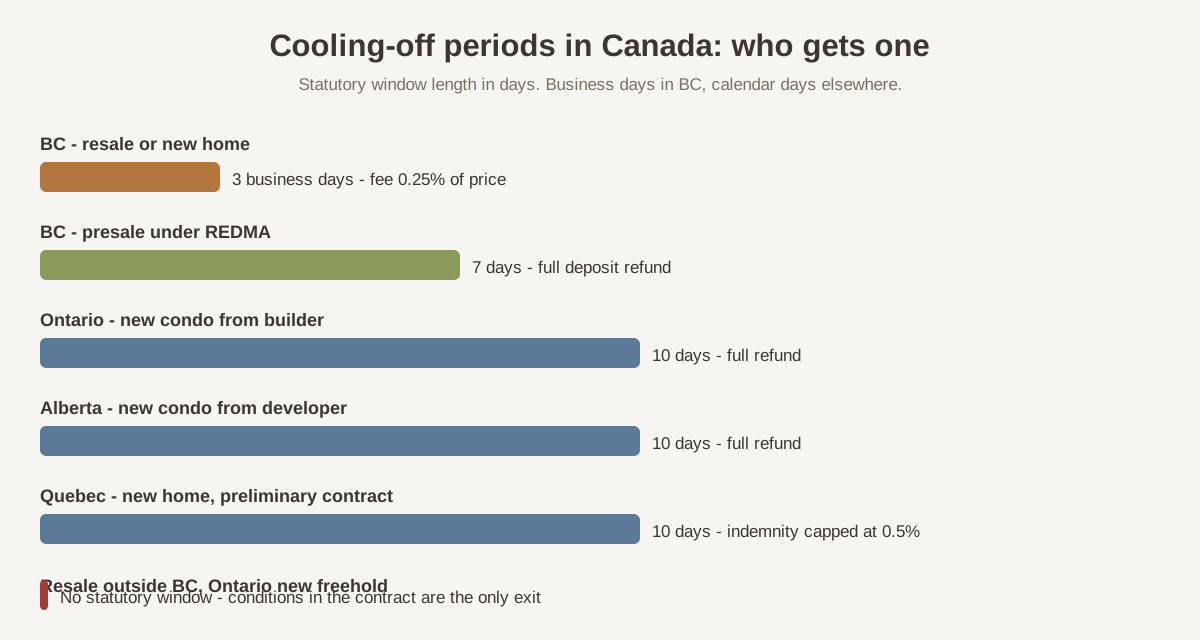
The whole map on one table
| Purchase | Window | How days count | Cost of walking away | Legal source |
|---|---|---|---|---|
| BC, resale or new home (most residential types) | 3 business days after acceptance | Business days; weekends and holidays excluded | 0.25% of the purchase price, paid to the seller | Property Law Act and Home Buyer Rescission Period Regulation |
| BC, new development marketed under REDMA | 7 days after the later of signing or receiving the disclosure statement | Calendar days | None; deposit returned promptly | Real Estate Development Marketing Act, section 21 |
| Ontario, new condo bought from the builder | 10 days after receiving the signed agreement and the disclosure package, whichever completes last | Calendar days, weekends included | None; all money paid refunded with interest | Condominium Act, 1998, section 73 |
| Ontario, resale home of any kind | None | n/a | Deposit at risk, plus damages if the seller loses money | No statute; contract law |
| Ontario, new freehold home from a builder | None in force today | n/a | Whatever the builder agreement says | Homeowner Protection Act, 2024 passed a 10-day right that has not been proclaimed in force |
| Alberta, new condo bought from a developer | 10 days after signing; extended if disclosure documents arrive late | Calendar days | None; full refund | Condominium Property Act (Alberta) |
| Alberta, resale home or new non-condo home | None | n/a | Deposit at risk, plus damages | No statute; contract law |
| Quebec, new home sold by a builder or developer to an owner-occupier | 10 days after signing the preliminary contract | Calendar days | Only if the contract sets an indemnity, capped at 0.5% of the agreed price | Civil Code of Quebec, articles 1785 and 1786 |
| Quebec, resale home | None | n/a | Deposit at risk, plus damages | No withdrawal right; conditions in the promise to purchase govern |
| Resale in Manitoba, Saskatchewan, Atlantic Canada and the territories | None | n/a | Deposit at risk, plus damages | No general statutory cooling-off period |
Two patterns explain the table. Legislatures aimed cooling-off rights at information problems: a buyer signing for a home that does not exist yet, sold from plans by a developer, gets time to read the disclosure. And BC, alone, decided the pressure of a resale bidding contest was itself the problem worth a pause. If your purchase does not sit in one of the window rows, your protection was never a window. It was the conditions you negotiated before you signed, covered in the section on no-window provinces below.
British Columbia: three business days on almost every home purchase
The Home Buyer Rescission Period (HBRP) sits in the Property Law Act and its regulation, and the BC Financial Services Authority (BCFSA) administers the guidance. The mechanics:
- Who gets it. Any buyer of residential real property in BC, whether or not a real estate licensee is involved. A private sale gets the same three days as a brokerage sale. Only buyers can rescind; sellers cannot.
- What it covers. A detached house, a semi-detached house, a townhouse, an apartment in a duplex or other multi-unit building, a residential strata lot, a manufactured home affixed to land, and a cooperative interest that includes a right to occupy a dwelling.
- What it excludes. Property on leased land, a leasehold interest, a property sold at auction, and a property sold under a court order or court supervision. A purchase where section 21 of the Real Estate Development Marketing Act applies is also outside the HBRP, because that Act carries its own seven-day right, covered next.
- The fee. 0.25 percent of the purchase price, paid to the seller. No reason needs to be given.
- No waiver. The right cannot be waived by the buyer or the seller, and a contract term that tries to remove it does not work. Licensees must disclose the right when an offer is prepared or presented, in the standard contract of purchase and sale or on BCFSA's disclosure form.
- The notice. The buyer must notify the seller in writing before the period expires. Serve it by a method the regulation permits, addressed as the contract directs, and keep proof of delivery with the date and time on it. A rescission that cannot be proven to have arrived in time is a dispute, not an exit.
The fee at common BC price points:
| Purchase price | Rescission fee at 0.25% |
|---|---|
| $500,000 | $1,250 |
| $750,000 | $1,875 |
| $900,000 | $2,250 |
| $1,200,000 | $3,000 |
| $1,600,000 | $4,000 |
Where the deposit sits decides how the fee is collected. BCFSA's deposit guidance is specific: if the buyer's brokerage is holding the deposit, the brokerage pays the 0.25 percent fee directly to the seller and returns the rest of the deposit to the buyer, and no separate deposit release form needs to be signed by either party. That is a sharp contrast with a failed subject clause, where the brokerage normally needs a signed release from both sides before it can move the money. If no brokerage is holding a deposit, the seller may need legal help to collect the fee, which BCFSA flags in its seller guidance. Our deposit guide works through where deposits sit and what puts them at risk in each province.
The deadline, worked on a real calendar
Business days are where buyers miscount. Weekends and holidays do not count, and the count starts the day after acceptance. Take an offer accepted on Wednesday, October 21, 2026:
- Day 1: Thursday, October 22
- Day 2: Friday, October 23
- Saturday and Sunday, October 24 and 25: not counted
- Day 3: Monday, October 26
The written notice has to reach the seller before that third business day runs out. Accept the same offer on a Friday and the third business day lands on the following Wednesday, because the weekend sits inside the count without adding days. A holiday inside the window pushes the deadline a day further. Count from your own acceptance date, in writing, and have your licensee or lawyer confirm the count the same day the offer is accepted, not on day three.
BC presales run on a different clock
A new development marketed under the Real Estate Development Marketing Act (REDMA) is exempt from the HBRP because section 21 of REDMA gives the purchaser a separate right: rescind by written notice to the developer within seven days after the later of the date the purchase agreement was made and the date the developer obtained the purchaser's written acknowledgement of having had the opportunity to read the disclosure statement. Deposits on these purchases must be held in trust by a brokerage, lawyer or notary, and if a purchaser rescinds under section 21, the deposit holder must promptly return the deposit. Two traps live here. First, seven calendar days is shorter in practice than buyers expect once a weekend is inside it. Second, if a developer never delivers a disclosure statement the purchaser was entitled to, section 21 allows rescission at any time, which is a fact pattern for a lawyer, not a self-help deadline.
Ontario: ten days, but only for a new condo bought from the builder
Section 73 of the Condominium Act, 1998 gives the purchaser of a new condominium unit from the declarant (the builder) a right to rescind the agreement within ten days, for any reason, with no penalty. The clock starts on the latest of the day the purchaser receives the disclosure statement, the day the purchaser receives the condominium guide, and the day the purchaser receives a copy of the agreement signed by both sides. The days are calendar days, weekends included. Rescission is by written notice received by the developer within the ten days, and the developer must refund all money credited toward the purchase price, with interest at the prescribed rate. The ten days are the working window for the steps that cannot be done at a sales centre: a lawyer reads the disclosure statement and the agreement, the buyer confirms financing against the real deposit schedule, and the closing cost stack gets priced. Our new home warranty guide covers the Tarion side of the same purchase, and the status certificate review guide covers the document a resale condo buyer relies on instead, because a resale condo buyer gets no ten days.
The limits matter as much as the right:
- Resale condos get nothing. A condo bought from an owner through a listing is a resale, even if the building is two years old. No statutory window.
- Assignment purchases get nothing. Buying someone else's pre-construction contract is not buying from the declarant. The assignment sale guide covers the tax and contract stack that applies instead.
- New freehold homes get nothing yet. The Homeowner Protection Act, 2024 received royal assent on June 6, 2024 and wrote a ten-day termination right for purchasers of new freehold homes into the New Home Construction Licensing Act, 2017. That right takes effect only when proclaimed, the supporting regulation setting out the prescribed information has not been passed, and as of October 2026 the right is not in force. A buyer signing a builder's freehold agreement today is bound on signing, subject only to conditions negotiated into the agreement itself. Because proclamation can happen with little notice, check the current status before you sign, and get any lawyer-review or financing condition in writing in the agreement rather than assuming a window exists.
Alberta and Quebec: ten-day windows that open only on new builds
Alberta. The Condominium Property Act lets a buyer of a new unit from a developer cancel the purchase agreement within ten days of signing it. If the buyer did not receive all the required disclosure documents before signing, the cancellation period extends to ten days after receiving them. Condo Law for Albertans, the public legal education project run by the Centre for Public Legal Education Alberta, states the developer must provide a full refund within 15 days of receiving the buyer's written notice to cancel. The purchase agreement itself must explain how to cancel, in the prescribed form. Nothing equivalent exists for an Alberta resale home or a new house that is not a condominium: those buyers rely on inspection and financing conditions, and on the deposit consequences in the standard contract.
Quebec. Article 1785 of the Civil Code of Quebec requires that the sale of an existing or planned residential immovable by its builder or a developer to a person who buys it to occupy be preceded by a preliminary contract, and that contract must include a stipulation letting the buyer withdraw the promise within ten days after signing it. Where a memorandum (the divided co-ownership disclosure document) must be given and was not in the buyer's hands at signing, the buyer may withdraw until receiving it, or within ten days after receiving it. Article 1786 caps the price of using the right: if the preliminary contract provides for an indemnity when the buyer withdraws, the indemnity may not exceed 0.5 percent of the agreed sale price. Two consequences follow. First, the indemnity is a ceiling, not a standard charge: a contract that sets no indemnity gives a free exit, and a contract that sets one cannot set it above the cap. Second, the right belongs to the owner-occupier buying from the builder or developer. An investor buying to rent, and any buyer of a resale home, is outside article 1785 and works with the conditions in the promise to purchase instead.
The Quebec cap at three price points:
| Agreed price | Maximum indemnity at 0.5% |
|---|---|
| $400,000 | $2,000 |
| $650,000 | $3,250 |
| $900,000 | $4,500 |
Everywhere with no window: the conditions are the cooling-off period
Most Canadian home purchases happen where the table says none. In those markets the exit doors are built into the offer itself, and they close on their own deadlines:
- Financing condition. The buyer may end the contract if a real, documented effort to get the stated financing fails by the deadline. What counts as a real effort, and what a lender refusal has to look like, is the subject of our financing condition guide. A buyer who never applied cannot use the condition as a change-of-mind clause.
- Inspection condition. A professional inspection that turns up material problems lets the buyer walk away inside the condition period, on the wording of the clause. Our inspection clause guide covers the drafting traps, including clauses that require the defect to be serious before the exit works.
- Status certificate or strata document review. A condo buyer's review condition is the resale substitute for the new-condo ten days: the financial state of the corporation, its reserve fund and its rules, read before the deal goes firm.
- Lawyer review and sale-of-home conditions. Less common in competitive markets, and sellers may refuse them, but a short lawyer-review condition is the closest contractual copy of a cooling-off period, and builders of new freehold homes in Ontario sometimes accept one where no statute forces their hand.
Once every condition has been waived or satisfied, the offer is firm, and the arithmetic of changing your mind changes completely. The seller keeps the deposit argument: deposits are generally forfeited when a buyer defaults, and the seller can also sue for the real loss, which is usually the difference between your price and the price the home eventually sells for, plus carrying and re-listing costs. On a falling market that second number can be much larger than the deposit. Buyers in this position sometimes negotiate a mutual release, paying the seller to end the contract cleanly, and sellers sometimes accept when a resale looks easy. None of that is a right. It is a negotiation conducted, on both sides, through lawyers, and the closing costs guide shows where a collapsed deal leaves the money already spent on inspections, appraisals and legal work. The practical rule for no-window provinces is the one BC buyers do not need: finish your doubts before you sign, because after you sign, doubt is priced in deposits and damages.
Use the window like a deadline, not a holiday
A cooling-off period only pays if the work happens inside it. In order:
- Day one: send the full agreement to a real estate lawyer. In BC that means the contract and the disclosure of the right of rescission; on a new build anywhere, the disclosure statement or memorandum and the deposit schedule. Legal review found on day nine of ten is a coin toss.
- Confirm the financing against this home, not a general pre-approval. The lender needs the actual property, the actual deposit schedule and, on a new build, the completion timeline. A pre-approval letter written before the property existed is not confirmation.
- Quote home insurance on the address. Insurability surprises, from flood exposure to old wiring, surface here while an exit still exists.
- Read the building, not the brochure. Strata minutes and depreciation reports in BC, the disclosure statement in Ontario and Alberta, the memorandum in Quebec. The documents the window exists to let you read are the ones that change decisions.
- Decide in writing before the last day. If you are rescinding, the notice goes out with a day to spare, by a permitted method, with proof of delivery kept. Deadlines counted in business days in BC and calendar days elsewhere have ended more exits than sellers have.
Sellers sit on the other side of the same clock. In BC a seller cannot refuse a valid rescission, cannot negotiate the fee, and receives the 0.25 percent from the deposit where a brokerage holds it, with the balance returned to the buyer and no release form required. In Ontario a builder who receives a valid section 73 notice refunds everything paid, with interest, and a builder who argues with the deadline invites a regulator complaint. Everywhere, a seller whose deal collapses inside a statutory window has lost days on market, not a deposit, which is why listing agents price the small chance of a rescission into how they handle the first week of a BC sale.
Sources
- BC Financial Services Authority, Home Buyer Rescission Period (in force January 3, 2023; three business days; eligible and excluded property types; written notice before expiry; 0.25 percent fee; no waiver), bcfsa.ca, read October 2026.
- BC Financial Services Authority, Deposits and Offers to Sellers (brokerage pays the 0.25 percent rescission fee to the seller from a held deposit and returns the balance without a release form; disclosure contents at offer), bcfsa.ca, read October 2026.
- Real Estate Development Marketing Act (BC), section 21 (seven-day rescission after the later of the agreement date and the disclosure acknowledgement; no rescission right where no disclosure statement is owed; deposit holder must promptly return the deposit), BC Laws, read October 2026.
- Condominium Act, 1998 (Ontario), section 73, as summarized in Ontario consumer and legal guidance (ten calendar days from the latest of the disclosure statement, the condominium guide and the signed agreement; full refund with interest), read October 2026.
- Law360 Canada, New 10-day freehold purchase termination right differs from condominiums (Homeowner Protection Act, 2024, royal assent June 6, 2024; the freehold termination right applies once proclaimed; the prescribed-information regulation has not been passed), read October 2026.
- Condo Law for Albertans (Centre for Public Legal Education Alberta), Purchase Agreements and Government of Alberta consumer tips on purchasing a condominium (ten days to cancel a new-unit purchase agreement, extension when disclosure documents arrive late, full refund), read October 2026.
- Civil Code of Quebec, articles 1785 and 1786, via LegisQuebec (preliminary contract required for builder and developer sales to an owner-occupier; withdrawal within ten days of signing, or around delivery of the memorandum where one is required; indemnity capped at 0.5 percent of the agreed sale price), read October 2026.
Deadlines, proclamation status and prescribed forms change. Confirm the current rule for your province and purchase type with the regulator or a real estate lawyer before you rely on a window, and treat any deadline in this guide as a reason to start the count today, not as the count itself.
Advertisement

About David R. Chen, CFA
David R. Chen is a Chartered Financial Analyst and the Senior Housing Economist at BubbleWatch.ca. He brings 12+ years of experience in quantitative real estate analysis and mortgage underwriting. Formerly an analyst at a major Canadian bank, he specializes in modeling payment shock, regional affordability divergence, and private lending risk.
View David's professional bio & credentials →