Leasehold vs Freehold in Canada (2026): The Cheaper Price Is Renting the Land
A leasehold home sells for less than a freehold home because the buyer purchases the building and a right to use the land for the years left on a lease, not the land itself. That discount is real, and so are the three costs that come with it: ground rent where the lease is not prepaid, a financing ceiling set by CMHC (the lease remaining must exceed the mortgage amortization by at least 10 years, and renewal periods do not count), and a resale market that shrinks as the lease runs down. This guide sorts Canadian leaseholds into their four working types, prices a prepaid Vancouver-style purchase and an Ontario land lease community purchase against freehold equivalents, and gives the document checks to run before an offer. The BC Financial Services Authority adds two traps buyers miss: at expiry the right of use ends, and BC leasehold purchases are excluded from the Home Buyer Rescission Period.
On this page(12 sections)ShowHide
- Leasehold vs Freehold in Canada (2026): The Cheaper Price Is Renting the Land
- What to do now, step by step
- The four kinds of leasehold a Canadian buyer actually meets
- What you own, and what happens at the end
- The financing ceiling, in one CMHC rule
- Worked example 1: a prepaid leasehold against its freehold twin
- Worked example 2: an Ontario land lease community, where the rent is the story
- False Creek South: what a lease endgame looks like in public
- Two traps that sit outside the price
- When leasehold is the right buy, and when it is not
- Pre-offer checklist for a leasehold purchase
- Sources
Leasehold vs Freehold in Canada (2026): The Cheaper Price Is Renting the Land
Short answer: Freehold means you own the land and the building, with no end date. Leasehold means you own the building, or a unit in it, plus a right to use the land until a lease expires. The land belongs to someone else: a city, a university, a First Nation, the Crown, or a private community operator. Because you are not buying the land, the price is lower. Because the right runs out, three things follow the home for its whole life. A lender can only lend against the years that remain. CMHC will only insure the mortgage if the lease has at least 10 years left after the mortgage would be fully repaid. And every future buyer faces the same shrinking clock, so the discount that helped you buy is still there, larger, when you sell.
This is education only, not legal or mortgage advice. Lease wording decides individual cases, and leasehold files are exactly the files where a real estate lawyer earns the fee. Prices and rates in the worked examples are labelled hypotheticals, computed for this guide. Rules are stated from the primary sources listed at the end, read in October 2026.
What to do now, step by step
- Find the tenure on the listing before you price anything. The words to search are leasehold, leased land, land lease, prepaid lease, and leasehold interest. If the tenure is not stated, ask in writing.
- Get the lease expiry date and do one subtraction: expiry year minus this year is the only term that matters. A 99-year lease signed in 1975 has about 48 years left, not 99.
- Run the CMHC test. Years remaining minus 10 is the longest amortization CMHC mortgage insurance allows. A standard 25-year amortization needs at least 35 years remaining.
- Find out whether ground rent is prepaid or still payable. Prepaid means the rent was paid up front, usually inside the original purchase price. Payable means a monthly or annual bill on top of your mortgage, taxes, and strata or community fees.
- If rent is payable, find the review clause. How often is it reset, against what measure, and is there a cap? CMHC generally will not insure a homeowner lease that contains a ground rent escalation clause, with case-by-case exceptions.
- Get written lender confirmation for that specific lease before you remove a financing condition. A general pre-approval written for freehold homes does not answer a leasehold question. Our mortgage pre-approval guide sets out what a real pre-approval does and does not commit.
- Read the expiry and renewal clauses yourself, then pay a lawyer who handles leasehold files to read them again. Look for what happens to the building at expiry, who sets a renewal rent, and whether renewal is a right or a negotiation.
- Price the home against its own kind. Compare leasehold to leasehold in the same complex or community, with similar years remaining. A freehold price per square foot tells you the size of the discount, not whether the price is fair.
The four kinds of leasehold a Canadian buyer actually meets
Leasehold is one legal idea sold in four different wrappers. The wrapper decides who your landlord is, which law protects you, and how the rent behaves.
| Type | Where you meet it | Who owns the land | Ground rent pattern | Which rules govern |
|---|---|---|---|---|
| Prepaid strata leasehold | Vancouver and Victoria condos and townhouses, university lands | City, university endowment, First Nation, or developer's landlord | Usually prepaid for the full term at the original sale | BC Strata Property Act for the strata; the head lease for the land |
| Non-prepaid leasehold | Older city leases, some False Creek South buildings, scattered Lower Mainland and Vancouver Island homes | Municipality or other long-term landlord | Payable monthly or annually, reset at review dates in the lease | The lease itself; BC's regulator notes non-strata leaseholders are not protected by the Residential Tenancy Act or the Strata Property Act |
| Ontario land lease community | Manufactured and modular home communities across Ontario | Private community operator | Payable monthly, plus community and service charges | Ontario Residential Tenancies Act covers land lease communities; the rent increase guideline applies to most, at 2.1% for 2026 |
| First Nation and Crown leases | Reserve land developments near Vancouver and other cities, national park townsites, cottage country Crown leases | First Nation or the Crown | Varies by lease; many residential leases are prepaid | The specific lease and the land regime behind it; CMHC applies its leasehold lending requirements, including for its Indigenous housing programs |
Two of these rows behave like ordinary home purchases with an expiry date attached. Two behave like a tenancy layered under a home purchase. Telling them apart at the listing stage is the first filter, because the questions that matter are different: a prepaid strata unit turns on years remaining and strata finances, while a land lease community home turns on the monthly rent, its increase rules, and what the community charges cover.
Advertisement
What you own, and what happens at the end
The BC Financial Services Authority (BCFSA), the province's real estate regulator, states the core fact without softening it: a leasehold is a right of use for a defined period, and on expiry of the term, the leaseholder's right of use ends. The strata owners and the strata corporation own the building in a leasehold strata. They do not own the land under it.
Three consequences in that paragraph drive everything else in this guide.
First, the asset wastes. A freehold home sits on land that has no expiry, and land is usually the part that appreciates. A leasehold interest is a right with a countdown attached. With 70 years left, the countdown barely registers in price. With 25 years left, it is the price.
Second, control is shared whether you like it or not. BCFSA again: leaseholders do not have exclusive control over decisions that may affect them, including some financial decisions. The head lease can require payments beyond the purchase: property taxes, management fees, building repairs and upgrades, in the regulator's list, and those payments may increase over time, sometimes unpredictably. The details sit in the head lease, which is why step 7 above is not optional.
Third, disputes run on different tracks. In BC, a fight between strata owners and their strata corporation can go to the Civil Resolution Tribunal. A fight about the head lease itself goes to civil litigation. For non-strata long-term leaseholds, BCFSA is blunt: if a dispute with the landlord cannot be settled between the parties, the only recourse is civil litigation. Budget for that asymmetry before you need it.
What happens to the building at expiry is a lease question, not a general rule. Some leases provide for a payment for the leaseholder's interest at the end, some provide for renewal at a rent set by a stated method, and some simply end. The City of Vancouver's False Creek South leases, covered below, spent years in public negotiation precisely because the original wording left the endgame unclear. If the lease in front of you does not say, in words you can point to, what happens on the last day, that silence is a price item.
The financing ceiling, in one CMHC rule
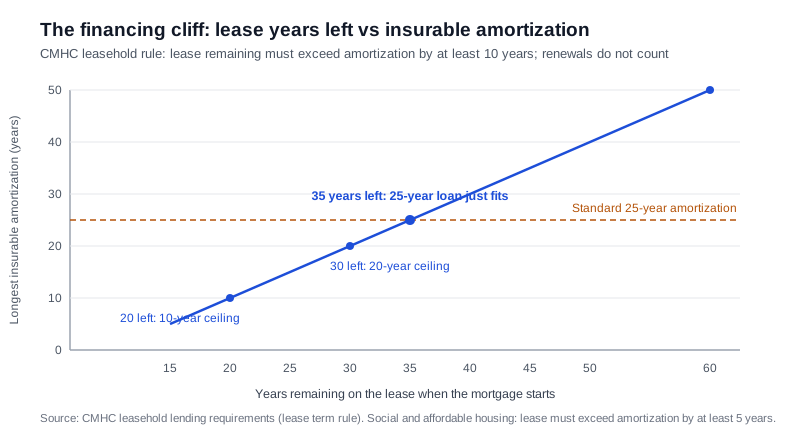
CMHC publishes leasehold lending requirements for the mortgages it insures. One sentence in them sets the ceiling for the whole market:
The term remaining on the lease when the mortgage begins must exceed the remaining mortgage amortization by at least 10 years. Renewal or option periods are not counted when measuring the remaining term. For social housing and properties that meet CMHC affordable housing criteria, the margin is 5 years instead of 10.
Turn that into the table lenders work from:
| Years left on the lease | Longest amortization CMHC insurance allows |
|---|---|
| 60 | 50 years (other rules cap amortization well below this) |
| 50 | 40 years |
| 45 | 35 years |
| 40 | 30 years |
| 35 | 25 years, the standard amortization, just fits |
| 30 | 20 years |
| 25 | 15 years |
| 20 | 10 years |
| 15 | 5 years, a mortgage in name only |
Read the table from the buyer's side. At 40 years remaining, a buyer can still get an insured mortgage with room to spare, and the home competes in something close to the normal market. At 30 years remaining, the next buyer is capped at a 20-year amortization, which raises the monthly payment on any given loan and cuts the price that buyer can carry. At 20 years remaining, the insured market is effectively gone: a 10-year amortization on a home purchase is a payment few households can service, so the buyer pool narrows to cash buyers and whatever uninsured or private lending will touch the file. Each step down removes buyers, and removing buyers is what a price discount is.
BCFSA makes the same point from the regulator's chair: it may be more difficult to obtain a mortgage for a leasehold unit, particularly as the end of the lease term approaches, and buyers may need to look at alternate sources of financing. CMHC adds two more lease conditions that surprise people. Homeowner ground rent is generally expected to be prepaid. And the lease must not contain provisions for ground rent escalation: CMHC can consider an escalation lease case by case where the financial uncertainty is shown to be mitigated, but the default answer for insured lending is no. A lease with market-based rent resets is therefore harder to finance with insurance than the same lease prepaid, even at the same years remaining.
The stress test still applies on top of all of this. A leasehold buyer qualifies at the same benchmark as a freehold buyer, on a shorter permitted amortization, which is the mechanical reason leasehold affordability is worse than the sticker price suggests.
Worked example 1: a prepaid leasehold against its freehold twin
Labelled hypothetical, built to show the arithmetic, not to describe a real listing. Two similar condos in the same Vancouver neighbourhood. The freehold is priced at $700,000. The leasehold is priced at $520,000, with the ground rent prepaid and 40 years left on the lease. Both buyers put 20% down and take a 25-year amortization at a labelled hypothetical 4.49%, computed with Canadian semi-annual compounding. The lease passes the CMHC test with 5 years to spare: 40 remaining, minus the 10-year margin, allows up to a 30-year amortization.
| Freehold (hypothetical) | Prepaid leasehold (hypothetical) | |
|---|---|---|
| Price | $700,000 | $520,000 |
| Down payment, 20% | $140,000 | $104,000 |
| Mortgage | $560,000 | $416,000 |
| Monthly payment at 4.49%, 25 years | $3,096.34 | $2,300.14 |
| Interest paid in the first 5 years | $117,358.50 | $87,180.60 |
| Balance after 5 years | $491,578.34 | $365,172.48 |
The leasehold buyer pays $796.20 less per month, brings $36,000 less to the table at closing, and carries $144,000 less debt. For a household that will sell within 10 or 15 years and that values the location over land ownership, those are real dollars, not a trick. That is the real case for leasehold, and in expensive cities it is why these units sell.
Now run the same purchase forward. In 15 years the lease has 25 years left. The next buyer faces a 15-year insured amortization ceiling, and the buyer's own down payment math has to absorb a payment built on 15 years instead of 25. In 20 years, 20 remain, and the insured buyer pool is close to empty. The freehold twin has no such schedule: its land is worth whatever land is worth in 2046. The $180,000 discount at purchase is, in substance, the market pricing that schedule in advance. A leasehold purchase works when your own exit date sits well before the financing cliff, and it works badly when you assume you can sell at the end of a long hold to a buyer who needs a normal mortgage.
One more line belongs in this example. Prepaid does not mean cost-free. The leasehold owner still pays strata fees, property taxes, and any head lease charges the strata passes through, and BCFSA's warning about additional payments rising over time applies to prepaid buildings too. Compare the full monthly stack, not the mortgage payment alone. Our condo vs townhouse comparison works through how strata-side costs change a purchase decision on freehold units; the same discipline applies here, with the head lease added to the reading list.
Worked example 2: an Ontario land lease community, where the rent is the story
Labelled hypothetical again. A manufactured home in an Ontario land lease community is priced at $350,000. The buyer owns the home and rents the site for $650 a month. A freehold house in the same town is priced at $500,000. Both buyers put 20% down. The freehold mortgage is priced at a labelled hypothetical 4.49% over 25 years. The land lease mortgage is priced at a labelled hypothetical 4.99%, half a point higher, reflecting the smaller lender pool for these files; treat the rate gap as an assumption to test with a broker, not as a quote.
| Freehold house (hypothetical) | Land lease home (hypothetical) | |
|---|---|---|
| Price | $500,000 | $350,000 |
| Mortgage after 20% down | $400,000 | $280,000 |
| Monthly mortgage payment | $2,211.67 at 4.49% | $1,626.90 at 4.99% |
| Monthly land rent | $0 | $650.00 |
| Total of the two, month one | $2,211.67 | $2,276.90 |
The home that costs $150,000 less to buy costs $65.23 more per month to carry, before community charges, and the gap widens in the landowner's favour for two structural reasons. The land rent never amortizes: in year 26 the freehold owner owes nothing on the mortgage, while the land lease owner still pays rent. And the rent rises. Ontario's Residential Tenancies Act covers land lease communities, and the provincial rent increase guideline applies to most of them. The guideline for 2026 is 2.1%. At a steady 2.1% a year, $650 a month becomes about $721 a month in year 6 and about $800 a month in year 11, and the first 10 years of rent add up to about $85,799. Communities first occupied after November 15, 2018 sit outside the guideline, so on a newer community even that cap may not apply; the community's status is a document check, not an assumption.
None of this makes the purchase wrong. It puts the full cost in the comparison. The land lease buyer needed $70,000 of down payment instead of $100,000, and for some households the lower entry price is the whole point. What the buyer cannot do is compare $350,000 to $500,000 and stop there. The rent is a second, permanent financing, and it belongs in the same table as the mortgage. Closing costs differ too: our Ontario closing costs guide covers the freehold side of that bill, and a land lease purchase changes several of its lines, starting with whether land transfer tax applies to your specific arrangement, which is a lawyer question on Ontario files.
False Creek South: what a lease endgame looks like in public
Vancouver's False Creek South is the largest worked example of lease expiry in Canada, and the City of Vancouver publishes the basic facts. The city holds title to 80 acres there. When the neighbourhood was built in the 1970s and 1980s, much of the city land was leased through 60-year ground leases, and most of those leases expire in the next 15 to 25 years. The city's engagement material counts about 1,800 homes on leased city land in the neighbourhood.
Sixty-year leases signed in the late 1970s were, at signing, longer than any mortgage and most lifetimes of ownership. They are now inside the window where the CMHC table above starts cutting amortizations, which is why lease extension negotiations there have run for years and why a resident protection plan exists. The lesson for a buyer anywhere in Canada is not about one neighbourhood. It is that a lease term is consumed in real time, including the decades when nobody is thinking about it, and that renewal, when it comes, is a negotiation with a price attached, not an automatic extension. Price a leasehold as if no renewal will happen. Treat any renewal that does happen as upside you did not pay for.
Two traps that sit outside the price
No cooling-off period in BC. BCFSA states that leasehold properties are excluded from BC's Home Buyer Rescission Period. The three business days that let a buyer of most BC homes walk away after an accepted offer do not exist on a leasehold purchase. Your protections have to be written into the contract as conditions instead: financing on that lease, document review, and legal review of the head lease. Our cooling-off period guide sets out the BC window and its exclusions in full.
The deposit is at risk the same way, with less room to fix a mistake. A leasehold deal that collapses over financing the lender never actually offered on that tenure puts the deposit in the same dispute as any failed purchase, with the added problem that the buyer had no rescission window to retreat into. Our deposit guide covers how deposits are held and when they are fought over. On a leasehold file, the sequence matters more than the amounts: lender confirmation on the specific lease first, conditions second, deposit deadlines last.
A third, quieter trap sits in the strata documents of prepaid buildings. The strata's own finances may include payments or reserves connected to the head lease, and a building can carry obligations that do not appear in the unit's listing price. Read the strata plan, the head lease, and the disclosure documents as one package. The discipline in our guide to title insurance in Canada applies as a starting point, with the added note that no insurance product converts a leasehold into a freehold or extends a lease by a day.
When leasehold is the right buy, and when it is not
Leasehold tends to work when most of these are true:
- At least 40 years remain on the lease, so your own mortgage and your buyer's mortgage both fit under the CMHC ceiling with room.
- Ground rent is prepaid, or payable at an amount and review pattern you have read and priced for 10 years forward.
- Your planned hold is 15 years or less, and your exit does not depend on a buyer who needs a 25-year insured mortgage at the far end of it.
- The discount against a comparable freehold is large enough to pay you for the countdown. In the worked example, $180,000 on a $700,000 comparison, about 26%, did that work. A 5% discount for a wasting asset does not.
- The location is the point of the purchase: a neighbourhood you could not otherwise buy into, priced with your eyes open.
Leasehold tends to fail when the mirror image holds: under 35 years remaining and a buyer who needs the largest mortgage the rules allow, a rent review clause with no cap and no prepaid protection, a hold-till-retirement plan that ends exactly when the financing cliff arrives, or a price set by comparing the home to freehold listings instead of to other leaseholds. The pattern to refuse is the listing that quotes the freehold neighbourhood price crossed out, as if the discount were a favour. The discount is the product. It is what a right that ends is worth against a right that does not.
Advertisement
Pre-offer checklist for a leasehold purchase
- Tenure confirmed in writing, and the lease, not the listing, gives the expiry date.
- Years remaining computed, and the CMHC test run: years remaining minus 10 must cover your amortization, with margin for your future buyer.
- Ground rent status established: prepaid in full, prepaid in part, or payable, with the amount, the next review date, and the review method copied out of the lease.
- Escalation wording read. If rent resets to market or by a formula with no cap, insured financing may be refused; confirm with the lender before conditions come off.
- Renewal and expiry clauses read for three answers: can the lease be renewed, who sets the new rent, and what is paid, if anything, for the building or the leaseholder's interest at the end.
- Assignment rules read. Some leases restrict resale or require the landlord's consent to a sale, which narrows your buyer pool further.
- Full monthly stack priced: mortgage at the amortization the lease actually allows, land rent if payable, strata or community fees, taxes, and head lease pass-through charges.
- Lender confirmation in writing, naming the property and the lease expiry, from a lender or broker who has closed leasehold files.
- Lawyer with leasehold experience retained before the offer, not after acceptance, because in BC there is no rescission period to buy thinking time.
- Exit priced on entry: the years remaining on the day you expect to sell, and the amortization ceiling your buyer will face on that day.
Sources
Rules and figures in this guide were taken from the sources below, read in October 2026. Your lease and your lender's current requirements govern your file.
- CMHC, Leasehold Lending Requirements (mortgage loan insurance): the lease term remaining must exceed the remaining amortization by at least 10 years (5 years for social and affordable housing), renewal and option periods are not counted, homeowner ground rent is generally prepaid, and the lease must not contain ground rent escalation provisions, with case-by-case exceptions: https://labrc.com/wp-content/uploads/2019/10/20b-CMHC-Leasehold-Lending-Requirements.pdf (CMHC requirements document, SV121120). CMHC's current program pages apply the same leasehold lending requirements to leasehold interests used as security, including in its Indigenous housing programs: https://www.cmhc-schl.gc.ca/professionals/project-funding-and-mortgage-financing/funding-programs/indigenous/alternative-types-of-security
- BC Financial Services Authority, Leasehold Considerations: the defined term and the end of the right of use at expiry, financing difficulty near expiry, additional fees under the head lease, the lack of exclusive control, dispute routes (Civil Resolution Tribunal for strata matters, civil litigation for head lease disputes), non-strata leaseholders not being protected by the Residential Tenancy Act or the Strata Property Act, and the exclusion of leasehold purchases from the Home Buyer Rescission Period: https://www.bcfsa.ca/industry-resources/real-estate-professional-resources/knowledge-base/practice-resources/leasehold-considerations
- City of Vancouver, False Creek South: the city holds title to 80 acres, most land was leased through 60-year ground leases in the 1970s and 1980s, and most leases expire in the next 15 to 25 years: https://vancouver.ca/home-property-development/false-creek-south.aspx ; the city's Shape Your City engagement FAQ counts about 1,800 homes on leased city land in the neighbourhood: https://www.shapeyourcity.ca/fcslands/widgets/77575/faqs
- Government of Ontario, rent increase guideline: the guideline is 2.1% for 2026, it applies to most tenants in land lease communities and mobile home parks under the Residential Tenancies Act, and units first occupied after November 15, 2018 are exempt. The guideline figure and coverage are stated on Ontario's residential rent increases pages and in Steps to Justice guidance for 2026.
Worked examples were computed for this guide from the stated prices, rates and amortizations using Canadian semi-annual compounding. They are illustrations of how the arithmetic behaves, not listings, rate quotes, or a recommendation for any household.
Frequently asked questions
What is the difference between leasehold and freehold in Canada?
Freehold means you own the land and the building with no end date. Leasehold means you own the building, or a unit in it, plus a right to use land owned by someone else until a lease expires. The BC Financial Services Authority puts it this way: on expiry of the term, the leaseholder's right of use ends. That expiry is why leasehold homes cost less and why financing them is harder.
Can you get a mortgage on a leasehold property in Canada?
Yes, if the lease qualifies. Under CMHC's leasehold lending requirements, the lease term remaining when the mortgage begins must exceed the remaining amortization by at least 10 years, and renewal periods do not count. A standard 25-year amortization therefore needs at least 35 years left on the lease for CMHC insurance. Ground rent is generally expected to be prepaid, and a lease with a ground rent escalation clause is generally not insurable. Fewer lenders take these files, so get written confirmation for the specific lease before removing conditions.
Why are leasehold condos so much cheaper in Vancouver?
Because the buyer is purchasing a wasting right, not land. The price has to compensate for the countdown: as years remaining fall, the longest insurable amortization falls with them under the CMHC rule (lease remaining minus 10 years), the buyer pool shrinks, and the end of the lease gets closer. In this guide's labelled hypothetical, a $520,000 prepaid leasehold with 40 years remaining against a $700,000 freehold twin saves $796.20 a month in payments, and the $180,000 discount is the market pricing the lease schedule in advance.
What happens when a leasehold lease expires in Canada?
The right of use ends, unless the lease itself provides for renewal or a payment for the leaseholder's interest. There is no general rule that rescues the owner: outcomes are set by the lease wording. Vancouver's False Creek South shows the public version of this: 60-year City of Vancouver ground leases from the 1970s and 1980s, most expiring in the next 15 to 25 years on the city's own description, with extensions handled as negotiations. Read the expiry and renewal clauses before you buy, and price the home as if no renewal will happen.
Is ground rent prepaid or monthly on Canadian leaseholds?
Both exist, and the difference is large. Many BC strata leaseholds and First Nation residential leases are prepaid: the rent for the full term was paid up front, usually inside the original sale price. Ontario land lease communities and some older city leases charge rent monthly or annually, with reviews set by the lease. In Ontario land lease communities covered by the Residential Tenancies Act, the rent increase guideline applies to most homes, at 2.1% for 2026. CMHC generally expects homeowner ground rent to be prepaid for insured lending.
Does the BC cooling-off period apply to leasehold purchases?
No. The BC Financial Services Authority states that leasehold properties are excluded from the Home Buyer Rescission Period. A buyer of a BC leasehold home does not get the three business days to rescind that most other BC buyers get. Protection has to come from contract conditions instead: financing confirmed on that lease, document review, and legal review of the head lease before the offer goes firm.
How much cheaper should a leasehold be than a freehold?
Enough to pay for the financing ceiling and the shrinking buyer pool. Work it from the lease, not from a rule of thumb: years remaining, minus 10, caps the next buyer's insured amortization, and a payable ground rent is a permanent second financing that belongs in the monthly comparison. In this guide's Ontario example, a land lease home priced $150,000 below a freehold house still cost $65.23 more per month to carry once $650 of land rent was added, using labelled hypothetical rates. A small discount on a short lease is not a bargain.
Can you sell a leasehold home easily?
Selling is straightforward early in a long lease and gets harder as the term runs down, for a mechanical reason: your buyer's mortgage is capped by the same CMHC rule that capped yours. At 35 years remaining a buyer can still insure a 25-year amortization. At 25 years remaining the ceiling is 15 years, and at 20 years it is 10, which removes most mortgage-dependent buyers. BCFSA warns it may become more difficult to sell or assign a leasehold as the expiry approaches. Price your expected exit date against that table before you buy.
About the BubbleWatch editorial team
BubbleWatch is written and checked by its editorial team under the site brand. Figures come from public sources such as CREA, Statistics Canada, CMHC and the Bank of Canada, and each article links the sources it uses. BubbleWatch is independent of realtor boards and lenders.
Read our full editorial methodology →