Early Mortgage Renewal in Canada (2026): The 120-Day Window, Rate Holds, and When Renewing a Year Early Costs You
Renewing early means two different things in Canada. Inside roughly 120 days of maturity, most big lenders let you lock a new term with no prepayment charge, and a rate hold protects you if rates rise before your date. Further out, an early renewal is either a blend and extend or a break with a penalty. This guide explains both, prices a quarter-point rate move on a typical 2026 renewal, and works two early-renewal cases where the answer flips on the penalty method.
On this page(15 sections)ShowHide
- Early Mortgage Renewal in Canada (2026): The 120-Day Window, Rate Holds, and When Renewing a Year Early Costs You
- Two kinds of early renewal
- What the rules say, and what they do not
- Why renewing inside the window matters more after the October 2026 hike
- How to renew early inside the window, step by step
- Should I renew my mortgage early? A decision table
- Renewing a year early when your rate is low: the 2021 borrower
- Renewing early when your rate is high: the 2023 borrower
- Documents to have ready for a switch
- Hidden costs to check before any early renewal
- Early renewal for variable-rate borrowers
- What if you do nothing?
- Early renewal and selling your home
- The bottom line
- Sources and assumptions
Early Mortgage Renewal in Canada (2026): The 120-Day Window, Rate Holds, and When Renewing a Year Early Costs You
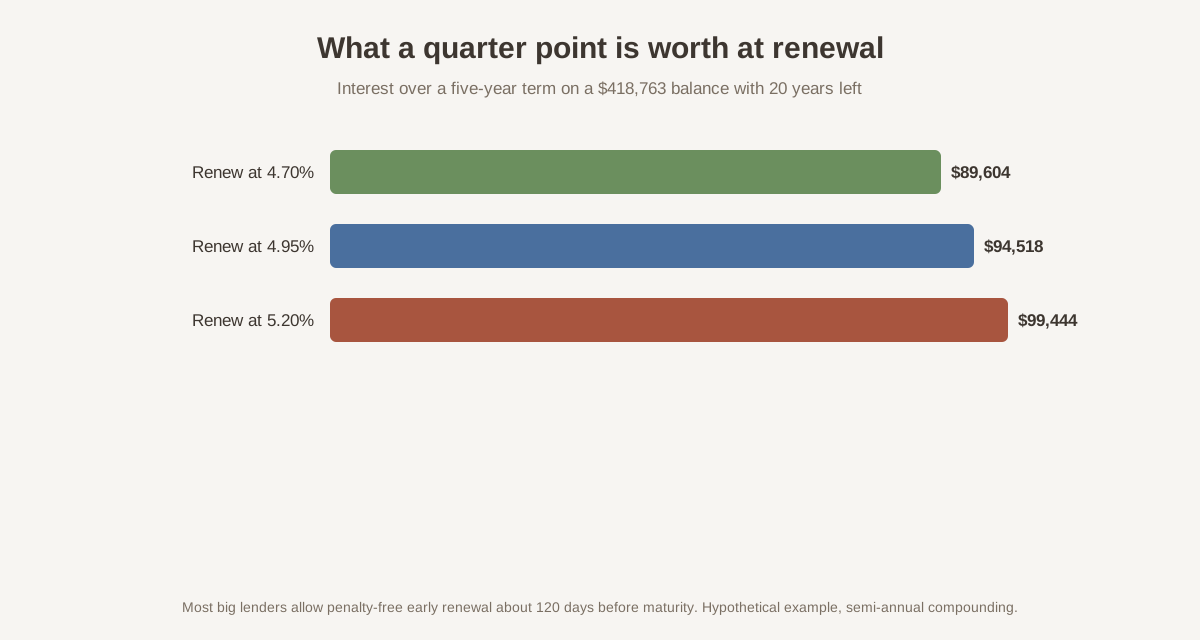
Short answer: You can usually renew your mortgage early without a penalty once you are within about 120 days of maturity. RBC and TD both say so on their renewal pages, and most large lenders work the same way. Renewing inside that window is worth doing when rates are rising, because locking an offer protects you from increases before your renewal date. On a $418,763 balance, a quarter-point move in the five-year rate changes five-year interest by about $4,900. Renewing earlier than 120 days is a different product: it is either a blend and extend, which averages your old and new rates, or a break with a prepayment charge. For borrowers with a low 2020 or 2021 rate, renewing a year early almost always costs money. For borrowers on a high 2023 rate, it can pay, but only after you price the penalty.
This guide covers both kinds of early renewal, the rules that actually apply, and the arithmetic. It is education, not advice. Your mortgage contract and your lender's written quote decide the real numbers.
Two kinds of early renewal
People use "early renewal" for two different things, and the cost of each is completely different.
Early renewal inside the window. Your term ends in, say, three months. Your lender lets you sign the renewal now, and the new term starts on your maturity date. You pay your current rate until then. No penalty applies because you are not ending the current contract early; you are simply choosing the next one ahead of time.
Early renewal outside the window. Your term ends in a year or more. You want today's rate now. To do that, the lender has to end your current contract before its term is up, which means either a blend and extend (your old rate and the new rate are averaged, with no penalty) or a full break with a prepayment charge. This is really an early payout dressed as a renewal, and it should be priced like one.
Most of the confusion about early renewal comes from mixing these up. A bank ad that says "renew early with no penalty" is talking about the first kind.
What the rules say, and what they do not
There is no federal rule that gives you a right to renew early. The 120-day window is a lender practice, not a law. What the rules do say:
- A renewal statement at least 21 days before maturity. The Financial Consumer Agency of Canada says federally regulated lenders must send it no later than 21 days before your term ends, with the new rate, term and other conditions, or tell you in the same window if they will not renew.
- Disclosure of how a prepayment charge is calculated. Your original mortgage contract spells out the method your lender uses if you pay off early, which matters for any early renewal outside the window.
- No stress test on an uninsured straight switch at renewal. Since November 21, 2024, OSFI no longer requires federally regulated lenders to apply the minimum qualifying rate when an uninsured borrower moves the same balance and amortization to them at renewal. That makes it easier to shop the renewal, including early in the window.
What the lenders publish: RBC's renewal page says customers can renew up to 120 days before their renewal date without penalties, with some restrictions, and describes a 30-day renewal rate guarantee. TD's renewal page says lenders may let you renew 120 days, or four months, before maturity without a prepayment charge. Credit unions, monoline lenders and private lenders set their own windows, which can be shorter. Ask your lender for its window in writing, especially if you are with a smaller lender.
Advertisement
Why renewing inside the window matters more after the October 2026 hike
The Bank of Canada raised its policy rate by a quarter point to 2.50% on October 28, 2026, its first increase since July 2023, and said a further increase was possible. Big-bank prime rose to 4.70% the next day. Five-year fixed rates follow Government of Canada bond yields rather than the policy rate directly, and the five-year yield stood at 3.46% on November 12, 2026, according to nesto's rate page. When yields rise, fixed offers tend to follow within days.
That is the environment where locking early has real value. If rates rise before your maturity date, your locked offer protects you. If rates fall, most lenders will give you the lower rate if you ask, though some only honour a lower rate for the same term and product.
What a quarter point is worth
Take a borrower renewing a $418,763 balance with 20 years of amortization left on a five-year fixed term. This is the 2021 borrower from our renewal payment calculation guide.
| Five-year rate at renewal | Monthly payment | Interest over the five-year term | Versus 4.95% |
|---|---|---|---|
| 4.70% | $2,684.38 | about $89,604 | about $4,914 less |
| 4.95% (lowest uninsured, Nov 12, 2026) | $2,740.50 | about $94,518 | n/a |
| 5.20% | $2,797.20 | about $99,444 | about $4,926 more |
A quarter-point move is worth roughly $56 a month and $4,900 over the term on this balance. A rate hold costs nothing at most lenders, so locking as soon as you are inside the window gives you a free option: you keep the lock if rates rise and ask for the lower rate if they fall.
How to renew early inside the window, step by step
- About 150 days out, get your numbers. Find your balance at maturity, remaining amortization and maturity date on your latest statement. Our renewal payment guide shows how to compute your new payment from those three numbers.
- At about 120 days, ask your lender for its best offer. Do not wait for the letter. Ask for the rate on each term you would consider and whether it is the lowest rate available, not a posted rate. Our posted vs discounted rates guide explains the difference.
- Get one or two competing quotes. A broker or another lender can usually hold a rate for 90 to 120 days on a switch. Since the stress test no longer applies to an uninsured straight switch, the main hurdles are documents and an appraisal.
- Lock the best offer. If your lender matches, sign the early renewal. If not, start the switch application.
- Watch rates until your maturity date. If rates fall, ask your lender, or the lender holding your switch, to reprice. Put the request in writing.
- Decide on extras before you sign. Renewal day is when you can make a penalty-free lump-sum payment, change payment frequency or change the amortization. Our guide to switching lenders at renewal covers the transfer process.
One caution: once you sign an early renewal, the new contract is binding from the start of the new term. If you then find a better offer elsewhere, moving would mean breaking the new term. Lock with your own lender only after you have checked the market.
Should I renew my mortgage early? A decision table
| Your situation | Usually the better move | Why |
|---|---|---|
| Within 120 days, rates rising or uncertain | Lock an early renewal or a switch rate hold now | Free protection against increases; most lenders reprice down if rates fall |
| Within 120 days, rates falling quickly | Lock anyway, but ask to reprice before maturity | The lock costs nothing; asking for the lower rate is the step people forget |
| More than 120 days out, your rate is far below today's (2020 or 2021 borrower) | Wait | Any early exit gives up cheap months, by blend or by penalty |
| More than 120 days out, your rate is well above today's (2023 or 2024 borrower) | Price a blend and a break, then decide | Can save money, but only if the penalty is three months of interest or the blend rate is fair |
| Selling or moving within the next term | Consider a shorter term, an open term or a portable mortgage | Avoids a second penalty when you sell |
| Payment no longer fits your budget | Talk to your lender now, before maturity | Options such as an amortization extension are easier before a missed payment |
Renewing a year early when your rate is low: the 2021 borrower
Suppose you took $500,000 at 1.99% over 25 years on a five-year term, and you are 12 months from maturity. Your balance is about $435,660. You are worried rates will be higher a year from now and want to lock today's 4.95% immediately.
Option 1: break and renew. On a variable or a fixed mortgage where the penalty is three months of interest, the charge would be about $435,660 × 1.99% ÷ 4 = $2,167. Then you would pay 4.95% for the 12 months you could have paid 1.99%. Interest at 4.95% instead of 1.99% on roughly $430,000 for a year costs about $12,700 more. You would be paying around $15,000 to lock in a rate you could have locked for free a few months later.
Option 2: blend and extend. The lender averages your 1.99% for the 12 months left with 4.95% for the other 48 months of a new five-year term. Using the Financial Consumer Agency of Canada's time-weighted method, the blended rate is (1.99% × 12 + 4.95% × 48) ÷ 60 = 4.36%. That looks better than 4.95%, but your payment still rises a year sooner than it had to, and you pay 4.36% on the 12 months that would have cost 1.99%. The lender is also free to feed a higher rate than its best offer into the blend.
For a borrower with a rate this low, early renewal outside the window is insurance with a very expensive premium. The cheaper hedge is to save the expected payment increase every month until the 120-day window opens, then lock.
Renewing early when your rate is high: the 2023 borrower
Now take a borrower who signed a five-year fixed at 5.69% in late 2023 on $400,000 over 25 years. Three years later, with 24 months left, the balance is about $376,084. The best five-year insured offer is 4.44%.
Option 1: break and refinance. The penalty is usually the greater of three months of interest and the interest rate differential (IRD).
- Three months of interest: $376,084 × 5.69% ÷ 4 = about $5,350.
- A simple IRD estimate, assuming the lender's comparison rate for the two years left is 4.44%: (5.69% − 4.44%) × $376,084 × 2 years = about $9,402. Big banks that calculate the IRD from posted rates can produce a larger figure; our prepayment penalty guide explains why.
Option 2: blend and extend. The blend is (5.69% × 24 + 4.44% × 36) ÷ 60 = 4.94%, with no penalty.
Comparing interest over the next 60 months on a 22-year amortization, plus any penalty:
| Path | Rate for next 60 months | Penalty | Interest plus penalty, 60 months |
|---|---|---|---|
| Blend and extend | 4.94% | $0 | about $85,732 |
| Break at three months of interest, renew at 4.44% | 4.44% | $5,350 | about $82,171 |
| Break at an IRD of $9,402, renew at 4.44% | 4.44% | $9,402 | about $86,223 |
If the penalty really is three months of interest, breaking saves about $3,560 over five years. If the penalty is the IRD in this example, the blend wins by about $490, and a larger posted-rate IRD would widen that. The decision turns entirely on the penalty figure, which only your lender can give you. Ask for it in writing before deciding, and run the comparison with the exact number. Our blend and extend guide works through more cases.
There is a third path for this borrower: do nothing for 18 months, then renew normally inside the window. If rates are still near 4.44% then, that is the cheapest option of all, because it costs nothing. Renewing early only beats waiting if you think rates are more likely to rise than fall before your term ends.
Documents to have ready for a switch
If you plan to move your mortgage to another lender at renewal, having these ready before the 120-day window opens avoids delays:
- Your latest mortgage statement and the renewal statement when it arrives.
- Two recent pay stubs and an employment letter, or two years of Notices of Assessment if you are self-employed.
- Your latest property tax bill and, for a condo, the most recent condo fee statement.
- Photo identification for every borrower.
- Home insurance details.
- Any separation agreement or court order that affects the property.
The new lender will usually order an appraisal or use an automated valuation, and its lawyer or title company handles the transfer of the mortgage from your current lender.
Hidden costs to check before any early renewal
- Cashback clawback. If you took a cashback mortgage, ending the term early may require repaying part of it.
- Discharge and admin fees. A switch or break can involve discharge, assignment or appraisal fees. Some lenders cover switch costs; ask.
- Changed features. A new term may come with different prepayment privileges, portability or penalty terms than your old one. Read the new commitment.
- Collateral charge. If your mortgage is registered as a collateral charge, switching to another lender usually means legal work to re-register it. Our collateral charge guide explains why.
- Insurance on the mortgage. Optional creditor insurance from your lender may need to be re-applied for at a new lender, at a new age-based price.
Advertisement
Early renewal for variable-rate borrowers
If you have a variable-rate mortgage, early renewal works a little differently. Breaking a variable mortgage usually costs three months of interest, which is often lower than a fixed-rate IRD. Some lenders also let variable borrowers convert to a fixed rate at any time without a penalty, as long as the new fixed term is at least as long as the time left on the variable term. Check your contract for a conversion clause before you consider a full break; it can lock a fixed rate early with no charge at all.
What if you do nothing?
If you ignore the renewal letter, many lenders renew you automatically into a default term, often a short closed term or an open term, and sometimes at a rate that is not their best. The renewal statement tells you what happens if you do not respond. Doing nothing is the most expensive renewal choice for most borrowers, because it gives up both the chance to shop and the chance to lock early.
If you need more time, a short open or one-year term can buy it, but expect a higher rate. A better approach is to start the process at 150 days, so the 120-day window opens with your numbers already in hand.
Early renewal and selling your home
If there is a real chance you will sell during the next term, think about that before you lock five years. Breaking a fixed term to sell can trigger an IRD penalty. Options to reduce the risk:
- A shorter term that ends closer to your likely sale date.
- A variable-rate mortgage, where the penalty is usually three months of interest.
- A portable mortgage, so you can move the rate to your next home. Our porting guide explains how portability works and where it fails.
The bottom line
Early renewal is two decisions that share a name. Inside the window, it is a free option, and after the October 28, 2026 rate increase it is worth taking as soon as the window opens. Outside the window, it is a trade: either a blended rate or a penalty in exchange for today's rate. That trade only makes sense when your current rate is well above today's offers and the penalty is modest. For the many Canadians renewing 2021 mortgages, the right move is to wait for the window, save the expected increase in the meantime, then lock the best rate you can find.
Sources and assumptions
- Renewal statement timing: Financial Consumer Agency of Canada, renewing your mortgage.
- Early renewal windows: RBC, mortgage renewal page (up to 120 days, 30-day renewal rate guarantee); TD, how to renew (120 days or four months), both checked November 13, 2026.
- Rates: nesto five-year fixed page, checked November 12, 2026 (4.44% insured, 4.95% uninsured, 3.46% five-year Government of Canada yield); Bank of Canada announcement, October 28, 2026 (policy rate 2.50%).
- Stress test removal for uninsured straight switches: OSFI, effective November 21, 2024.
- Blend formula: Financial Consumer Agency of Canada's time-weighted method, as described in our blend and extend guide.
- All mortgage examples are hypothetical, use semi-annual compounding for fixed rates and are rounded. Penalty figures are simplified estimates; your lender's method may produce a different charge.
Frequently asked questions
How early can I renew my mortgage without a penalty?
At most big lenders, about 120 days before maturity. RBC says customers can renew up to 120 days early without penalties, and TD's renewal page uses the same 120-day, or four-month, window. Smaller lenders set their own windows, so ask yours.
Should I renew my mortgage early in 2026?
If you are inside the 120-day window, locking early is usually worth it after the October 28, 2026 rate hike, because the lock protects you if rates rise and most lenders reprice down if they fall. Further out, early renewal means a blend or a penalty and needs to be priced.
Is there a penalty for renewing my mortgage early?
Not inside the lender's early renewal window, typically about 120 days. Earlier than that, ending your term early triggers a prepayment charge, usually the greater of three months of interest and the interest rate differential, unless you use a blend and extend.
What is a mortgage rate hold at renewal?
A promise to give you a quoted rate for a set period, such as RBC's 30-day renewal rate guarantee or a 90- to 120-day hold from a competing lender on a switch. It protects you from increases; ask whether a lower rate is passed on if rates fall.
Is it worth renewing a year early if my rate is low?
Rarely. A 2021 borrower at 1.99% who renews a year early at 4.95% would pay a penalty of around $2,200 plus roughly $12,700 more interest for that year on a $435,000 balance, or accept a blended rate that still gives up the cheap months.
What happens if I do not respond to my renewal letter?
Many lenders renew you automatically into a default term, often short or open and not always at their best rate. The renewal statement, which federally regulated lenders must send at least 21 days before maturity, says what happens if you do nothing.
Do I have to pass the stress test to switch lenders at renewal?
Not for an uninsured straight switch of the same balance and amortization to a federally regulated lender since November 21, 2024. You still need to provide documents, and the new lender usually wants an appraisal.
About the BubbleWatch editorial team
BubbleWatch is written and checked by its editorial team under the site brand. Figures come from public sources such as CREA, Statistics Canada, CMHC and the Bank of Canada, and each article links the sources it uses. BubbleWatch is independent of realtor boards and lenders.
Read our full editorial methodology →