Posted vs Discounted Mortgage Rates in Canada (2026): What Banks Post, What Borrowers Pay, and Why the Gap Sets Your Penalty
A posted mortgage rate is the rate a bank advertises as its standard rate for a term. Almost nobody pays it. Borrowers get a discount, and the gap between posted and discounted rates has ranged from about one point to nearly three. This guide shows the Bank of Canada's posted-rate series from 2015 to 2026, what the gap means on a $500,000 mortgage, where posted rates still bite (prepayment penalties and some renewal letters), and how to find the rate you can actually get.
On this page(19 sections)ShowHide
- Posted vs Discounted Mortgage Rates in Canada (2026): What Banks Post, What Borrowers Pay, and Why the Gap Sets Your Penalty
- What a posted mortgage rate is
- The posted-rate history, 2015 to 2026
- How big is the gap today?
- Why banks still publish posted rates
- How discounted fixed rates are priced
- The insured and uninsured gap
- Where posted rates still bite: the prepayment penalty
- Where posted rates bite at renewal
- Posted variable rates and prime
- Cashback mortgages and other rate trade-offs
- Three borrowers, three ways the posted rate reaches them
- A short glossary
- How to get the discounted rate
- Why discounted rates differ between borrowers
- Before you sign: what to ask the lender
- When a posted rate is the right rate
- The bottom line
- Sources and assumptions
Posted vs Discounted Mortgage Rates in Canada (2026): What Banks Post, What Borrowers Pay, and Why the Gap Sets Your Penalty
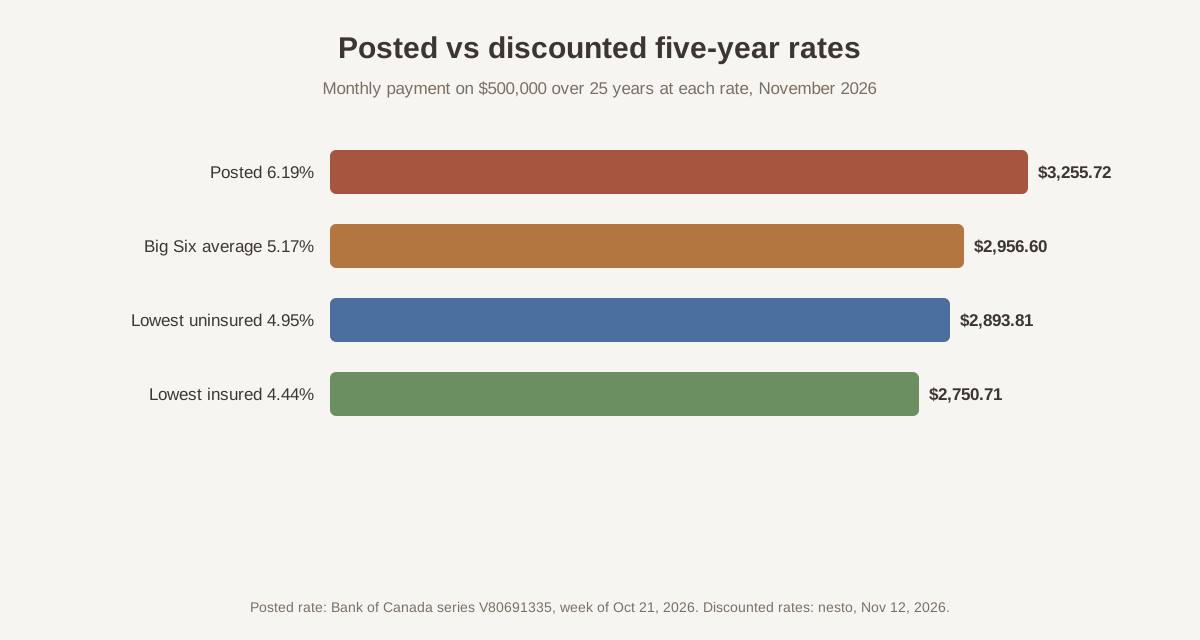
Short answer: A posted mortgage rate is the standard rate a Canadian bank publishes for each term, before any discount. The Bank of Canada tracks the typical big-bank posted five-year fixed rate every week: it was 6.19% for the week of October 21, 2026. Most borrowers pay well under that. On November 12, 2026, nesto listed a Big Six average discounted five-year fixed rate of 5.17% and the lowest uninsured five-year fixed at 4.95%. On a $500,000 mortgage over 25 years, paying the posted rate instead of 4.95% would cost about $362 more a month. You should almost never pay a posted rate, but you should know it, because many big-bank prepayment penalties are still calculated from posted rates.
This guide explains where posted rates come from, how far they sit from real offers, the places they still matter, and how to get the discounted rate. It is general information, not advice, and rates change daily.
What a posted mortgage rate is
Every large Canadian bank publishes a rate sheet with a rate for each term: six months, one year, two, three, four, five, seven and ten years, fixed and variable. Those are the posted rates. They are real in the sense that a bank will lend at them, but they work more like a sticker price on a car. The bank's front-line staff and its online tools usually offer a discount from the posted rate, and brokers and online lenders often go lower still.
The Bank of Canada collects the posted five-year conventional mortgage rate from the big banks and publishes it as a weekly series, V80691335, on its Valet data service. The figure is the most common posted rate among the big chartered banks that week. It moves rarely, in steps, because banks change posted rates far less often than they change the discounted rates they actually offer.
The discounted rate is the rate you actually sign for. It depends on the lender, the term, whether your mortgage is insured, the size of your down payment, the property and how hard you shop. Insured mortgages, where the borrower put less than 20% down and pays a default insurance premium, often get the lowest rates because the lender's risk is covered.
The posted-rate history, 2015 to 2026
These figures come from the Bank of Canada's weekly posted five-year series, as collected for our mortgage rate history data.
| Year | Average posted 5-year | Lowest in year | Highest in year | Year-end |
|---|---|---|---|---|
| 2015 | 4.67% | 4.64% | 4.79% | 4.64% |
| 2016 | 4.66% | 4.64% | 4.74% | 4.64% |
| 2017 | 4.77% | 4.64% | 4.99% | 4.99% |
| 2018 | 5.27% | 4.99% | 5.34% | 5.34% |
| 2019 | 5.27% | 5.19% | 5.34% | 5.19% |
| 2020 | 4.95% | 4.79% | 5.19% | 4.79% |
| 2021 | 4.79% | 4.79% | 4.79% | 4.79% |
| 2022 | 5.65% | 4.79% | 6.49% | 6.49% |
| 2023 | 6.68% | 6.49% | 7.04% | 7.04% |
| 2024 | 6.73% | 6.49% | 7.04% | 6.49% |
| 2025 | 6.23% | 6.09% | 6.49% | 6.09% |
| 2026 (to Oct 21) | 6.10% | 6.09% | 6.19% | 6.19% (latest) |
The low point of the series since 2000 was 4.64%, first reached in April 2015 and held for 110 weeks. The high was 8.75% in May 2000.
What the table hides is how far real rates moved inside those years. In 2021 the posted rate sat at 4.79% all year, yet borrowers were signing five-year fixed mortgages near 2%. That is a gap of nearly three points. In November 2026 the posted rate is 6.19% and the best uninsured offer is 4.95%, a gap of about 1.24 points. The posted rate is sticky; the discount does the moving.
Advertisement
How big is the gap today?
| Rate, five-year fixed | Level | Source and date | Payment on $500,000, 25 years | Interest in first five years |
|---|---|---|---|---|
| Big-bank posted rate | 6.19% | Bank of Canada, week of Oct 21, 2026 | $3,255.72 | about $145,720 |
| Big Six average discounted | 5.17% | nesto, Nov 12, 2026 | $2,956.60 | about $121,107 |
| Lowest uninsured | 4.95% | nesto, Nov 12, 2026 | $2,893.81 | about $115,818 |
| Lowest insured | 4.44% | nesto, Nov 12, 2026 | $2,750.71 | about $103,587 |
Payments use semi-annual compounding, as Canadian fixed mortgages do. The difference between the posted rate and the lowest uninsured rate is $361.91 a month and almost $30,000 of interest over five years on this loan. Even the gap between the big-bank average discount and the lowest uninsured offer is about $63 a month, or $5,300 over the term.
Why banks still publish posted rates
If almost no one pays them, why do they exist? Three reasons.
- They anchor negotiation. A bank that posts 6.19% and offers you 5.17% has given you "a discount of more than a point." That framing makes the offer feel generous even when a competitor is lower.
- They set penalties. Many big-bank fixed mortgages calculate the interest rate differential (IRD) penalty using posted rates. A higher posted rate, combined with the discount you received, can make the penalty larger. This is the most important reason to care about them.
- They are a default. Some renewal letters and some automatic renewals quote the posted rate, or a rate close to it, for terms you did not negotiate. Borrowers who sign without checking can end up paying it.
Posted rates used to have a fourth role. Until June 1, 2021, the minimum qualifying rate for insured mortgages was the Bank of Canada's posted five-year rate, the same series in the table above. Today the stress test uses the greater of your contract rate plus two percentage points and 5.25%, for insured and uninsured mortgages from federally regulated lenders. Our stress test guide covers the current rule.
How discounted fixed rates are priced
Discounted five-year fixed rates track the five-year Government of Canada bond yield plus a lender spread. The spread covers the lender's funding costs, the risk of default, the cost of the borrower's right to prepay, and profit. On November 12, 2026, the five-year yield was 3.46%, according to nesto's rate page. The lowest uninsured five-year fixed rate, 4.95%, sat about 1.49 points above it. The big-bank posted rate of 6.19% sat about 2.73 points above it.
That is why the posted rate is a poor guide to the direction of rates in the short run. When bond yields rise, as they did through the fall of 2026 after inflation forecasts moved up, discounted fixed offers tend to follow within days. Posted rates often wait, then move in a single step. If you are watching rates before a purchase or a renewal, watch the five-year yield and the discounted offers, not the posted rate.
The insured and uninsured gap
Insured mortgages often get the best discounted rates. On November 12, 2026, nesto listed 4.44% insured and 4.95% uninsured on a five-year fixed, a gap of 0.51 points. On a $500,000 mortgage over 25 years, that is the difference between $2,750.71 and $2,893.81 a month, or about $143.
Buyers with just over 20% down sometimes ask whether to put down less, pay the insurance premium and get the lower rate. The premium is a one-time cost of 2.80% to 4.00% of the loan, plus provincial tax in Ontario, Quebec and Saskatchewan, so the trade usually only pays when the rate gap is large and the borrower plans to keep the mortgage for the full term. Our CMHC premium guide works through that comparison.
Where posted rates still bite: the prepayment penalty
When you break a fixed mortgage before its term ends, by selling, refinancing or switching lenders, the lender usually charges the greater of three months of interest and an interest rate differential. The IRD is meant to cover the interest the lender loses because you are leaving early. How the lender calculates the comparison rate makes a large difference.
Here is a simplified example. In late 2024 you took $500,000 at 4.89% for five years over 25 years. Your bank's posted five-year rate at the time was 6.49%, so your discount was 1.60 points. Two years later, in late 2026, you sell. Your balance is about $478,380 and three years remain.
- Three months of interest: $478,380 × 4.89% ÷ 4 = about $5,848.
- IRD using a discounted comparison rate. Suppose the lender's real offer today for a three-year term is 4.40%. The IRD is (4.89% − 4.40%) × $478,380 × 3 years = about $7,032.
- IRD using a posted comparison rate. Suppose the bank's posted three-year rate today is 5.80%. Many big banks subtract your original discount of 1.60 points from that posted rate, giving a comparison rate of 4.20%. The IRD is (4.89% − 4.20%) × $478,380 × 3 = about $9,902.
The posted-rate method in this example costs about $2,870 more than the discounted-rate method, on the same mortgage, for the same move. The exact formula is in your mortgage contract and on your lender's prepayment charge calculator, and the actual posted three-year rate on the day you break is what matters. The Financial Consumer Agency of Canada requires federally regulated lenders to explain how they calculate the charge. Our prepayment penalty guide works through the main methods in more detail.
The practical lesson: when two lenders offer similar rates, ask each one how it calculates the IRD. A lender that uses discounted rates or a fixed penalty formula can be worth a slightly higher rate if there is a chance you will break the mortgage.
Where posted rates bite at renewal
Your renewal letter shows the rates your lender will give you for each term. Some letters show posted rates or something close to them. Others show a modest discount. Few show the best rate the lender would give if you asked or brought a competing offer.
On a $418,763 renewal balance with 20 years left, the difference between a posted 6.19% and a negotiated 4.95% is about $287 a month, using the figures in our renewal payment calculation guide. Before signing, ask your lender for its lowest rate for the term you want and compare it with at least one other offer. Our early renewal guide explains how to use the 120-day window to do that without pressure.
Posted variable rates and prime
Variable-rate mortgages are priced as prime plus or minus a margin. Big-bank prime was 4.70% from October 29, 2026, after the Bank of Canada raised its policy rate to 2.50%. A variable offer of "prime minus 0.50%" was therefore 4.20%. Banks also post variable rates, but the more useful number is the margin to prime, because that margin is fixed for your term while prime moves with every Bank of Canada decision. Our how mortgage rates are set guide explains the link between the policy rate, prime, bond yields and fixed offers.
Cashback mortgages and other rate trade-offs
Some lenders offer cash back at closing, often a percentage of the loan, in exchange for a higher rate. The cash is useful to buyers who are short on closing money, but the higher rate is paid every month for the whole term. If you break the mortgage early, most cashback contracts also require you to repay part of the cash. Compare a cashback offer against the lowest discounted rate by adding up the extra interest over the term. On a $500,000 mortgage, every 0.25 points of extra rate costs about $70 a month.
Other features carry a price too: a longer rate hold, a more generous prepayment privilege, a portable or assumable mortgage, or a lender that calculates penalties on discounted rates. Sometimes those features are worth a slightly higher rate. The point is to know what you are buying.
Three borrowers, three ways the posted rate reaches them
The first-time buyer. Maya is buying a $550,000 condo with 10% down. Her bank's first quote is 5.29% for five years, close to its posted-rate-minus-a-little offer. A broker finds 4.44% insured. On her roughly $510,000 loan with the premium added, the difference is about $245 a month. She never sees the posted rate, but the first quote she got was anchored to it.
The renewing homeowner. Daniel's renewal letter offers 5.84% for five years with a signature line at the bottom. He calls, mentions a 4.95% competing offer, and his bank matches 4.99%. The letter was not a posted rate, but it was far closer to one than to the market.
The seller who breaks early. Priya sells three years into a five-year fixed at a big bank. Her penalty uses the bank's posted two-year rate minus the discount she got at origination. Because her original discount was large, the comparison rate is low and the IRD is high. Her neighbour, with a similar mortgage at a lender that uses discounted comparison rates, pays several thousand dollars less to leave.
Each case is hypothetical, but each describes a common way the posted rate shapes what Canadians pay without ever appearing on their contract.
A short glossary
- Posted rate: the published standard rate for a term, before discounts.
- Discounted or contract rate: the rate in your mortgage contract.
- Qualifying rate: the rate used for the stress test, the greater of your contract rate plus two points and 5.25%.
- Comparison rate: the rate a lender uses to calculate an interest rate differential penalty. Some lenders use a posted rate minus your original discount; others use a current discounted rate.
- Prime rate: the base rate for variable mortgages and lines of credit, 4.70% at the big banks from October 29, 2026.
- Spread: the difference between a mortgage rate and the matching bond yield.
How to get the discounted rate
- Know the market rate before you talk to your bank. Check two or three rate comparison sites and note the lowest rates for your term, insured or uninsured. Rates change often, so note the date.
- Ask your bank for its best rate, not its posted rate. Say which competing rate you have seen. Front-line staff can often go lower with approval.
- Talk to a mortgage broker. Brokers can compare many lenders, including monoline lenders that do not have branches. Our broker vs bank guide covers the trade-offs.
- Compare the whole product. Prepayment privileges, portability, penalty method and whether the mortgage is a collateral charge all matter. A rate 0.05 points lower with a harsh IRD formula may cost more if you move.
- Get the offer in writing with a rate hold. Most lenders will hold a rate for 90 to 120 days for a purchase or a switch. Ask what happens if rates fall during the hold.
- At renewal, start early. Most lenders let you renew without a penalty from about 120 days before maturity. That gives you time to shop.
Advertisement
Why discounted rates differ between borrowers
Even among discounted rates, you may not get the lowest rate you see advertised. Common reasons:
- Insured vs uninsured. Insured mortgages, with less than 20% down, often carry lower rates than uninsured ones because the lender's risk is covered by the insurer.
- Rental or second properties. Investment properties usually cost more.
- Refinances and high loan amounts. Refinances and mortgages above certain sizes can carry higher rates.
- Quick-close or long hold. Rates for a closing within 30 days can be lower than rates held for 120 days.
- Credit and income profile. Self-employed borrowers or those with weaker credit may be offered higher rates or be referred to alternative lenders.
Advertised "lowest rates" usually describe the best case. Ask any lender for the rate it will give you on your specific file.
Before you sign: what to ask the lender
- Is this your lowest available rate for this term and product, or a posted rate?
- How do you calculate the prepayment penalty if I break the mortgage, and do you use posted or discounted rates for the IRD?
- What are the annual prepayment privileges, and can I port the mortgage if I move?
- Is the mortgage registered as a standard charge or a collateral charge?
- How long will you hold this rate, and will you lower it if rates fall before closing or renewal?
When a posted rate is the right rate
There are a few cases where paying close to a posted rate is reasonable. A very short or open term, used for a few months before a sale or a refinance, often carries a rate near posted because flexibility has value. Borrowers whose files are hard to place, such as those with recent credit problems or income that is difficult to document, may find that a big bank's posted-adjacent rate is still cheaper than an alternative lender. Even then, ask for the best rate in writing and compare.
The bottom line
Posted mortgage rates are the list prices of Canadian mortgages. They tell you where the big banks anchor, they move slowly, and in late 2026 they sit about a point above what a careful borrower can get. You should not pay them. But they still shape the cost of breaking a mortgage, and they still appear on renewal letters, so knowing the gap between posted and discounted rates is one of the cheapest pieces of financial literacy a Canadian homeowner can have.
Sources and assumptions
- Posted five-year rates: Bank of Canada Valet series V80691335, chartered bank conventional five-year mortgage rate, weekly, 2000 to October 21, 2026, as collected in this site's mortgage rate history dataset.
- Discounted rates and five-year yield: nesto five-year fixed page, checked November 12, 2026.
- Policy rate and prime: Bank of Canada announcement, October 28, 2026; big-bank prime of 4.70% effective October 29, 2026.
- Stress test: OSFI Guideline B-20 minimum qualifying rate and the federal insured-mortgage rule, both the greater of contract rate plus two points and 5.25% since June 1, 2021.
- Penalty example is simplified and hypothetical; the posted three-year rate of 5.80% and the 4.40% discounted comparison rate are assumptions for illustration. Payments use semi-annual compounding and are rounded.
Frequently asked questions
What is a posted mortgage rate in Canada?
The standard rate a bank publishes for each mortgage term before any discount. The Bank of Canada's weekly series puts the typical big-bank posted five-year fixed rate at 6.19% for the week of October 21, 2026. Most borrowers pay a discounted rate well below it.
How much lower than the posted rate can I get?
In November 2026, about one to one and a quarter points on a five-year fixed. nesto listed a Big Six average discounted rate of 5.17% and a lowest uninsured rate of 4.95% on November 12, 2026, against a posted 6.19%. In 2021 the gap was nearly three points.
Why do posted rates matter if no one pays them?
Because many big-bank fixed mortgages use posted rates to calculate the interest rate differential penalty when you break the mortgage, which can make the penalty larger. Some renewal letters also quote rates close to posted rates.
Is the posted rate used for the mortgage stress test?
Not since June 1, 2021. The qualifying rate is now the greater of your contract rate plus two percentage points and 5.25%. Before that, insured borrowers qualified at the Bank of Canada's posted five-year rate.
What is the difference between posted and discounted rates on a $500,000 mortgage?
At 6.19% posted versus 4.95% discounted, over 25 years, the payment is $3,255.72 versus $2,893.81, about $362 a month, and interest over the first five years differs by almost $30,000.
How do I avoid paying the posted rate at renewal?
Start about 120 days before maturity, check current discounted rates, ask your lender for its lowest rate in writing, and get at least one competing offer. Sign only after comparing.
About the BubbleWatch editorial team
BubbleWatch is written and checked by its editorial team under the site brand. Figures come from public sources such as CREA, Statistics Canada, CMHC and the Bank of Canada, and each article links the sources it uses. BubbleWatch is independent of realtor boards and lenders.
Read our full editorial methodology →