How to Calculate Your Mortgage Payment at Renewal in Canada (2026): The Formula, Worked Examples and a Payment Table
Your payment at renewal depends on three numbers: the balance left when your term ends, the new rate, and the amortization you renew for. Canadian fixed rates compound semi-annually, so the monthly rate is not the posted rate divided by 12. This guide shows the formula step by step, works a full example for a 2021 borrower renewing in late 2026, gives a payment table per $100,000 at 3.5% to 6.5%, and prices the levers you control: amortization, payment frequency and a lump-sum prepayment on renewal day.
On this page(17 sections)ShowHide
- How to Calculate Your Mortgage Payment at Renewal in Canada (2026): The Formula, Worked Examples and a Payment Table
- The three inputs that decide your new payment
- Step 1: find your balance at renewal
- Step 2: convert the annual rate to a monthly rate
- Step 3: apply the payment formula
- How much will my mortgage go up at renewal? A quick ratio table
- Worked example 2: a 2023 borrower renewing a three-year term
- Lever 1: the amortization you renew for
- Lever 2: payment frequency
- Lever 3: a lump-sum prepayment on renewal day
- Lever 4: the term and product you choose
- If you had a variable rate with fixed payments
- Does the lender re-check your home's value or income at renewal?
- Check your renewal letter in five minutes
- What your new payment means for your budget
- Common mistakes in homemade renewal calculations
- Sources and assumptions
How to Calculate Your Mortgage Payment at Renewal in Canada (2026): The Formula, Worked Examples and a Payment Table
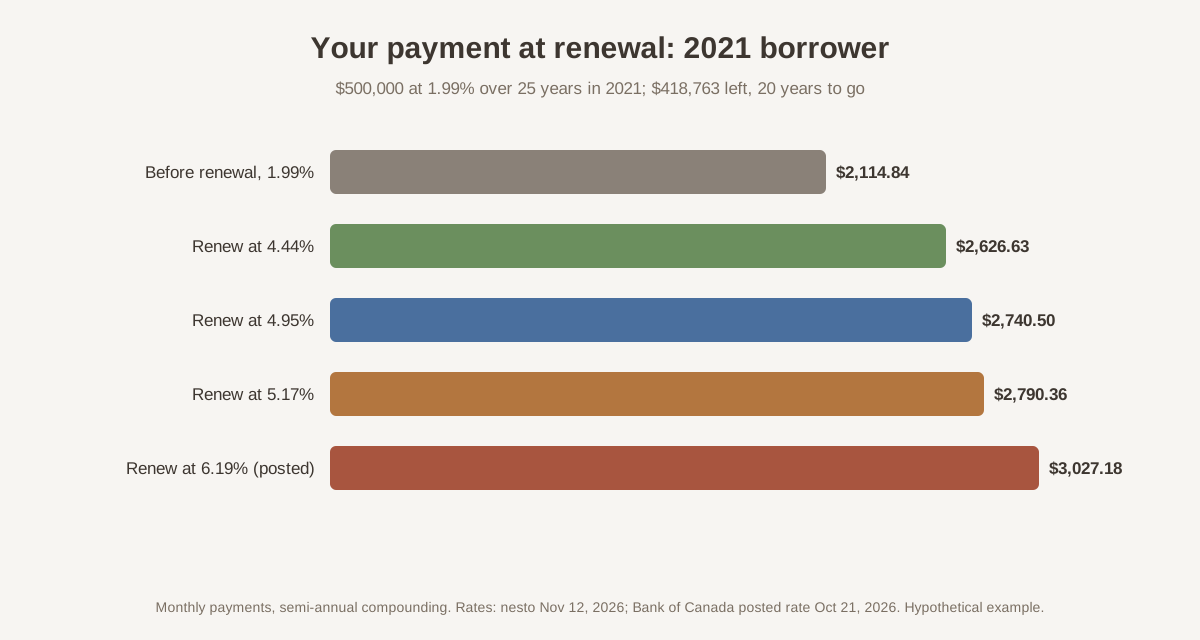
Short answer: To calculate your mortgage payment at renewal, take the balance left at the end of your current term, convert the new annual rate to a monthly rate using Canadian semi-annual compounding, and spread the balance over the months of amortization you have left. A borrower who took $500,000 at 1.99% over 25 years in late 2021 owes about $418,763 at renewal. At 4.95% over the remaining 20 years, the payment rises from $2,114.84 to $2,740.50 a month, an increase of $625.66, or 29.6%. Renewing for 25 years instead brings the payment to $2,423.64, but adds about $69,000 of interest over the life of the loan if rates stayed where they are.
This page is the long version of that calculation. It is written so you can check your lender's renewal letter by hand or in a spreadsheet, and so you know which lever moves the payment the most before you sign. It is education, not mortgage advice: your contract, your lender's rounding and any fees on your account decide the final figure.
The three inputs that decide your new payment
Every renewal payment, at every Canadian lender, comes from the same three inputs.
- The balance at maturity. This is what you still owe on the day your term ends, after your last scheduled payment and any prepayments. It is printed on your annual mortgage statement and on the renewal statement your lender sends before maturity.
- The new interest rate. This is the rate on the renewal offer, or the rate a competing lender offers if you switch. It is a nominal annual rate. For fixed mortgages in Canada it is compounded semi-annually, not monthly.
- The remaining amortization. Amortization is the total time to pay off the mortgage. If you started with 25 years and your term was five years, 20 years remain. You can usually keep it, shorten it, or ask to extend it, subject to the lender's rules and, if you are insured, the insurer's.
Your old payment does not enter the calculation at all. That surprises people. The renewal is a fresh calculation on whatever balance is left, which is why borrowers who made prepayments during the term see a smaller increase than neighbours with identical original mortgages.
Step 1: find your balance at renewal
The easiest source is your lender. The renewal statement must show the balance at maturity. For federally regulated lenders, the Financial Consumer Agency of Canada says that statement must arrive at least 21 days before the term ends. Most lenders send it far earlier, and many let you renew from about 120 days out. Our early renewal guide covers that window.
If you want the figure before the letter arrives, you can compute it. The balance after a set number of payments is the original amount, grown at the monthly rate, minus every payment, also grown at the monthly rate. In a spreadsheet, the simplest method is a row per month: interest for the month equals the balance times the monthly rate, the principal paid equals the payment minus that interest, and the new balance equals the old balance minus the principal paid.
For the example in this guide, a $500,000 mortgage at 1.99% over 25 years carries a monthly payment of $2,114.84. After 60 monthly payments, the balance is about $418,763. In five years the borrower paid $126,890 in total, of which about $81,237 reduced the principal and about $45,653 was interest. At a rate that low, nearly two-thirds of every payment went to principal, which is why 2021 borrowers owe less at renewal than borrowers who started at higher rates.
Advertisement
Step 2: convert the annual rate to a monthly rate
This is where most homemade spreadsheets go wrong. Canada's Interest Act requires a blended-payment mortgage to state its rate as an annual rate compounded no more often than semi-annually, and fixed-rate lenders compound semi-annually. The monthly rate is therefore not the annual rate divided by 12.
The conversion is:
Monthly rate = (1 + annual rate ÷ 2) ^ (1 ÷ 6) − 1
At 4.95%, that is (1 + 0.02475) raised to the power of one-sixth, minus one, which equals 0.4083% a month. Divide 4.95% by 12 instead and you get 0.4125% a month. The gap looks tiny, but over a 20-year amortization it overstates the payment by roughly $12 a month on this loan and throws off every balance in a spreadsheet.
The same rate expressed as a true effective annual rate is 5.011%, because semi-annual compounding adds a little on top of the nominal 4.95%. That is the rate to use if you compare a mortgage against a savings account or a line of credit quoted differently.
Variable-rate mortgages are the exception. Many lenders compound variable mortgages monthly, and some set the payment differently. If you are renewing into a variable product, read the interest calculation clause in the commitment letter, which states how interest is compounded.
Step 3: apply the payment formula
With the balance and monthly rate in hand, the payment is the standard annuity formula:
Payment = Balance × r ÷ (1 − (1 + r) ^ −n)
where r is the monthly rate from Step 2 and n is the number of monthly payments left in the amortization.
For the example: balance $418,763, r = 0.004083, and n = 240 for 20 years. The payment is $2,740.50 a month. In a spreadsheet, the PMT function gives the same answer if you feed it the semi-annual monthly rate: =PMT((1+0.0495/2)^(1/6)-1, 240, -418763).
Here is what the same borrower faces at four rates that were all real offers or reference rates in the fall of 2026. The 4.44% and 4.95% figures are the lowest insured and uninsured five-year fixed rates nesto listed on November 12, 2026; 5.17% is the Big Six banks' average discounted five-year fixed rate on the same page; and 6.19% is the conventional five-year posted rate the Bank of Canada recorded for October 21, 2026.
| Renewal rate (5-year fixed) | New payment, 20 years left | Change from $2,114.84 | Change in % | Payment if extended to 25 years |
|---|---|---|---|---|
| 4.44% (lowest insured, Nov 12, 2026) | $2,626.63 | +$511.79 | +24.2% | $2,303.79 |
| 4.95% (lowest uninsured, Nov 12, 2026) | $2,740.50 | +$625.66 | +29.6% | $2,423.64 |
| 5.17% (Big Six average discounted, Nov 12, 2026) | $2,790.36 | +$675.52 | +31.9% | $2,476.23 |
| 6.19% (posted rate, Oct 21, 2026) | $3,027.18 | +$912.34 | +43.1% | $2,726.75 |
Two things stand out. First, the gap between the best uninsured rate and the big-bank average is about $50 a month, or roughly $3,000 over a five-year term, which is the price of not shopping. Second, nobody should be renewing at the posted rate, yet it is the rate that some renewal letters print as the default. Our guide to posted versus discounted mortgage rates explains why that number still matters for penalties even if you never pay it.
How much will my mortgage go up at renewal? A quick ratio table
If you just want a fast estimate, this table gives the monthly payment per $100,000 of balance at common rates and amortizations, using semi-annual compounding. Multiply by your balance in hundreds of thousands.
| Rate | 15 years | 20 years | 25 years | 30 years |
|---|---|---|---|---|
| 3.50% | $713.64 | $578.66 | $499.27 | $447.64 |
| 4.00% | $738.04 | $604.25 | $526.02 | $475.52 |
| 4.50% | $762.87 | $630.41 | $553.47 | $504.22 |
| 5.00% | $788.12 | $657.13 | $581.60 | $533.69 |
| 5.50% | $813.80 | $684.39 | $610.39 | $563.91 |
| 6.00% | $839.88 | $712.19 | $639.81 | $594.82 |
| 6.50% | $866.37 | $740.50 | $669.82 | $626.40 |
Example: a $350,000 balance with 20 years left, renewing at 4.5%, pays about 3.5 × $630.41 = $2,206 a month. At 5.5% the same balance pays 3.5 × $684.39 = $2,395. Each half-point of rate on a 20-year amortization moves the payment by roughly $26 to $29 per $100,000.
This is also the fastest way to answer the question renewal letters invite: "what will my mortgage payment be at renewal?" You need only your balance, the offered rate and your remaining years. The table cannot capture lender fees or rounding, so expect your letter to differ by a few dollars.
Worked example 2: a 2023 borrower renewing a three-year term
Not every 2026 renewal is a payment shock. Borrowers who locked in at the 2023 peak can see their payment fall.
Take a $400,000 mortgage at 5.69% for a three-year term over 25 years, signed in late 2023. The monthly payment is $2,485.99. After 36 payments the balance is about $376,084, and 22 years of amortization remain.
| Renewal rate | New payment, 22 years left | Change |
|---|---|---|
| 4.20% | $2,177.57 | −$308.42 |
| 4.44% | $2,225.89 | −$260.10 |
| 4.95% | $2,330.33 | −$155.66 |
This borrower has a different decision to make. A lower payment is welcome, but keeping the old payment of $2,485.99 at the new rate would pay the mortgage off years sooner. Most lenders let you set a payment above the minimum at renewal; it is usually the cheapest way to prepay because it uses money you were already spending. If your lender offers a lower rate and you want to keep the higher payment, say so in writing before you sign.
Lever 1: the amortization you renew for
Extending the amortization is the most powerful payment lever and the most expensive one. On the main example at 4.95%, renewing over 20 years costs $2,740.50 a month. Renewing over 25 years cuts that to $2,423.64, saving $316.86 a month.
The trade-off shows up in total interest. If the rate stayed at 4.95% for the whole remaining life of the loan:
- Over 20 years, total interest would be about $238,958.
- Over 25 years, total interest would be about $308,329.
That is about $69,000 more interest for $317 a month of breathing room. Rates will not stay constant for 25 years, so treat the figure as an order of magnitude, not a forecast.
Whether you can extend at all depends on the mortgage. For an uninsured mortgage, the lender decides and may ask you to qualify again. For an insured mortgage, the insurer's maximum amortization applies, and since December 15, 2024 a 30-year insured amortization is available only to first-time buyers and buyers of new builds at origination. The Financial Consumer Agency of Canada's guideline on existing consumer mortgage loans in exceptional circumstances asks federally regulated lenders to consider temporary relief, including amortization extensions, for borrowers at risk of financial hardship. If you are in that position, ask your lender directly what it can do before maturity, not after a missed payment.
Lever 2: payment frequency
Switching to accelerated biweekly or accelerated weekly payments is a mild form of prepayment. An accelerated biweekly payment is the monthly payment divided by two, paid 26 times a year, which works out to one extra monthly payment each year.
On the main example at 4.95%, the accelerated biweekly payment is $1,370.25. Paid every two weeks from renewal onward, it would clear the $418,763 balance in about 17.5 years instead of 20, if the rate held. A plain biweekly payment, which is calculated to keep the same 20-year amortization, would be $1,263.46 and saves almost nothing.
Read the renewal form carefully. "Biweekly" and "accelerated biweekly" sit next to each other on most forms, and only one of them shortens your mortgage.
Lever 3: a lump-sum prepayment on renewal day
Renewal day is the one day in a closed-term mortgage when you can usually pay down any amount without a prepayment charge. Your lender may still need notice, and the money must be in place.
On the main example, paying $20,000 at renewal reduces the balance to $398,763. At 4.95% over 20 years, the payment falls to $2,609.62, which is $130.89 a month lower. Over the five-year term, the prepayment saves about $4,514 of interest; over the full remaining amortization, it saves much more because the $20,000 never accrues interest again.
That is a guaranteed return equal to your mortgage rate, after tax. For most households with cash beyond an emergency fund, it beats a non-registered savings account. It may not beat a contribution to a TFSA or RRSP that you can later use against the mortgage, so check your room first. Our prepayment privileges guide covers the annual lump-sum and payment-increase limits that apply during the term.
Lever 4: the term and product you choose
The renewal formula does not care whether you pick a one-year, three-year or five-year term, but your future payments do. A shorter term at a slightly higher rate is a bet that rates will fall before your next renewal. A five-year term is a bet that they will not, or that payment certainty is worth the price.
The Bank of Canada raised its policy rate to 2.50% on October 28, 2026, and big-bank prime moved to 4.70% the next day. Variable-rate borrowers renewing now start at prime minus a discount, and their payment can change at every rate decision. The next decision is scheduled for December 9, 2026. Our fixed vs variable guide prices both paths; the point here is that a renewal payment calculated on a variable rate is a snapshot, not a promise.
If you had a variable rate with fixed payments
Borrowers who took a variable-rate mortgage with fixed payments in 2020 or 2021 face a different calculation. When rates rose in 2022 and 2023, their payment stayed the same while more of it went to interest. Some hit their trigger rate, where the payment no longer covered the interest, and their lender raised the payment or let the amortization stretch.
At renewal, the lender typically resets the payment to pay off the balance over the original remaining amortization. If your balance is higher than you expected, or your effective amortization had stretched to 35 or 40 years, the renewal payment can jump sharply even if the new rate is lower than the rate you are paying today. Ask your lender for three numbers before you renew: the balance at maturity, the remaining amortization it will use, and whether you can extend it.
Does the lender re-check your home's value or income at renewal?
For a straight renewal with your current lender, usually not. The lender already holds the mortgage, and renewing the same balance for a new term rarely needs a new appraisal or new income documents.
Switching to a new lender is different. The new lender is making a new loan and normally wants an appraisal or an automated valuation, plus income and credit documents. Since November 21, 2024, the federal banking regulator, OSFI, no longer requires the stress test for an uninsured straight switch at renewal, meaning the same balance and amortization moved to a new federally regulated lender. Insured mortgages could already switch without re-qualifying. Our switching lenders at renewal guide walks through the paperwork.
If you want to add money at renewal, that is a refinance, not a renewal. It needs a full application, a stress test and an appraisal, and the payment calculation starts from the new, larger balance.
Advertisement
Check your renewal letter in five minutes
- Find the balance at maturity on the letter.
- Note the rate offered for each term. Compare it with the lowest discounted rate available that week, not with the posted rate.
- Check the amortization the letter uses. It should match your remaining years unless you asked to change it.
- Convert the rate with the semi-annual formula and compute the payment, or use the per-$100,000 table above for a quick check.
- If your number and the lender's differ by more than a few dollars, ask why. Common causes are a different amortization, a payment frequency change, or insurance premiums added to the payment.
Then compare the offer with at least one competing quote. Renewing with your lender is convenient, but the first offer is not always its best one. The mortgage renewal cliff page shows how many Canadians face this decision through 2027, and our renewal payment history by cohort shows how renewal payments have changed for every five-year cohort since 2000.
What your new payment means for your budget
A payment increase of 25% to 30% is large, but it is easier to absorb when you plan for it months ahead. Three practical steps help.
Start paying the new amount early. If your renewal is six months away, put the expected difference, say $626 a month in the main example, into a savings account now. You will learn whether your budget can handle it, and you will have a cushion if it cannot.
Look at the full housing cost. Property tax, insurance and condo fees often rise at the same time. The mortgage stress test guide explains the debt-service ratios lenders use, which are a reasonable check on whether the new payment fits your income.
Talk to your lender before maturity if it does not fit. Options such as a temporary amortization extension or a change of payment date are easier to arrange before a payment is missed. Our missed mortgage payment guide explains what happens if it comes to that, and why acting early matters.
Common mistakes in homemade renewal calculations
- Dividing the rate by 12. Use the semi-annual conversion for fixed mortgages.
- Using the original amortization. After a five-year term on a 25-year mortgage, 20 years are left, not 25.
- Using the original principal. The payment is calculated on the balance at maturity, not the amount you first borrowed.
- Forgetting prepayments. Any lump sums or increased payments during the term lower the balance and the new payment.
- Comparing payment instead of cost. A longer amortization always lowers the payment and always raises total interest.
Sources and assumptions
Payments in this guide use the Canadian convention for fixed-rate mortgages: a nominal annual rate compounded semi-annually, converted to an equivalent monthly rate, with level monthly payments over the stated amortization. All examples are hypothetical and rounded to the cent; your lender's figures may differ slightly because of rounding, payment dates and fees.
- Five-year fixed offers of 4.44% insured and 4.95% uninsured, and the Big Six average discounted rate of 5.17%: nesto, five-year fixed rate page, checked November 12, 2026.
- Conventional five-year posted rate of 6.19%: Bank of Canada Valet series V80691335, week of October 21, 2026.
- Policy rate of 2.50% and prime of 4.70%: Bank of Canada announcement of October 28, 2026, and big-bank prime notices effective October 29, 2026.
- Renewal statement timing: Financial Consumer Agency of Canada, renewing your mortgage.
- Stress test removal for uninsured straight switches: OSFI, effective November 21, 2024.
- 30-year insured amortization for first-time buyers and new builds: Department of Finance Canada, effective December 15, 2024.
Frequently asked questions
How do I calculate my mortgage payment at renewal?
Take the balance owing at the end of your term, convert the new annual rate to a monthly rate with (1 + rate ÷ 2)^(1/6) − 1, and apply the payment formula over the months of amortization left. A $418,763 balance at 4.95% over 20 years pays $2,740.50 a month.
How much will my mortgage payment go up at renewal?
It depends on your old rate, new rate and balance. A borrower who took $500,000 at 1.99% in 2021 and renews at 4.95% with 20 years left sees the payment rise from $2,114.84 to $2,740.50, about 30%. Someone who locked in at 5.69% in 2023 may see a drop.
Why is my renewal payment higher than my calculation?
The most common reasons are dividing the rate by 12 instead of using semi-annual compounding, using a different amortization than the lender, or leaving out insurance premiums included in the payment. Ask the lender which balance, rate and amortization it used.
Can I extend my amortization at renewal to lower my payment?
Often, if the lender agrees and, for insured mortgages, within the insurer's limits. Extending from 20 to 25 years on a $418,763 balance at 4.95% lowers the payment by about $317 a month but adds about $69,000 of interest if rates held.
Can I make a lump-sum payment at renewal without a penalty?
Usually yes. Renewal is the point where a closed term ends, so most lenders let you pay down any amount then without a prepayment charge. On the example in this guide, $20,000 at renewal cuts the payment by about $131 a month.
Does my lender reappraise my house at renewal?
Not for a straight renewal with the same lender in most cases. Switching lenders usually needs an appraisal or automated valuation, and adding money is a refinance that needs a full appraisal and income check.
Is the monthly mortgage rate the annual rate divided by 12 in Canada?
Not for fixed-rate mortgages. They compound semi-annually, so the monthly rate is (1 + annual rate ÷ 2)^(1/6) − 1. At 4.95% that is 0.4083% a month, not 0.4125%.
About the BubbleWatch editorial team
BubbleWatch is written and checked by its editorial team under the site brand. Figures come from public sources such as CREA, Statistics Canada, CMHC and the Bank of Canada, and each article links the sources it uses. BubbleWatch is independent of realtor boards and lenders.
Read our full editorial methodology →