Assumable Mortgages in Canada: How Taking Over the Seller's Mortgage Works, and When the Math Holds Up
An assumable mortgage lets a buyer take over the seller's existing mortgage on the same terms, if the contract allows it and the lender approves the buyer. The rate saving is real only in a narrow set of cases: a fixed rate well below current offers, enough months left in the term for the gap to add up, and a price-to-balance gap the buyer can fund without expensive second financing eating the benefit. This guide prices all three conditions, including the seller's residual liability problem that FCAC warns about.
Assumable Mortgages in Canada: How Taking Over the Seller's Mortgage Works, and When the Math Holds Up
Short answer: An assumable mortgage lets the buyer take over the seller's mortgage and the property, with the terms of the original mortgage staying the same. That is the Financial Consumer Agency of Canada (FCAC) definition, and the same guidance adds the two conditions that decide whether an assumption happens at all. The lender must approve the buyer who wants to assume the mortgage, and the option is typically available on most fixed-rate mortgages, not with variable-rate mortgages or home equity lines of credit. If the lender approves, the buyer takes over the remaining payments and is responsible for the terms and conditions in the contract. The seller is not automatically free: in some provinces, the seller may remain personally liable after the sale, and the lender may ask the seller to pay if the buyer stops paying. Price the rate saving, price the gap between the purchase price and the mortgage balance, and get the seller's release in writing. An assumption that skips any of those three steps is a hope, not a plan.
This is education only, not mortgage or legal advice. Assumability, fees, and release practice vary by lender, contract, insurer, and province. Get the lender's answer on your specific mortgage in writing before an offer depends on it.
Assumption, porting, and a new mortgage are three different transactions
These three get mixed up in listing descriptions and in conversation, and the mix-up costs people their financing condition window.
| Route | Whose mortgage is it? | Rate and terms | Who must be approved? |
|---|---|---|---|
| Assumption | The seller's existing mortgage, taken over by the buyer | The original contract terms stay the same for the remaining term | The buyer, by the seller's lender |
| Porting | The same borrower's mortgage, moved to a different property | The borrower's balance, rate, and terms move with them, subject to the lender's port rules | The same borrower again, plus the new property |
| New mortgage | A fresh contract in the buyer's name | Current offers, buyer's choice of term and features | The buyer, by the lender they choose |
A vendor take-back mortgage is a fourth thing, and it is not an assumption either. In a vendor take-back, the seller lends the buyer money directly and registers their own mortgage. No existing bank contract changes hands.
The practical difference between an assumption and a new mortgage comes down to one trade. The buyer inherits a rate and a remaining term they did not choose, in exchange for not paying today's rate on that balance. Everything else about the purchase, the appraisal, the legal work, the closing costs, still happens. Our closing costs coverage sets out the cash-to-close stack that applies either way.
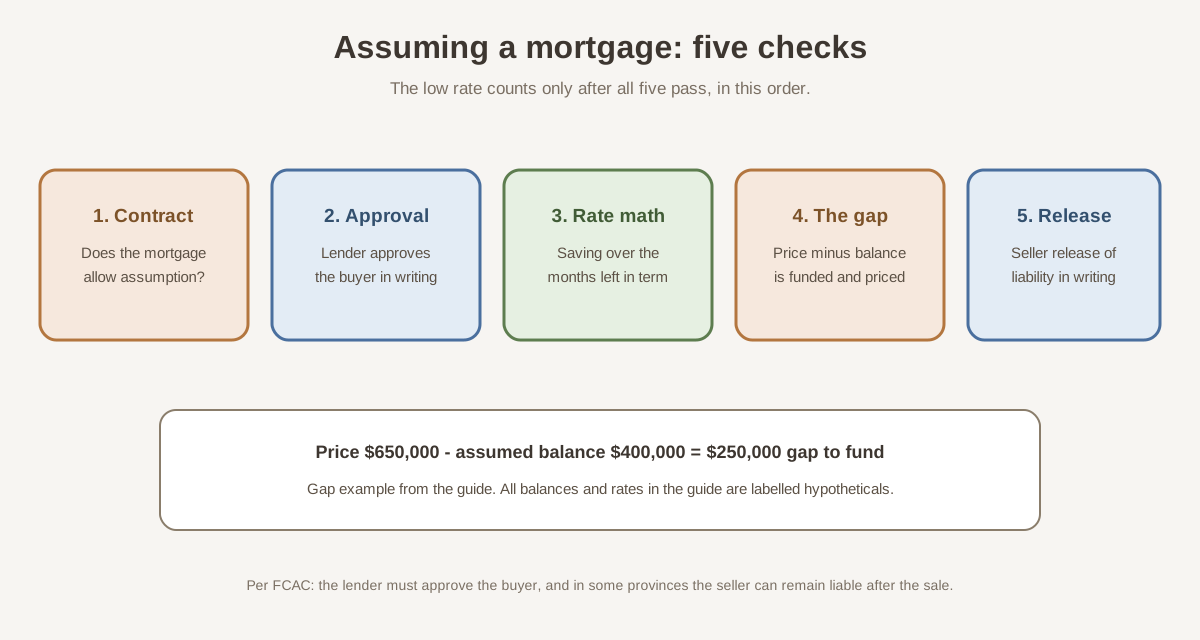
The five checks, in order
Run these in order. A failure early makes the later math pointless.
1. Does the contract allow assumption? Start with the mortgage contract and the lender, not the listing. The FCAC tells borrowers to check with their lender to see if the mortgage is assumable, and notes that lenders may charge a fee to assume a mortgage, with the contract stating whether a fee applies. A fixed-rate mortgage is the usual candidate. A variable-rate mortgage or a HELOC is not, per FCAC guidance. If the existing mortgage is insured, the insurer's rules sit on top of the lender's, so the lender's answer needs to cover both.
2. Will the lender approve this buyer? Approval is not a formality. The buyer is taking over the remaining payments and the full contract, so expect the lender to review income, debts, credit, and the property much as it would on a new application. Our GDS and TDS ratios guide shows the debt-service math lenders run, and the stress test guide explains the qualifying-rate framework. Ask the lender directly which qualifying rate and which ratios it applies to an assumption on this contract, and get that answer before the financing condition expires. A buyer who cannot pass the seller's lender has no assumption, whatever the purchase agreement says.
3. Is the rate gap worth money over the months actually left? The saving is the rate gap multiplied by the balance, collected only over the remaining term. A large gap with 30 months left is a different product from the same gap with 6 months left. Section below prices both.
4. Can the buyer fund the gap? The buyer assumes the balance, not the price. The difference is the seller's equity, and the buyer pays it in cash, with additional financing, or with a mix. This is where most assumptions die, and it is priced in full below.
5. Does the seller get a release? Per the FCAC, some lenders may release the seller from responsibility if they approve the buyer. Some is the operative word. A seller who signs without a written release, or a written statement of when a release will be considered, may carry the debt into their next purchase and into a default they did not cause.
Worked example 1: the rate saving, priced over the remaining term
Labelled hypothetical. Every rate, balance, and price in this guide is assumed for the example. Payments and interest are computed with the standard Canadian convention: nominal rate compounded semi-annually, monthly payments, over the stated remaining amortization.
| Input | Value |
|---|---|
| Assumed mortgage balance | $400,000 |
| Assumed fixed rate | 2.50% |
| Months left in the term | 24 |
| Remaining amortization | 240 months (20 years) |
| Hypothetical new-mortgage rate for comparison | 4.50% |
| Path | Monthly payment | Interest over the next 24 months | Balance after 24 months |
|---|---|---|---|
| Assume at 2.50% | $2,117 | $19,148 | $368,338 |
| Borrow new at 4.50% | $2,522 | $34,576 | $374,057 |
| Difference | $405 a month | $15,427 saved | $5,719 less owed |
Read the table the way a lender would. The $15,427 is interest the buyer does not pay across the 24 months left in the term, and the lower payment also retires $5,719 more principal in the same window, because more of each payment reaches the balance at the lower rate. After month 24, the assumed mortgage matures and renews at whatever rates exist then, same as any other mortgage. The saving stops at maturity. Any price a seller asks for the assumable feature should be measured against $15,427 plus the principal effect, not against a lifetime of low payments that the contract does not promise.
Two deductions belong against that $15,427 before anyone celebrates. First, fees: the lender may charge an assumption fee, and the buyer still pays legal and closing costs on the purchase. Get the fee from the contract and the lender in writing. Second, the price itself: if the seller has priced the home $15,000 above comparable sales because the mortgage is assumable, the buyer has handed the saving back at the door. Compare the price to comparable properties first, and the financing second.
Worked example 2: the gap is the real price of an assumption
Same hypothetical mortgage, now with a purchase price attached.
| Line | Amount |
|---|---|
| Purchase price | $650,000 |
| Assumed mortgage balance | $400,000 |
| Gap the buyer must fund | $250,000 |
The buyer needs $250,000 on closing day, plus closing costs, on top of taking over the $400,000 mortgage. There are two clean ways to fund it, and they produce very different deals.
Gap paid in cash. The buyer brings $250,000 in cash and carries only the assumed mortgage: a $2,117 monthly payment on a $650,000 home. This is the version in listing photos. It requires a quarter of a million dollars liquid, which is why assumptions cluster in move-up sales where the buyer has just sold a home of their own, and in family transfers where the equity picture is different. A gifted down payment can fund part of a gap in some cases, subject to the lender's gift rules, which the assuming lender will apply to this file too.
Gap financed with a second mortgage. Labelled hypothetical: the $250,000 gap is borrowed as a second mortgage at 6.00%, amortized over 240 months. That second mortgage costs $1,780 a month and $28,860 in interest over the same 24 months. Our second mortgage guide explains why second financing prices higher: the second lender is paid after the first if the home is sold under enforcement.
| Combined path, 24 months | Monthly payment | Interest over 24 months |
|---|---|---|
| Assumed $400,000 at 2.50% plus second $250,000 at 6.00% | $3,898 | $48,009 |
| One new mortgage of $650,000 at 4.50% | $4,098 | $56,186 |
| Difference | $200 a month | $8,177 saved |
The assumption still wins in this example, by $8,177 over two years, but the margin is half the headline figure from example 1, and it rests on the buyer actually qualifying for both loans at once, with both payments counted in their debt ratios. Change the second-mortgage rate to 8% or shorten its amortization, and the margin thins further. Change the gap to $350,000 on a $750,000 price with the same $400,000 balance, and a buyer should rerun the whole comparison rather than trusting the shape of this one. The rule is portable even when the numbers are not: price the assumed slice and the gap slice separately, add them, and compare the total against one new mortgage for the full amount.
Worked example 3: a short remaining term shrinks the prize
Same $400,000 balance, same 2.50% assumed rate against the same hypothetical 4.50% new rate, but only 6 months left in the term.
| Path | Interest over the next 6 months |
|---|---|
| Assume at 2.50% | $4,934 |
| Borrow new at 4.50% | $8,859 |
| Difference | $3,925 |
$3,925 is still money. It is also the ceiling, before fees, and the buyer renews at market rates in month 7 either way. If the assumption fee, added legal work, and any price premium the seller attached to the feature total a hypothetical $1,500, that is 38% of the saving gone. With 24 months left, the same $1,500 is under 10% of the saving. Remaining term is the multiplier on every other number in the deal, which is why the first question about an assumable listing is not the rate. It is the maturity date.
The seller's side: penalty relief now, liability risk later
Sellers have two reasons to offer an assumable mortgage, and one reason to be careful.
The first reason is price support. A below-market rate with two or more years left is a feature a buyer can price, as the examples above show, and in a slow market it can separate one listing from comparable homes. The second reason is on the seller's own contract. The FCAC lists avoiding prepayment fees as a reason a seller may consider an assumable mortgage when they have several years left on their term. If a buyer assumes the mortgage, the seller is not paying it out mid-term, so the greater-of-three-months-or-IRD charge that our prepayment penalty guide prices in detail is not triggered by a payout that never happens. Confirm that treatment with the lender for your contract, in writing, rather than assuming it.
The risk is residual liability. The FCAC states it plainly: in some provinces, the seller may remain personally liable for the assumable mortgage after the sale of the property, and if the buyer does not make their payments, the lender may ask the seller to make them. The FCAC also notes that some lenders may release the seller from responsibility if they approve the buyer.
Three consequences follow for a seller:
- Your next mortgage application may count this debt. Until you are released, a new lender looking at your file can treat the assumed mortgage as your obligation, because in your province it may still be one. That can reduce what you qualify to borrow on your next home.
- A stranger's payment record can reach your credit and your wallet. If the buyer defaults and the lender pursues you, the amount at stake is not a missed payment. It is whatever shortfall remains after the property is sold, in a province and contract where the lender has that right.
- The release is a document, not a closing-day handshake. Ask the lender, before the offer is firm, whether approval of the buyer comes with a release of your covenant, and if not, what has to happen and how much time has to pass before a release will be granted. Put the answer in the file. If the lender will not release you at closing, price that risk into the deal or walk away from the assumption structure and sell with a normal payout.
Whether a mortgage is registered as a standard charge or a collateral charge also belongs in this conversation, because the charge type affects what can be transferred, discharged, or re-registered on a sale. Your lawyer reads the registered charge. Do not rely on the listing description for it.
What the buyer inherits, besides the rate
Taking over a contract means taking over all of it. Read these terms in the seller's mortgage documents before you price the rate:
- Remaining amortization. The buyer steps into the schedule already running. A mortgage with 17 years of amortization left does not restart at 25 because a new owner arrived. A shorter remaining amortization raises the payment relative to a fresh mortgage on the same balance.
- Prepayment privileges and penalties. The annual lump-sum and payment-increase privileges are the original contract's, and so is the penalty formula if the buyer later breaks the term early. A low rate paired with a posted-rate IRD penalty is a worse inheritance than the rate alone suggests.
- Payment frequency and features. Payment schedule, portability, and any cashback clawback terms carry over with the contract. If the original mortgage came with a cashback that is repayable on early payout, ask how an assumption treats it.
- The renewal date. The buyer inherits the seller's maturity date, which may be months away. Budget for a renewal negotiation on the lender's timetable, not yours, and start the renewal comparison early if the date is close.
- Property conditions. The lender approved the property once, for the seller. Insurance, occupancy, and property type still have to satisfy the lender and any insurer on the transfer. A home being converted to a rental, or a property type the lender no longer finances, can fail at this gate.
How an assumption runs, step by step
- Seller confirms assumability. The seller gets the lender's written answer: is this contract assumable, is there a fee, and does approval of a buyer release the seller?
- The offer says so, with time to prove it. The purchase agreement records that the buyer will apply to assume the seller's mortgage, with the balance, rate, and maturity date stated from the seller's documents. Use a financing condition long enough for the seller's lender, not just the buyer's own lender, to decide.
- Buyer applies to the seller's lender. Income, credit, debts, down payment and gap funds, and the purchase agreement. The buyer should also hold a backup approval from another lender in parallel, so a refusal does not kill the purchase inside the condition window.
- Lender approves or declines the assumption. Approval should name the exact balance being assumed, the rate, the remaining term, any fee, and the seller's release treatment.
- Lawyers prepare the assumption agreement. Title transfers, the assumption is registered, and the gap funds flow from the buyer to the seller through the lawyers, along with the usual closing adjustments.
- Seller verifies the release after closing. If the release was promised at closing, get the document. If it was promised after a period of on-time payments, diary the date and request it then. Do not rely on memory for a liability this size.
Decision table
| Situation | Assumption usually makes sense? | Why |
|---|---|---|
| Fixed rate well below current offers, 18 or more months left, gap is small or paid in cash | Yes, price it first | The rate gap has time to add up and the gap does not need expensive financing |
| Fixed rate well below current offers, large gap financed with a second mortgage | Sometimes | Price both slices together; the second rate eats part of the saving, as example 2 shows |
| Six or fewer months left in the term | Rarely | The saving ceiling is low, fees take a larger share, and renewal is near either way |
| Variable-rate mortgage or HELOC | No, per FCAC guidance | The assumable option is typically not available on these products |
| Seller cannot get a written release or a written release path | Risky for the seller | Residual liability can follow the seller into their next purchase and a future default |
| Buyer cannot pass the seller's lender | No | Lender approval is a condition of the transaction, not a courtesy |
| Seller's asking price already capitalizes the full rate saving | No for the buyer | The buyer pays for the saving in the price and keeps none of it |
Questions to put to the lender, in writing
For the seller, before listing the mortgage as assumable:
- Is my mortgage contract assumable, and is my mortgage type eligible?
- What fee applies to an assumption, and who pays it under your rules?
- If you approve a buyer, do you release me from the covenant at closing? If not, what triggers a release later?
- Is a prepayment charge payable by me if the mortgage is assumed rather than paid out?
- Does my mortgage insurer, if the mortgage is insured, need to approve the assumption as well?
- Is my charge a standard charge or a collateral charge, and does that change the assumption process?
For the buyer, before the financing condition expires:
- What balance, rate, remaining term, and remaining amortization will I assume, exactly as they will appear in the assumption agreement?
- Which qualifying rate and debt ratios are you applying to my application?
- How will you treat the funds I am using for the gap: cash, gift, or additional financing?
- What are the prepayment privileges and the prepayment penalty formula on the contract I am inheriting?
- Are there any property, occupancy, or insurance conditions that could still stop this approval?
- How long is this approval valid, and what happens if closing moves by two weeks?
Frequently asked questions
What is an assumable mortgage in Canada?
A mortgage that lets a buyer take over the seller's existing mortgage and property, with the terms of the original mortgage staying the same. The FCAC describes it that way, and adds that the lender must approve the buyer. If approved, the buyer takes over the remaining payments and the contract's terms and conditions.
Are all Canadian mortgages assumable?
No. The FCAC says the assumable option is typically available on most fixed-rate mortgages, and is not available with variable-rate mortgages and home equity lines of credit. Even on a fixed-rate mortgage, the specific contract and lender decide. Check with the lender rather than relying on a listing description.
Does the buyer still have to qualify if they assume a mortgage?
Yes. The lender must approve the buyer who wants to assume the mortgage. Expect income, credit, and debt checks, and ask the lender which qualifying rate it applies. A buyer who is declined by the seller's lender cannot complete the assumption and should hold a backup approval elsewhere.
Does assuming a mortgage save the buyer money?
It can, when the assumed rate is well below current offers and enough of the term remains. In this guide's labelled hypothetical, assuming $400,000 at 2.50% instead of borrowing at 4.50% saved $15,427 in interest over the 24 months left in the term. With only 6 months left, the same gap saved $3,925. Fees and any price premium for the feature reduce both figures.
How does the buyer pay the difference between the price and the mortgage balance?
That difference is the seller's equity. On a $650,000 purchase with a $400,000 assumed balance, the buyer must fund $250,000 at closing, in cash, with additional financing such as a second mortgage, or with a mix. The added financing is priced on its own terms and can cut the rate saving roughly in half, as the worked example shows.
Is the seller still responsible after a buyer assumes their mortgage?
Possibly. The FCAC warns that in some provinces the seller may remain personally liable after the sale, and the lender may ask the seller to pay if the buyer does not. Some lenders release the seller when they approve the buyer. A seller should get the release, or the conditions for a later release, in writing before closing.
Does an assumption avoid the seller's prepayment penalty?
That is one of the reasons the FCAC says a seller may consider an assumable mortgage: avoiding prepayment fees when several years remain in the term. The mortgage is transferred rather than paid out. Confirm with your own lender that no charge applies on your contract, in writing, before you rely on it.
What is the difference between assuming and porting a mortgage?
In an assumption, a different person, the buyer, takes over the seller's mortgage on the same property. In porting, the same borrower moves their own mortgage from the home they sold to a different home they are buying. Both need lender approval, and both keep original terms only to the extent the lender's approval says so.
Sources and method
Assumability rules, lender approval, the fixed-rate versus variable-rate and HELOC distinction, the assumption fee note, and the seller's residual liability warning are from the Financial Consumer Agency of Canada's consumer guidance on choosing a mortgage (canada.ca, Financial Consumer Agency of Canada, services for mortgages). All balances, prices, and rates in the worked examples are labelled hypotheticals, not quotes or market rates. Payments, interest totals, and balances were computed with semi-annual compounding converted to monthly payments, the Canadian convention, and rounded to the nearest dollar in the tables. Lender and insurer practice on approval, fees, and releases varies by contract and province, so the lender's written answer on the specific mortgage governs. This guide is education only and is not mortgage, legal, or financial advice.
Advertisement

About David R. Chen, CFA
David R. Chen is a Chartered Financial Analyst and the Senior Housing Economist at BubbleWatch.ca. He brings 12+ years of experience in quantitative real estate analysis and mortgage underwriting. Formerly an analyst at a major Canadian bank, he specializes in modeling payment shock, regional affordability divergence, and private lending risk.
View David's professional bio & credentials →