Buying a Tenanted Home in Canada (2026): What Happens to the Tenant, and What It Costs You
Buying a home with a tenant inside means buying the tenancy too. The province's own-use process decides when the tenant leaves, what compensation is owed, and what happens if the plan fails.
On this page(11 sections)ShowHide
- Buying a Tenanted Home in Canada (2026): What Happens to the Tenant, and What It Costs You
- Short answer: you buy the tenancy, then you end it (or keep it)
- Ontario: the N12 is the whole game
- British Columbia: three months, from the portal
- Alberta: the lease term decides
- Quebec: the sale changes nothing
- The four provinces, side by side
- Keeping the tenant: run the numbers before you fall for the rent
- The offer: put the tenancy in the agreement
- Five traps that catch buyers
- Frequently asked questions
Buying a Tenanted Home in Canada (2026): What Happens to the Tenant, and What It Costs You
A tenanted listing looks like any other listing until you read the fine print. The tenant stays. The purchase agreement does not end the tenancy, the closing date does not end the tenancy, and a line in the listing that says "tenant will vacate" is a promise from the seller, not a legal fact. What ends a tenancy is the province's own-use process, run correctly, on time, and with the compensation paid.
That process differs sharply by province. In Ontario it is an N12 notice with at least 60 days and one month of compensation. In British Columbia it is a three-month notice generated through the Residential Tenancy Branch portal. In Alberta a fixed-term lease cannot be cut short for own use at all. In Quebec a sale never ends a lease, and moving in means a repossession with six months of notice. Buyers who price a tenanted home as if the tenant leaves on closing day are the ones who end up paying rent to a stranger, or paying a lawyer to fix a closing that cannot happen.
This guide covers the two choices a buyer faces, the own-use rules in the four largest provinces, the diligence that protects you if you keep the tenant, and the offer clauses that keep a failed move-out from becoming your problem.
Short answer: you buy the tenancy, then you end it (or keep it)
When a tenanted home changes hands, the buyer steps into the seller's shoes as landlord. The lease, the rent, the last month's deposit, and the tenant's rights all transfer on closing. The seller cannot hand you vacant possession by promising it in the listing. Only the province's termination process can do that, and it runs on the province's timetable, not yours. Our vacant possession guide covers the closing-day side of this in detail, from the occupant inventory to key release.
So every tenanted purchase starts with one decision, made before the offer: do you want the tenant gone, or do you want the rent?
| Move in yourself | Keep the tenant | |
|---|---|---|
| What you get | The home, empty, after the notice period runs out | Immediate rental income from closing day |
| What it costs | Notice period of 60 days to 6 months, plus one month of compensation in most provinces | The tenant's rent, which may sit well below market, and the limits on raising it |
| Biggest risk | The tenant disputes the notice or stays past the date, and your closing has nowhere to go | You inherit arrears, a damaged unit, or a tenancy you cannot end when your plans change |
| Who it suits | A buyer who can wait for the notice period and has somewhere to live meanwhile | An investor, or a buyer who wants the rent to help carry the mortgage |
| First step | Confirm the province's notice can be served at all, then build the closing date around it | Get the lease, the rent ledger, and the rent-control status before you price the offer |
Neither door is free. The rest of this guide prices both.
Advertisement
Ontario: the N12 is the whole game
Ontario runs tenanted purchases through the Residential Tenancies Act, 2006. Two sections matter. Section 48 covers a landlord ending a tenancy for their own use or a family member's use. Section 49 covers a landlord ending a tenancy because a purchaser needs the unit. A buyer moving into a home they just bought is a section 49 case, and the rules are narrower than most buyers expect.
The five conditions for a purchaser's N12
- A signed agreement of purchase and sale. The seller cannot serve the notice on a buyer's behalf before the deal is signed. A conditional offer counts once it is signed, but the notice still has to survive the conditions.
- Three units or fewer. Section 49 applies only to a residential complex with no more than three residential units, or a condominium unit. A four-plex does not qualify, and neither does a larger apartment building.
- An individual purchaser. The person moving in must be the purchaser, the purchaser's spouse, a child or parent of either, or a person who provides care services to one of them. A corporation buying the property cannot use a purchaser's N12 for its own use.
- Good faith, for at least one year. The person named must genuinely intend to live in the unit as their home for at least a year. An N12 served to clear a low-rent tenant so the unit can be re-rented higher is bad faith, and the Landlord and Tenant Board (LTB) treats it that way.
- The right form, served right. The notice is the LTB's Form N12. It must give at least 60 days, and the termination date must fall on the last day of a rental period, or the last day of a fixed term if one is running.
The compensation rule, and the 2026 change that does not apply to buyers
A purchaser's N12 always carries compensation: one month's rent, or another rental unit the tenant finds acceptable. The money must be paid on or before the termination date. Paying it late voids the notice at the LTB, and waiving the last month's rent deposit does not count as paying it. The obligation to pay sits with the landlord who served the notice, not the buyer, though buyers and sellers routinely settle it between themselves in the agreement.
Ontario changed the compensation rule on September 21, 2026, through Bill 60. A landlord's own-use N12 under section 48 now needs no compensation if the termination date is at least 120 days after the notice is given. That exception does not touch section 49. A purchaser's N12 still requires the one month of compensation no matter how much notice is given. Anybody who tells a buyer the 120-day rule saves them the compensation is mixing up the two sections.
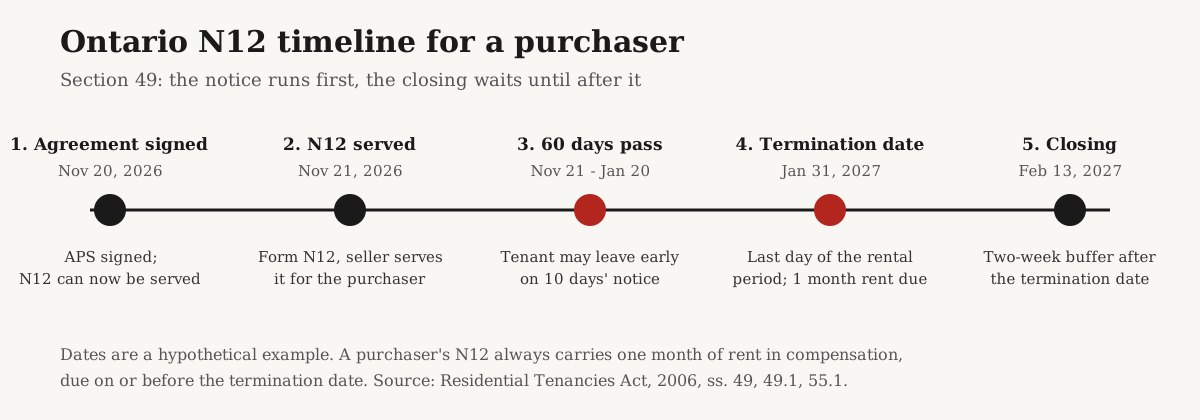
A worked timeline, with real dates
The dates below are a hypothetical example, worked from the rules above, so you can see how the calendar actually runs.
- November 20, 2026: agreement of purchase and sale signed, conditional on financing and inspection.
- November 21, 2026: seller serves the N12 on the buyer's behalf, termination date January 31, 2027. That date is more than 60 days out and falls on the last day of the January rental period.
- January 31, 2027: termination date. One month of compensation is due by this date. On a hypothetical rent of $2,400 a month, that is $2,400.
- February 13, 2027: closing date, set two weeks after the termination date so a tenant who leaves on time still leaves a buffer, and a tenant who leaves late does not blow up the closing.
The closing date is the part buyers get wrong most often. Set it on or before the termination date and you are betting the closing on a tenant leaving exactly on schedule. Set it after the termination date, with a buffer, and a late departure is an inconvenience instead of a failed closing.
If the tenant does not leave
An N12 is a notice, not an eviction order. If the tenant stays past the termination date, the landlord applies to the LTB on Form L2 for an eviction order. The tenant can dispute the notice at the hearing, and the Board looks hard at good faith: who is moving in, why, and whether the story holds together. A hearing takes time, and that time is why the closing buffer matters.
The tenant also has an exit of their own. Once an N12 is served, the tenant can end the tenancy early by giving at least 10 days of written notice on Form N9, and still keeps the one month of compensation. Some tenants take it. Do not count on it.
The bad-faith price tag
A former tenant who believes the N12 was given in bad faith has one year from moving out to file a T5 application with the LTB. If the Board agrees, it can order the rent difference for up to one year, reasonable moving and storage costs, and general compensation of up to 12 months of the rent last paid. On a hypothetical $2,400 rent, that general compensation alone can reach $28,800. The Board can also levy administrative fines, and giving a notice in bad faith is an offence under the Act, with fines of up to $50,000 for individuals and $250,000 for corporations.
The Act also builds in a presumption. If, within one year after the former tenant vacates, the landlord re-rents the unit, advertises it for rent or for sale, demolishes it, or converts it to another use, the Board presumes the notice was given in bad faith unless the landlord proves otherwise. A buyer who moves in, then changes their mind and re-rents the place six months later, walks straight into that presumption. The one-year occupancy promise in the N12 is not a suggestion.
British Columbia: three months, from the portal
BC's rules changed twice in two years, so anything written before 2024 is now wrong. A landlord or purchaser who wants the unit for their own use must give three months' notice. The notice period was two months for years, rose to four months in July 2024, and dropped back to three months in August 2024. The tenant gets one month of rent as compensation, payable on or before the effective date, or credited against the last month's rent.
Two BC details catch buyers out. First, the notice must be generated through the Residential Tenancy Branch web portal. The landlord's-use notice (RTB-32L) and the purchaser's-use notice (RTB-32P) both come out of the portal with a unique notice ID. A notice filled in by hand does not meet the requirement. Second, the tenant has 21 days to dispute the notice and apply for dispute resolution. The person moving in must occupy the unit for at least 12 months, and if the unit is not used for the stated purpose within a reasonable period, the landlord can owe the tenant 12 months of rent.
Alberta: the lease term decides
Alberta is the province where the type of tenancy matters most. A fixed-term tenancy ends only on the date in the agreement, and it cannot be ended early so the landlord or a buyer can move in, unless both sides agree or the tenant commits a substantial breach. A buyer who purchases a home with a tenant eight months into a twelve-month fixed term is a landlord for eight months, whether they like it or not.
Periodic tenancies are different. A landlord can end a monthly periodic tenancy for a prescribed reason, including the landlord or a relative moving in, or a sale where the conditions are met or waived and the buyer or a relative will move in. The notice is three tenancy months, in writing, stating the reason and the termination date. For a sale, the buyer must ask the landlord in writing to give the notice. Weekly tenancies need one week, yearly tenancies need 90 days before the last day of the tenancy year. Demolition, major renovations that need an empty unit, and condominium conversion need 365 days. Disputes go to the Residential Tenancy Dispute Resolution Service.
Quebec: the sale changes nothing
Quebec is the sharpest contrast. Under article 1937 of the Civil Code of Quebec, a sale does not end a lease. The buyer takes over the lease and the landlord's rights and obligations, and the tenant keeps the same rent, the same terms, and the same right to renew. A buyer who wants to live in the unit must use repossession, and repossession is a court-supervised process, not a notice.
Only the owner can repossess, and only for themselves, their parents or children, another relative or in-law they mainly support, or a former spouse they still mainly support. The notice must be in writing and must be sent at least six months before the end of a lease longer than six months, at least one month before the end of a lease of six months or less, and at least six months before the repossession date for a lease with no fixed term. The tenant has one month to accept or refuse. Silence counts as a refusal, and if the tenant refuses, the owner needs the Tribunal administratif du logement to authorize the repossession, and must prove the intention is real and not a pretext.
No compensation is owed for a repossession itself, but the Tribunal can order the owner to pay the tenant's moving expenses. A tenant who believes the repossession was in bad faith has three years to claim damages, and the Tribunal can add punitive damages. Quebec also protects tenants aged 70 or older who have lived in the unit for at least 10 years and meet a low-income test, with only narrow exceptions. And a landlord cannot repossess a unit if they own a similar unit that is sitting empty.
The four provinces, side by side
| Ontario | British Columbia | Alberta | Quebec | |
|---|---|---|---|---|
| Notice to move in yourself | 60 days (N12, s.49) | 3 months (RTB-32P/32L) | 3 tenancy months (periodic only) | 6 months before lease end (repossession) |
| Compensation | 1 month of rent, always for a purchaser | 1 month of rent | None set by the Act for own use | Moving expenses only if the Tribunal orders them |
| Fixed-term lease | Notice must end on the last day of the term | Notice runs to the end of the term | Cannot be ended early for own use | Cannot be ended before the lease ends |
| Who can use it | Purchaser, spouse, child, parent, caregiver; building of 3 units or fewer | Landlord or purchaser, close family | Landlord, relative, or buyer after a written request | Owner, parents, children, supported relative |
| If the tenant stays | LTB hearing on Form L2 | RTB order of possession | RTDRS or court order | TAL authorization |
| Bad-faith cost | Up to 12 months' rent in general compensation, plus rent difference and fines | Up to 12 months' rent | RTDRS order; tenancy continues if the notice fails | Damages plus punitive damages, 3 years to claim |
| Sale ends the tenancy? | No | No | No | No |
No province lets a sale end a tenancy by itself. The difference is only how long the buyer waits, and what the wait costs.
Keeping the tenant: run the numbers before you fall for the rent
A tenanted home can be a good purchase. The rent starts on closing day, the tenant is already in place, and an investor skips the vacancy and the search for a tenant. It can also be a slow leak. The rent the tenant pays is the rent you inherit, and in a rent-controlled unit that number moves only by the guideline. Our rent increase limits guide sets out the provincial caps.
Work it out with the figures below, which are a hypothetical example. A tenant pays $1,850 a month. Similar empty units in the building rent for $2,400. The 2026 Ontario guideline is 2.1%, so the most the rent can rise this year is $38.85, to $1,888.85. The gap to market is $511.15 a month, or $6,133.80 a year, and it closes only by $38.85 a year while the guideline stays near 2%. If the unit was first occupied for residential purposes after November 15, 2018, the guideline does not cap the increase, though 90 days' notice and the once-per-12-months rule still apply. That single date, the date the unit was first lived in, can be worth thousands a year. Ask for it in writing.
If the tenanted space is a basement suite rather than the whole house, the financing rules differ again, since lenders treat a secondary suite as its own file. Our secondary suite financing guide covers the loan program, the appraisal, and the rent the lender will count.
The diligence list for a tenanted purchase is short, and every item on it has a reason:
- The written lease. Get the actual agreement, not the listing's summary of it. Check the term, the rent, who is named on it, and whether it renews into a periodic tenancy.
- The rent ledger. Ask for 12 months of payment records. Arrears transfer with the tenancy, and a tenant who has not paid in three months is a different purchase from one who pays on the first.
- The last month's deposit. Confirm the amount and that it transfers to you at closing. The tenant's deposit is their money, held for the last month, and it moves with the tenancy.
- Notices already served. Ask whether an N12 or any other notice has been served, and get copies. A notice served badly by the seller becomes your hearing to lose.
- Rent-control status. Confirm the first-occupancy date and whether the unit is exempt from the guideline. In Ontario, that is the November 15, 2018 line. In BC there is no equivalent exemption date, and rent increases follow the province's own annual limit.
- The unit itself. Inspect it. Tenants can refuse entry for showings without proper notice, and a unit you have never seen is a unit you have not priced. Your home inspector still needs access, and the tenant still needs the notice the province requires.
- Insurance and the lender. Tell both that the property is tenanted. Some insurers price tenanted properties differently, and some lenders want evidence of how the tenancy will be handled. Finding that out after the financing condition is waived is the expensive way to learn it. Line up home insurance before closing early, since coverage has to be bound by the closing date either way.
- The condo documents, if it is a condo. A status certificate shows arrears, special assessments, and whether the unit is tenanted under the condo's rules. An assessment levied after closing is still your bill.
If the numbers work only at market rent, and the tenant is paying well below it under rent control, the purchase does not work. Say so before the offer, not after closing.
The offer: put the tenancy in the agreement
A tenanted purchase needs clauses a vacant purchase does not. These are points to raise with your own lawyer, not a template. Every one of them exists because a buyer before you learned the lesson the hard way.
- State the tenancy. The agreement should name the tenant, the rent, the lease term, and the deposit, and require the seller to deliver the lease and the rent ledger before closing. The closing costs, including land transfer tax and legal fees, still run on the same schedule as any purchase, so keep our Ontario closing costs guide beside the agreement while you budget.
- Pick a path and write it down. Either the seller delivers vacant possession through the province's process, with the notice served and the termination date set, or the buyer takes the tenancy as it stands. Do not leave it ambiguous.
- Set the closing date after the termination date. A two-week buffer is a reasonable starting point. A closing date that lands before the termination date hands the tenant's moving schedule veto power over your mortgage.
- Address the compensation. In Ontario the seller pays the one month of compensation, since the obligation sits with the landlord who served the notice. The agreement should say who bears it, so it is not argued about at the closing table.
- Hold something back. A holdback for vacant possession, released when the tenant has actually left, gives the seller a reason to make the plan work. The amount and the release terms belong to your lawyer.
- State the tenancy in the financing condition. If your financing depends on vacant possession, or on the rent, say so in the condition. A lender who learns about the tenancy at the last minute can delay or re-price the mortgage. See our financing condition guide for how the condition works.
Your lawyer should also confirm whether the property is in a building of three units or fewer before anyone promises a purchaser's N12, and whether the tenant's lease has months left that no notice can cut short.
Advertisement
Five traps that catch buyers
1. "Tenant will vacate before closing" in the listing. A listing is marketing. What matters is a notice served under the Act, with a termination date, and compensation paid. If there is no notice, there is no plan.
2. An N12 served before the agreement is signed. In Ontario, a purchaser's N12 needs a signed agreement of purchase and sale first. A notice served on a handshake, or on a buyer who has not signed yet, fails.
3. Compensation paid late, or not at all. In Ontario the one month of compensation is due on or before the termination date, as a separate payment. Waiving the last month's rent deposit does not count. A late payment voids the notice at the Board.
4. Closing on the termination date. The tenant's last day and your closing day should not be the same day. Tenants leave late. Trucks break down. Keys get lost. A buffer costs nothing and saves the closing. Run the final walkthrough once the unit is actually empty, not while the tenant is still moving boxes.
5. Assuming Quebec works like Ontario. It does not. A sale never ends a Quebec lease, a buyer cannot serve an N12, and moving in means a six-month repossession process through the Tribunal. A buyer who closes in Montreal expecting the Ontario rules has bought a tenancy with no exit for months.
Frequently asked questions
Does buying a house with a tenant mean the tenant has to leave?
No. In every province, the sale does not end the tenancy. The buyer becomes the landlord on closing and inherits the lease, the rent, and the tenant's rights. The tenant leaves only through the province's own-use process: an N12 in Ontario, a three-month RTB notice in BC, a three-month notice for a periodic tenancy in Alberta, or a repossession in Quebec.
How much notice does a buyer have to give a tenant in Ontario?
At least 60 days on Form N12 under section 49, with the termination date falling on the last day of a rental period or the last day of a fixed term. One month of rent in compensation is always owed on a purchaser's N12. The September 2026 Bill 60 change that removes compensation for 120-day notices applies only to a landlord's own-use notice under section 48, not to a purchaser's notice.
Can a buyer in Ontario serve an N12 on a four-plex?
No. Section 49 applies only to a residential complex with no more than three residential units, or a condominium unit. A four-plex or larger building does not qualify, and a purchaser's N12 served on one is of no effect.
What happens if the tenant does not leave after an N12?
The landlord applies to the Landlord and Tenant Board on Form L2 for an eviction order, and the tenant can dispute the notice at a hearing. The Board examines good faith closely. This is why the closing date should sit after the termination date with a buffer, not on it.
Can you raise the rent after buying a tenanted home in Ontario?
Only within the rules. For most units the 2026 rent increase guideline is 2.1%, with at least 90 days' written notice and no more than one increase per 12 months. Units first occupied for residential purposes after November 15, 2018 are exempt from the guideline cap, though the 90-day notice and 12-month rules still apply. A new tenancy after the old one ends can be priced freely.
What should a buyer check before offering on a tenanted home?
Get the written lease, the rent ledger showing what was actually paid, proof of the last month's deposit, and the rent-control status of the unit. Confirm whether the tenancy is fixed-term or periodic, whether any notices have already been served, and whether the building has three units or fewer if you plan a purchaser's N12. Have your lawyer confirm the tenancy in the agreement and your lender confirm the tenancy does not change your financing.
How long does it take to get a tenant out in Quebec?
At least six months before the end of a lease longer than six months, and the tenant has one month to accept or refuse. If the tenant refuses, the owner needs authorization from the Tribunal administratif du logement. A sale alone never ends a Quebec lease.
What is the penalty for a bad-faith N12 in Ontario?
A former tenant has one year from moving out to file a T5 application. The Board can order the rent difference for up to one year, moving and storage costs, and general compensation of up to 12 months of the rent last paid, plus administrative fines. Giving a notice in bad faith is also an offence with fines of up to $50,000 for individuals and $250,000 for corporations.
This article is general information about Canadian tenancy law, not legal advice for any specific situation. Tenancy rules, guidelines, and Board practices change, and the right process depends on the province, the building, and the lease. Confirm the current requirements with the province's tenancy tribunal or a licensed lawyer before you act.
About the BubbleWatch editorial team
BubbleWatch is written and checked by its editorial team under the site brand. Figures come from public sources such as CREA, Statistics Canada, CMHC and the Bank of Canada, and each article links the sources it uses. BubbleWatch is independent of realtor boards and lenders.
Read our full editorial methodology →