Flood Insurance in Canada (2026): The Two Add-Ons a Standard Policy Leaves Out, and the Federal Program With No Launch Date
Most Canadian homeowners who say they have flood insurance mean something narrower than they think. Flood coverage is optional in Canada, it is sold as separate pieces for separate water paths, and each piece carries its own limit. This guide maps the four ways water enters a home to the coverage that answers each one, works through a labelled hypothetical basement loss at two different limits, tracks the national flood insurance program from its 2021 mandate letter to its missed April 2026 target, and explains the federal disaster-assistance rule that makes under-insuring a costly bet: where a hazard is deemed insurable, disaster assistance does not pay for losses that insurance could have covered.
Flood Insurance in Canada (2026): The Two Add-Ons a Standard Policy Leaves Out, and the Federal Program With No Launch Date
Short answer: A standard home insurance policy in Canada does not cover flooding. Water that arrives from outside the home, whether it flows over land after heavy rain or snowmelt, overflows from a lake or river, or backs up through a sewer or drain, is covered only if you bought the specific optional add-on for that water path, and only up to the limit printed for that add-on. The federal government has been building a low-cost national flood insurance program for high-risk homes since 2021. It was supposed to be advanced by 2025, then targeted for April 2026 with $450 million pledged during the 2025 election campaign. As of the most recent industry reporting in 2026, it has no delivery date, no application process, and no published policy terms. Until it exists, the coverage decision sits entirely with the homeowner, and the disaster-assistance rules are written so that skipping available coverage can disqualify the loss later.
This guide is education, not insurance advice. Policy wordings differ by insurer and province, and the wording you bought is the document that decides a claim. The Insurance Bureau of Canada (IBC) pages, the federal budget documents, and Public Safety Canada's Disaster Financial Assistance Arrangements (DFAA) guidelines cited here are the sources to check against your own policy.
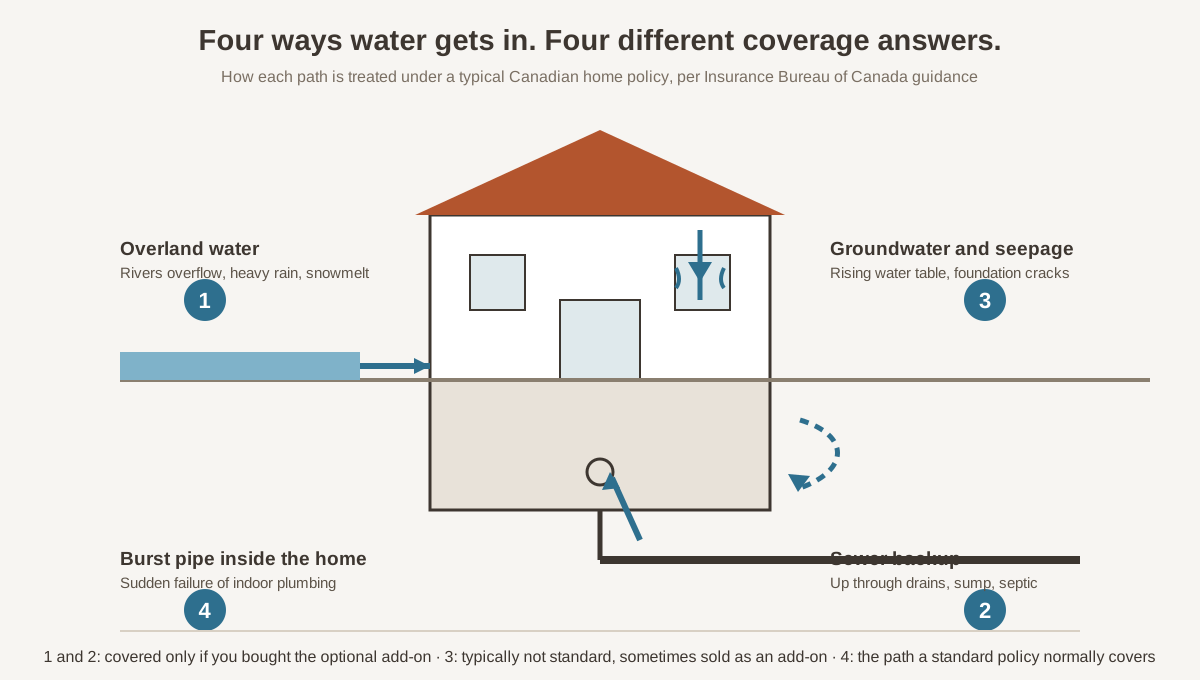
Four water paths, four different coverage answers
Disputes about flood claims usually start with a vocabulary problem. "Water damage" on a policy is not one thing. IBC's flooding guidance separates the paths water takes into a home, and each path has a different coverage status.
| How the water got in | Covered by a standard policy? | What covers it |
|---|---|---|
| Overland water: overflow of lakes, ponds or rivers; surface water from heavy rainfall or melting snow entering at ground level | No | Optional overland flood coverage, bought as an add-on; may be limited or unavailable in a known flood plain or high-flood-hazard area |
| Sewer backup: water or sewage coming back through sewers, drains, sump or septic into the basement | No | Specific, optional sewer backup coverage; coverage limits may apply |
| Groundwater and seepage: a rising water table, or water entering through below-ground walls, windows, doors and foundations | Typically not standard | Some insurers sell groundwater and seepage protection as optional endorsements, separately or bundled, for an additional cost |
| A burst pipe or a sudden failure of indoor plumbing or an appliance | Generally yes, for sudden and accidental escape | The standard policy itself; the failed pipe or appliance is a separate question from the damage the water did |
Two consequences follow from the table. First, a storm can send water down more than one path in the same night. Rain ponds against the house and comes through a window well while the municipal sewer, overwhelmed by the same rain, pushes water up through the floor drain. A homeowner who bought only the sewer backup add-on has coverage for the second path and none for the first, and the adjuster will sort the damage by path, not by storm. Second, the add-ons are capped separately from the main policy. A home insured for its full rebuilding cost can still carry a sewer backup limit of $25,000, and that limit, not the headline policy amount, is what a basement claim runs into.
Our basement flooding due diligence guide covers the physical side of this: tracing which paths a specific house is exposed to. This guide covers the financial side: which of those paths your policy actually pays for, and for how much.
Read your own policy in ten minutes
You do not need your full policy wording for a first pass. The declarations pages, the summary your insurer issues at renewal, list the endorsements and their limits. Look for five things, in this order:
- Is sewer backup listed at all? If the endorsement is absent, a backup claim pays zero regardless of the damage. If it is listed, note the limit. It is often far below the cost of refinishing a basement, as the worked example below shows.
- Is overland water (or flood) listed, and at what limit? Some insurers bundle several water endorsements into one package with one combined limit; others list them separately. A bundle with a single shared limit is worth less than the same numbers listed separately.
- What deductible applies to water claims? The general deductible and any separate water or sewer-backup deductible can differ. The deductible comes off the payment, so it belongs in the same arithmetic as the limit.
- Are groundwater and seepage in or out? IBC notes these are typically not standard across home policies. If your home has a high water table or a history of damp foundation walls, this line decides more claims than the flood line does.
- What does the additional living expenses (ALE) section pay, and under which perils? IBC's guidance is that standard policies cover alternate accommodation after an insured loss, and that in a flood situation this applies to homeowners who bought the optional sewer backup or overland coverage. No water endorsement, no ALE for a water event, even if the rest of the policy is comprehensive.
If any of the five answers surprise you, that is a conversation with your broker or insurer before renewal, not after a storm. Ask the questions in writing so the answers form part of your file.
The math: the limit is the claim
Premiums get the attention at renewal. Limits decide the recovery. The worksheet below is a labelled hypothetical, built to show the method rather than to quote prices in any city: the line items are illustrative, and you should replace them with quotes for your own basement. The arithmetic is exact.
Labelled hypothetical: a finished basement takes sewer water during a storm. Cleanup and remediation $6,400; drywall and insulation replacement $8,900; flooring $7,600; furnace and water heater service and parts $3,850; damaged contents $9,300; a basement kitchenette and cabinets $6,800; paint and finishing $5,000. Total loss: $47,850.
Now run that loss through two versions of the same policy, each with a $1,000 deductible:
| Sewer backup limit of $25,000 | Sewer backup limit of $50,000 | |
|---|---|---|
| Total covered loss | $47,850 | $47,850 |
| Insurer pays (loss up to the limit, minus the deductible) | $24,000 | $46,850 |
| Owner pays out of pocket | $23,850 | $1,000 |
Same house, same storm, same total premium class. The difference in recovery is $22,850, and it was set at a desk when the policy was sold or renewed, not at the claim. Two riders on the method: contents are sometimes subject to their own sub-limits inside an endorsement, and depreciation can apply to contents unless the policy pays replacement cost, so treat the table as the ceiling of what the limit allows, then check your wording for what trims it further.
The premium side of the trade is smaller than most owners assume. IBC's 2026 market report, covered in the next section, found that 88 percent of overland flood policies in Canada cost $300 or less per year. That figure describes the policies people actually bought, most of them on lower-risk homes, and a high-risk address will be quoted differently or not quoted at all. Use it as a reference point for a quote, not as a promise about yours.
The private market quietly got bigger
For years the standard fact in this file was that roughly 1.5 million Canadian households could not get flood insurance at any price. Reporting through mid-2026 still cited that figure, attributed to IBC. IBC's own newer market study, The State of the Flood Insurance Market in Canada, reported on by Insurance Business in 2026, tells a different and more recent story:
- About 94 percent of residential properties in Canada are now eligible for overland flood coverage, from a market that was largely inaccessible a decade ago. Overland residential coverage only became broadly available in Canada after the 2013 Alberta floods, with the first products appearing around 2015.
- Household take-up of flood insurance rose from 26 percent in 2017 to 71 percent in 2023.
- 88 percent of overland flood policies cost $300 or less annually.
- The number of homes unable to access overland flood insurance fell by nearly 45 percent over seven years, from about 1.5 million to roughly 850,000.
- More than 30 insurers now offer some form of overland flood coverage.
- Risk is concentrated: about 2 percent of residential properties account for more than half of the country's total potential flood losses.
Both sets of numbers can be in circulation at once because they measure different things in different years: an older access estimate against a newer eligibility study, and eligibility is not the same as a premium a household can pay. The federal government's own adaptation reporting has continued to use the 1.5 million figure for high-risk households lacking adequate and affordable flood insurance. The direction of travel is not in dispute: the private market now reaches most addresses. The remaining gap is a specific group of high-risk homes, and it is the group the federal program was designed for. The losses keep arriving while the design work continues: CatIQ's initial estimates put insured damage from the June 9 and 10, 2026 storms across Manitoba and Saskatchewan at more than $728 million, and flooding in Montreal and surrounding areas on June 20 and 21, 2026 caused more than $409 million in insured damage.
The national flood insurance program: promised since 2021, still not open
The program's paper trail is long, and every date on it has passed.
| When | What happened |
|---|---|
| January 2021 | Public Safety Canada establishes a task force of federal, provincial and territorial governments and the insurance industry to examine flood insurance and relocation options |
| December 2021 | The mandate letter for the Minister of Emergency Preparedness commits to creating a low-cost national flood insurance program for high-risk homeowners |
| August 2022 | The task force findings are published as Adapting to Rising Flood Risk: An Analysis of Insurance Solutions for Canada |
| Budget 2023 | $31.7 million over three years for Public Safety Canada and CMHC to develop a low-cost flood insurance program, plus $15.3 million for a publicly accessible online portal for flood risk information |
| Budget 2024 | A commitment to establish a CMHC subsidiary to deliver flood reinsurance, and $15 million to advance the national flood insurance program by 2025 |
| 2025 election campaign | $450 million over five years pledged for the program, with an April 2026 launch target |
| Mid-2026 | No launch. IBC officials told industry press there is no confirmed delivery timeline and the federal government is still designing the program; IBC's director of federal affairs put it plainly in 2026 reporting: there is no timeline she could share |
The design, as described in the budget documents, is a reinsurance backstop: a CMHC subsidiary would stand behind participating insurers so they can sell affordable overland coverage to high-risk households, with a separate subsidy element for affordability. It is not a government storefront where a homeowner buys a policy. As of October 2026 there is no application, no eligibility list, no published premium, and no policy a homeowner can hold. Budget 2025, the most recent full budget cycle in the trail, contained broader climate resilience funding and no update on the program.
Plan as if the program does not exist, because for any claim filed this year it does not. If it launches, it will be aimed at the highest-risk households first, the roughly 850,000 to 1.5 million homes, depending on which current estimate you use, that the private market still will not cover affordably.
Disaster assistance is not the fallback it looks like
The other common assumption is that government disaster assistance will fill the gap after a major flood. The federal rules behind that assistance say otherwise, in writing.
The Disaster Financial Assistance Arrangements are the federal cost-sharing program that reimburses provinces and territories after large disasters; households apply to their provincial or territorial program, not to Ottawa. The DFAA guidelines in force for disasters beginning on or after April 1, 2025 state the core rule at section 8.3: the DFAA does not cover insurable losses and is not a replacement or substitute for insurance. Insurable is defined at the regional or community level, reviewed annually: if coverage for the hazard was available and adequate in the region, then expenses that could have been covered by that insurance are ineligible, and the guidelines add that where people elect to self-insure or under-insure for a hazard deemed insurable, those losses are not eligible either.
Read that against the market numbers above. In a region where overland and sewer backup endorsements are widely sold, which is now most of the country, the insurability test is the obstacle: the assistance system is built to pay for the losses insurance could not have covered, not the ones a homeowner chose not to cover. Two more limits in the same guidelines matter to households. Assistance is capped around standard replacement value, the cost of restoring function with standard models, not the cost of restoring a renovated finish. And for assets with major damage in designated high-risk areas, eligibility can depend on the property having been appropriately mitigated, with flood high-risk designations referenced to a 1-in-200 year event standard where provincial designations meet it. Provincial programs add their own rules on top; Quebec's general disaster assistance program, for example, has treated a sewer backup caused by heavy rain alone differently from one caused by an overflowing watercourse, as reporting on the 2026 Montreal claims explained.
None of this makes disaster assistance useless. It is the payer of last resort for genuinely uninsurable loss, and for the high-risk homes the private market still refuses, it may be the only payer. It does make "the government will help" a weak reason to decline an endorsement that was offered to you at a price you could pay.
Buying a home: price the water risk before the offer goes firm
For buyers, the sequence matters more than the shopping. A flood quote obtained after closing is information. The same quote obtained during a condition period is bargaining power, and occasionally a reason to walk away.
- Ask the water questions with the other disclosure questions. Sellers disclose known water history through the property disclosure statement where one is used, and a past flood that was repaired is exactly the kind of fact that changes both the price and the insurance quote. Our property disclosure statement guide works through what those forms do and do not promise.
- Walk the paths in the house, not just the finishes. The home inspection checklist and our sewer lateral camera inspection guide cover the drain, grading, window well and foundation evidence to collect while you still have conditions.
- Quote the address, not a comparable address. Insurers price flood at the property level. A quote on the actual home, including whether overland and sewer backup endorsements are offered and at what limits, is part of knowing the home is insurable at all, which our home insurance before closing guide treats as a closing requirement rather than an afterthought. If an insurer will not offer overland coverage on the address at any price, you have learned something about the home that no staging can show you.
- Carry the answer into the price. A home that needs a $50,000 backup limit, a backwater valve and a regraded lot is a different purchase from the same home priced as if none of that applied. The home maintenance budget guide is where those recurring costs belong in your first-year numbers.
Shrink the loss before you raise the limit
Insurance pays after the fact. The cheaper half of flood risk is keeping the water out or giving it somewhere else to go, and several steps cost less than one year of the premium difference between limits:
- A backwater valve on the sewer lateral is the single mechanical defence against the sewer backup path. Some municipalities run subsidy programs for valves and sump pumps; check yours before paying full price.
- A sump pump with backup power only helps if it runs during the outage that storms tend to cause. A battery or water-powered backup is the difference between a system and a decoration.
- Grading and downspouts decide where surface water goes in the first ten minutes of a downpour. Soil should slope away from the foundation and downspouts should discharge well away from the house, not beside the footing.
- Move what water ruins. A finished basement stores value at floor level. Documents, electronics and anything irreplaceable belong up high or upstairs; anything stored low should be in sealed bins, priced in your head as already lost.
- Know the mould clock. Standing water and soaked drywall become a mould problem on a short timeline, which is why the first call after a flood is about drying, not decorating. Our mould inspection guide explains what assessors look for after a water event.
None of these measures changes what your policy says. They change the size of the loss the policy has to answer, and insurers may ask about valves and pumps when they set the terms of a water endorsement, so keep the invoices.
If the water gets in anyway
IBC's claims guidance is procedural and worth following in order:
- When it is safe, list and photograph all damaged or lost items, with proofs of purchase, receipts and warranties where you have them. Keep the ruined items unless they are dangerous or a health hazard.
- Report the claim to your insurer or representative as soon as possible, and keep detailed notes. Keep every receipt for cleanup and for additional living expenses if you have to leave.
- Expect to complete a proof of loss form listing the damaged property and its value. You sign it as true, and IBC notes it typically has to be returned within 30 days. Ask your adjuster to confirm the deadline on your file rather than assuming it.
- Ask about additional living expenses at the first call: what your limit is, and whether your water endorsements trigger it. In a flood, ALE generally follows the optional water coverage, not the base policy.
- Do not sign off on government disaster assistance as a substitute until you know whether your loss is the kind it can pay. Making the insurance claim first protects both routes.
Sources
- Insurance Bureau of Canada, Flooding and Insurance (coverage types, sewer backup and overland status, groundwater and seepage, additional living expenses, claims and proof of loss steps), ibc.ca, read October 2026.
- Public Safety Canada, Parliamentary Committee Notes: Mitigating Disaster Risks (task force January 2021, December 2021 mandate letter, August 2022 report, Budget 2023 amounts of $31.7 million and $15.3 million portal funding, Budget 2024 CMHC subsidiary and $15 million to advance the program by 2025), modified January 23, 2025.
- Public Safety Canada, Guidelines for the Disaster Financial Assistance Arrangements, for eligible disasters beginning April 1, 2025 (section 8.3 insurance by hazard, the insurable definition, high-risk area and standard replacement value rules).
- Insurance Business Canada, reporting on IBC's The State of the Flood Insurance Market in Canada (94 percent eligibility, take-up 26 percent in 2017 to 71 percent in 2023, 88 percent of overland policies at $300 or less, inaccessible homes down from about 1.5 million to roughly 850,000, more than 30 insurers, 2 percent of properties and more than half of potential losses), 2026.
- Insurance Business Canada, 2026 reporting on the national flood insurance program's status ($450 million pledge and April 2026 target, no confirmed delivery timeline, IBC federal affairs comments) and on CatIQ's initial insured damage estimates for the June 2026 Manitoba and Saskatchewan storms (more than $728 million) and Montreal flooding (more than $409 million).
This article is general education about how flood coverage is structured in Canada. It is not a recommendation of any insurer, endorsement or limit for a specific property. Your policy wording, your insurer's underwriting rules for your address, and provincial regulation decide your coverage. A licensed broker or agent can apply those rules to your home before you buy, renew or file.
Advertisement

About David R. Chen, CFA
David R. Chen is a Chartered Financial Analyst and the Senior Housing Economist at BubbleWatch.ca. He brings 12+ years of experience in quantitative real estate analysis and mortgage underwriting. Formerly an analyst at a major Canadian bank, he specializes in modeling payment shock, regional affordability divergence, and private lending risk.
View David's professional bio & credentials →