Pest and Termite Inspections When Buying a Home
A source-first buyer method for identifying the pest, mapping activity and building damage, correcting moisture and entry conditions, verifying lawful treatment, and pricing repair, monitoring, cleanup, and recurrence risk together.
Pest and Termite Inspections When Buying a Home in Canada
Droppings, mud tubes, chewed wiring, insect wings, wood dust, traps, patched soffits, and a treatment sticker are clues - not a complete pest diagnosis. Buyers need the species or pest group, active and historical locations, entry or moisture conditions, building damage, treatment record, monitoring plan, and repair scope.
A pest professional controls organisms. A carpenter, roofer, electrician, remediation contractor, arborist, or engineer may be needed to repair the conditions or damage. One spray invoice cannot establish that the structure is sound or the entry path is closed.
The transaction file should separate four questions: What is present? Why is the property suitable for it? What damage or contamination occurred? What proves control over time?
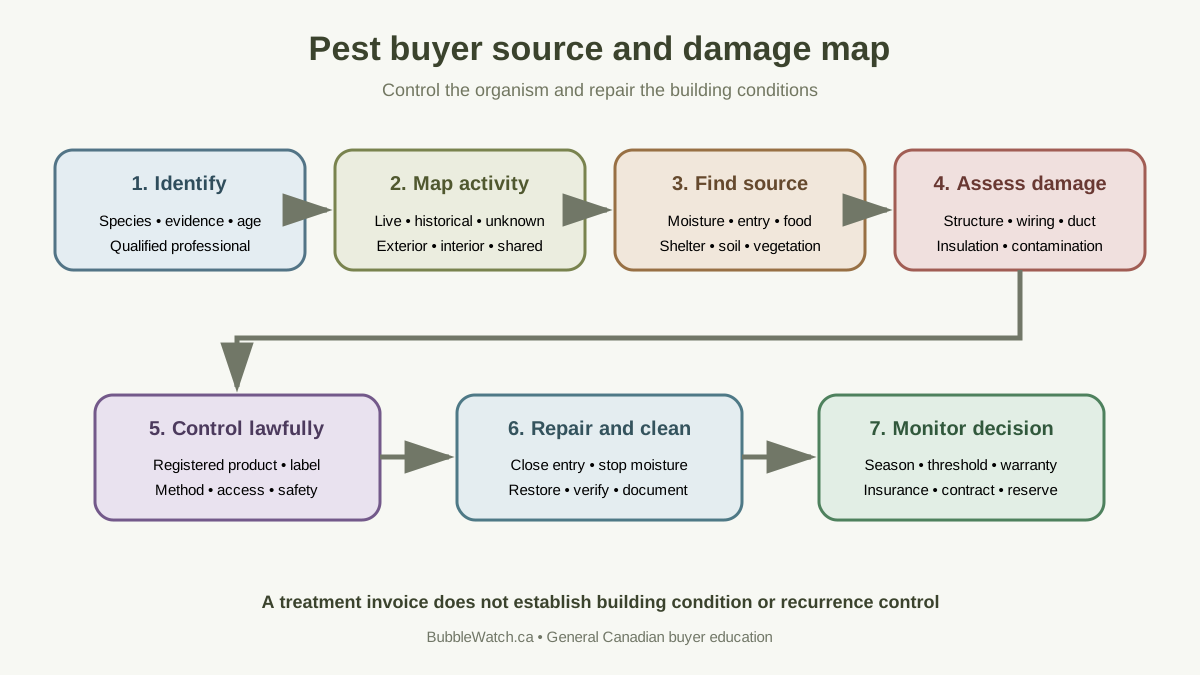
Short answer: identify, map, correct, control, and verify
Use this order:
- stop casual disturbance and preserve evidence;
- retain a qualified pest professional for identification and activity assessment;
- map visible and concealed-risk areas;
- find moisture, food, shelter, vegetation, soil, and entry conditions;
- assess structural, electrical, insulation, duct, finish, and sanitation damage;
- correct building sources and access points;
- use lawful, pest-specific control under current labels and local rules;
- clean or remediate affected materials safely;
- monitor through the relevant season;
- price recurrence and repair risk before removing conditions.
Do not destroy mud tubes, vacuum specimens, move bait stations, open suspect walls, or apply products during a showing. The evidence may guide identification and scope.
Know where a general home inspection stops
The federal home-inspection guidance includes accessible site, structure, envelope, attic, interior, and safety observations. A general inspector can identify pest clues and recommend specialist review.
ISED's industry classification distinguishes general building inspection from establishments primarily inspecting for termites and other pests. That boundary matters: a home inspector's “possible carpenter-ant activity” should trigger a qualified pest and damage assessment rather than a species claim.
General scope normally cannot identify every insect from debris, see through finishes, determine colony location, quantify concealed wood loss, certify pesticide use, or guarantee eradication. Snow, stored contents, insulation, decks, crawl spaces, finished basements, landscaping, height, contamination, and occupant safety can hide evidence.
Ask whether the inspection agreement includes pest observations, which areas are entered, and how suspected activity is reported. Record every area excluded.
Build a property-wide activity map
Create one line per clue:
| ID | Location | Evidence | Live/old/unknown | Material affected | Moisture/entry clue | Access limit |
|---|---|---|---|---|---|---|
| P-01 |
Inspect accessible:
- foundation perimeter, soil, mulch, wood piles, stumps, roots, and fences;
- siding, trim, sills, porches, decks, stairs, roof edges, soffits, and vents;
- basement, crawl space, rim joists, sill plates, posts, and beams;
- attic insulation, sheathing, ducts, wiring, hatches, and eaves;
- kitchens, pantries, bathrooms, laundry, mechanical rooms, and garbage areas;
- cabinets, closets, utility penetrations, floor edges, and ceiling patches;
- garage, shed, barn, boathouse, and stored contents;
- trees touching or overhanging the building;
- shared walls and common areas in attached homes.
Photograph scale and context without touching material. A pile of sawdust below a beam can come from current insect activity, old drilling, construction, or falling debris. Identification changes the response.
Separate common pest categories
Termites
Possible clues include shelter or mud tubes, damaged wood, discarded wings, live insects, hollow or layered wood, and prior treatment components. Species, geography, soil, building design, and colony behaviour affect investigation.
Do not infer absence because no tubes are visible during one visit. Concealed paths, finished walls, insulation, slabs, porches, and inaccessible crawl spaces can limit observation.
Carpenter ants
Carpenter ants excavate galleries in wood rather than eating it as food. Moist or damaged wood can create favourable conditions. Clues may include workers, frass-like debris, smooth galleries, sound, satellite nests, and activity trails.
Finding ants in a kitchen does not locate the nest or prove structural damage. Trace moisture, roof, window, plumbing, deck, tree, and wall conditions.
Wood-boring beetles and other insects
Exit holes, powder, pellets, galleries, and damaged wood require specialist identification. Hole shape and debris can help, but age and activity need informed interpretation.
Rodents
Droppings, gnawing, grease marks, tracks, nests, odour, damaged food, burrows, and noises can indicate mice, rats, or other rodents. Electrical, insulation, duct, food-safety, and contamination work may extend far beyond trapping.
Wildlife and birds
Bats, squirrels, raccoons, birds, and other animals can use attics, soffits, chimneys, decks, crawl spaces, and sheds. Wildlife handling, maternity seasons, protected species, exclusion timing, and cleanup rules require qualified local advice.
Cockroaches, bed bugs, and household pests
These can involve units, furnishings, wall voids, shared service paths, occupant cooperation, preparation, repeated visits, and stigma. A detached-building method may fail in a multi-unit property.
Find the condition that sustains activity
Pest control begins with the building and site. The Canadian Food Inspection Agency's pest-prevention guidance, written for food businesses, illustrates durable principles: prevent entry, remove harbourage, monitor evidence, manage waste, and maintain the building. Residential professionals must adapt the method to the home.
Map:
- roof, window, plumbing, foundation, condensate, and drainage moisture;
- wood or siding contact with soil;
- mulch, stored lumber, firewood, cardboard, and debris;
- cracks, gaps, screens, vents, utility penetrations, and door seals;
- tree limbs, vines, fences, and decks bridging to the house;
- food, pet feed, compost, garbage, and grease;
- condensation and high indoor humidity;
- vacant, cluttered, or rarely entered areas;
- shared walls, chases, ducts, and drains.
Treatment without source correction can produce repeated service. Source correction without removing an active infestation can allow continuing damage.
Use the roof inspection guide, window and door guide, and basement-flood map when water creates the favourable condition.
Distinguish activity from damage
A pest professional can locate evidence and recommend control. Structural or system damage may need other qualifications.
Assess:
- sill plates, rim joists, beams, columns, joists, rafters, trusses, sheathing, stairs, decks, and guards;
- door and window frames;
- wiring, cables, junctions, equipment, and alarms;
- ducts, flexible connectors, insulation, vapour and air barriers;
- plumbing and drain lines;
- drywall, flooring, cabinets, stored contents, and finishes;
- contaminated porous materials;
- tree stability and damaged roots where relevant.
Ask the damage professional to state material lost, remaining section, load path, temporary support, repair design, access, and concealed limits. “No visible structural damage” may simply mean the pest inspection did not expose structural members.
Chewed wiring calls for authorized electrical review. Compacted or contaminated attic insulation calls for safe removal and the attic inspection workflow.
Reconstruct the pest history
Request:
- first and later sighting dates;
- species identification and report;
- activity map and photographs;
- inspection areas and exclusions;
- product, registration number, label, quantity, placement, and applicator;
- bait, trap, barrier, injection, heat, exclusion, or other method;
- preparation, re-entry, pet, child, food, and ventilation instructions;
- follow-up visits and monitoring results;
- warranty, renewal, transfer, and cancellation terms;
- moisture, entry, landscape, sanitation, and building corrections;
- structural, electrical, insulation, duct, and finish repairs;
- neighbour, condo, tenant, or property-manager reports;
- recurrence and seasonal observations.
“Treated annually” can describe preventive monitoring, repeated unresolved activity, or a service contract. Read the reports.
Use the property-disclosure evidence ledger to distinguish known past activity, current professional conclusion, and areas never assessed.
Use pesticides only under Canadian registration and label rules
Health Canada's current pesticide safety guidance says only registered products should be used and label directions must be followed. Registered products carry a Pest Control Products Act registration number.
The department's Pesticide Product Information Database provides product, active ingredient, label, application, and incident information. Verify the current authorized label rather than relying on a contractor brochure or foreign website.
Ask:
- Is the product registered for the exact pest and treatment location?
- Is it domestic, commercial, or restricted class?
- Who may apply it under provincial or territorial rules?
- What preparation, personal protection, ventilation, re-entry, food, pet, water, and environmental directions apply?
- Which surfaces, voids, perimeter, soil, bait, or spot applications are authorized?
- How will residues, spills, damaged containers, and waste be handled?
- What record and incident process applies?
Do not apply an unregistered online product. Health Canada warns that unregistered products can contain unknown or ineffective ingredients, incomplete instructions, or misleading claims.
Do not let treatment destroy diagnostic evidence
Spraying before identification can scatter activity, expose occupants, contaminate samples, and complicate the specialist's map. Removing damaged wood can erase galleries or moisture clues.
Sequence access:
- document current evidence;
- identify or collect specimens under professional direction;
- assess activity boundaries and source conditions;
- plan hazardous-material and contamination controls;
- open construction only with permission and repair terms;
- assess building damage;
- coordinate source repair, pest control, cleanup, and reconstruction;
- verify and monitor.
If treatment already occurred, request pre-treatment photographs and maps.
Compare control proposals by decision, not product name
Ask every bidder to use the same activity map and building facts. A useful proposal states:
- target pest and identification basis;
- active, suspected, historical, and excluded areas;
- inspection and monitoring method;
- entry, moisture, sanitation, landscape, or material corrections assigned to others;
- treatment objective and chosen method;
- exact registered product and current label where a pesticide is proposed;
- location, application type, quantity basis, preparation, ventilation, re-entry, and precautions;
- number and timing of visits;
- criteria for retreatment or escalation;
- access openings and restoration;
- occupants, tenants, children, pets, food, aquariums, wells, gardens, and pollinator protections;
- warranty, renewal, transfer, cancellation, and exclusions;
- documentation delivered after each visit.
Compare the reasoning. One company may price bait and monitoring, another a localized void treatment, and another broad work without establishing why its method fits the property. Ask what evidence would make the professional change course.
A warranty with unlimited retreatment can still leave building repair, belongings, cleanup, hotel stays, neighbour treatment, and source correction outside coverage.
Inspect soil, wood, and landscape interfaces
Walk the entire foundation where access is safe. Record wood-to-soil contact, buried siding, foam insulation, cracks, service penetrations, porches, steps, deck ledgers, lattice, crawl vents, mulch depth, irrigation, tree roots, stumps, and stored lumber.
Ask the pest professional how each feature changes inspection access and pest pathways. Removing every plant is not a universal solution; landscape work should preserve grading, drainage, tree health, property boundaries, and habitat rules.
Firewood should be evaluated by location, ground contact, cover, moisture, and movement into the home. Moving an infested or contaminated pile can spread activity or expose workers.
If a tree contains activity, an arborist should assess species, health, structural condition, ownership, and safe work. Pest presence in a dead stump does not by itself prove the house is infested, but the site relationship matters.
Investigate attached garages, additions, and renovations
Garages combine exterior doors, slab joints, stored food or seed, vehicles, cardboard, drains, utility penetrations, and shared walls. Check the fire separation after pest or wildlife openings are closed.
Additions create interfaces where old foundations, roofs, crawl spaces, and cladding meet new work. These joints can trap moisture or leave concealed entry. Ask for pre-construction pest findings and photographs.
Renovation can bury activity, remove visible tubes, disturb pesticide barriers, move infested materials, or leave wall voids open. Review permits and invoices, then identify which areas have never been visible since the work.
If the buyer plans immediate renovation, coordinate pest, hazardous-material, structural, and demolition scopes before opening walls. Discovery after a contractor mobilizes can stop work and expose occupants.
Distinguish pest evidence from look-alikes
Paint flakes, insulation, construction sawdust, seeds, bat droppings, mouse droppings, insect frass, and wood powder can resemble one another in poor light. Water stains can be mistaken for urine, while old foam and sealant can resemble nests or tubes.
Do not use an internet photograph as the final identification. Preserve a clear photograph and specimen under professional direction, noting date and exact location.
Dead insects near a window may reflect ordinary seasonal entry, a hidden infestation, or treatment elsewhere. Quantity, species, life stage, pattern, building conditions, and recurrence provide context.
Plan for occupants and belongings
Treatment preparation can involve laundering, heat, bagging, moving furniture, emptying cabinets, protecting food, vacating rooms, arranging pet care, and repeated access. Ask who performs each task and which preparation is essential to effectiveness and safety.
For bed bugs or cockroaches, belongings and adjacent units can be part of the control plan. Throwing away furniture without professional direction can spread pests through common areas and create unnecessary cost.
Older adults, children, pregnant occupants, people with disabilities, respiratory conditions, or limited transport may need an adapted plan from medical, public-health, and pest professionals. The purchase budget should include safe accommodation and assistance where required.
Price control and building repair together
Build a cost stack:
| Layer | Scope examples |
|---|---|
| Identification | Inspection, specimens, monitoring, opening plan |
| Source correction | Roof, plumbing, drainage, humidity, food, landscape, entry |
| Pest control | Product or non-chemical method, visits, placement, safety |
| Damage | Structure, wiring, ducts, insulation, finishes, tree work |
| Cleanup | Droppings, carcasses, nests, contaminated material, odour |
| Restoration | Air barrier, insulation, drywall, flooring, cabinets, paint |
| Verification | Reinspection, monitoring period, warranty, recurrence plan |
Ask for quantities, access, occupant preparation, move-out, tax, permit, warranty, hidden-condition rates, and exclusions. A per-visit treatment price is not the ownership cost.
For termites or widespread wood damage, include engineer, shoring, demolition, framing, utilities, cladding, waterproofing, interior finish, and landscaping.
Evaluate cleanup as a separate safety scope
Droppings, urine, nests, carcasses, parasites, dust, mould, pesticides, and damaged insulation can create health and exposure questions. Do not dry sweep or vacuum unknown contamination during a showing.
Ask the qualified cleanup professional to define containment, worker protection, material removal, cleaning, disinfection where appropriate, waste, HVAC isolation, odour treatment, drying, and verification. Health questions belong with public-health or medical professionals.
If moisture and mould overlap, use the mould inspection guide so pest cleanup does not substitute for moisture correction.
Monitor across time and season
One quiet visit does not prove eradication. Monitoring may use stations, traps, visual checks, remote devices, moisture readings, or scheduled professional visits depending on the pest.
Define:
- locations and numbering;
- inspection frequency and responsible person;
- activity threshold and escalation;
- relevant swarm, breeding, migration, or winter season;
- building and landscape conditions to maintain;
- warranty visit and transfer deadline;
- documentation retained for insurer and future sale.
A warranty can be conditional on paid renewals, access, moisture correction, or no construction changes. Read exclusions and remedy.
Insurance, condos, rentals, and neighbours
Ask the insurer about pest damage, sudden resulting loss, contamination, vacancy, required correction, and claim history. Do not infer coverage from a general property policy. Use the home-insurance before closing workflow.
In condos and attached homes, activity can cross common walls, roofs, foundations, ducts, pipes, and landscaping. Review corporation responsibility, pest contracts, minutes, reports, unit access, chargebacks, neighbouring treatment, insurance, and disclosure.
For rentals, local law affects entry, notice, habitability, treatment preparation, accommodation, belongings, pets, and cost allocation. A buyer acquiring tenants needs the full service and complaint history.
Neighbouring trees, wood piles, drains, garbage, or untreated attached units can affect recurrence. The buyer may lack authority to change them, so price the residual risk.
Contract terms and seller work
Use local legal advice for specialist access, specimens, traps, controlled openings, pesticide records, seller treatment, source repair, cleanup, structural assessment, monitoring, insurance, reinspection, price, holdback, extension, or termination.
Avoid “seller to exterminate.” Name pest or identification process, inspected areas, professional qualification, source correction, lawful method, damage assessment, repair, cleanup, documents, follow-up interval, and acceptance.
Seller treatment shortly before closing can reduce visible activity while leaving recurrence untested. A credit may give the buyer control, but only after complete scope and insurance review.
At final walkthrough, look for new droppings, wings, tubes, frass, traps, odour, damage, open holes, unfinished repair, removed stations, or contractor equipment. Obtain the full file, not only a warranty certificate.
Worked example: carpenter ants reveal a roof and wiring project
A buyer sees a few large ants near a second-floor window. The seller provides a recent perimeter spray invoice.
The pest professional identifies carpenter-ant activity and traces it to damp wood above the window. Envelope review finds failed roof-to-wall flashing. A controlled opening shows damaged sheathing and a chewed cable nearby. The electrician assesses the circuit, while the carpenter and roofer define safe repair.
The scope becomes flashing correction, localized pest control, damaged sheathing and framing repair, electrical correction, insulation and interior finish, plus seasonal monitoring. Repeating the perimeter spray would not stop the moisture or repair the building.
Buyer checklist
- Pest evidence preserved and mapped
- Species or pest group identified by qualified professional
- Active, historical, and unknown areas separated
- Moisture, food, harbourage, vegetation, and entry conditions found
- Structural, electrical, insulation, duct, and finish damage assessed
- Product registration and current label verified
- Applicator authority and safety instructions confirmed
- Cleanup and source repair priced separately
- Condo, tenant, neighbour, insurance, and warranty issues checked
- Monitoring period and transaction evidence defined
Frequently asked questions
Does a home inspection include termites?
A general inspector may report clues, but pest identification, activity mapping, treatment, and concealed damage often require separate qualified professionals.
Are termites found everywhere in Canada?
Risk varies by region, species, property conditions, and climate. Ask a local qualified pest professional rather than relying on a national yes/no rule.
Does one treatment prove the infestation is gone?
No. Review identification, method, source correction, follow-up, monitoring, warranty, and relevant season.
Can the seller spray before inspection?
The seller should follow law and label requirements, but treatment can alter evidence. Buyers should obtain the pre-treatment map, product record, diagnosis, and follow-up findings.
Does pest damage belong in a pest-control quote?
Control and repair are distinct. Structural, electrical, envelope, insulation, duct, cleanup, and finish work may require other professionals.
Will home insurance cover termite or rodent damage?
Coverage depends on the actual policy, cause, exclusions, and resulting loss. Obtain a written insurer response using accurate facts.
What to read next
Use the attic inspection guide when animals, droppings, compressed insulation, roof entry, ducts, or wiring are involved. If the pest source is damp material, use the mould and moisture workflow before closing the repaired cavity.
This article provides general Canadian home-purchase information, not pest-control, pesticide, wildlife, structural, electrical, environmental, health, safety, code, legal, insurance, or contracting advice. Requirements vary by pest, product, province, property, occupancy, and authority. Use current official guidance and qualified local professionals.
Advertisement

About David R. Chen, CFA
David R. Chen is a Chartered Financial Analyst and the Senior Housing Economist at BubbleWatch.ca. He brings 12+ years of experience in quantitative real estate analysis and mortgage underwriting. Formerly an analyst at a major Canadian bank, he specializes in modeling payment shock, regional affordability divergence, and private lending risk.
View David's professional bio & credentials →