Condo Insurance in Canada (2026): What the Building Covers, What You Must Buy, and the $25,000 Deductible Gap
A condo has two insurance policies, and most buyers only know about one. The corporation insures the building and the standard unit. Your own policy covers your improvements, your belongings, your liability, and the corporation's deductible if a leak starts in your unit. Get the second policy wrong and a single water claim can hand you a five-figure bill.
On this page(13 sections)ShowHide
- Condo Insurance in Canada (2026): What the Building Covers, What You Must Buy, and the $25,000 Deductible Gap
- Short answer: two policies, one building
- The policy in 8 steps
- What the corporation's policy covers
- What your policy must cover
- What it costs
- The deductible gap, worked on real numbers
- Water damage: the claim you are most likely to make
- The provinces, in brief
- Is condo insurance required?
- Before you buy: the checklist
- Buying the policy: what to ask
- Frequently asked questions
Condo Insurance in Canada (2026): What the Building Covers, What You Must Buy, and the $25,000 Deductible Gap
A toilet overflows in a Toronto condo unit. The water runs through the floor into the units below. The building's insurer pays for the repairs, and then the corporation sends the owner of the unit where the leak started a bill for the insurance deductible: $25,000, added to that owner's common expenses. The owner thought the building's insurance covered the building. It does. The deductible is the part the owner had not priced.
That sequence is not a hypothetical. In Abeygunasekara v. Peel Condominium Corporation No. 392, decided in Ontario Superior Court in 2024, water overflowed from a toilet in a unit, the corporation sought to recover the amount inside its insurance deductible from the unit's owners, and the court concluded the owners were responsible for the loss inside the deductible. The bill was real, the coverage gap was real, and the fix was a line on the owner's own policy that costs a few dollars a month.
Condo insurance confuses buyers because a condo has two policies covering one building, and the line between them is drawn in a document most buyers never read: the standard unit definition. This guide draws that line, prices the owner's policy from published 2026 figures, and shows the deductible math that decides whether a leak costs you $1,000 or $25,000.
Short answer: two policies, one building
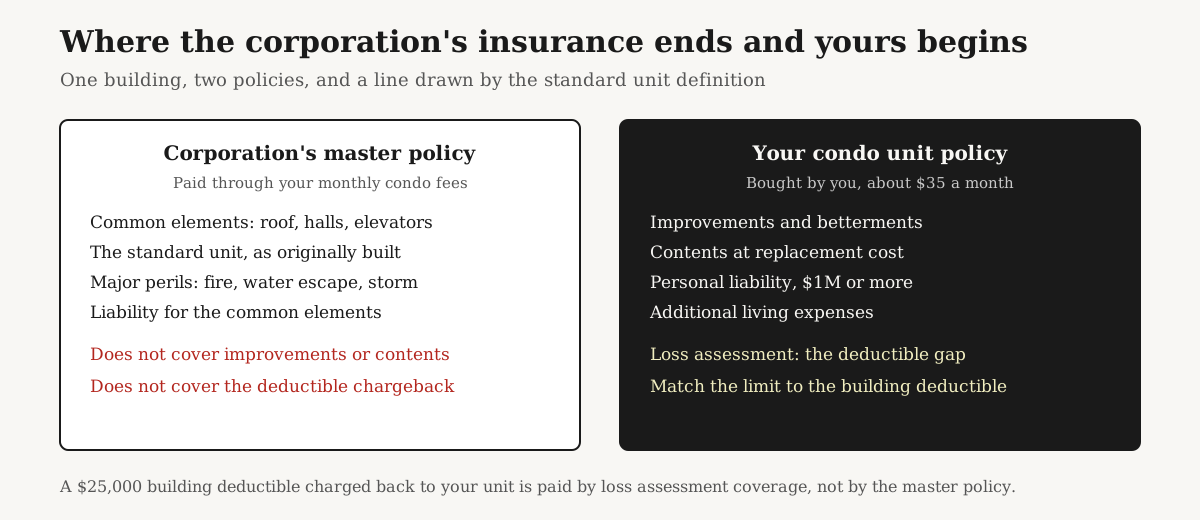
The corporation's master policy insures the building: the common elements and each unit as originally built, against major perils such as fire and water escape. Your own condo policy insures everything the master policy leaves out: the improvements you made to your unit, your belongings, your personal liability, your living expenses if you cannot stay in the unit, and the corporation's deductible if a loss starts in your unit.
| Corporation's master policy | Your condo unit policy | |
|---|---|---|
| Who pays for it | Every owner, through monthly condo fees | You, directly to your insurer |
| What it covers | Common elements and the standard unit, against major perils | Improvements and betterments, contents, personal liability, additional living expenses, loss assessment |
| What it does not cover | Improvements you made, your belongings, your liability | The building structure, the common elements, other owners' units |
| The deductible | Paid by the corporation, and charged back to the responsible owner where the law and the by-laws allow | Your own deductible, plus the building deductible if you carry loss assessment coverage |
| Required by law | Yes, in every province's condo legislation | No province requires it by law, but lenders and many condo declarations do |
| Where to check it | The status certificate and the corporation's insurance certificate | Your policy declarations page |
If you buy a condo and skip the second policy, you are uninsured for the four things most likely to cost you money: your own upgrades, your belongings, a liability claim from a neighbour, and the building's deductible after a leak that starts in your unit.
The policy in 8 steps
- Find the building's deductible first. It is in the status certificate and the insurance certificate. In Ontario, water deductibles of $25,000 or $50,000 are common.
- Read the standard unit definition. It draws the line between what the corporation restores and what you insure. In Quebec it is called the reference unit.
- Price the improvements. Upgraded floors, a renovated kitchen, a new bathroom: the corporation's policy restores the original, not the upgrade.
- Set the loss assessment limit to the building deductible. A $10,000 limit against a $25,000 deductible leaves a $15,000 gap.
- Cover contents at replacement cost. Add up what it would cost to buy everything again, not what it is worth used.
- Take at least $1 million of personal liability. In Quebec, co-owners must carry $1 million or $2 million by law, depending on the size of the building.
- Add sewer backup, and earthquake in BC. Standard policies exclude both unless you add them.
- Send the binder to your lawyer and lender before closing. The lender usually requires proof of coverage before it advances the mortgage.
Advertisement
What the corporation's policy covers
Every province's condominium legislation puts the same duty on the corporation: insure the building. The details differ, but the shape is the same everywhere.
In Ontario, section 99 of the Condominium Act, 1998 requires the corporation to obtain and maintain insurance, on its own behalf and on behalf of the owners, for damage to the units and common elements caused by major perils or other perils the declaration or by-laws specify. Major perils include fire, lightning, smoke, windstorm, hail, explosion, water escape, strikes, riots or civil commotion, impact by aircraft or vehicles, and vandalism or malicious acts. Section 102 requires liability insurance as well. Section 99(4) states plainly what the duty does not include: insurance for damage to improvements made to a unit. Section 99(5) says what counts as an improvement is decided by reference to a standard unit for the class of unit.
The standard unit is the key document. It is a by-law that defines the unit as originally built: the floors, walls, doors, windows, and standard fixtures as the developer installed them. The corporation insures and restores the standard unit. Anything beyond it, a hardwood floor laid over the original carpet, a stone counter replacing laminate, a renovated bathroom, is an improvement, and insuring it is the owner's job. A corporation that defines the standard unit generously, with better finishes, lowers its owners' insurance needs. A corporation that defines it bare, with builder-basic finishes, pushes more of the risk onto each owner. Buyers should ask for the standard unit by-law before closing, not after a claim.
In British Columbia, section 149 of the Strata Property Act requires the strata corporation to insure the common property, common assets, the buildings shown on the strata plan, and fixtures built or installed by the owner developer as part of the original construction. Section 161 lets an owner insure the strata lot and those fixtures as well, so the owner's policy can overlap with the corporation's on the original fixtures. Section 158 makes the payment of an insurance deductible a common expense shared through strata fees, but it also preserves the strata corporation's right to sue an owner to recover the deductible if that owner is responsible for the loss.
In Quebec, article 1073 of the Civil Code of Quebec gives the syndicate an insurable interest in the whole immovable, including the private portions, and requires it to take out insurance against ordinary risks, such as fire and theft, covering the whole building except improvements made by a co-owner to their portion. The amount insured must equal the replacement cost of the building, and the syndicate must also carry third-party liability insurance. The reference unit, described under article 1070, plays the same role as Ontario's standard unit: it identifies what counts as an improvement. The reconstruction value must be reassessed at least every five years by a chartered appraiser. Alberta and the Atlantic provinces follow the same two-policy split, with the exact duties set out in each province's condominium legislation.
One point that surprises buyers: the corporation's policy names the owners and their mortgage lenders as insured parties too. The master policy is not the corporation's private policy. It is a policy held for the building, and the lender's interest in your unit is protected by it. What it does not do is protect your upgrades, your belongings, or your bank account after a deductible chargeback.
What your policy must cover
A condo unit owner's policy has five parts, and leaving any one out leaves a hole a single claim can find.
Improvements and betterments. This is the coverage for everything in your unit beyond the standard unit: the floors, the kitchen, the bathroom, the built-ins. Set the limit from what the upgrades would cost to replace, not from what you paid for them. A $40,000 kitchen renovation needs a $40,000 improvements limit, and the limit should be reviewed after every renovation. Most claims disputes about improvements come down to a limit set years ago and never updated.
Contents. Your furniture, electronics, clothing, and everything else you own inside the unit. Contents should be insured at replacement cost, what it costs to buy new, rather than actual cash value, what the used items are worth. Walk through the unit and add it up. Most people undercount by a third or more because they forget the small things, which are the bulk of a contents claim.
Personal liability. If someone is hurt in your unit, or water from your unit damages a neighbour's home, liability coverage pays the claim and the legal costs. One million dollars is the usual minimum, and two million is common in larger buildings. In Quebec it is not optional: co-owners must carry liability insurance of at least $1 million if the building has fewer than 13 fractions, and at least $2 million if it has 13 or more.
Additional living expenses. If a fire or a flood makes your unit unlivable, this pays for a hotel or a rental and the extra cost of living elsewhere while repairs run. Check the limit and the time cap. A three-month repair with a 30-day cap leaves two months on you.
Loss assessment, also called deductible assessment. This is the coverage that pays the corporation's deductible when it is charged back to you, and your share of a special assessment levied because the corporation's insurance fell short. It is the cheapest coverage on the policy and the one most buyers skip, because nobody explains what it is for. The worked example below shows what skipping it costs.
Two endorsements deserve a separate decision. Sewer backup is excluded from most standard policies and must be added, which matters in basement and ground-floor units and in any building with a history of backups. Earthquake is excluded everywhere and must be added as a separate endorsement, which matters most in British Columbia, where the corporation's own earthquake coverage, if it has any, comes with a deductible that can run into six figures and is shared across owners.
What it costs
Condo insurance is cheap relative to the risk, which is why skipping it is hard to defend. Published 2026 figures cluster in a narrow range, but they do not agree exactly, and the disagreement is worth understanding before you treat any single number as the price.
| Source, as published in 2026 | What it says | What it measures |
|---|---|---|
| Ratehub | $30 to $50+ a month, or $400 to $600 a year | National average; October 2026 sample quotes included $37 a month for a Montreal low-rise |
| YouSet, from its own policy data, updated May 22, 2026 | $21 a month in Ontario, $20 a month in Quebec | Average premium on policies YouSet actually sold |
| MyChoice, by province | Ontario $35, Quebec $28, BC $38, Alberta $39, Manitoba $31, Saskatchewan $31, Atlantic $28; most people pay $25 to $40 a month | Average monthly premium by province |
| Insureye | $27 to $33 a month on average; as little as $20 a month | Average personal condo policy |
| Insurely | About $33 a month for its Essential plan | Average for its own book, with $500,000 condo protection and $50,000 deductible protection |
| LowestRates, quotes from November 6 to 7, 2026 | Etobicoke high-rise: lowest $44 a month, average $71; Burnaby high-rise: lowest $76, average $100; Coquitlam townhouse: lowest $97, average $116 | Real quotes returned by its comparison tool that week |
Read the table as a range, not a price. The broker averages, $20 to $50 a month, describe typical policies on typical units. The quote-site averages run higher because they include larger units, higher coverage limits, and buildings in higher-risk postal codes, and because a shopper who runs a comparison tool is often the shopper whose renewal just jumped. Your quote will depend on the city, the building's age and construction, the floor, the coverage limits you choose, your claims history, and your deductible. A $35-a-month policy in Ontario, $420 a year, is a realistic planning number for a standard one-bedroom with $1 million of liability and a $25,000 loss assessment limit. A larger unit in a BC high-rise with a $50,000 loss assessment limit will cost more, and the LowestRates quotes show how much more.
The corporation's insurance is a separate cost, and it is much larger. It is paid through your monthly condo fees, not as a separate bill. Figures compiled from about 8,000 condo communities across Canada put the corporation's insurance cost at roughly $35 a month per unit in Ontario and roughly $105 a month per unit in BC, where rebuild costs, reinsurance rates, and years of water claims have pushed premiums far above the rest of the country. That is why BC condo fees run higher and why a BC status certificate deserves a close read on insurance renewals. Our condo fees guide breaks down what those fees pay for, and our reserve fund guide covers the fund that absorbs the costs insurance does not.
The deductible gap, worked on real numbers
This is the section that justifies the whole policy. The numbers below are a labelled hypothetical, built on the published figures above, so you can see the size of the bill before it arrives.
Take a Toronto condo with a $25,000 water-damage deductible on the corporation's master policy. That figure is not extreme: industry guidance from the Canadian Condominium Institute's Golden Horseshoe chapter notes that many Ontario condos carry a water deductible of $25,000 or $50,000, and some buildings carry deductibles of $50,000 to $100,000 or more for water damage. A dishwasher supply hose fails in your unit while you are at work. Water runs into the unit below. The corporation claims on the master policy, pays the $25,000 deductible, and charges it back to your unit under section 105 of the Condominium Act and the corporation's deductible by-law. The court decisions say no proof of negligence is needed: in Lozano v. TSCC 1765, decided in 2020 and upheld on appeal, the court held that section 105 places the deductible on the owner whose unit the loss came from, without asking whether that owner was negligent. An accident is enough.
Your own policy decides what happens next.
| Your loss assessment limit | Your own deductible | Your insurer pays | You pay |
|---|---|---|---|
| $25,000 | $1,000 | $24,000 | $1,000 |
| $10,000 | $1,000 | $9,000 | $16,000 |
| No loss assessment coverage | $1,000 | $0 toward the chargeback | $25,000 |
The arithmetic is simple: the insurer covers the chargeback up to your loss assessment limit, less your own deductible. A $25,000 limit against a $25,000 deductible leaves you paying your own $1,000 deductible and nothing else. A $10,000 limit leaves you paying $16,000. No coverage leaves you paying the full $25,000. Raise the deductible to $50,000, which many buildings now carry, and the same $10,000 limit leaves you paying $41,000.
The rule of thumb follows directly: set your loss assessment limit at or above your building's deductible, and check the deductible every year at renewal, because it moves. Buildings raise deductibles after claims, and a limit that matched last year's $10,000 deductible does not match this year's $25,000 one. The status certificate tells you the current figure. If your insurer will not sell you a limit that high, that is information too: it means the building is a risk the insurer does not want, and you should ask why before you close.
Chargebacks are not unlimited, and owners have won pushback. In British Columbia, a strata corporation tried in 2024 to charge a $25,000 water-damage deductible back to a unit owner, but the restoration firm's final invoice did not arrive until September 2024, three years after the leak was found in 2021. The BC Civil Resolution Tribunal ruled the strata was out of time: BC's two-year limitation period had run, and the strata had known since early 2022 that it would have to pay the deductible. The owner kept her $25,000. The lesson cuts both ways: a corporation that moves slowly can lose the right to charge back, and an owner who assumes every chargeback is final should have a lawyer check the dates.
Water damage: the claim you are most likely to make
Water damage tops the list of insurance claims by condo owners, according to the Insurance Bureau of Canada. It is also the claim where the two policies meet most awkwardly, because a leak rarely respects the line between units.
A typical water claim runs like this. Water escapes from your unit, from a washing machine hose, a dishwasher connection, a toilet supply line, or a bathtub left running. It damages your own unit, the unit below, and the common-element ceiling between them. Three policies can be involved: the corporation's master policy for the common elements and the standard unit, your policy for your improvements and contents and the deductible, and the neighbour's policy for their improvements and contents. The corporation's insurer restores the standard unit. Your insurer restores your upgrades and your belongings, and pays the deductible chargeback if you carry the coverage. The neighbour claims on their own policy for their upgrades and belongings, and their insurer may come after you for the cost if the leak started in your unit, which is what your liability coverage is for.
Two habits cut the risk more than any policy wording. First, replace rubber washing machine and dishwasher supply hoses with braided steel lines, and replace them on a schedule, because a failed hose is the most common starting point and the cheapest to prevent. Second, know where your unit's water shutoff is before you need it, because the difference between a $2,000 claim and a $25,000 deductible chargeback is often ten minutes of running water.
If you are buying, ask the seller and the property manager three questions: has the unit ever had a water claim, what is the building's water-damage deductible, and has the building had a water claim in the last five years. A building with repeated water claims will have a higher deductible, higher fees, and a harder time renewing its master policy, and all three show up in the status certificate and the budget.
The provinces, in brief
| Province | Corporation insures | Owner insures | The deductible rule |
|---|---|---|---|
| Ontario | Common elements and standard unit, major perils, under s.99 of the Condominium Act, 1998 | Improvements, contents, liability, additional living expenses, loss assessment | s.105: chargeback where the loss came from the owner's act or omission, up to the deductible; by-laws can extend it; no negligence needed |
| British Columbia | Common property, common assets, buildings, original fixtures, under s.149 of the Strata Property Act | Strata lot, fixtures, contents, liability, loss assessment, under s.161 | s.158: deductible is a common expense, but the strata can sue a responsible owner to recover it; two-year limitation period applies |
| Quebec | Whole immovable except improvements, at replacement cost, plus liability, under art. 1073 of the Civil Code | Improvements, contents, civil liability, additional living expenses | The responsible co-owner bears the deductible as a civil liability matter; the syndicate keeps a self-insurance fund for deductibles |
| Alberta and Atlantic Canada | The building, under each province's condominium legislation | Improvements, contents, liability, loss assessment | Same two-policy split; the chargeback mechanics sit in the provincial act and the corporation's by-laws |
Quebec adds one requirement no other province has. Co-owners must carry civil liability insurance of at least $1 million if the building has fewer than 13 fractions, and at least $2 million if it has 13 or more. The syndicate must also keep a self-insurance fund, a liquid reserve used to pay deductibles and repair syndicate property when a loss falls below the deductible. Quebec also requires the reconstruction value to be reassessed at least every five years by a chartered appraiser, so the syndicate's coverage tracks rebuild costs rather than drifting below them.
Is condo insurance required?
No province makes a unit owner's condo policy a legal requirement. That sentence is the whole legal answer, and it misleads buyers who stop there, because three other parties can require it anyway.
Your mortgage lender can. A lender advancing funds on a mortgaged unit usually requires proof of property coverage, with its interest noted on the policy, before closing. Our home insurance before closing guide walks through the binder, the loss-payee clause, and the deadline your lawyer and lender will set. Buying without a policy in place risks a delayed closing, and in a firm deal a delayed closing is a breach.
Your condo corporation can. Many declarations and by-laws require owners to carry a unit policy and to show proof of coverage, and some set minimum liability limits. A by-law can also set maintenance standards for the unit, which is how a corporation pushes owners to keep supply lines and appliances in repair. Check the declaration before closing; the requirement, if it exists, will be there.
Your lease can, if you rent. A landlord renting out a condo unit can require tenant insurance as a term of the lease, and a condo corporation can require a tenant's proof of insurance under its by-laws. Tenant insurance in a condo covers the same ground from the renter's side: contents, liability, and additional living expenses, usually $15 to $30 a month. The corporation's master policy does not cover a tenant's belongings, and neither does the owner's unit policy.
The short version: the law does not force you to buy it, but the lender, the corporation, and the arithmetic all point the same way. A policy that costs roughly $35 a month protects against a deductible chargeback that commonly runs $25,000 to $50,000. That is the trade, and it is not close.
Before you buy: the checklist
Do this before the condition period ends, while you can still walk away or renegotiate.
- Get the status certificate and read the insurance section. It lists the corporation's coverage, the deductibles, and any claims history. Our Ontario status certificate guide shows how to review the whole package, including the insurance line, against the budget and the reserve fund.
- Ask for the standard unit by-law. It defines what the corporation restores. If the by-law is missing or vague, your lawyer should flag it, because the gap between the standard unit and the actual unit is exactly what your improvements limit must cover.
- Ask for the corporation's insurance certificate. It shows the insurer, the coverage limits, the deductibles by peril, and the renewal date. A renewal due next month with a deductible that just doubled is a negotiation point.
- Check the deductible by-law. In Ontario, the by-law decides how far a chargeback can reach. A by-law that charges back the full deductible for any loss starting in your unit is a bigger risk than one limited to the cost of repairing your own unit.
- Price the improvements. List the upgrades in the unit and what they would cost to replace. A renovated kitchen and bathroom can run past a $25,000 improvements limit quickly.
- Match the loss assessment limit to the deductible. Set it at or above the building's water deductible, and confirm the insurer will sell you that limit on this building.
- Check for special assessment exposure. A building with a thin reserve fund and a history of assessments is a building where loss assessment coverage earns its keep. Our special assessment guide explains how assessments are levied and what they cost.
- Confirm the lender's requirements. Send the policy binder to your lawyer and lender before their cutoff, with the lender named as loss payee if the mortgage terms require it.
Advertisement
Buying the policy: what to ask
Get three quotes on the same coverage, not three quotes on three different policies. The comparison only works if the limits match: same improvements limit, same contents limit, same liability limit, same loss assessment limit, same deductible. Then ask each broker or insurer these questions.
- What is the loss assessment limit, and can it match my building's deductible? If the answer is no, ask why, and treat the answer as information about the building.
- Are improvements covered at replacement cost? Actual cash value pays the depreciated value of a five-year-old kitchen. Replacement cost pays to rebuild it.
- Is sewer backup included, or an add-on? In a basement or ground-floor unit, or a building with a backup history, it should be on the policy.
- Is earthquake included? In BC it is an add-on with its own deductible. Ask what the deductible is, because earthquake deductibles are usually a percentage of the insured value, not a flat amount.
- Does the policy cover short-term rental use? If you plan to rent the unit on a short-term platform, a standard owner-occupied policy may not respond. Our short-term rental rules guide covers the municipal and condo-rule side of that decision.
- What happens to my premium after a claim? A claim on your policy can raise your premium at renewal and can affect your ability to move insurers. That is a reason to pay small losses yourself and save the policy for the large ones.
- Will you put the lender on the policy? If the mortgage terms require a loss-payee clause, the insurer needs the lender's exact legal name and the mortgage instructions before closing.
Frequently asked questions
Does my condo corporation's insurance cover my unit?
It covers your unit as originally built, the standard unit, against major perils such as fire and water escape, plus the common elements. It does not cover improvements you made, your belongings, your personal liability, or your living expenses if you have to move out during repairs.
How much does condo insurance cost in Canada?
Published 2026 figures put most policies between $20 and $50 a month. Ratehub puts the national average at $30 to $50 a month, YouSet's policy data shows $21 a month in Ontario and $20 in Quebec, and MyChoice's provincial averages run from $28 in Quebec and the Atlantic provinces to $39 in Alberta. Larger units and BC high-rises cost more: LowestRates quotes from November 2026 show $44 to $76 a month at the low end for high-rise units in Etobicoke and Burnaby.
What is loss assessment coverage, and do I need it?
It pays the corporation's insurance deductible when the corporation charges it back to you, and your share of a special assessment levied because the corporation's insurance fell short. You need it if your building's deductible is larger than you can pay from savings, which is true for most owners: water deductibles of $25,000 or $50,000 are common in Ontario. Set the limit at or above the building's deductible.
Can the condo corporation make me pay its insurance deductible?
Yes, where the loss started in your unit and the law and the corporation's by-laws allow it. In Ontario, section 105 of the Condominium Act lets the corporation add the lesser of the repair cost and the deductible to your common expenses, and the courts have held that no proof of negligence is needed. In BC, the strata can sue a responsible owner to recover the deductible, subject to the two-year limitation period.
What is a standard unit, and why does it matter?
It is the by-law definition of your unit as originally built. The corporation insures and restores the standard unit. Anything beyond it, upgraded floors, a renovated kitchen, a new bathroom, is an improvement that your own policy must cover. In Quebec the equivalent document is called the reference unit.
Is condo insurance mandatory in Canada?
No province requires it by law. But your mortgage lender usually requires proof of coverage before closing, many condo declarations and by-laws require owners to carry a policy, and in Quebec co-owners must carry civil liability insurance of $1 million or $2 million depending on the size of the building.
Does condo insurance cover water damage from the unit above?
Your policy covers damage to your improvements and belongings from a leak above, and your additional living expenses if you have to move out. The corporation's policy covers the common elements and the standard unit. The owner above may face a deductible chargeback, which is what their loss assessment coverage is for.
I rent a condo. Do I need insurance too?
Yes, tenant insurance, which covers your belongings, your liability, and your living expenses if the unit becomes unlivable. The corporation's policy does not cover a tenant's belongings, and the owner's unit policy does not either. It usually costs $15 to $30 a month, and many landlords and condo corporations require proof of it.
This article is general information about Canadian condo insurance, not insurance, legal, tax, or financial advice for any specific situation. Coverage, deductibles, and legal duties vary by province, building, and policy. Have the declaration, by-laws, and status certificate reviewed by a real estate lawyer, and confirm coverage and limits with a licensed insurance broker before you buy.
About the BubbleWatch editorial team
BubbleWatch is written and checked by its editorial team under the site brand. Figures come from public sources such as CREA, Statistics Canada, CMHC and the Bank of Canada, and each article links the sources it uses. BubbleWatch is independent of realtor boards and lenders.
Read our full editorial methodology →