Closing Costs for Sellers in Ontario (2026): Commission With HST, Mortgage Discharge, Penalties and Your Net Proceeds
Sellers in Ontario do not pay land transfer tax, but selling still costs most owners 4% to 9% of the price. The largest line is real estate commission, which carries 13% HST. Then come legal fees, the mortgage discharge, any prepayment penalty, adjustments and the costs of getting the home ready and moving out. This guide prices each line, shows commission with HST per price point, and works two full examples from sale price to the cheque you receive.
On this page(18 sections)ShowHide
- Closing Costs for Sellers in Ontario (2026): Commission With HST, Mortgage Discharge, Penalties and Your Net Proceeds
- What sellers do not pay in Ontario
- Line 1: Real estate commission, plus 13% HST
- Line 2: Your lawyer
- Line 3: Discharging your mortgage
- Line 4: The prepayment penalty, if you break a term
- Line 5: Adjustments
- Line 6: Getting the home ready, and moving out
- Line 7: Condo-specific costs
- Line 8: Tax on the sale
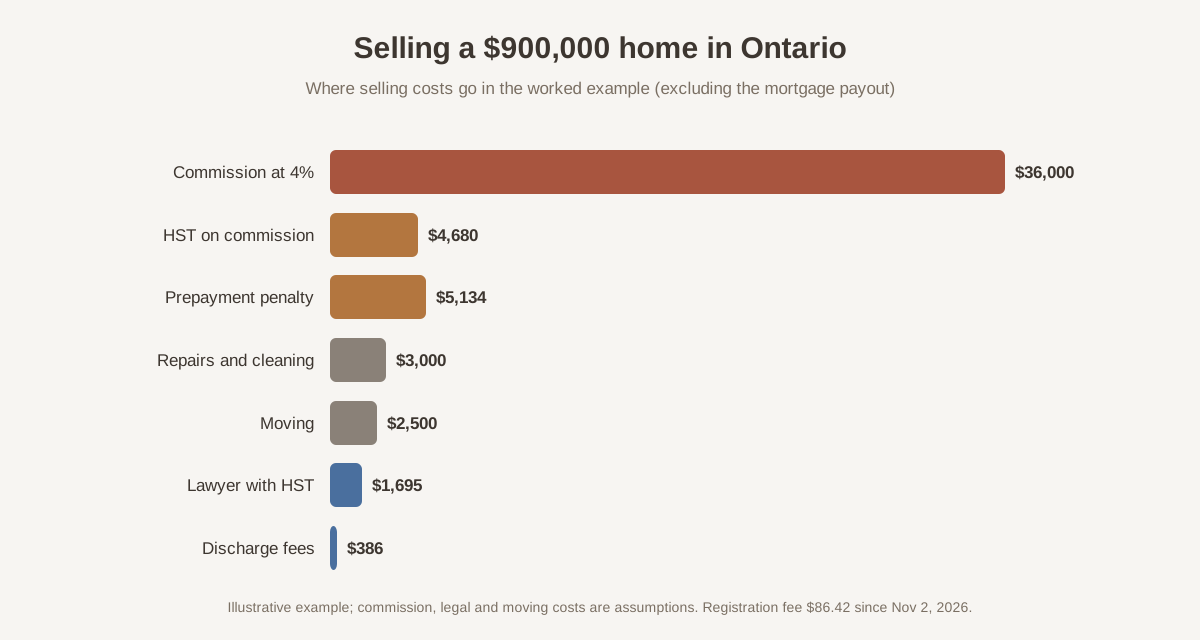
- Worked example 1: a $900,000 house, mortgage broken mid-term
- Worked example 2: a $600,000 condo at mortgage maturity
- Ways to lower your selling costs
- Selling and buying at the same time
- Selling a home you inherited or own with others
- When the money arrives
- A selling checklist for Ontario owners
- Sources and assumptions
Closing Costs for Sellers in Ontario (2026): Commission With HST, Mortgage Discharge, Penalties and Your Net Proceeds
Short answer: Sellers in Ontario do not pay land transfer tax; the buyer does. The main seller closing costs are real estate commission plus 13% HST, your lawyer's fee and disbursements, the cost of discharging your mortgage (a lender fee plus an $86.42 electronic registration fee since November 2, 2026), any prepayment penalty if you break a mortgage mid-term, and adjustments for prepaid property tax or utilities. On a $900,000 sale with a 4% commission, the commission and HST alone come to $40,680. Including a modest penalty, legal costs, small repairs and moving, our worked example costs about $53,400, or 5.9% of the price. Most Ontario sellers should budget 4% to 9% of the sale price, depending mostly on commission and whether they break a mortgage.
This guide is written for owners selling a resale home in Ontario. It covers every common line, shows how much each costs, and ends with two complete net-proceeds examples. It is general information, not legal or tax advice. Your lawyer's statement of adjustments and your lender's payout statement are the documents that decide the final numbers.
What sellers do not pay in Ontario
It helps to start with what is not on the bill, because it is the question sellers ask most.
- No land transfer tax. Ontario's land transfer tax, and Toronto's municipal land transfer tax, are paid by the buyer. Our Ontario buyer closing costs guide explains the buyer's side.
- No HST on the sale of a used home. The sale of a resale home that has been lived in as a residence is generally exempt from HST. Builders and people who substantially renovate a home for resale are the exceptions. If you have gutted and rebuilt a property, ask your lawyer or accountant about HST before you list.
- Usually no capital gains tax on your home. If the home was your principal residence for every year you owned it, the principal residence exemption usually shelters the whole gain. You must still report the sale on your tax return. More on that below.
Line 1: Real estate commission, plus 13% HST
Commission is a negotiated fee, not a set rate. In Ontario it is commonly agreed as a percentage of the sale price split between the listing brokerage and the buyer's brokerage, though flat-fee and reduced-commission models exist. The rate is in your listing agreement, so read the commission clause before you sign it and ask how much goes to the buyer's agent.
Commission is a taxable service, so HST at 13% is added on top. That turns a 4% commission into 4.52% of the price.
| Sale price | 3% + HST | 4% + HST | 5% + HST |
|---|---|---|---|
| $500,000 | $16,950 | $22,600 | $28,250 |
| $750,000 | $25,425 | $33,900 | $42,375 |
| $1,000,000 | $33,900 | $45,200 | $56,500 |
| $1,250,000 | $42,375 | $56,500 | $70,625 |
The percentages in the table are examples for comparison, not quotes. Commission is usually paid out of the deposit and sale proceeds by your lawyer on closing, so you rarely write a separate cheque.
Three things to check in the listing agreement:
- The holdover clause. If a buyer who saw the home during the listing buys it after the listing ends, you may still owe commission.
- How the buyer's side is paid. Since the Trust in Real Estate Services Act came into force in Ontario in December 2023, brokerages must give consumers clearer information about who they represent. Ask how compensation for the buyer's brokerage is set out.
- Extra fees. Some brokerages charge administration or marketing fees outside the commission.
For more on how commission works across Canada, see our real estate commission guide.
Advertisement
Line 2: Your lawyer
Ontario sales close through lawyers. Your lawyer reviews the agreement of purchase and sale, deals with the buyer's lawyer, requests your mortgage payout, receives the money from the buyer, pays off your mortgage and the commission, registers the discharge and sends you the balance.
Expect a fee plus disbursements, with HST on the fee. A sale-side file is usually simpler than a purchase, so it often costs less. In our examples we use an illustrative $1,500 fee plus HST, $1,695 in total; get a written all-in quote, including disbursements, before you list. If you are buying and selling at the same time, many lawyers quote a reduced combined fee.
Line 3: Discharging your mortgage
If you have a mortgage, it must be paid off and removed from title on closing. That has two parts.
The lender's payout and discharge fee. Your lender sends a payout statement showing the balance, interest to the closing date, any prepayment charge and an administration or discharge fee. Discharge fees vary by lender; we use an illustrative $300 in our examples. Ask your lender for its current fee.
The registration fee. Your lawyer registers the discharge electronically on title. Ontario's fee schedule for registering an instrument electronically is $86.42, effective November 2, 2026: a $72.75 statutory fee, a $12.10 Electronic Land Registration Services Act fee and $1.57 HST. If you have a second mortgage or a home equity line registered on title, each charge needs its own discharge.
If your mortgage is registered as a collateral charge, it may also secure lines of credit. Clear and close those accounts too, or the lender may not discharge the charge. Our collateral charge guide explains the difference.
Line 4: The prepayment penalty, if you break a term
Selling before your term ends usually means breaking the mortgage. A fixed-rate mortgage typically charges the greater of three months of interest and an interest rate differential (IRD). A variable mortgage usually charges three months of interest.
On a $420,000 balance at 4.89%, three months of interest is $420,000 × 4.89% ÷ 4 = $5,134.50. An IRD can be much larger, especially at big banks that use posted rates in the calculation, as our posted vs discounted rates guide shows.
Ways to cut the penalty:
- Time the sale near maturity. If your term ends within a few months of closing, no penalty may apply, or you can ask about early renewal into an open term.
- Port the mortgage. If you are buying another home, many lenders let you move the mortgage and its rate to the new property and waive the penalty. Our porting guide explains when that works.
- Let the buyer assume it. Some mortgages are assumable with lender approval. This is uncommon but can help when your rate is lower than market.
- Use your prepayment privileges first. Some lenders let you make an annual lump-sum prepayment before breaking, which lowers the balance on which the penalty is calculated. Ask your lender whether that applies.
Ask for a written penalty quote with the payout statement and before you sign a listing agreement. Our prepayment penalty guide covers the methods in more detail.
Line 5: Adjustments
On closing, your lawyer prepares a statement of adjustments that settles costs between you and the buyer up to the closing day.
- Property tax. If you have paid tax for the full year, the buyer reimburses you for the days after closing. If you are behind, the shortfall is deducted from your proceeds.
- Utilities. Water and some other utilities are read on closing day, and you pay to that date.
- Condo fees. Monthly common expenses are adjusted to the closing date.
- Rented equipment. Water heaters and furnaces are often rented in Ontario. The buyer usually assumes the rental contract, but any buyout clause in the agreement can create a cost for you.
- Fuel oil and propane. If the home has a tank, the remaining fuel may be adjusted.
Adjustments can be a credit or a cost. They are usually a few hundred to a few thousand dollars.
Line 6: Getting the home ready, and moving out
These are not closing costs in the legal sense, but they are real cash.
- Repairs and touch-ups. Small fixes, paint and cleaning. We use $3,000 in our main example.
- Staging. Some agents include basic staging; full staging can be a separate cost.
- Pre-listing inspection. Optional, and sometimes worth it on an older home.
- Moving. Local moves vary widely. We use $2,500 in our main example.
- Bridge financing. If you are buying before your sale closes, a bridge loan covers the gap. It has interest and a set-up fee. Our bridge financing guide covers the costs.
- Overlap. Two homes at once means two sets of property tax, utilities and insurance for a period.
Line 7: Condo-specific costs
Ontario condo sellers face a few extra lines.
- The status certificate. Under the Ontario Condominium Act and its regulations, the corporation can charge no more than $100, including taxes, for a status certificate. Who orders and pays is negotiated; the buyer often pays, but some sellers order one upfront to speed up a sale.
- Special assessments. Any special assessment levied before closing is usually the seller's to pay unless the agreement says otherwise. Our special assessment guide covers the risk.
- Move-out fees and elevator booking. Some buildings charge for elevator use or a damage deposit.
Line 8: Tax on the sale
Principal residence. If the home was your principal residence for every year you owned it, the gain is usually fully exempt. You still have to report the sale and designate the property as your principal residence on Schedule 3 of your tax return for the year you sell. Missing the designation can bring penalties.
Rental or partial use. If you rented part of the home, used it for business, or owned more than one property, part of the gain may be taxable. Our capital gains on selling a home guide explains when.
Residential property flipping rule. Since January 1, 2023, a gain on a home you owned for less than 365 days is generally taxed as business income, not as a capital gain, and the principal residence exemption does not apply, unless an exemption such as a death, separation or job relocation applies.
Non-resident sellers. If you are not a resident of Canada, the buyer's lawyer will usually hold back a large share of the price, commonly 25% of the gross sale price for a home held as capital property, unless you obtain a clearance certificate from the Canada Revenue Agency under section 116 of the Income Tax Act. Start that application well before closing.
Worked example 1: a $900,000 house, mortgage broken mid-term
A family sells a detached home for $900,000. They owe $420,000 on a five-year fixed at 4.89% with two years left, and they are not porting the mortgage.
| Line | Amount |
|---|---|
| Sale price | $900,000.00 |
| Commission at 4% | −$36,000.00 |
| HST on commission (13%) | −$4,680.00 |
| Lawyer, illustrative $1,500 plus HST | −$1,695.00 |
| Lender discharge fee (illustrative) | −$300.00 |
| Discharge registration (Ontario, from Nov 2, 2026) | −$86.42 |
| Prepayment penalty, three months of interest | −$5,134.50 |
| Repairs and cleaning | −$3,000.00 |
| Moving | −$2,500.00 |
| Selling costs subtotal | −$53,395.92 |
| Mortgage balance paid out | −$420,000.00 |
| Net to the sellers, before adjustments | $426,604.08 |
Selling costs equal about 5.9% of the price. If the penalty were an IRD of $15,000 instead of three months of interest, costs would rise to about 7%. If the commission were 5%, they would rise by another $10,170.
Worked example 2: a $600,000 condo at mortgage maturity
A seller lists a condo for $600,000 and times the sale to close the week the mortgage term ends, so no penalty applies. The balance is $310,000. The commission is 3.5%.
| Line | Amount |
|---|---|
| Sale price | $600,000.00 |
| Commission at 3.5% | −$21,000.00 |
| HST on commission | −$2,730.00 |
| Lawyer, illustrative $1,500 plus HST | −$1,695.00 |
| Lender discharge fee plus registration | −$386.42 |
| Repairs and cleaning | −$1,500.00 |
| Moving | −$2,000.00 |
| Selling costs subtotal | −$29,311.42 |
| Mortgage balance paid out | −$310,000.00 |
| Net to the seller, before adjustments | $260,688.58 |
Costs here are about 4.9% of the price. Timing the sale to the mortgage maturity saved this seller roughly $3,800 in three months of interest at a 4.89% rate.
Ways to lower your selling costs
- Negotiate the commission, in writing. Ask what services are included at each rate, and compare at least two brokerages.
- Time the closing to your mortgage. A closing near your maturity date avoids the penalty; a portable mortgage can avoid it altogether if you are buying.
- Ask for the penalty quote early. Lenders calculate the charge on the day you pay off, but an early quote tells you whether moving the closing date by a few weeks is worth it.
- Fix only what buyers will pay for. Small repairs and a deep clean usually pay back; major renovations rarely do before a sale.
- Check the property tax and utility accounts. Clearing arrears before closing avoids surprise deductions on the statement of adjustments.
- Get one lawyer for both sides of a move. If you are selling and buying at once, a combined quote is often lower.
Advertisement
Selling and buying at the same time
Most Ontario sellers are also buyers. That creates two extra risks. The first is timing: if your purchase closes before your sale, you need the down payment for the new home before your sale money arrives. A bridge loan solves that for a fee and interest. The second is the penalty: if you break your old mortgage and take a new one, you may pay a penalty on one and closing costs on the other. Porting the old mortgage, or blending it with new money at the same lender, can avoid both. On the buying side, budget for Ontario's land transfer tax and the rest of the stack in our Ontario buyer closing costs guide.
Selling a home you inherited or own with others
Estate sales and sales by co-owners add steps. An estate usually needs probate, or a certificate of appointment of estate trustee in Ontario, before the home can be sold, and the estate administration tax is calculated on the estate's value. Co-owners must all sign, and a separating couple may need their agreement in place first. Our selling an inherited home guide and spousal buyout guide cover those situations.
When the money arrives
On closing day, the buyer's lawyer sends the balance of the purchase price to your lawyer. Your lawyer pays your mortgage, the brokerage's commission (less the deposit the brokerage already holds) and any other amounts on the statement, registers the discharge, then sends you the remaining funds, often the same day or the next business day. If you are buying another home the same day, those funds can go straight into the purchase.
If anything on the payout statement or the statement of adjustments looks wrong, raise it with your lawyer before closing. Corrections after the money has moved are slower and harder.
A selling checklist for Ontario owners
- Ask your lender for a payout estimate and a written penalty quote before you list.
- Check whether your mortgage is portable, and how long you have to port it.
- Read the commission clause, holdover clause and any extra fees in the listing agreement.
- Get an all-in quote from a real estate lawyer.
- Confirm property tax and utility accounts are current.
- If you are a condo owner, check for any special assessment and the status certificate process.
- If you rented part of the home or are a non-resident, talk to an accountant early.
- Keep a buffer for adjustments, repairs and moving.
Our national seller closing costs guide compares Ontario with other provinces, and the Ontario housing market forecast covers where prices are heading as you plan the timing.
Sources and assumptions
- Electronic registration fee: Government of Ontario, land registration fee schedule under the Electronic Land Registration Services Act, 2010, $86.42 effective November 2, 2026.
- HST on real estate commission: 13% harmonized sales tax in Ontario; resale residential exemption under the Excise Tax Act.
- Status certificate fee: Ontario Condominium Act, 1998 and its regulations, maximum $100 including taxes.
- Residential property flipping rule: Income Tax Act, for sales after January 1, 2023.
- Non-resident withholding: Income Tax Act section 116 and CRA guidance on clearance certificates.
- Trust in Real Estate Services Act, 2002, as amended, in force December 1, 2023.
- Commission rates, lawyer fee, lender discharge fee, repairs and moving costs in the examples are illustrative assumptions, not quotes. Prepayment penalties depend on your contract and lender.
Frequently asked questions
What are closing costs for sellers in Ontario?
Real estate commission plus 13% HST, lawyer fees and disbursements, the mortgage discharge (a lender fee plus an $86.42 registration fee since November 2, 2026), any prepayment penalty, and adjustments for property tax and utilities. Most sellers budget 4% to 9% of the price.
Do sellers pay land transfer tax in Ontario?
No. Ontario land transfer tax and Toronto's municipal land transfer tax are paid by the buyer.
Is HST charged on real estate commission in Ontario?
Yes. Commission is a taxable service, so 13% HST is added. A 4% commission on a $900,000 sale is $36,000 plus $4,680 HST, or $40,680.
How much does it cost to discharge a mortgage in Ontario?
Your lender's discharge or administration fee, which varies by lender, plus the electronic registration fee of $86.42 that has applied since November 2, 2026. Each registered charge needs its own discharge.
Do I pay a penalty if I sell my house before my mortgage term ends?
Usually, unless you port the mortgage to a new home or close near maturity. Fixed mortgages typically charge the greater of three months of interest and an interest rate differential; variable mortgages usually charge three months of interest.
Do I pay capital gains tax when I sell my home in Ontario?
Usually not if it was your principal residence for every year you owned it, but you must report the sale and make the designation on Schedule 3. Homes owned under 365 days can fall under the federal flipping rule.
What does an Ontario condo seller pay for a status certificate?
The condo corporation can charge at most $100 including taxes. The buyer often pays, but the agreement decides, and some sellers order it upfront to speed up the sale.
About the BubbleWatch editorial team
BubbleWatch is written and checked by its editorial team under the site brand. Figures come from public sources such as CREA, Statistics Canada, CMHC and the Bank of Canada, and each article links the sources it uses. BubbleWatch is independent of realtor boards and lenders.
Read our full editorial methodology →