The Cost of Owning a Home in Alberta (2026): Mortgage, Property Tax, Hail Insurance, Utilities and Upkeep, Priced for Calgary and Edmonton
Alberta is cheap to buy into, with no land transfer tax, but owning a home there has its own costs. This guide prices the monthly cost of owning Calgary and Edmonton benchmark homes in late 2026, line by line: mortgage, property tax at each city's 2026 rate, insurance in Canada's hail belt, utilities, condo fees and maintenance. It also shows the household income lenders would want to see for each home.
On this page(15 sections)ShowHide
- The Cost of Owning a Home in Alberta (2026): Mortgage, Property Tax, Hail Insurance, Utilities and Upkeep, Priced for Calgary and Edmonton
- What Alberta does not charge you
- Line 1: the mortgage payment
- Line 2: property tax at the 2026 rates
- Line 3: home insurance in Canada's hail belt
- Line 4: utilities
- Line 5: condo fees, if you buy a condo or townhouse
- Line 6: maintenance
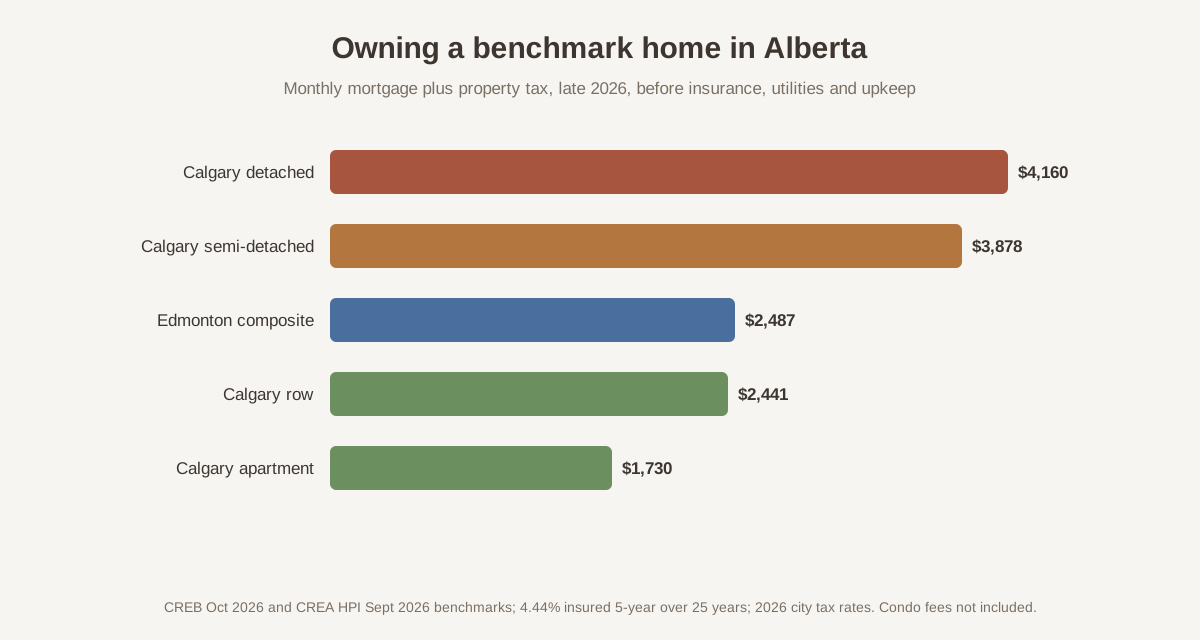
- Putting it together: monthly cost of the core lines
- The income a lender would want
- Calgary or Edmonton: same income, different homes
- A yearly budget worksheet
- Owning versus renting in Alberta
- Five ways to lower the cost of owning in Alberta
- Sources and assumptions
The Cost of Owning a Home in Alberta (2026): Mortgage, Property Tax, Hail Insurance, Utilities and Upkeep, Priced for Calgary and Edmonton
Short answer: Owning a benchmark detached home in Calgary in late 2026 costs about $4,160 a month for the mortgage and property tax alone, before insurance, utilities and maintenance, with 10% down at a 4.44% insured five-year rate. A benchmark Calgary apartment costs about $1,730 a month for the same two lines, plus condo fees. Edmonton's composite benchmark home costs about $2,487. Property tax is a bigger share of the bill in Edmonton, where the 2026 residential rate is 1.03637%, than in Calgary at 0.66499%. Home insurance is the wild card in southern Alberta: a study for the Insurance Bureau of Canada found hail makes up 30% to 68% of homeowner premiums in high-risk areas, highest in and around Calgary.
This guide prices each line of Alberta homeownership with figures you can check, then shows the income a lender would expect for each home. It is a planning tool, not advice. Use your own quotes for insurance and utilities, which vary by address and by home.
What Alberta does not charge you
Alberta's reputation for cheap homeownership starts with taxes it does not have.
- No land transfer tax. Buyers pay only Land Titles registration fees, which come to about $1,180 on a $600,000 purchase with a $480,000 mortgage. Our Alberta closing costs guide prices them in full.
- No provincial sales tax. Only the 5% GST applies to services such as legal fees, inspections and repairs, and to new homes. There is no provincial tax on the CMHC premium either, unlike Ontario, Quebec and Saskatchewan.
- No consumer carbon charge since April 1, 2025. The federal fuel charge was set to zero that day, which lowered natural gas bills for Alberta households compared with 2024.
Those savings are real. But they are one-time or modest, and the monthly cost of owning is what decides whether a home fits your budget.
Line 1: the mortgage payment
We use the benchmark prices by home type in CREB's October 2026 release for Calgary, and the September 2026 MLS Home Price Index composite benchmark for the Greater Edmonton Area recorded on our Edmonton city page. Our Calgary city page has the composite figure. Payments assume an insured five-year fixed rate of 4.44%, the lowest insured rate nesto listed on November 12, 2026, over 25 years, with the CMHC premium added to the loan.
| Home | Benchmark price | Down payment | Mortgage with premium | Monthly payment |
|---|---|---|---|---|
| Calgary detached | $735,100 | 10%: $73,510 | $682,099 | $3,752.52 |
| Calgary semi-detached | $685,200 | 10%: $68,520 | $635,797 | $3,497.79 |
| Calgary row | $407,500 | 5%: $20,375 | $402,610 | $2,214.93 |
| Calgary apartment | $288,800 | 5%: $14,440 | $285,334 | $1,569.75 |
| Edmonton composite | $416,700 | 10%: $41,670 | $386,656 | $2,127.16 |
The CMHC premium is 3.10% of the loan at 10% down and 4.00% at 5% down. On homes over $500,000, the minimum down payment is 5% of the first $500,000 and 10% of the rest: $48,510 on the Calgary detached benchmark, or 6.6%. Our down payment rules guide explains the tiers. With 20% down, there is no premium, but you would need $147,020 on the detached home.
If your rate is 4.95%, the best uninsured rate on the same date, the Calgary detached payment would be roughly $200 a month higher. Our renewal payment calculation guide has a payment table per $100,000 at other rates.
Advertisement
Line 2: property tax at the 2026 rates
Alberta cities assess homes at market value as of July 1 of the year before the tax year, and set a rate each spring. The 2026 residential rates, from our property tax rates by city guide:
- Calgary: 0.66499%, made up of a city rate of 0.38906% and the provincial education rate of 0.27593%.
- Edmonton: 1.03637%, made up of a municipal rate of 0.77419%, education at 0.25409% and a requisition allowance of 0.00809%.
Applied to each benchmark price as a stand-in for assessed value:
| Home | Assumed assessment | Annual tax | Monthly |
|---|---|---|---|
| Calgary detached | $735,100 | $4,888 | $407.36 |
| Calgary semi-detached | $685,200 | $4,557 | $379.71 |
| Calgary row | $407,500 | $2,710 | $225.82 |
| Calgary apartment | $288,800 | $1,920 | $160.04 |
| Edmonton composite | $416,700 | $4,319 | $359.88 |
Assessment is not the same as price. The City of Calgary's own 2026 illustration uses its median single-detached assessment of $706,000, which produces a bill of $4,694.82. Look up the actual assessment of any home you are considering on the city's assessment search before you budget.
The comparison that surprises newcomers: an Edmonton home worth $416,700 pays almost as much property tax as a Calgary detached home worth $735,100. Edmonton's lower prices are partly offset by a higher rate. Both cities offer monthly instalment plans, so you can spread the bill over 12 payments instead of paying it in one sum at the end of June.
Line 3: home insurance in Canada's hail belt
Insurance is the line where Alberta differs most from the rest of the country, and where your own quote matters most.
A study by MNP for the Insurance Bureau of Canada, reported on September 29, 2026, found that hail accounts for 30% to 68% of the total homeowner premium in high-risk areas, with the highest risk in and around Calgary. The same report put insured hail damage in Alberta at about $6 billion over the past five years, with the August 2024 Calgary storm alone accounting for billions of dollars of it. The same study found that homeowners in the highest-risk areas who install hail-resistant roofing and siding can cut their premiums by up to 50%.
What that means for a buyer:
- Get a quote before you remove conditions. Premiums can differ by hundreds of dollars a year between neighbourhoods and between roofs. Your lender will want proof of insurance before closing; our home insurance before closing guide covers the timing.
- Ask about the roof. Impact-rated shingles, metal roofs and hail-resistant siding can lower the premium. Ask the seller for roof age, material and any past hail claims. Our roof inspection guide explains what to look for.
- Check the deductible and any separate hail or wind deductible. Some policies carry a higher deductible for hail damage. Keep that amount in your emergency fund.
- Overland flooding is separate. Basement flooding from sewer backup and overland water often need their own coverage. Calgary's 2013 flood made this a familiar issue in parts of the city. Our flood insurance guide covers it.
Condo owners pay for a unit-owner policy, which is usually far cheaper than a house policy because the corporation insures the building. Check what the condo's master policy deductible is, because owners can be charged a share of it after a claim. Our condo insurance guide explains that risk.
Line 4: utilities
Alberta has a deregulated electricity and natural gas market. You can choose a retailer and a contract, or stay on a regulated rate.
- Electricity. Since January 1, 2025, households not on a contract pay the Rate of Last Resort, which replaced the old Regulated Rate Option. According to Direct Energy's explanation of the regulated rates, the price is fixed from January 1, 2025 to December 31, 2026, varies by area of the province, is approved by the Alberta Utilities Commission, and can rise or fall by at most 10% at the end of each two-year term. Delivery and transmission charges are added on top and are a large share of a typical bill.
- Natural gas. Gas heats most Alberta homes. Regulated gas rates are set monthly and approved by the Alberta Utilities Commission, and they rise and fall with the market. Fixed delivery charges apply whatever you use.
- Water, wastewater and waste. Billed by the city or its utility. Calgary bills these through ENMAX; Edmonton through EPCOR.
Utility costs depend heavily on the home's size, age, insulation and furnace. The best estimate comes from the seller's last 12 months of bills, which you can ask for during the offer. Older homes with original windows and single-stage furnaces can cost far more to heat through a Prairie winter than new builds. Our heating and cooling inspection guide covers what to check.
Line 5: condo fees, if you buy a condo or townhouse
Condo fees in Calgary vary widely by building age, amenities and reserve fund health. A newer concrete tower with a gym and concierge will cost more per square foot than an older low-rise. Before you buy, review the reserve fund study and the latest financial statements to see whether fees are likely to rise or a special assessment is coming. Our condo fees guide explains what fees cover, and our Calgary condo market page explains why apartment prices are falling while detached homes hold.
In the income example below, we assume $450 a month for the apartment and $300 a month for the row home. Use the actual fee for the unit you are considering.
Line 6: maintenance
A common planning rule is to set aside a share of the home's value each year for maintenance, but the right amount depends on age, condition and climate. Alberta adds specific risks: hail on roofs and siding, freeze-thaw cycles on concrete and foundations, and dry winters that are hard on wood. Our home maintenance budget guide builds a budget from the home's actual components rather than a rule of thumb, and walks through a 2000s Calgary house as an example.
For older detached homes, plan for the large items on their own schedule: roof, furnace, water heater, windows and sewer line. A pre-purchase inspection and the seller's maintenance records are the best guide.
Putting it together: monthly cost of the core lines
| Home | Mortgage | Property tax | Condo fee (assumed) | Subtotal before insurance, utilities, upkeep |
|---|---|---|---|---|
| Calgary detached | $3,752.52 | $407.36 | n/a | $4,159.88 |
| Calgary semi-detached | $3,497.79 | $379.71 | n/a | $3,877.50 |
| Calgary row | $2,214.93 | $225.82 | $300 | $2,740.75 |
| Calgary apartment | $1,569.75 | $160.04 | $450 | $2,179.79 |
| Edmonton composite | $2,127.16 | $359.88 | n/a | $2,487.04 |
Add your own insurance quote, utility estimate and maintenance reserve to finish the picture. For the detached home, those three lines together can easily add several hundred dollars a month.
The income a lender would want
Lenders use a gross debt service (GDS) ratio: housing costs should be no more than 39% of gross income for an insured mortgage. Housing costs include the mortgage payment at the stress-test rate, property tax, heating and half of any condo fee. The stress-test rate is the greater of your contract rate plus two points and 5.25%, so 6.44% in these examples. We use a heating allowance of $100 a month, a common lender assumption; lenders set their own.
| Home | Payment at 6.44% | Property tax | Heat | Half condo fee | Minimum gross income at 39% GDS |
|---|---|---|---|---|---|
| Calgary detached | $4,544.08 | $407.36 | $100 | n/a | about $155,400 |
| Calgary semi-detached | $4,235.62 | $379.71 | $100 | n/a | about $145,100 |
| Calgary row | $2,682.15 | $225.82 | $100 | $150 | about $97,200 |
| Calgary apartment | $1,900.87 | $160.04 | $100 | $225 | about $73,400 |
| Edmonton composite | $2,575.87 | $359.88 | $100 | n/a | about $93,400 |
For context, Statistics Canada puts the median total income of census families at $116,530 in the Calgary area and $114,130 in the Edmonton area, for the 2023 tax year. The median Calgary family could qualify for a benchmark row home or apartment, but not a benchmark detached or semi-detached home with 10% down at these rates, unless it has little other debt and a larger down payment. The median Edmonton family could qualify for the composite benchmark home with room to spare. Lenders also apply a total debt service (TDS) limit of 44% that includes car loans, student loans and credit cards, which lowers the reachable price for many households. Our income needed to buy in Calgary and Edmonton guides go further.
Calgary or Edmonton: same income, different homes
A household earning $116,000 a year, close to the median family income in both cities, can reach different homes in each. In Edmonton, the composite benchmark home at $416,700 needs about $93,400 of income on our assumptions, leaving room for other debt or a smaller down payment. In Calgary, the same household can comfortably reach a row home at the $407,500 benchmark, but the detached benchmark needs about $155,400. For a family that wants a detached house, Edmonton's single-family benchmark of $501,900 in September 2026, against Calgary's $679,600 on the same CREA measure, is the more relevant comparison. Our Calgary vs Edmonton guide covers the jobs, commute and lifestyle side of that choice.
Advertisement
A yearly budget worksheet
Use this to build your own number for a specific home. The first two lines come from the tables above; the rest come from quotes and records.
| Line | How to estimate it |
|---|---|
| Mortgage | Your lender's figure, or the payment table in our renewal payment guide |
| Property tax | The home's assessed value times the city's 2026 rate |
| Home insurance | Two or three quotes for the specific address and roof |
| Electricity | The seller's last 12 months of bills, or the Rate of Last Resort plus delivery charges |
| Natural gas | The seller's last 12 months; winter months matter most |
| Water, wastewater, waste | The city utility's published rates or the seller's bills |
| Condo fee | The current fee and the reserve fund study's planned increases |
| Maintenance reserve | A component-by-component plan from the inspection |
| Emergency and deductible fund | At least your insurance deductible, including any hail deductible |
Add the lines, divide by 12, and compare the monthly total with your take-home pay, not your gross income. A budget that works only on gross income is not a budget.
Owning versus renting in Alberta
Calgary's purpose-built vacancy rate was 5.0% in CMHC's October 2025 survey, with an average two-bedroom rent of $1,912. Edmonton's was 3.8% and $1,577. High vacancy gives renters choice and bargaining power. Compare those rents with the subtotals above: a benchmark Calgary apartment costs about $2,180 a month for the mortgage, tax and an assumed condo fee before insurance and maintenance, against the $1,912 average two-bedroom rent, and the owner builds equity with part of each payment. A benchmark detached home costs more than double the average rent. Our rent vs buy in Calgary and Edmonton guides model the full trade-off over time.
Renting also avoids the costs that only owners carry: the hail deductible, the furnace that fails in January, the special assessment in an older condo. Owning avoids rent increases and builds equity. Neither is automatically better; the numbers for the specific home and your plans decide.
Five ways to lower the cost of owning in Alberta
- Choose the roof as carefully as the kitchen. A hail-resistant roof can cut the largest part of a Calgary premium.
- Look up the assessment, not just the price. Property tax follows assessed value, and two similar homes can have different assessments.
- Compare Calgary and Edmonton on total cost, not price. Edmonton's higher tax rate offsets part of its price advantage.
- Shop your energy contract. Compare a fixed-rate retail contract with the regulated rate, and check delivery charges, which do not change by retailer.
- Keep a hail and water reserve. A deductible and a surprise repair are the most common budget shocks for Alberta owners.
Sources and assumptions
- Calgary benchmark prices by type: Calgary Real Estate Board, October 2026 statistics, reported November 2, 2026. Edmonton composite benchmark: CREA MLS Home Price Index, Greater Edmonton Area, September 2026, as recorded on this site's city page.
- Mortgage rate: nesto, lowest insured five-year fixed rate of 4.44%, checked November 12, 2026. Payments use semi-annual compounding over 25 years. CMHC premiums of 3.10% (10% down) and 4.00% (5% down) from CMHC's premium schedule.
- Property tax rates: City of Calgary and City of Edmonton 2026 residential rates, as compiled in this site's property tax guide.
- Hail and insurance: MNP study for the Insurance Bureau of Canada, reported by Insurance Business on September 29, 2026.
- Electricity: Rate of Last Resort, fixed January 1, 2025 to December 31, 2026, per Direct Energy's guide to Alberta regulated rates. Federal fuel charge set to zero April 1, 2025.
- Incomes: Statistics Canada, Table 11-10-0009-01, median total income of census families, 2023. Rents and vacancy: CMHC Rental Market Survey, October 2025.
- Condo fees, heating allowance and the use of benchmark price as assessed value are assumptions for illustration.
Frequently asked questions
How much does it cost to own a house in Calgary per month?
On the October 2026 detached benchmark of $735,100, with 10% down at 4.44% over 25 years, the mortgage is about $3,753 and property tax about $407 a month, roughly $4,160 before insurance, utilities and maintenance.
What are property tax rates in Calgary and Edmonton for 2026?
Calgary's 2026 residential rate is 0.66499% and Edmonton's is 1.03637%. On $400,000 of assessed value that is about $2,660 a year in Calgary and $4,145 in Edmonton.
Why is home insurance expensive in Calgary?
Hail. A study by MNP for the Insurance Bureau of Canada, reported September 29, 2026, found hail makes up 30% to 68% of homeowner premiums in high-risk areas, highest around Calgary. Hail-resistant roofing and siding can cut premiums by up to 50%.
Does Alberta have a land transfer tax?
No. Buyers pay Land Titles registration fees instead, about $1,180 on a $600,000 home with a $480,000 mortgage. There is also no provincial sales tax and no provincial tax on the CMHC premium.
What income do you need to buy a house in Calgary?
For the detached benchmark of $735,100 with 10% down, about $155,400 of gross household income at a 39% GDS ratio and a 6.44% stress-test rate, with little other debt. A benchmark apartment needs about $73,400, assuming a $450 condo fee.
Is it cheaper to own in Edmonton or Calgary?
Edmonton's benchmark home costs less to buy and carry: about $2,487 a month for mortgage and tax on the $416,700 composite benchmark. But Edmonton's property tax rate is higher, so a home of the same value pays more tax there than in Calgary.
About the BubbleWatch editorial team
BubbleWatch is written and checked by its editorial team under the site brand. Figures come from public sources such as CREA, Statistics Canada, CMHC and the Bank of Canada, and each article links the sources it uses. BubbleWatch is independent of realtor boards and lenders.
Read our full editorial methodology →